Any idea why no manual transmission in the current 4Runners?

But isnt there a substantial power and torque loss in the torque converter? Something like 20%?

We've had locking torque converters for many years now. The whole idea of locking the torque converter is to minimize those losses that you're talking about. The only problem is the percentage of time that a typical torque converter is locked.....it obviously can't be locked all the time, so yes, losses are unavoidable.
 
First, let me start by saying no one will be able to give you a proper answer short of an R&D engineer or project manager at Toyota Corporate (in Japan). Good luck getting a hold of one, attempting to communicate and getting a straight answer. In the meantime, all we can offer are possible explanations of why; basically, conjecture. I’m going to limit my discussion here to the 4th and 5th gen because they’re really the only ones relevant to your post since they’re the most recent.

In your thread in the 5th gen section (http://www.toyota-4runner.org/5th-gen-t4rs/185161-must-decide-toyota-4runner-vs-highlander.html), KidV gave a good explanation as to why you shouldn’t classify the 4Runner – especially 4th and 5th gens as made for “off-road.” They were designed for the masses (family haulers, mild towing, mall crawlers, etc.) with nods to its off-road heritage. For high volume manufacturers, vehicle development and design pretty much comes down to two things: meeting regulations and making money. In 2014, only 3.7% of all new vehicles sold in the U.S. were manuals and only 1.1% of all “trucks” were manuals (source; table 5.3.1, pg. 80 and table 5.3.3. pg. 82). Here’s an interesting article, written by someone with real life automotive manufacturing experience:Why Manual Transmissions...Are a Challenge. The tl;dr version is this – with today’s regulations and requirements, it’s cheaper and less risky to make a more complex automatic than it is to make a manual for the same vehicle. Knowing the above, would it make sense to spend time and money to make one fit and available in America?

The market here doesn’t stand for manuals the same way it used to. Unless Toyota owns 100% of the BOF, off-road SUV market, it would not make sense to cater to the small crowd who would want a manual $35k to $45k SUV, and the even smaller crowd that would buy a manual $35k to $45k SUV, modify it, and beat it up off road.

Are the 4th and 5th gens capable off road? There are a ton of build threads on this forum that prove just that. Do you absolutely need a manual to control torque to the wheels? No, but even if you did, Toyota wouldn’t make money. You'll find a new manual SUV with Toyota in the FJ (discontinued after 2014 model year). Otherwise you've got a small handful of makes and models to choose from (including the Jeeps, which come with another host of issues).

OA


This ^^^^ is how yo answer a question.

200,745 internet points go to [MENTION=101966]Omar RVA[/MENTION]

I thought they don't sell manual transmission is because kids today think this is what it means to be able to drive a stick..
harry-potter-flying-broom-1920x1080.jpg


IMO, everyone should learn how to drive on a manual transmission, It promotes vehicle awareness (like RPM management and power range) and it forces more attention to be paid while learning to drive.

But alas, even the military gave up on manuals, and spent millions to convert decades old 2.5 tons to automatics in 2000-2003
 
That's incorrect. As an engineer, you should know better. On average, manual transmissions are inherently more efficient (less losses) than an automatic transmission. The primary reason that automatics are often (but not always) rated to return high fuel economy is gearing. Look at how many 8-speed and even 9-speed automatics are available now. Manual transmissions still make due with 6 speeds with the exception of the 7-speed manuals in the new Corvette and Porsche 911.

But to say that automatics are more efficient than manuals is completely wrong. There are zero pumping losses in a manual transmission (always direct drive) and if you've ever heard of a torque converter, than you know that there are losses there any time it's not locked.

Case in point--I own a 6-speed manual Audi. The slushbox version of my car recently got a new 8-speed transmission that bumped the EPA fuel economy numbers higher than my 6-speed manual. But before it got the new 8-speed, my car actually got higher EPA fuel economy rating than the slushbox version. Nothing else on the car changed at all...still the same engine with the same output, etc.... so it's clear that the new 8-speed automatic is what made the difference in fuel economy. Oh, and it also made the car a lot quicker too. My 6-speed manual used to be quicker than the automatic cars, but the new 8-speed automatic is now quicker than the manual transmission cars.

Anyway, as much as I love driving stick, I have to say that these new 8-speed automatics are really fantastic. Anytime you get increased performance and increased fuel economy at the same time, it's a win-win.

Don't call me out without data to back you up besides "your one experience."
Biggest reason automatics are more efficient than manuals? People, not hardware. Manual guys rarely shift efficiently where automatics are programmed to do so.

I never said "historically" nor anything else so don't assume I meant historically.

Last, here are a few of about 800,000 links out there proving my point. Five Myths About Stick Shifts: Manual vs Automatic Transmissions on Edmunds.com

Greenlings: Why do automatic transmissions now get better fuel efficiency than manuals?

And here is one that pretty much sums it up: Gas Mileage of 2015 Vehicles by Subaru
I randomly picked Subaru. You can go pick yourself. Good website. Take a minute to browse. Gives you the fuel economy for every drivetrain for every model for every make. You can find a few articles out there that give credence to your argument but you can't find one that trumps this.

Transmissions don't operate themselves. They require a human interface. That human interface is what was more inefficient in the past and now that they have improved the automatic efficiency it is even a bigger disparity now.

With all that said, I still love manual transmissions.
 
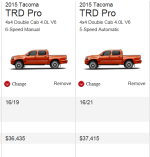
hehe, might want to tell the Toyota engineers they screwed up.

the only time I see a manual with better mpg is the lowly 4 cylinders in the Tacoma.

most of the v6 in the Tacoma get better mpg in the automatics than the manuals.

now if you go down to the 4 cylinders you can get better mpg in the manuals than the automatics in the sedans.


and yes I am stirring the pot :)
 

Attachments

  • Manul vs Auto Tacoma.png
    Manul vs Auto Tacoma.png
    36.6 KB · Views: 4,413
Last edited:
Don't call me out without data to back you up besides "your one experience."
Biggest reason automatics are more efficient than manuals? People, not hardware. Manual guys rarely shift efficiently where automatics are programmed to do so.

I never said "historically" nor anything else so don't assume I meant historically.

Last, here are a few of about 800,000 links out there proving my point. Five Myths About Stick Shifts: Manual vs Automatic Transmissions on Edmunds.com

Greenlings: Why do automatic transmissions now get better fuel efficiency than manuals?

And here is one that pretty much sums it up: Gas Mileage of 2015 Vehicles by Subaru
I randomly picked Subaru. You can go pick yourself. Good website. Take a minute to browse. Gives you the fuel economy for every drivetrain for every model for every make. You can find a few articles out there that give credence to your argument but you can't find one that trumps this.

Transmissions don't operate themselves. They require a human interface. That human interface is what was more inefficient in the past and now that they have improved the automatic efficiency it is even a bigger disparity now.

With all that said, I still love manual transmissions.

When you say "Automatics" are you talking about only traditional "slushbox" automatics, or are you including DSGs and CVTs. Subaru pretty much exclusively uses CVTs now for their "Automatics" and they return much higher MPGs then their manual counterpart, since CVTs are able to keep the RPMs at the most efficient level.

Coming from current Gen VW TDIs, I know that their 6-speed manuals return better MPGs then their 6-speed DSG counterparts, about 5mpg combined.

To respond to the OP, the real reason Toyota doesn't offer Manual Transmissions in 4runners is they no longer know how to engineer a Throw-Out Bearing that lasts more then a few thousand miles...
 
A manual sounds nice for reliability, but I read about as many or more manual transmission problems than automatic transmission problems. Automatics tend to fail completely after too many miles, but manuals seem to have a lot more little things that can go wrong.

I've never been off-roading in a manual, but it seems like it would be really hard on the clutch?

Ironically, the FJ manual transmission has been much more problematic than the autos from what I've read.

And yes, offroading with a manual (Well trail/rock climbing anyway) is VERY hard on manuals. Last trip I was on one guy was one try away from burning his clutch out and had to back off the obstacle and let it cool off, where as the autos got through fine even with the same number of hard tries...

Plain fact is, Auto is better for driving in almost every way on and off road. Probably the only real objective plus for manual at this point is still (possibly) being able to start your car with a dead starter or battery...

Of course, some people just like driving sticks, pretty much a requirement in sports cars especially :)

Personally I don;t miss it at all in a DD or for offroading, just like I don't miss manual chokes and timing advance levers even if that would make me feel closer to the tune of the car :D
 
When you say "Automatics" are you talking about only traditional "slushbox" automatics, or are you including DSGs and CVTs. Subaru pretty much exclusively uses CVTs now for their "Automatics" and they return much higher MPGs then their manual counterpart, since CVTs are able to keep the RPMs at the most efficient level.

Coming from current Gen VW TDIs, I know that their 6-speed manuals return better MPGs then their 6-speed DSG counterparts, about 5mpg combined.

To respond to the OP, the real reason Toyota doesn't offer Manual Transmissions in 4runners is they no longer know how to engineer a Throw-Out Bearing that lasts more then a few thousand miles...


and on the Tacoma forums, there is a thread on throw out bearings about once a month or someone resurrects the original thread from the dead all the time over there :)
 
Ironically, the FJ manual transmission has been much more problematic than the autos from what I've read.

And yes, offroading with a manual (Well trail/rock climbing anyway) is VERY hard on manuals. Last trip I was on one guy was one try away from burning his clutch out and had to back off the obstacle and let it cool off, where as the autos got through fine even with the same number of hard tries...

Plain fact is, Auto is better for driving in almost every way on and off road. Probably the only real objective plus for manual at this point is still (possibly) being able to start your car with a dead starter or battery...

Of course, some people just like driving sticks, pretty much a requirement in sports cars especially :)

Personally I don;t miss it at all in a DD or for offroading, just like I don't miss manual chokes and timing advance levers even if that would make me feel closer to the tune of the car :D

The only other thing I will give props to Manuals on is better control of the gears in terms of shifting. With the Automatics they can be a bit finicky to up-shift/down shift when you want them (i.e wanting a transmission to shift UP to 4th instead of slowly ramping up through the gears if you had a reason to do so.)
 
I'll avoid any "efficiency" discussion as I'm not better qualified to do so than others in this thread.

When I was a kid automatics were in their infancy and generally regarded by some as unreliable. My dad believed in simplicity. Ours cars were manual shifters. No A/C(it too was also fresh out of the womb) and no radio; he felt the latter was a distraction. 'Bout as plain as it could get. I drove a column shifter 1950 Chevrolet to school.

I continued to drive manual shifters until just after the millennium, although mine were equipped with things dad would not have. 65 mile Mon-Fri round trip commutes in ever-increasing traffic finally brought rest to my aging left foot.

I'll always remember the good-ole days, but I don't miss them that much.
 
Don't call me out without data to back you up besides "your one experience."

Data? LOL, seriously? It doesn't take a rocket scientist (or even an engineer) to know that automatic transmissions ARE NOT more efficient than a manual transmission. Sorry bud, but that's a fact and it's not even debatable.

Biggest reason automatics are more efficient than manuals? People, not hardware. Manual guys rarely shift efficiently where automatics are programmed to do so.

We will have to end the discussion right here. I find it ironic that you have to resort to the "human" factor to somehow think you're justifying your silly statement. Fact of the matter is that you said that an automatic transmission is more efficient than a manual transmission. That's a 100% false statement. The human factor has absolutely nothing to do with it. People can choose to drive ANY vehicle with a manual or automatic in an efficient manner or a not-so-efficient manner. So what's your point again? Oh yeah, you don't have one.

I also find it incredibly ironic that you, being such an obviously proud engineer (yeah--you're screen name, lol) turned completely to the human factor as an argument instead of discussing torque converters versus direct drive. Hmm....wonder why? Yeah, maybe because you were 100% wrong and you realized it after you read my post.

Oh well......thanks anyway for the laugh. Like I said before, you hate to be challenged, but you obviously hate it even more when you're wrong.

.[/QUOTE]
 
Data? LOL, seriously? It doesn't take a rocket scientist (or even an engineer) to know that automatic transmissions ARE NOT more efficient than a manual transmission. Sorry bud, but that's a fact and it's not even debatable.


We will have to end the discussion right here. I find it ironic that you have to resort to the "human" factor to somehow think you're justifying your silly statement. Fact of the matter is that you said that an automatic transmission is more efficient than a manual transmission. That's a 100% false statement. The human factor has absolutely nothing to do with it. People can choose to drive ANY vehicle with a manual or automatic in an efficient manner or a not-so-efficient manner. So what's your point again? Oh yeah, you don't have one.

I also find it incredibly ironic that you, being such an obviously proud engineer (yeah--you're screen name, lol) turned completely to the human factor as an argument instead of discussing torque converters versus direct drive. Hmm....wonder why? Yeah, maybe because you were 100% wrong and you realized it after you read my post.

Oh well......thanks anyway for the laugh. Like I said before, you hate to be challenged, but you obviously hate it even more when you're wrong.

.
[/QUOTE]

No problem Jeep boy. I posted that last .gov link just for you so you could look around and see the mpgs of every vehicle comparing automatic versus manual.
So tell me again how you can operate a transmission in a vehicle without a human? If they are part of the equation then they are part of the discussion. I don't hate being challenged. I hate it when someone posts inaccurate information like you. Again, show me data. I provided links. You provided nothing but your one single experience.
 
When you say "Automatics" are you talking about only traditional "slushbox" automatics, or are you including DSGs and CVTs. Subaru pretty much exclusively uses CVTs now for their "Automatics" and they return much higher MPGs then their manual counterpart, since CVTs are able to keep the RPMs at the most efficient level.

..

Exactly. I suppose he might be lumping all automatics (yes, even CVTs) together. Subaru is HUGE on CVTs, as is Nissan. Hell, we'll most likely see more and more of them as time passes, simply because they are very efficient. But like I said in my post, a conventional automatic transmission is not as efficient as a manual transmission mostly because of the fact that it uses fluid transfer (a torque converter) and is not directly driven like a manual transmission. The main reasons why you see higher EPA fuel economy numbers on many automatics versus their manual transmission counterparts is simply because automatics now have more gear ratios. Put a 9-speed manual in a car that has a 6-speed manual today, and I can guarantee that the EPA fuel economy rating will be quite a bit higher.
 
No problem Jeep boy. I posted that last .gov link just for you so you could look around and see the mpgs of every vehicle comparing automatic versus manual.
So tell me again how you can operate a transmission in a vehicle without a human? If they are part of the equation then they are part of the discussion. I don't hate being challenged. I hate it when someone posts inaccurate information like you. Again, show me data. I provided links. You provided nothing but your one single experience.

*sigh* So you still won't talk about torque converters or direct drive..you know, stuff that determines efficiency. Still falling back on the human factor. LOL, okay bud..whatever floats your boat.

Ironically, you still fail to admit that the human factor is irrelevant because a driver can drive either transmission efficiently or not efficiently. So if you want to continue with that flawed argument, lets just call it ceteris paribus (look that up)
 
Last edited:
*sigh* So you still won't talk about torque converters or direct drive..you know, stuff that determines efficiency. Still falling back on the human factor. LOL, okay bud..whatever floats your boat.

Ironically, you still fail to admit that the human factor is irrelevant because a driver can drive either transmission efficiently or not efficiently. So if you want to continue with that flawed argument, lets just call it ceteris paribus (look that up)

I didn't have to. Modus vivendi.

I will give you this:
If you just compared a mechanical gear set to an automatic gear set then of course the mechanical box will be more efficient. It's tough to beat the mechanical efficiency of gears meshing together. Unfortunately we don't ride around on just transmissions.

With that said, the context of the post was about vehicles and their transmissions and their use. Sure, humans could be efficient or inefficient using a manual but they are not. Most have no idea when or why to shift, they just shift when it feels right. Manufacturers even tried to put shift lights in there to help people out.

My definition of a vehicle automatic transmission is any transmission that does not have to have a gear mechanically selected. Eight or nine speeds, CVT's and anything else is an automatic transmission. In this context automatic wins in the only measurable metric which is mpg.

If you have two identical vehicles and the only difference is one is a manual and the other is an automatic, the automatic gets more miles per gallon, what does that mean?
 
It is true that the older 4Runners with manual transmissions get better mileage than the autos, however that may not be true for the late model cars. But some of us really don't care, we drive manuals for the control and for the driving experience.

Toyota last made 4Runners with manual transmissions in the year 2000. I own a 2000, and will continue to drive my 2000 because a 2014 4Runner is not NEARLY as much fun to drive as my old 4Runner. One day when I become old and crippled, I will start driving automatics; no offense to those of course that are happy letting your car choose your gears for you. I am a grown man and can make those decisions for myself.
 
Newer torque converters can be locked almost all the time. For example, Mazda's Skyactiv transmission locks the torque converter 89% of the time in city driving. On the highway, it would be locked 100% of the time. It's not necessary to unlock for shifts since each gear has a clutch, and the car can rev-match the engine better than you.
MAZDA: SKYACTIV-DRIVE | TRANSMISSION | SKYACTIV TECHNOLOGY

Although an automatic or CVT alone might be less efficient than a manual, if it is able to keep the engine at a more efficient operating point for longer, the overall system will be more efficient.

I'd love to have an electronic CVT like the new Honda Accord Hybrid. The input-output is probably lower than a normal transmission (mostly electrical losses. Each motor could be about 95% efficient, but the power conversion electronics to drive everything may be closer to 80%, so around 70% overall purely based on my speculation), but the engine can work more efficiently and there are fewer moving parts than any conventional transmission. They can design it with a smaller engine since the drive motor and battery can help with instantaneous torque. A smaller engine is lighter, which helps efficiency. And eliminating the gears could make up for some of the lost efficiency of the transmission. Even a manual transmission with gears has some loss due to friction in the bearings, gears, and fluid. It basically has the benefits of an electric vehicle, drivetrain-wise, without the downside of limited range.
 
Data? LOL, seriously? It doesn't take a rocket scientist (or even an engineer) to know that automatic transmissions ARE NOT more efficient than a manual transmission. Sorry bud, but that's a fact and it's not even debatable.
[...]
[...]
If you have two identical vehicles and the only difference is one is a manual and the other is an automatic, the automatic gets more miles per gallon, what does that mean?

All this boils down to what 1E said (emphasized by me in bold above). In my mind, true mechanical efficiency was never the intent of what was posted. Pretty much no one but the guy/gal working for the manufacturer or designing/building transmissions cares how mechanically efficient an automatic is vs. a manual. All that matters to the EPA and to the average consumer is MPG. For the sake of this discussion it doesn't make sense to compare number of gears or even transmission type, as long as performance, fuel efficiency, and cost goals are met.

Post 14 earlier in this thread is all you need to see. Fuel efficiency for automatics on average has met and surpassed that of manuals. (Full disclosure: I went the extra mile to find a 6MT Audi B7 A4 that was in good shape for my previous vehicle; I loved it until it started to self destruct. Enjoying manuals and preferring them to automatics is completely subjective. What isn't subject are the fuel efficiency numbers).

OA
 
All this boils down to what 1E said (emphasized by me in bold above).

Actually, what he said is this:

...Automatics are more efficient than manual transmissions so mpg numbers go up....

And I said that he was wrong. Efficiency of an automatic transmission versus a manual transmission should be glaringly obvious, hence my remark that he was incorrect in his statement. But lets move on because he already admitted (finally!) that the manual transmission is more efficient. Unfortunately, that didn't come until after a bunch of backpedaling nonsense about the "human factor" etc....

At the end of the day, it's funny to even think that anyone on a 4Runner forum would care at all about fuel efficiency anyway. Like someone else said here---if I cared about fuel economy, I'd be driving a Prius.
 
Newer torque converters can be locked almost all the time. For example, Mazda's Skyactiv transmission locks the torque converter 89% of the time in city driving.

Mazda probably has the best conventional automatic transmissions available right now when it comes to efficiency. The newer skyactiv vehicles have automatics that use a much smaller torque converter, while also using a much more robust and damped lock-up clutch mechanism. The whole idea is to keep the thing locked up as much as possible. And of course the idea there is to increase its efficiency, thus improving fuel economy. But that's the philosophy they're using throughout the vehicle. Have you read up on their i-loop (or e-loop, forgot what they call it) in the Mazda6? Another great idea that really works. They basically store power in a capacitor to allow the alternator to freewheel at times. Most people probably wouldn't believe that an alternator freewheeling part time would help fuel economy by a considerable amount, but it apparently does, judging by the fuel economy numbers of otherwise identical cars that have or don't have the feature. Mazda really is doing a great job building efficient vehicles without resorting to hybrid technology or CVTs, etc....
 
I've read about i-eloop, but it didn't sound like it would have a significant benefit. I guess it must help, or they wouldn't put it in their cars.

I just read about their i-stop system.
While conventional idling stop systems rely on a starter motor to restart the engine, Mazda's i-stop restarts the engine through combustion; fuel is directly injected into a cylinder while the engine is stopped and ignited to generate downward piston force. The result is a quick and quiet engine re-start compared to other systems and a significant saving in fuel.
That's really cool! MAZDA: Idling Stop Technology | Environmental Technology

4runners actually have some of the best fuel economy for trucks of similar size and capability. I think the 4th gen V6 beats almost anything comparable on the market from that era. I haven't really looked at what's out there these days, but the 5th gen is up there, I'm sure.

I don't really care about fuel economy in an absolute sense or I wouldn't drive a V8 4runner, but I like to maximize efficiency anyway.
 

Members online

Forum statistics

Threads
278,316
Messages
3,554,120
Members
248,016
Latest member
Advally Service

Trending content

Back
Top