ATF Exchange (using the cooling line)

46runner

Member
With 130,000 miles, I decided to refresh my ATF.
My 2004 SR5 V8 has the automatic 5-SPEED transmission A750F and it uses WS fluid; the 340 transmission uses Type IV fluid. I confirmed at a dealership.

I have the A750F and it holds 11.5 US qts. This is not a drain and refill which only replaces 2-3 qts. This is not a ATF machine flush (ATF Flush) either. I am calling it a manual DIY ATF Exchange. It will replace ~13 qts of ATF. You can also drop the pan and clean the filter and magnets, I decided not to do this.

Supplies/tools:
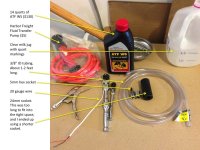
  • 14 quarts of Toyota WS ATF fluid (part # 00289-ATFWS) (cost $130-$140)
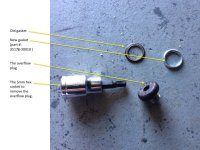
  • 2 crush washers from dealer (part #: 35178-30010 ) (cost $5-$8)
  • 5mm hex socket (for overflow plug), 12mm socket (for skid plate), 14mm socket (for drain plug), 24mm socket (for refill plug)
  • Fluid pump (to pump in new ATF)
  • Oil catch pan (to catch old fluid)
  • Clear milk jug, with quart markings, to collect/measure old fluid
  • 16, 18 or 20 gauge wire for the temperature check. I had a piece of 20ga. Post #334 suggests a paper clip.
  • 3/8" ID vinyl hose, ~2 feet in length
  • Torque wrenches for 5mm hex socket (for overflow plug), 14mm socket (for drain plug), 24mm socket (for refill plug)
  • Needle nose pliers to remove hose clamp
Slide01.jpg

Torques:

  • Drain plug with new gasket: 28 Nm (21ftlbf)
  • Overflow plug with a new gasket: 20 Nm (15 ftlbf)
  • Refill plug: 39 Nm (29 ftlbf)

Steps for ATF Exchange:

1. No need to put truck on jack stands
2. Remove front-most skid plate (12mm socket)
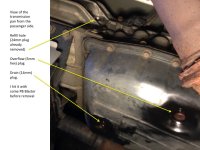
3. Remove ATF fill plug 24mm, located on passenger side
Slide02.jpg


4.Remove the ATF overflow plug (5mm hex), replace with new gasket and hand tighten. Tip: tap the hex wrench into the overflow plug to be sure it's fully seated before you start to take it out. Otherwise you might strip the head.

Slide03.jpg


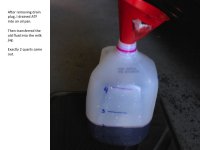
5. Remove the 14mm drain plug and drain ATF into catch pan. 2 qts came out.
Slide04.jpg

6. Return drain plug with new gasket and torque to 21ft
lb
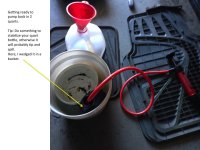
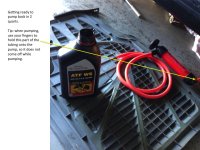
7. Hand pump in 2 qts (or the amount that came out) through the ATF refill hole.
Slide05.jpg
Slide06.jpg

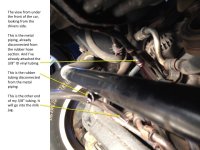
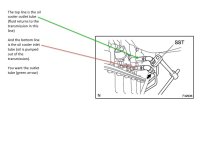
8. There are two ATF cooler lines on the passenger side of the transmission. They run together towards the radiator. The top line is the oil cooler outlet tube (fluid returns to the transmission from the cooler) and the bottom line is the oil cooler inlet tube (oil is pumped out of the transmission to the cooler). You want the outlet tube (top) . You will want to catch the old fluid coming out from this line - to intercept the old fluid before it goes back into the transmission. Follow this line to towards the front of the car.
Slide07.jpg

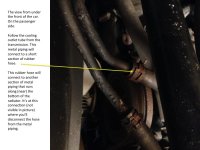
9. The metal piping will connect to a rubber hose which will connect to another section of metal piping. Disconnect here by sliding off the hose clamp. A few ounces of ATF will flow out so be ready to catch it in a cup or small bucket.

Slide08.jpg

to be continued...
 

Attachments

  • Slide01.jpg
    Slide01.jpg
    115.5 KB · Views: 29,351
  • Slide02.jpg
    Slide02.jpg
    89.1 KB · Views: 41,673
  • Slide03.jpg
    Slide03.jpg
    110.5 KB · Views: 28,238
  • Slide04.jpg
    Slide04.jpg
    53.5 KB · Views: 27,664
  • Slide05.jpg
    Slide05.jpg
    107.6 KB · Views: 27,984
  • Slide06.jpg
    Slide06.jpg
    89.3 KB · Views: 27,622
  • Slide07.jpg
    Slide07.jpg
    51.9 KB · Views: 32,467
  • Slide08.jpg
    Slide08.jpg
    87.5 KB · Views: 31,552
Last edited:
Register to hide this ad
10. Attach the 3/8" clear tubing to the metal pipe at the connection you just removed, and route the other end of the clear tubing into the milk jug.

Slide09.jpg

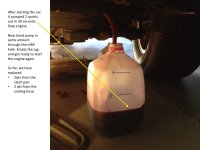
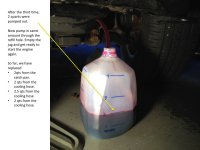
11. Start car, and it will pump ATF out into the jug at about 1 qt every 15 seconds. Shut engine after 2 qts have been pumped out.
12. Hand pump in 2 qts (or the amount that came out) through the refill hole, and empty the milk jug.

Slide10.jpg

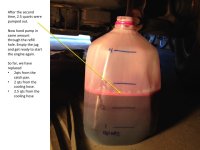
13. Start car, cycle through all the gears. This time 2.5 qts were pumped out when I stopped the engine.
14. Hand pump in 2.5 qts (or the amount that came out) through the refill hole, and empty the milk jug.

Slide11.jpg

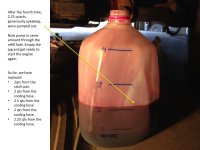
15. Start car, stop after 2 qts have been pumped out

16. Hand pump in 2 qts (or the amount that came out) through the refill hole, and empty the milk jug

Slide12.jpg

17. Start car, stop after ~2 qts have been pumped out
18. Hand pump in through the refill hole the amount that came out, and empty the milk jug

Slide13.jpg

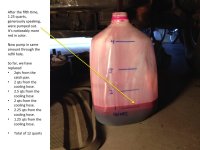
19. Start car, stop after 1.25 qts pumped out. I wanted to get 12 quarts in there
.
20. Hand pump in through the refill hole the amount that came out, and empty the milk jug. At this point, I've pumped in 12 quarts total.

Slide14.jpg

21. Pump another half quart so you will have some fluid flow out during the Fluid Temp Check. So now I have pumped 12.5 quarts of new fluid in there.
22. Reconnect ATF line and return the hose clamp to its original position
23. Finger tighten fill plug

Next is the fluid temp check...
 

Attachments

  • Slide09.jpg
    Slide09.jpg
    92.6 KB · Views: 28,111
  • Slide10.jpg
    Slide10.jpg
    74.3 KB · Views: 27,244
  • Slide11.jpg
    Slide11.jpg
    72.1 KB · Views: 27,248
  • Slide12.jpg
    Slide12.jpg
    76.6 KB · Views: 27,212
  • Slide13.jpg
    Slide13.jpg
    78.3 KB · Views: 26,992
  • Slide14.jpg
    Slide14.jpg
    88 KB · Views: 27,071
Last edited:
Steps for ATF Temperature Check:

1. Car should be on level ground
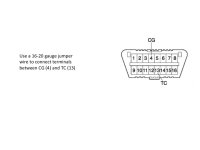
2. On the ODB-II connector, use a 16-20 gauge (16, 18, or 20 gauge will work) jumper wire to connect terminals between CG (4) and TC (13)

Slide15.jpg

3. Start engine

4. Check that electrical systems such as the air conditioning system, audio system and lighting system are off.
5. Shift to N
6. Shift to D, then back to N, within 1 second
7. Shift to D, then back to N, within 1 second
8. Shift to D, then back to N, within 1 second
9. This will activate the fluid temperature detection mode: A/T OIL TEMP warning light remains illuminated for 2 seconds and then turns off. It will be to the right of the flashing seat belt light
10. Return the shift lever to P; light will illuminate again for 2 seconds)
11. Remove the jumper wire
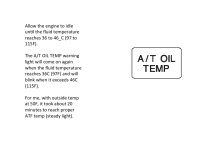
12. Allow the engine to idle until the fluid temperature reaches 36 to 46_C (97 to 115F). The A/T OIL TEMP warning light will come on again when the fluid temperature reaches 36C (97F) and will blink when it exceeds 46C (115F). For me, with outside temp at 50F, it took about 20 minutes to reach proper ATF temp (steady light).

Slide16.jpg

13. The fluid temperature must be between 36C (97F) and 46C (115F) to accurately check the fluid level.
14. Remove the overflow plug (5mm hex), with the engine idling.
15. Check that the fluid comes out of the overflow tube.
16. If fluid does not come out (this unfortunately was the case for me):

  • Install the overflow plug.
  • Stop the engine.
  • Remove the refill plug.
  • Add another ~half qt of fluid.
  • Allow the engine to idle and wait for 10 seconds.
  • Remove the overflow plug with the engine idling.
  • Check that the fluid comes out of the overflow tube.
17. If fluid comes out, wait until the overflow slows to a trickle then

  • Install the overflow plug with a new gasket. Torque: 20 Nm (205 kgfcm, 15 ftlbf)
  • Stop the engine
  • Install the refill plug with same rubber gasket. Torque: 39 Nm (400 kgfcm, 29 ftlbf)
The whole project will probably take about 3 hrs, a little longer with interruptions. In all, I used 13 quarts of ATF WS, including some that dripped out during the temp check.
 

Attachments

  • Slide15.jpg
    Slide15.jpg
    28.6 KB · Views: 27,061
  • Slide16.jpg
    Slide16.jpg
    45.2 KB · Views: 27,495
Last edited:
Thank you for the writeup. I've bookmarked it because I'll be doing this soon.

Did you notice any difference after doing it? Did it shift smoother or anything?
 
Thank you for the writeup. I've bookmarked it because I'll be doing this soon.

Did you notice any difference after doing it? Did it shift smoother or anything?


It does feel smoother. (1) I used to hear it go into gear when gassing it between 10-30 mph, now that's muted and (2) it used to have a pretty loud harmonic hum when the gas was applied between 60-70 mph, now that is muted.

For Sale: leftovers from this project. One (1) quart unopened ATF WS Fluid, a 2 foot section of 3/8" ID tubing, used milk jug with markings, fluid pump (already primed with Toyota ATF haha), 20 gauge wire. For the low low price of $12 plus shipping cost from 02111 zip code.
 
Last edited:
Excellent write up! I debated on doing what you did verses the drain and fills and decided on drain and fills but I was having no issues with shifting or anything.

I just did my second drain and fill yesterday and the drain and fill changes more like 3.5 quarts when it is filled to the correct level and cold. Last weekend on the first drain and fill, it was a little less than 3 quarts but I think that might have been because it was a little low. My truck has a v6 but the same transmission. It only has 80,000 miles but the fluid was pretty brown. After much research on Bobistheoilguy.com, I went with Vavoline MaxLife.

I plan on doing 2 more drain and fills before starting on a schedule of 10,000 between drain and fills. It wasn't that bad except for trying to tighten the fill plug next to the hot catalytic converter. I should have been more patient and let it cool after checking the final level. I had to top it off because I only filled it with a half a quart more than drained out. That is how I knew it was low to start with.

I think my plan from here on out will be to drain the 3.5 quarts(or whatever comes out), button everything up, fill with 4 quarts, put the fill plug in, crank it up and drive until warm, and finally, while it is warm and idling in Park, open the overflow plug to allow the extra half quart to come out(that way I dont have to deal with the fill plug after it is hot).
 
For any of you that have done this on the V6, 4-speed version, what are the differences?

Probably different fluid type and capacity, obviously.

The outlet and return hoses aren't reversed or anything are they?

Do you get it into temp test mode by jumping the same two ports? I'd hate to find out after-the-fact that it's different for my model and that I just fried my CPU or something.
 
For any of you that have done this on the V6, 4-speed version, what are the differences?

Probably different fluid type and capacity, obviously.

The outlet and return hoses aren't reversed or anything are they?

Do you get it into temp test mode by jumping the same two ports? I'd hate to find out after-the-fact that it's different for my model and that I just fried my CPU or something.

For a v6 5 speed, it looks the same as the pictures above. As stated above I only did drain and fills but the cooler lines look to be the same. The 5sp in our trucks are in several different vehicles. Our transmissions do not have dipsticks which was concerning but once you figure out the process, it is pretty straight forward. Does your transmission have a dipstick?
 
To the OP, had your fluid ever been changed before? It looks better than what came out of mine. My first drain was brown, no red tint at all. It smelled fine but very brown. Yours looks more red definitely. And at a 130,000 miles, it makes me think that either something was very wrong with mine or your's had been changed.
 
Your change should be more straight forward. In the past with that type of transmission in my 2000 Landcruiser, I would do a drain and fill at every oil change. Filling through the dipstick makes the process so much easier. What fluid does yours require? Should be on the dipstick or in the manual.
 
To the OP, had your fluid ever been changed before? It looks better than what came out of mine. My first drain was brown, no red tint at all. It smelled fine but very brown. Yours looks more red definitely. And at a 130,000 miles, it makes me think that either something was very wrong with mine or your's had been changed.


I don't think it's been changed before. The first 6 quarts that came out was definitely darker.
 
Last edited:
I agree, excellent write-up!

Only comment I have add is if you have the tow package you can pull the trans-cooler lines in front of your radiator which is much easier than accessing lines from underneath.
 
Definately one of the best, if not the best, ATF fluid exchange/drain/ write up.

Thanks for the taking the time!
 
Definately one of the best, if not the best, ATF fluid exchange/drain/ write up.


Thanks for the taking the time!


Thanks. I figure the details might help someone who's anxious about trying it. I wasn't sure what to expect and turns out it wasn't that bad at all. New struts and shocks are next!
 
I was under my truck today to replace my tie rods and took a look at the transmission. Mine is a 2004 4-speed A340F with a dipstick so it's going to be a little different from most of yours but I'm still hoping that you can help.

I follow all of the details of this writeup and I obviously see the need for a drain plug, overflow plug, and fill plug on your transmissions. On mine, however, I only saw a drain plug. Is that right or am I missing something?

If that's right, I assume that I use the dipstick port as the fill port and the dipstick itself to check the fluid level. With the dipstick, do I still need to put it in 'transmission oil temp check mode?'

Does the fluid level tend to increase or decrease after you drive it? I don't want to fill it to the right level, drive it around the block a few times, and then find out that it's way too full and I need to drain some back out.
 
You do not need to put your truck in oil check mode. I do not even know if there is such a mode on models with the 4-speed trans. Your dipstick should have cold and hot markings on it for the fluid level. You fill through the dipstick tube.
 

Members online

Forum statistics

Threads
278,309
Messages
3,554,068
Members
248,016
Latest member
Advally Service

Trending content

Back
Top