
Axle bearing retainer direction.

texadelphia

New member
Is it still considered best practice to install the inner bearing retainers with the chamfer towards the wheel? I've talked to 2 machine shops that do a lot of these and neither seems to have heard of doing it that way so I'm going to have to push for them to do it.

Sent from my moto x4 using Tapatalk
 
Register to hide this ad
Yes, just did mine this weekend, definitely still need to do this. Last time, I took my axles to a machine shop to do the pressing and I don't think they did a good job. How do you tell them where to stop pressing the ABS tone ring and inner retainer since they don't go all the way down to the c-clip? Each axle's polished area is slightly different in my experience (which isn't much). But this weekend, my diver's side was good with 5mm of polished surface showing inside of the inner retainer but the passenger side needed just over 4mm.
 
I asked how they locate the inner retainer and he claims to have a measurement spec that they use for the position of the inner retainer.

I measured where they are now and they're both right at 5.1 mm of polished axle showing.

Sent from my moto x4 using Tapatalk
 
You have to do the Sharpie test that Tim shows in one of his youtube videos. That measurement is OK, but you have to test it by insertingthe axle to the housing with at least 2 bolts fullt tighten.

Hope you used new retainers. There was a thread about leaking axles even after getting it done the right method, but failed to use NEW retainers.
 
Well the shop is a half hour drive from me so making small adjustments is going to be difficult.

I guess I can do the test with the retainers that are on there now and figure out if the new ones need to shift from where the current ones are.

I got all new retainers from the dealership. Only thing I'm reusing is the ABS wheel.

Sent from my moto x4 using Tapatalk
 
So I went out and took some measurements off my dismantled axles and came up with this. The lengths are to scale so all of these should be exactly as it sits when assembled. If I look at my axles, the retainers and abs ring are stacked right up against each other with no gaps.

EC8Vsnr.jpg


Based on this, I'm not convinced that it makes sense to flip the inner retainer so that the chamfer goes toward the wheel. Based on my measurements it looks like the seal should sit right in the middle of the non-chamfered area of the retainer. I'd also be concerned with the square side of the retainer hitting the raised portion of the axle tube just inside the inner seal if they were flipped.
 
Last edited:
Remember that flipping the retainer is done when using the NEW design of Toyota axle seal that rides further in than the old design. If you are using other seals flipping the retainer may not be in your interest. Either way the grease test should tell you where you need to be but you have to go bit by bit.
 
I thought the retainer design was updated and changed from square shoulders to one chamfered shoulder.

Sent from my moto x4 using Tapatalk
 
Ok, I just rewatched Timmy's video and it makes more sense now. The relative position of the sealing lip on the inner seals has moved inboard closer to the chamfer on the retainer. That said if I flip the retainer and install it to the same depth as it currently sits the flat part of the retainer should fully span the width of the seal.

Sent from my moto x4 using Tapatalk
 
Ok, I just rewatched Timmy's video and it makes more sense now. The relative position of the sealing lip on the inner seals has moved inboard closer to the chamfer on the retainer. That said if I flip the retainer and install it to the same depth as it currently sits the flat part of the retainer should fully span the width of the seal.

Sent from my moto x4 using Tapatalk
Just because the seal is 8.5mm does not mean the lip of the seal that rides on the retainer is 8.5mm or that the seal will ride perfectly in the center of that 8.5mm. 5mm of polished showing seems to be the happy spot for most people. Sharpie or grease test is the best way to verify it's riding in the correct spot. If you want to shoot for 4mm showing and the use a long pipe of the correct diameter, thickness, and length along with a hammer to push the inner retainer in further as needed without making the hour round trip for an adjustment.
 
Hope you used new retainers. There was a thread about leaking axles even after getting it done the right method, but failed to use NEW retainers.

I may have this problem, although I did swap the outer retainer to the inner position. Grease (sharpie) test had the seal riding dead center of the retainer surface, so I have confidence on that. What does worry me is the service records (PO had all the work done at Seattle Toyota) show that that seal was replaced twice by the dealer. Don't remember if they changed the bearing though so they may have just pulled the axle and slapped a seal in and called it good. It could make sense that the retainer was off, but I swapped to the outer one and made sure it was located correctly.

Anyone know what the actual OD of the retainer should be?
 
Just because the seal is 8.5mm does not mean the lip of the seal that rides on the retainer is 8.5mm or that the seal will ride perfectly in the center of that 8.5mm. 5mm of polished showing seems to be the happy spot for most people. Sharpie or grease test is the best way to verify it's riding in the correct spot. If you want to shoot for 4mm showing and the use a long pipe of the correct diameter, thickness, and length along with a hammer to push the inner retainer in further as needed without making the hour round trip for an adjustment.

Yeah, I measured my current seal and the sealing lip is 6.5mm back from the outboard edge of the seal so I realize it's not centered on the seal. I'm going to measure the new seal when I pick it up this morning and see how it compares and adjust accordingly. That's a good idea with the long pipe and adjusting myself. But I think I have enough measurements to figure out exactly how much it needs to be adjusted from where it sits now. I'll verify with the sharpie test when I get everything home.

dIVF37I.jpg
 
Yeah, I measured my current seal and the sealing lip is 6.5mm back from the outboard edge of the seal so I realize it's not centered on the seal. I'm going to measure the new seal when I pick it up this morning and see how it compares and adjust accordingly. That's a good idea with the long pipe and adjusting myself. But I think I have enough measurements to figure out exactly how much it needs to be adjusted from where it sits now. I'll verify with the sharpie test when I get everything home.
Keep in mind the seal lip will move slightly inboard (towards the differential) as it stretches to seal on the inner retainer
 
I may have this problem, although I did swap the outer retainer to the inner position. Grease (sharpie) test had the seal riding dead center of the retainer surface, so I have confidence on that. What does worry me is the service records (PO had all the work done at Seattle Toyota) show that that seal was replaced twice by the dealer. Don't remember if they changed the bearing though so they may have just pulled the axle and slapped a seal in and called it good. It could make sense that the retainer was off, but I swapped to the outer one and made sure it was located correctly.

Anyone know what the actual OD of the retainer should be?

Reusing the outer retainer at the inner position ends up not the greatest idea. The surface the seal would ride on is perfect but the inner diameter that mates up with the axle shaft isn't. I've confirmed this by taking off the inner retainers on two different vehicles, my 98 and my buddy Wei's 96 because we both also had gear oil getting past and we know the seal to retainer mating was good. It ends up that some damage occurs to the retainer inner diameter during the removal process. It's obvious to me now that the retainer metal is much softer than the axle shaft and slight gouging or grooves are left in the metal when you remove it. If you reuse the retainer, this might give a pathway for gear oil to flow between the retainer and axle shaft. I think this is probably the reason you're having some leaking as well. The leaking we both had wasn't significant because we both had a decent amount of miles traveled after the repair (I put 17k on my rig after the repair) but the leaking over the long term allowed gear oil to contaminate and wash out some of the grease from the bearing which isn't ideal. We put on new inner retainers and cleaned out and repacked the bearings with grease. So far, it looks like that stopped the leak on both of our rigs.

Another possibility is the seal to axle housing mating. Somebody reported even though they used all new parts and confirmed a good mating of the seal and retainer with a sharpie test, they were still getting a leak. It ended up for this person that the fix was installing a new seal with a little RTV between the seal and axle housing. This would definitely be prudent to do if the repair was done before by someone else and they were careless with a hooked style seal puller and gouged the axle housing.

So, something I didn't consider as well as others is it's not just the seal to inner retainer mating that determines a successful axle seal job but you also have to consider the metal to metal mating of the inner retainer to the axle shaft and the metal to metal mating of the seal to the axle housing.

I feel bad that I gave money saving advice for this job that ended up not being the greatest. I have updated both our rear axle seal videos to let people know they can safely reuse the ABS tone rings and retainers at the outer positions to save money but they should definitely use a NEW retainer at the inner position.
 
Last edited:
After comparing the new and old seals all of the dimensions are exactly the same. The metal part is the same depth and the seal lip is the same distance from the face of the seal.

However, the inner diameter of the rubber part of the seal is about 2 mm smaller on the new seal. I think this means that when it's compressed against the axle it probably deforms such that the sealing lip would be further inboard than the larger diameter seal lip which is why it seems like the sealing lip is further inboard when installed.

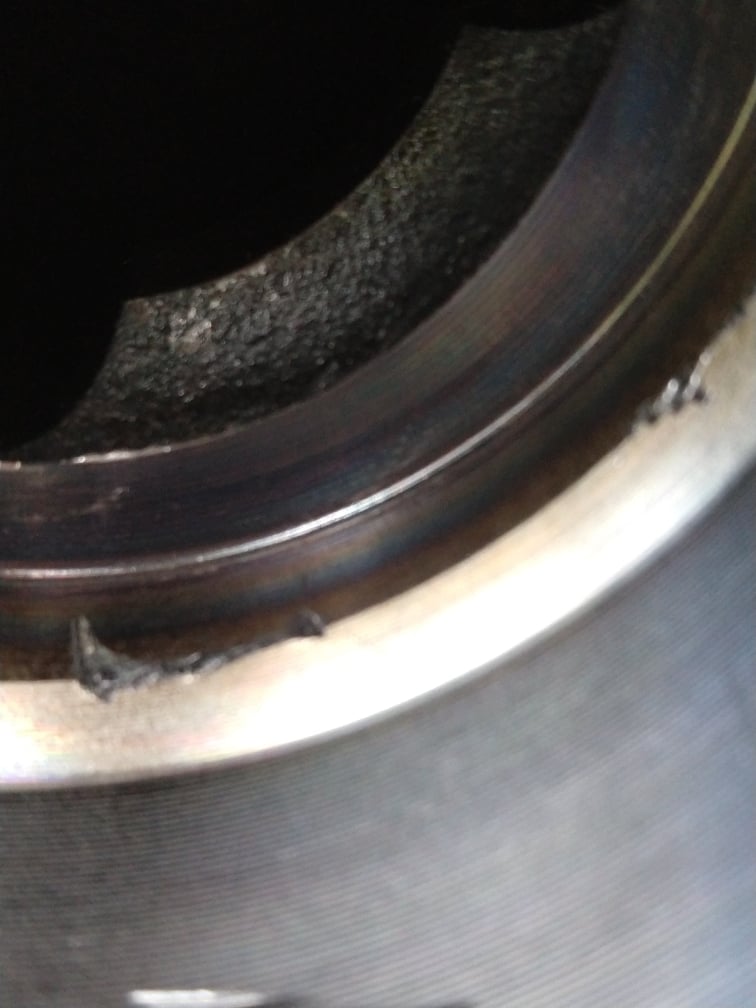
That said the inner surface of my axle housing is gouged pretty badly in one spot which is probably why it was leaking. Looks like the last guy that replaced the seals hit it pretty good with whatever he used to pull the seals. I guess I'm going to put some silicone between the seal and the housing to try to remedy that. Should I hit it with some emery cloth to knock down the burrs? How should I apply the silicone? A thin layer on the outside of the seal? Or should I just put a thin bead along the seated edge of the seal after it's installed?
7aae290e841ad718bcc28ffdd056d75e.jpg


Sent from my moto x4 using Tapatalk
 
That said the inner surface of my axle housing is gouged pretty badly in one spot which is probably why it was leaking. Looks like the last guy that replaced the seals hit it pretty good with whatever he used to pull the seals. I guess I'm going to put some silicone between the seal and the housing to try to remedy that. Should I hit it with some emery cloth to knock down the burrs? How should I apply the silicone? A thin layer on the outside of the seal? Or should I just put a thin bead along the seated edge of the seal after it's installed?

I had a similar gouge that took me several rear axle seals to figure out. What I did was knock down any sharp or rough edge to it that would damage the new seal. Then I took Permatex gear oil rtv Amazon.com: Permatex 81182 Gear Oil RTV Gasket Maker, 3 oz.: Automotive (if you have toyota fipg for transmission pan gasket that works too) and smeared some where the axle seal mates with the axle housing and smeared a light coat on the outside edge of the axle seal as well. Installed and let cure. I didn't have the 24 hours of cure time recommended by Permatex so I let it cure for as long as I could before reassembling to drive home (it cured for about 3 hours). No leaks since then. Still need to redo my other side following this procedure, but my toyota parts guy is starting to recognize me for all the rear axle seals that I've been getting lol
 
per Timmy's new instructions, I also filled the outer lip of the axle type to seal mating with RTV as well as the inner lip to axle mating of the inner retainer ring. In my case, it was the axle shaft itself that was heavily gouged, looks like a previous replacement was cut instead of pressing off the retainers.
 
Here's what I did. I had this Dirko grey leftover from sealing the cam girdle on my Audi. Hit it with some emery cloth to take off the edges, filled in the gouges, smeared a little on the outside of the seal in the same area and installed. I didn't want to put it around the entire seal area because I didn't want to make it a bear to remove if it has to come out again. It was hard enough without any sealant on it.

HunbXpP.jpg

YAJ50v6.jpg

Fm2Nj7A.jpg

MYp49Vq.jpg
 
Last edited:
Got the axles back and did the sharpie test. I'm really glad I had the machine shop flip the retainers. The seal line was only about 3mm from the inner edge of the polished surface. There was also 5mm of polished axle showing so I guess that's not a consistent rule of thumb. 4.5 mm would have been the center of the polished area which would have been ideal but I didn't want to take it back to the shop to have them try try back off the retainer. I feel like 3mm should be adequate.

Sent from my moto x4 using Tapatalk
 

Members online

Forum statistics

Threads
278,310
Messages
3,554,080
Members
248,016
Latest member
Advally Service

Trending content

Back
Top