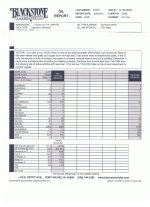
Blackstone oil report

vicpick58

New member
I just got my report from Blackstone for my 15,000 mile oil change. I changed my oil at 5k, 10k and 15k with the Toyota synthetic 0w20 and Toyota filters. This was the first analysis I have had done for this vehicle.

I had asked if 10k oil change interval was advisable.

Here is what the 15k report said at miles on unit: 14927, miles on oil 4761 ;

"You want to run 10,000 miles on the oil and that's probably within reach, but not just yet. Most of the wear metals look great, but copper is on the high side. That shows wear at brass/bronze parts. If this is only the second or third oil change, the copper is probably residual wear-in and not a problem, Otherwise, it could show something like a bushing not wearing properly. We'll see how it looks next time. The TBN was 4.8 showing lots of active additive left; less than 1.0 is too low. Try 6000 miles on the oil and check back to monitor copper."

Well this was only the third oil change so I hope they are right about the copper being from wear-in.

I think I will stay with the 5k OCI for the time being.

Edit: Oh yeah the copper was 44 with a universal average being 6, the molybdenum was 576 with the universal avarage being 80, and boron was 65 with and avarage of 40 but they did not say anything about those. Everything else was very close or well under avarage.
 
Last edited:
Register to hide this ad
What is the OCI consensus for those of us that primarily tow? I'm thinking 5,000 miles or once a year (i have other vehicles). Did first change at 3,000 miles.
 
I could be wrong here, but it is my understanding that Syn oil does not deteriorate over time like dino oil. If that is correct, then I would not worry too much about "once a year" vs. just the mileage/use. If I am wrong, please, other chime in.....be safe.
 
I could be wrong here, but it is my understanding that Syn oil does not deteriorate over time like dino oil. If that is correct, then I would not worry too much about "once a year" vs. just the mileage/use. If I am wrong, please, other chime in.....be safe.

I would change it at a max interval of 6 months if you are not driving much. There is potential for moisture and condensation to form that could affect the oil. Two changes a year shouldn't hurt your pocket book too bad, especially if you change it yourself.
 
Can you scan the report and post it? It would be interesting to see.

Also, how long did it take to get a report after sending them the sample?

Thanks.
 
Last edited:
The Toyota 0W20 is known for high moly. That should be one way to tell if you suspect your dealer is not using the real deal 0w20 on your free oil changes. I wonder if you got the old formula with the even higher moly.
 
Last edited:
Thanks for posting your UOA. Can you type the rest of the data for us?

Boron and Moly are additives in the oil. Nothing to worry about. I do seem to remember reading about high levels of some forms of moly causing copper corrosion. Let's hope this isn't the case, but I haven't seen copper levels this high on any Toyota engine, old or new. Some oil companies use Copper as an anti-wear additive. But I've never seen it in the Toyota oil.

It would be nice to see how this oil did on the ASTM D130 copper corrosion test. But I haven't been able to find a product data sheet. Blackstone mentions bushing wear possibilities. But I usually consider it a bearing wear issue, or leaching from copper tubing. But I don't know if the oil cooler lines are made of copper in the 4Runner.

Please let us know how the next UOA looks.
 
Last edited:
:hiding: Waiting for 1st Engineer to chime in........

Haha Bay! I really don't care if people change it every 50 or every 50,000 miles lol. I won't have to live with either choice as I buy new. I have changed my oil every 10K per manual (Toyota engineers know much more about their engines than me so I listen) and I have no issues with anyone getting "piece of mind" by doing it sooner. The only time I take exception with a thread like this is when someone starts blowing smoke up other's a$$es by professing to know something about stuff when all they know is 3rd hand info or heresay and then I will correct it only if I have factual knowledge of the subject.

With that said, Blackstone does a good job with end users of a product (thats us) and they are reasonable. My company does not use them as when we test hydraulic fluids we need specific tests, usually on additive packages, and we need the results yesterday and we need chemists on the other end of the line telling us what the samples really mean. I have been running synthetics long enough in my vehicles to not worry about it as it would be very unusual to have something wrong with a sample. Good job to the OP for posting results. Don't worry about 60 on the cuprum (latin for copper and where they got the abbreviation of Cu on the periodic table) though.
 
I know it will cost money but get you a baseline, send them an unused oil sample.

This was my thought as I read this. I'm surprised that 1E didn't bring this up, but admittedly, I know zip-$h!t about the subject.

Seems to me that without a control, these values are, um, valueless.

So, if "the molybdenum was 576", what use can I derive from that if I don't know the molybdenum content of the stock oil?

Can someone 'splain?
 
Sending in a clean sample for baseline noise and additive levels is an excellent idea. Unfortunately, formulas change and different batches of the same formula can have differences.

Before I send a used sample in for testing, I inspect the cartridge filter carefully for any debris (especially metal). Blackstones ICP method can only detect metals up to 10 microns in size, so this will help you find the bigger stuff if there is any. I also like to inspect the bottom of my drain pan for the same. Sometimes the heavier materials will just sit in the oil pan until you drain it. As a data point, I never see anything in the filter or drain pan of note on Toyota engines. Differentials? Yes.

For the OP, or anyone who thinks they may have a problem, I recommend using Terry Dyson's services. He is a professional tribologist that will interpret the data for you.
Dyson Analysis ...
 
Can you scan the report and post it? It would be interesting to see.

Also, how long did it take to get a report after sending them the sample?

Thanks.

Here is the actual report. It took about two weeks after I mailed the sample to get the report.
 

Attachments

  • 15k oil report 001.jpg
    15k oil report 001.jpg
    133 KB · Views: 4,159
The Toyota 0W20 is known for high moly. That should be one way to tell if you suspect your dealer is not using the real deal 0w20 on your free oil changes. I wonder if you got the old formula with the even higher moly.

I have not participated in the free oil changes from the dealer. I bought the Toyota oil from a couple different dealers and the bottle caps seemed factory sealed. I am confident that the oil is real.

The reason for my sending the sample was to determine if going to a 10k mile OCI was appropriate for me, I knew that the first oil change or two would have a lot of break in metal in them. So I waited until the third oil change. But apparently there is still some copper coming off.

I am not too worried about it, but will send another sample at maybe 25k just to confirm that it is coming down.

I have used Blackstone for years on several different vehicles, I do not send samples every oil change. I drive about 45k miles per year and change oil about every six weeks (5k miles) so unless something comes up as unusual, I only send a sample once or twice a year. But I will check this again soon and post the results.
 
thanks for the informations. This convinces me that my first oil change won't be at 10K miles per toyota specs, I'll clearly do it at 5K at least for the first oil change.

Thereafter, I might use the oil filter/5K change, oil/10K change route for a while.
 
Great information guys. I too need to adjust my OCI as I was raised on the 3 months or 3,000 mile OCI. I now have 170,000 miles on my 97 T4R and she's still running strong.
I have always used regular oil in my vehicles, not synthetic. I have also always gotten my first oil change at 1,000 and changed it every 3,000 miles thereafter.
With the technology of todays motors, I still got the oil changed at 1,000 miles and then again at 5,000 miles. So at this point I think I am going to stick with the every 5,000 OCI on my 5th since I am running regular oil.
 
Thanks for posting the entire report. Bearings don't appear to be the source of the Cu, or would have seen some Pb (lead) as well. Cu at 44 ppm is high and I hope it comes down to single digits or zero for you soon.

I'll be sending a sample in soon at 5K. I'll let you know what I see.
 
Not the same as getting a before and after, but you can find a VOA (Virgin Oil Analysis) of the old and new formulas of the 0w20 on BITOG website. Here.
 
Last edited:

Members online

Forum statistics

Threads
278,309
Messages
3,554,075
Members
248,016
Latest member
Advally Service

Trending content

Back
Top