brake bleed

When I had my rear axles out, one of the brake line plugs came off and leaked a fair bit of fluid. When I went to refill the master cylinder, I was already pouring and too late to stop when I noticed the forward part of the reservoir looked nearly or possibly completely empty. I did a gravity bleed on the right rear until long after it ran clear, got tons of air out, then did the left rear but did not get much air out. This took forever, and I did not bleed the front. But the brakes are spongy.

I sorely hope I do not need to remove the master cylinder. Should i try bleeding the front, or go back and rear first and then front? Or something even worse? is there a way to tell if there is air trapped in the MC as opposed to elsewhere?
 
Register to hide this ad
Man that sucks. But I would bench bleed the master just in case, as it sounds like it is dry, do a regular bleed after that. Then drive it on dirt and get the abs to kick in. Then bleed again. Wash, rinse, repeat until you get a stiff pedal.
 
You can bleed it in the vehicle.
 

Attachments

  • Screenshot_20241104_121605_Chrome.jpg
    Screenshot_20241104_121605_Chrome.jpg
    91 KB · Views: 942
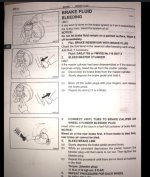
Follow the procedure shown above.

That should get you 50-75% of the way there. At that point, you need to activate ABS (gravel or other slick surface) and do another bleed cycle. You may need to repeat the ABS+bleed 2-4 times to get back to 'normal' brakes.

Good luck!

-Charlie
 
Probably due for a brake "tune" and wasn't 100% sure about the ABS activation:

How quickly after an ABS cycle to you need to perform the bleed? like - immediately after you come to a stop?
or do you have a few minutes to get back to the garage, bleed, repeat, etc.? I'll certainly do it in the dirt if I get better results.
 
I just shot a video with [MENTION=148218]JZiggy[/MENTION] replacing master cylinder on his rig and I can confirm the procedure outlined in the FSM to bleed the master cylinder works. But, his rig does not have ABS.
 
So, ahh, this sounds messy. I will have to do this by myself.

What is happening when I disconnect the lines and then press the brake pedal? Brake fluid and air coming out both ports?

Then I plug the ports and release the brake. Do I unplug the ports again before depressing the pedal, causing a repeat of brake fluid ejection?
 
So, ahh, this sounds messy. I will have to do this by myself.

What is happening when I disconnect the lines and then press the brake pedal? Brake fluid and air coming out both ports?

Then I plug the ports and release the brake. Do I unplug the ports again before depressing the pedal, causing a repeat of brake fluid ejection?
Once, when cash was short, I did this:
Solo brake bleed using the front seat cushion as a pressure creating device...
1. Stick, about 24" long.Can be any stick that length, but I happened to have a scrap piece of 1" ID PVC pipe on hand.
2. Wedged the stick between the bottom driver's side seat cushion front edge and the brake pedal. Nice tension due to the soft Toyota foam seat bottom. Remember, you can adjust the available tension by sliding the seat along it's rack.
3. Went underneath, opened, then closed, one brake bleeder valve in the normal fashion. Returned to cab, reset the stick for the next bleed. Repeat as necessary for all bleeder valves in the normal order.
Since then, I've been fortunate to 'hire it done' at a local brake/suspension shop.
 
So, ahh, this sounds messy. I will have to do this by myself.

What is happening when I disconnect the lines and then press the brake pedal? Brake fluid and air coming out both ports?

Then I plug the ports and release the brake. Do I unplug the ports again before depressing the pedal, causing a repeat of brake fluid ejection?
When I did it, I used two short extra brake lines I had laying around that ejected brake fluid right back into the reservoir. If you don't have that, you'll need to figure out a way to make sure the fluid doesn't get on your paint.

It will be MOSTLY brake fluid with just a few small bubbles. Blocking the lines when releasing the pedal makes sure that the extra element on the side of the master is set in the right place to work the rear brakes - you'll hear it clicking around in its bore while doing the 'bench' bleed portion of the process. Bleeding the rears first is important for the same reason. You really should have a partner if you are doing the bench bleed portion on the vehicle. You can vacuum or pressure bleed the rest of the system by yourself.

For the 'bench bleed' portion:
- fill master cylinder and keep both 'sides' full
- unplug ports
- depress pedal
- plug ports
- release pedal
- repeat...

I use the auto-refiller bottle from my vacuum bleeder kit even if I have a friend around to help me bleed the traditional way.

-Charlie
 
What do you think of this method, if I first bleed the old dirty fluid out of the front?
Its from the description at:
https://www.youtube.com/watch?v=oi4BnNA3Ep4

begin quote:
On the last brake I was flushing, I forgot to keep the master brake cylinder reservoir topped off! In fact, I let the brake master cylinder run dry which meant I introduced air into the brake master cylinder. This traditionally would require uninstalling the brake master cylinder, connecting hoses to its bottom drain port lines and running those to the reservoir with the master brake cylinder clamped in a vice and then pumping in the piston with a screw driver to cause the brake fluid to move out of the brake master cylinder and into the reservoir which would flush out all air bubbles over time - this process being called a bench bleed to remove the air from the master cylinder. However, after extensive research, I discovered a little known method for bleeding the brake master cylinder while it is still on car and better yet, without having to remove ANY brake lines or hoses! You don't even need a brake master cylinder bleeder kit! All you need is 10ft of vinyl hose! You simply connect the hose up to the front left caliper bleeder nipple and then run the hose into the brake master cylinder fluid reservoir. Then you top off the reservoir and tape the hose in place if needed to ensure it doesn't come out. Now, you pump your brakes while making sure to keep the brake master cylinder reservoir topped off with fluid so you don't introduce more air into the system. Then, after pumping the brakes (never pumping the brake petal all the way to the ground but only 2/3rd of the way tops else you risk breaking the master cylinder - or so I read) you eventually see all of the air gone from your clear vinyl hose and just see fluid running through! Then you know you have successfully removed all air from the master cylinder. Well you need to keep going even after that just about 50 or so more pumps. The more pumps the better as you are enabling the master cylinder trapped air pockets to bubble and work their way out of the master cylinder over repeated patting of the brake petal over time. After this process is done, flush all the brakes at each of the 3 remaining wheels beginning with the rear right wheel, then the rear left wheel, then the front right wheel. You can do this with any brake bleeding method - gravity, partner, vacuum pump, pressure bleeding, etc. Once all brakes are fully bled, you should be back in business! My car brakes were PERFECT after this process. Also, as a side note, when flushing the fluid in the first step from the caliper and back into the reservoir, I put a coffee strainer on the end of the hose to ensure no particles got into the reservoir. Also, the fluid I was cycling back into the reservoir was new fluid as I had already flushed all my lines with new fluid 2 days prior. So the fluid was very clean still.
 
What do you think of this method, if I first bleed the old dirty fluid out of the front?
Toyota didn't just randomly put in very specific instructions in the 4Runner FSM. Please follow them. If you do the front brakes first (and in the way described in the video) you will have way too much brake pedal travel and no rear brakes.

-Charlie
 
Toyota didn't just randomly put in very specific instructions in the 4Runner FSM. Please follow them. If you do the front brakes first (and in the way described in the video) you will have way too much brake pedal travel and no rear brakes.

-Charlie

When I said "front first" I just meant so that they aren't pumping dirty fluid back into the MC. They have not been bled yet, only the rear have been bled since I changed rear axle seals.
 
Whenever you bleed the brakes, you really need to do it in order. Passenger rear, driver rear, passenger front, driver front, LSPV (if present). That way, it will not draw dirty fluid into the rest of the system, but WILL discharge the dirty fluid and air out of the system.

always bench bleed the MC if it has been removed.
Always use clean, fresh fluid, and keep the MC full. It's level will drop as you bleed the various brakes. Keep it topped up to prevent drawing air into the system.

Make sure the brake pedal alignment is correct. If it isn't, you can get all sorts of interesting problems crop up.

good luck to you. I wish you all the best!
Pat☺
 
Whenever you bleed the brakes, you really need to do it in order. Passenger rear, driver rear, passenger front, driver front, LSPV (if present). That way, it will not draw dirty fluid into the rest of the system, but WILL discharge the dirty fluid and air out of the system.

always bench bleed the MC if it has been removed.
Always use clean, fresh fluid, and keep the MC full. It's level will drop as you bleed the various brakes. Keep it topped up to prevent drawing air into the system.

Make sure the brake pedal alignment is correct. If it isn't, you can get all sorts of interesting problems crop up.

good luck to you. I wish you all the best!
Pat☺


Yep, that is how I always bleed them. I just hadn't done the front yet, but I did that yesterday and the pedal feels improved enough to drive. Did 250 miles today, but I will still bleed the MC.
 

Members online

No members online now.

Forum statistics

Threads
278,306
Messages
3,554,045
Members
248,016
Latest member
Advally Service

Trending content

Back
Top