Check Engine - Lean

jbach

New member
Allright, got a check engine light. Autozone says it's from a lean condition. I should have taken it into the dealer. I have replaced, the fuel filter, PCV valve, plugs, cleaned the MAF sensor, replaced the O2 sensor before the cat, probably more but can't remember. When i disconnect the battery it runs like shit for a while a few minutes like it's missing, even heard a backfire. Then it seems to run normally for a while without the check engine light, then mayb after a few more miles, 20-100 the check engine light is back on.

It seems to run good except for the short while after i disconnect the battery to reset the computer. I'm stumped
 
Register to hide this ad
Autozone scanners are notoriously wrong.However, on the slim chance they are right, here is a tip. Leaky intake gaskets can cause a lean condition. The simplest way to check for this: with engine running, spray some carb cleaner around the intake and plenum chamber, where the head meets the intake, and where the plenum meets the intake. If you hear any change in engine rpm, then a leaky gasket is your culprit. If you are getting a backfire as you say, that is a sure sign of a lean condition.
 
techno said:
What error code are you getting?

I can't even remember anymore. It was an autozone code, check engine lean. the guy printed a list of everything it could be. I think i've replaced everything on the list now. i'm wondering if it's an injector?
 
shawnstcyr said:
Autozone scanners are notoriously wrong.However, on the slim chance they are right, here is a tip. Leaky intake gaskets can cause a lean condition. The simplest way to check for this: with engine running, spray some carb cleaner around the intake and plenum chamber, where the head meets the intake, and where the plenum meets the intake. If you hear any change in engine rpm, then a leaky gasket is your culprit. If you are getting a backfire as you say, that is a sure sign of a lean condition.

Thanks, I'll give that a try this evening.
 
jbach said:
I can't even remember anymore. It was an autozone code, check engine lean. the guy printed a list of everything it could be. I think i've replaced everything on the list now. i'm wondering if it's an injector?
The reason I ask is, the code descriptions from the OBDII reader can be vague and sometimes slightly misleading. I have a Toyota factory service manual that lists all the error codes and the proper way to troubleshoot each one, so if you can get the code pulled again we can start to narrow the problem down in a logical fashion rather than the hit and miss approach. Also, researching the error code online is great too since there is bound to be other forum members who have had the exact problem occur to them.
 
techno said:
The reason I ask is, the code descriptions from the OBDII reader can be vague and sometimes slightly misleading. I have a Toyota factory service manual that lists all the error codes and the proper way to troubleshoot each one, so if you can get the code pulled again we can start to narrow the problem down in a logical fashion rather than the hit and miss approach. Also, researching the error code online is great too since there is bound to be other forum members who have had the exact problem occur to them.

I appreciate your help. I'll go get that code again tonight and check to see if I have any type of intake leak. I'll get back with you. Thanks again!!
 
I'll see what the FSM recommends when I get home tonight. Btw, lets us know the details of your 4Runner (year, engine, transmission etc).
 
techno said:
I'll see what the FSM recommends when I get home tonight. Btw, lets us know the details of your 4Runner (year, engine, transmission etc).

Sorry. it's a 2000 Limited Auto.
 
I would bet money that its a bad MAF sensor. Go get one from autozone and switch them out while your there, and if its the problem, then keep the maf and give them your core, it will end up being 90 bucks. And if its not your MAF then just take it back out and return it.

I had this problem too, i would clean the maf sensor, reset the battery and then once it the computer cycled through and the check engine light came back on it would run like sh*t.
 
this is where an actual scan tool (not a code reader) would come in handy. You could use a digital multi meter as well though. put the multi meter on the maf signal wire and monitor the voltage. I don't have any datalogs from the truck on this computer anymore, but i'll try to throw the innovate in before i leave for work and get you an idea of what the voltage output should be. I would also suggest checking fuel pressure, and maybe running a good injector cleaner (i prefer redline brand), and double check the intake tubing and manifold for vacuum leaks first.
 
I would check for any kind of vacume leaks like around the PCV and also any other vacume lines. You could also check for air leaks after the MAF sensor on the air intake. Like 00Spork said the MAF could be the culprit. Also do not discount the IAC having a problem and allowing to much air all the time. Just some more ideas. I had this code once on my 2000 4runner but cleaning the MAF took care of it and you have already done that.
 
From a 2000 4Runner FSM.... Not sure if you have California Spec Emissions or not so I will describe both since they are similiar.

P0171 - SYSTEM TOO LEAN (Fuel Trim)

Fuel trim refers to the feedback compensation value compared to the basic injection time. Fuel trim includes short-term fuel trim and long-term fuel trim.
Short term fuel trim is the short term fuel compensation used to maintain the air-fuel ratio at its ideal theoretical value.

For NON CAL SPEC, the signal from the heated oxygen sensor indicates whether the air-fuel ratio is RICH or LEAN compared to the ideal theorectical value, triggering a reduction in fuel volume if it is rich and an increase in fuel volume if it is lean.
Long term fuel trim is overall fuel compensation carried out long-term to compare for continual deviation of the short-term fuel trim from the central value due to individual engine differences, wear over time and changes in the usage environment.
If both the short term fuel trim and the long term fuel trim are LEAN or RICH beyond a certain value, it is detected as a malfunction and the MIL (check engine light) lights up.

For CAL SPEC, The signal from the A/F sensor is approximately proportional to the existing air-fuel ratio, and ECM comparing it with the ideal theorectical value, the ECM reduces fuel volume immediately if the fuel ratio is rich and increases fuel volume if it is lean.
Long-term fuel trim compensates for the deviation from the central value of the short term fuel trim stored up by each engine tolerance, and the deviation from the central value due to the passage of time and changes in the environment.
If both the short-term and the long-term fuel trim exceed a certain value it is detected as a malfunction and the MIL (check engine light) lights up.

P0171 Trouble areas -
1. Air induction system
2. Injector blockage
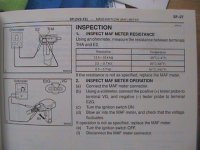
3. Mass air flow meter
4. Engine coolant temp. sensor
5. Fuel pressure
6. Gas leakage on exhaust system
7. NON CAL SPEC, Open circuit in heated oxygen sensor (bank 1 sensor 1) circuit
CAL SPEC, Open or short circuit in A/F sensor (bank 1 sensor 1) circuit.
8. NON CAL SPEC, heated oxygen sensor
CAL SPEC, A/F sensor
9. ECM

Just for reference, P0172 is the same but for the opposite detected condition (P0171 = lean, P0172 = rich).

I'll just describe the check procedures for the first three most common conditions and hope that solves the issue, if not the let me know and we can go through the rest.

1. Check the air induction system
Check for separation of the oil dipstick, oil filler cap, PCV hose, etc, these may cause the engine to run out of tune. Check for disconnection, looseness or cracks in the parts of the air induction system between the throttle body and cylinder head, this will cause air suction and cause the engine to run out tune.
2. Check injector injection
This really requires some special tools, but the injector volume should be between 60-73 cubic cm or 3.4-4.5 cubic in. You can also test the injector terminal resistance, it should be approx 13.8 ohms at 68

 

Attachments

  • dsc00014.jpg
    dsc00014.jpg
    136 KB · Views: 4,481
techno said:
From a 2000 4Runner FSM.... Not sure if you have California Spec Emissions or not so I will describe both since they are similiar.

P0171 - SYSTEM TOO LEAN (Fuel Trim)

Fuel trim refers to the feedback compensation value compared to the basic injection time. Fuel trim includes short-term fuel trim and long-term fuel trim.
Short term fuel trim is the short term fuel compensation used to maintain the air-fuel ratio at its ideal theoretical value.

For NON CAL SPEC, the signal from the heated oxygen sensor indicates whether the air-fuel ratio is RICH or LEAN compared to the ideal theorectical value, triggering a reduction in fuel volume if it is rich and an increase in fuel volume if it is lean.
Long term fuel trim is overall fuel compensation carried out long-term to compare for continual deviation of the short-term fuel trim from the central value due to individual engine differences, wear over time and changes in the usage environment.
If both the short term fuel trim and the long term fuel trim are LEAN or RICH beyond a certain value, it is detected as a malfunction and the MIL (check engine light) lights up.

For CAL SPEC, The signal from the A/F sensor is approximately proportional to the existing air-fuel ratio, and ECM comparing it with the ideal theorectical value, the ECM reduces fuel volume immediately if the fuel ratio is rich and increases fuel volume if it is lean.
Long-term fuel trim compensates for the deviation from the central value of the short term fuel trim stored up by each engine tolerance, and the deviation from the central value due to the passage of time and changes in the environment.
If both the short-term and the long-term fuel trim exceed a certain value it is detected as a malfunction and the MIL (check engine light) lights up.

P0171 Trouble areas -
1. Air induction system
2. Injector blockage
3. Mass air flow meter
4. Engine coolant temp. sensor
5. Fuel pressure
6. Gas leakage on exhaust system
7. NON CAL SPEC, Open circuit in heated oxygen sensor (bank 1 sensor 1) circuit
CAL SPEC, Open or short circuit in A/F sensor (bank 1 sensor 1) circuit.
8. NON CAL SPEC, heated oxygen sensor
CAL SPEC, A/F sensor
9. ECM

Just for reference, P0172 is the same but for the opposite detected condition (P0171 = lean, P0172 = rich).

I'll just describe the check procedures for the first three most common conditions and hope that solves the issue, if not the let me know and we can go through the rest.

1. Check the air induction system
Check for separation of the oil dipstick, oil filler cap, PCV hose, etc, these may cause the engine to run out of tune. Check for disconnection, looseness or cracks in the parts of the air induction system between the throttle body and cylinder head, this will cause air suction and cause the engine to run out tune.
2. Check injector injection
This really requires some special tools, but the injector volume should be between 60-73 cubic cm or 3.4-4.5 cubic in. You can also test the injector terminal resistance, it should be approx 13.8 ohms at 68
 
Thanks man. Time to find a friend I can try and swap mine out with.

yeah, i hear you. advance auto parts let me throw it in there to make sure that was it. you may want to ask them if they will return it if that's not the problem. it can easily be done in the parking lot with a phillips head.
 

Members online

Forum statistics

Threads
278,304
Messages
3,554,040
Members
248,016
Latest member
Advally Service

Trending content

Back
Top