Chronic alternator problem

GSMNP125

New member
1986 4-Runner 22RE...mt, 4X4.
I have a chronic alternator problem. The problem is it quits working leaving the 4-Runner to run off the power from the battery until the battery runs out. My mechanic put a new alternator on in February 2012. It quit working almost immediately. It was defective right out of the box. He got one from the same supplier and it seemed to be working but I had to replace my battery the next day. All was well for about a week when the third alternator quit. He replaced it with a N_ _A. They looked for the cause of the problem and determined it was a small wire running to the fuse box from the hot side of the battery. They replaced it with a larger wire and it's been running fine. Today the dash light came on again and soon after that the 4-Runner was, once again running off the power in the battery. At some point just turning on the FM radio will kill the engine. What is killing my alternators?
Thanks
 
Register to hide this ad
What is "that small wire from the fuse box"?

1986 4-Runner 22RE...mt, 4X4.
I have a chronic alternator problem. The problem is it quits working leaving the 4-Runner to run off the power from the battery until the battery runs out. My mechanic put a new alternator on in February 2012. It quit working almost immediately. It was defective right out of the box. He got one from the same supplier and it seemed to be working but I had to replace my battery the next day. All was well for about a week when the third alternator quit. He replaced it with a N_ _A. They looked for the cause of the problem and determined it was a small wire running to the fuse box from the hot side of the battery. They replaced it with a larger wire and it's been running fine. Today the dash light came on again and soon after that the 4-Runner was, once again running off the power in the battery. At some point just turning on the FM radio will kill the engine. What is killing my alternators?
Thanks
When your mech said alternator died, did he verify that the alternator was indeed defective?
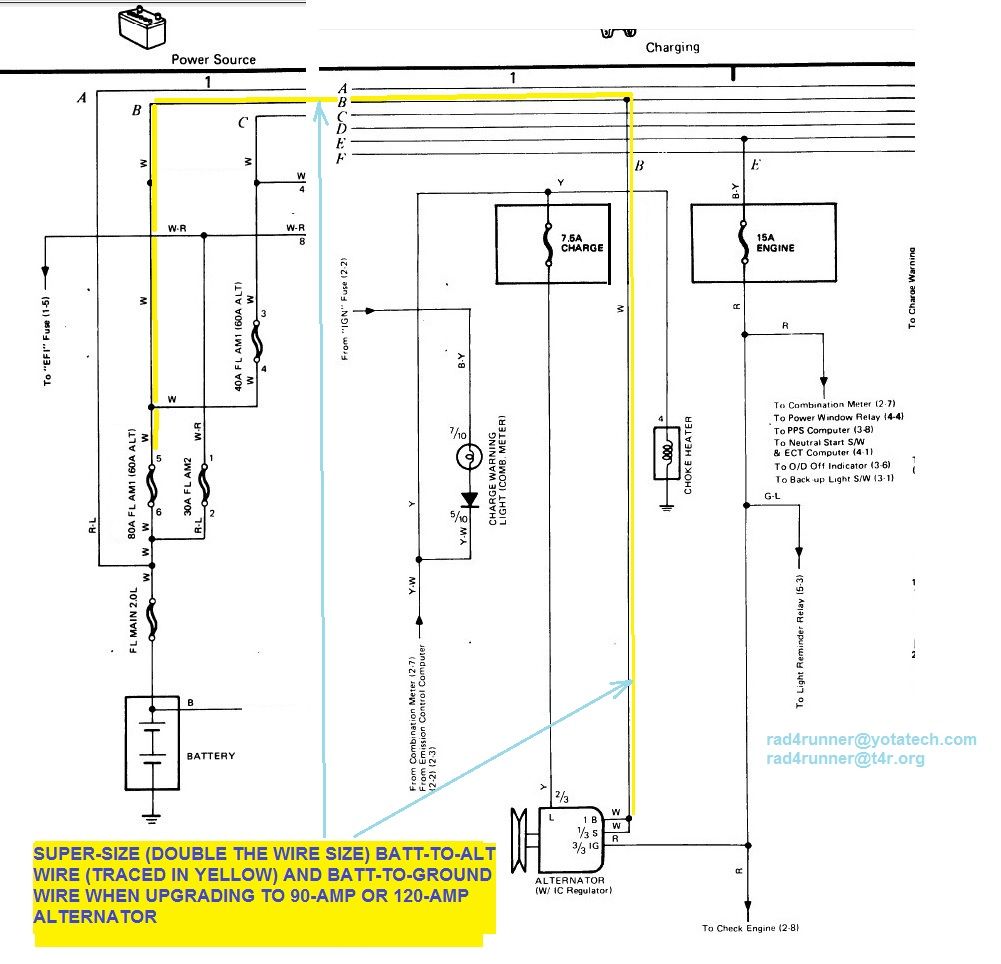
Did he say which wire is "that small wire from the fuse box". in the schematic, so we'll understand which wire and what it does?
What color is "that small wire from the fuse box"?
Did he even refer to a schematic so he troubleshoots it systematically, rather than guessing and making you buy replacement for parts that were not really defective?
Maybe the alternator was thought as "defective right out of the box", because it did not generate power, but the root cause was really because it was not getting excitation current from "IG" (if that's "that small wire from the fuse box").
What was wrong with "that small wire from the fuse box"? No voltage?
When engine was running what voltage did you get at wire "B" (Alt-to-batt)? This should be between 13.5V & 14.5V on a healthy alternator.
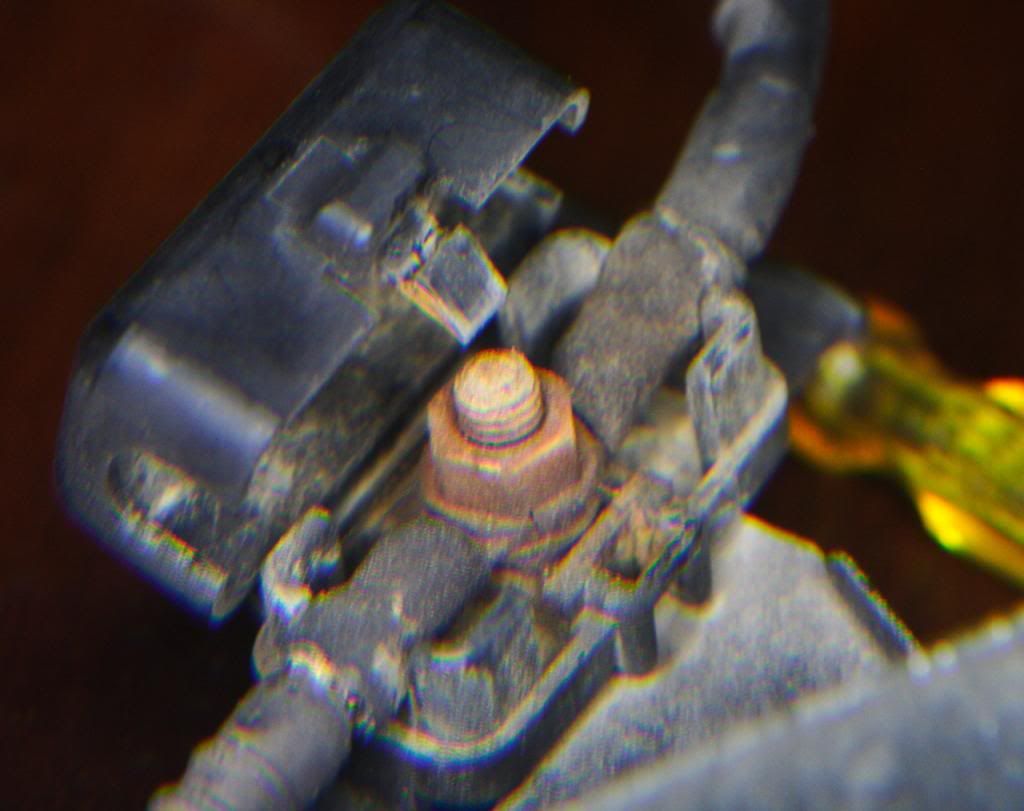
002_B_Terminal_zps4b6e920f.jpg~original


Did you get charge error light? IF B voltage is outside above range voltage on "L" wire will be low, and cause Charge Light to come on.

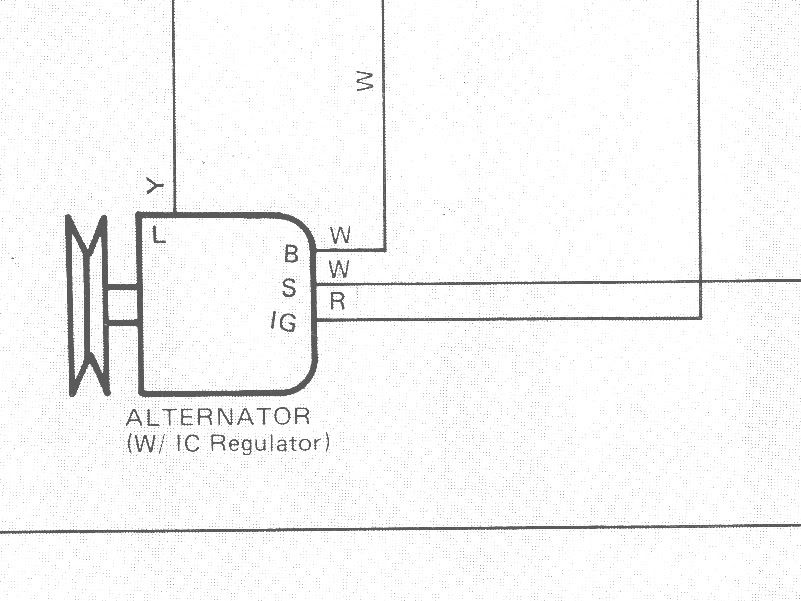
Why did he replace it with a larger wire? The wires leading to the alternator need not be thicker. Only the B (white alt-to-battery wire) needs to be thick.
The red IG wire only carries minimal current.
Alternator_Closeup.jpg~original


If "that small wire from the fuse box" is the red IG wire, did he check if the 15A Engine fuse is good and is getting power to it? If engine fuse is blown, something could be shorting it to ground. Reverse light takes power from that fuse. Reverse light wiring is poorly managed on the 22RE.
If insulation wears out and wire shorts to transmission body, it will blow engine fuse. (Ignore "Supersize" comment on schematic)
Charging_Alt_Batt-Notes_zps3da087c5.jpg~original


Wanna verify that it's not a problem?
IF No voltage on red IG wire but Engine fuse is OK, just trace that wire back until you find where it lost power.

Mind posting schematic of your charging system so electrically-savvy members even with different models can help analyze?
 
Last edited:
WOW ! I guess I don't know the answers to all those questions. I did what I could and got no where so that's why I took it to the mechanic. I trust his judgement and didn't question his analysis of the problem. He's been in business for as long as I can remember and I'm 60. He's been recognized as the number 1 mechanic in our area for the lasts 20. I know his evaluation would be accurate but I'm pretty sure he isn't the one that did the work. He has about about 5 mechanics that work for him. He did say he checked the alternator and it was bad. The wire from the + post, leading to the fuse box was red.
Update...I had to take it to Toyota because I wanted a second openion. They told me they did all the tests they could and they didn't find anything wrong with the alternator, battery, wires and fuse box. All they could find was a leak in the powersteering pump. They said it is leaking pretty bad and the fluid is getting into the alternator openings and causing the alternators to eventually quit. I'm glad I got a second openion. Thank you for your insight on my problem. I can tell you know your stuff and I'm sure I'll be back with more questions in the future. It's a good old 4-Runner. It's just about to reach 300 k.
Thanks again
 
I have a question. What will happen if you don't replace the "B" wire with a larger diameter wire, when you have a higher amp alternator?

Reason I'm asking, I just recently had an alternator fail or so says the battery & brake lights that come on in the dash. I put in a high amp alternator cause I'm running a winch.
However, if I keep the engine rpms above 2000, the lights go off, but the volt gauge remains reading low.

I guess I'm an idiot for not doing it sooner, but the company (that I bought the alternator from) did recommend upgrading to a larger wire and I never got around to it.
 
What will happen if you don't replace the "B" wire with a larger diameter wire, when you have a higher amp alternator?

It's only going to matter when the current drain is extremely high, like when you are winching. Even then, it shouldn't hurt the alt, but it may overheat the wiring.

While your HO alt maybe rated at say 100A, it only produces as much current as is needed at any particular time, up to it's limit. Also, it's output varies with engine RPMs, it will only put out its max at high RPM.

But it never hurts to up grade the stock wiring even with a stock alt, and don't forget the ground wires too.
 
It's only going to matter when the current drain is extremely high, like when you are winching. Even then, it shouldn't hurt the alt, but it may overheat the wiring.

While your HO alt maybe rated at say 100A, it only produces as much current as is needed at any particular time, up to it's limit. Also, it's output varies with engine RPMs, it will only put out its max at high RPM.

But it never hurts to up grade the stock wiring even with a stock alt, and don't forget the ground wires too.

So, what I've been experiencing recently, it sounds like I might've fried the stock wiring. Which, sounds like to me, would explain when the engine is above 2000 rpms, the charge/brake lights in the dash would go off.
Which would also explain how I managed to drive it home from the off road park...it didn't keep the battery charged to the normal 14 volts, but kept up enough to keep the engine from running off strictly battery power.

Sorry to blab on and on. Just trying to figure this out in my head and figure out what to look for when I start fixing the truck this coming weekend.

Cause you see, right before the volt gauge dropped & the charge/brake lights came on in the dash, I was winching myself out of a mudhole.
 
Last edited:
... I might've fried the stock wiring.
Or you could have over-loaded you battery while winching and killed a cell. Did you have battery tested?

To check if you fried wiring for charging circuit or problem with alternator:

With electrical off and nothing connected to B terminal of alternator, MEasure resistance of B terminal to ground. Should be a very high resistance. Can't remember exactly (I think it was in the meg-ohms not Kilo ohms - search my post on Yotatech to be sure).
002_B_Terminal_zps4b6e920f.jpg~original

If in kilo-ohms or lower- probably bad rectifier inside alternator.

Everything re-connected, engine is running and alternator charging:
Measure voltage at IG (red wire). This should be +12V - same as at 15A engine fuse. If not 12V, inspect red wire for breaks, etc.

Measure voltage at B terminal/screw where thick alt-to-batt connects.
This should range from 13.5 to 14.5. If outside this range, charge error light should come on.

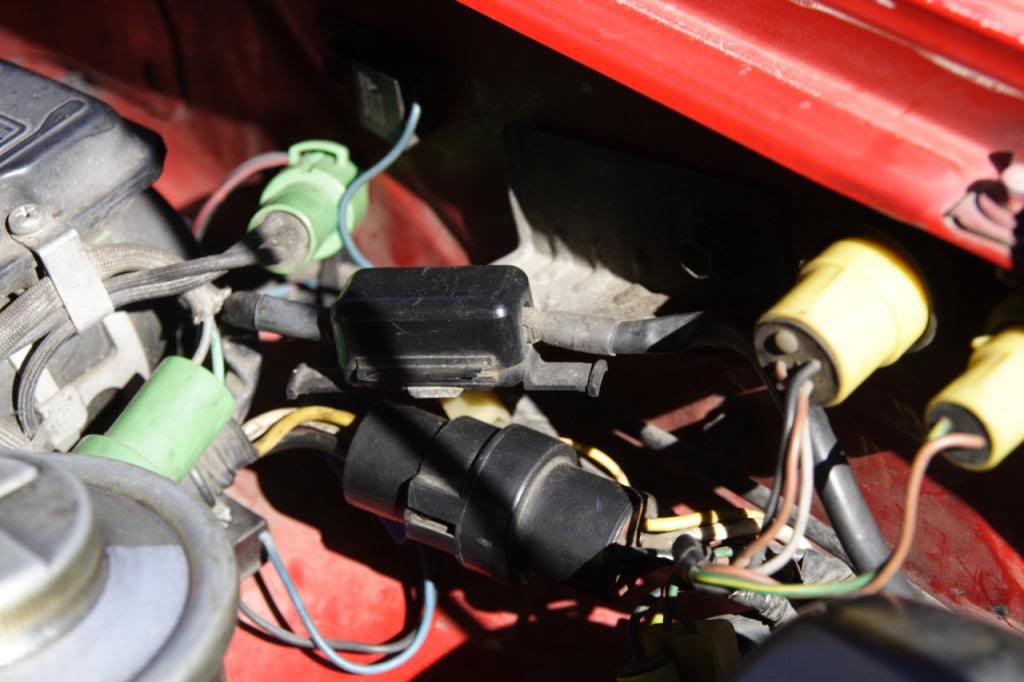
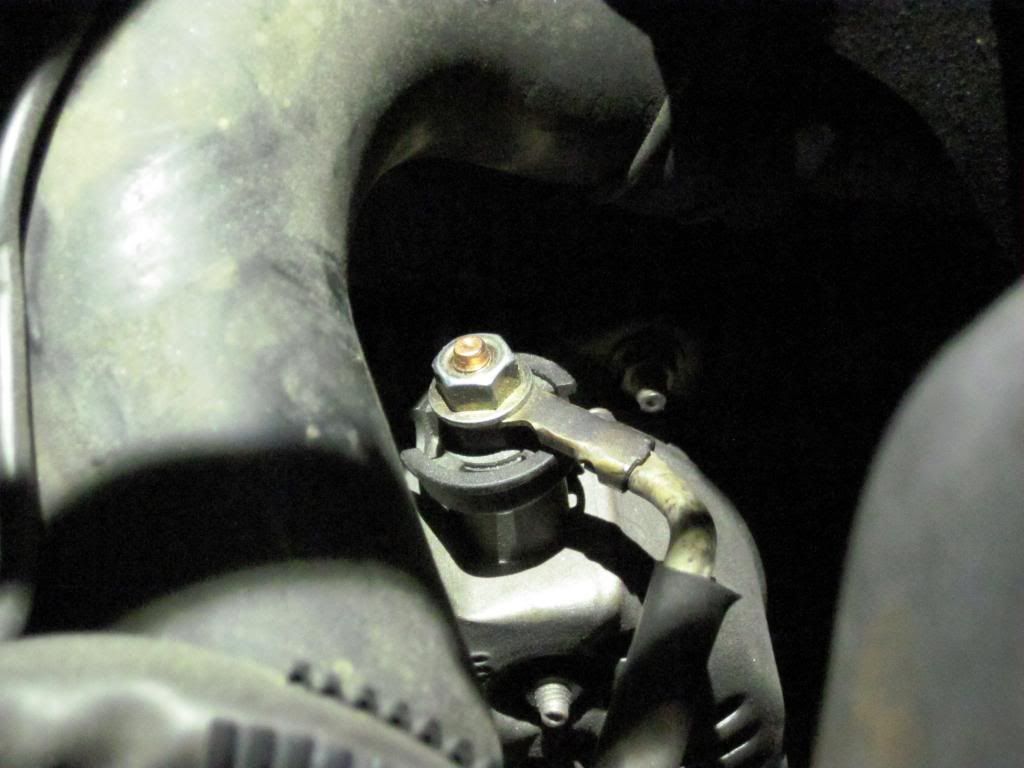
Voltage at battery post should be very close to voltage at B terminal. If not, inspect B wire for breaks, etc. Also open up this plastic case.
001_Graphite_Core_Maybe_zps68a404c0.jpg~original


It contains a junction that could loosen or get corroded.
001_Just_Junction_Point_zpsa274310f.jpg~original

(At first I thought this was a ferrite core suppressor). This is like an appendix- no real-life purpose; has anyone found a use for this in the past 27 years? When I upgrade my alternator wiring, I will remove this unnecessary part.

Which, sounds like to me, would explain when the engine is above 2000 rpms, the charge/brake lights in the dash would go off.
If your alternator belt is OK, wiring (checked above) is OK, battery load-tested OK, but voltage at B terminal is lower than 13.5 V and charge light is on, most likely bad alternator.

Cause you see, right before the volt gauge dropped & the charge/brake lights came on in the dash, I was winching myself out of a mudhole.
Winching is not likely to fry wiring (check as above) IF you connected your winch correctly, which is directly to battery - because winch motor probably draws about as much current as starter motor. IF you connected to wrong point (i.e., after fusible links) fried wiring would be obvious.
 
Or you could have over-loaded you battery while winching and killed a cell. Did you have battery tested?

To check if you fried wiring for charging circuit or problem with alternator:

With electrical off and nothing connected to B terminal of alternator, MEasure resistance of B terminal to ground. Should be a very high resistance. Can't remember exactly (I think it was in the meg-ohms not Kilo ohms - search my post on Yotatech to be sure).
002_B_Terminal_zps4b6e920f.jpg~original

If in kilo-ohms or lower- probably bad rectifier inside alternator.

Everything re-connected, engine is running and alternator charging:
Measure voltage at IG (red wire). This should be +12V - same as at 15A engine fuse. If not 12V, inspect red wire for breaks, etc.

Measure voltage at B terminal/screw where thick alt-to-batt connects.
This should range from 13.5 to 14.5. If outside this range, charge error light should come on.

Voltage at battery post should be very close to voltage at B terminal. If not, inspect B wire for breaks, etc. Also open up this plastic case.
001_Graphite_Core_Maybe_zps68a404c0.jpg~original


It contains a junction that could loosen or get corroded.
001_Just_Junction_Point_zpsa274310f.jpg~original

(At first I thought this was a ferrite core suppressor). This is like an appendix- no real-life purpose; has anyone found a use for this in the past 27 years? When I upgrade my alternator wiring, I will remove this unnecessary part.

If your alternator belt is OK, wiring (checked above) is OK, battery load-tested OK, but voltage at B terminal is lower than 13.5 V and charge light is on, most likely bad alternator.

So far I just had the alternator checked out...and it's fried. $220 down the toilet in a day. :crybaby:
Hopefully the Optima red top battery is ok, but I might as well go and have it checked out too just for the hell of it.
Ripped out the factory wire from the alternator all the way to the fuse box, then the short wire from fuse box to battery. Then of course the ground wires and starter wire.
According to the people, who I bought the high output alternator from, they recommend 4 gauge wire or thicker. So I bought a bunch of 4 gauge wire and terminal ends.

Now, if any of you say "That's not big enough" You have to understand, I don't off road this truck a whole lot and I BARELY use the winch at all, so I don't see the point of trying to figure out how to screw/soder/weld, 2 gauge wire to the alternator or fuse box. :redbrick:

On another note, the only thing that I can think of on what that, useless little "appendix" conjunction on the driver side, can be used for is a jumper cable connection.
 
Last edited:
So far I just had the alternator checked out...and it's fried. $220 down the toilet in a day. :crybaby:
Sorry dude :(

...then the short wire from fuse box to battery...
Oh no, that short wire (here) from bat to fuse block is a fusible link - there to protect stock wiring. Do not bypass nor remove that.

A heavy, momentary load with appropriate, super-thick wires, such as a winch or starter motor, should be connected directly to battery without a fuse.

OTHER loads, whose wiring require protection - such as audio amps and auxiliary lights - should be connected to battery through proper fuses without passing through that fusible link. Again, because that fusible link is meant to allow current to stock components. You wold not want to overload that.

... the only thing that I can think of on what that, useless little "appendix" conjunction on the driver side, can be used for is a jumper cable connection.
Oh no, never connect jumper cable to that junction. Cranking current is sure to blow F.L.'s and possibly fuses on it's way to starter.
 
Oh no, that short wire (here) from bat to fuse block is a fusible link - there to protect stock wiring. Do not bypass nor remove that.

A heavy, momentary load with appropriate, super-thick wires, such as a winch or starter motor, should be connected directly to battery without a fuse.

OTHER loads, whose wiring require protection - such as audio amps and auxiliary lights - should be connected to battery through proper fuses without passing through that fusible link. Again, because that fusible link is meant to allow current to stock components. You would not want to overload that.

So wait...are you saying that I shouldn't replace that short wire (fuse block to battery) with something thicker?
I wasn't going to just leave it out or bypass it. I was saying I ripped out the main alt. to fuse block, fuse block to battery, grounding wires, and starter wires so I can replace them all with 4 gauge wire.

Also, I have a safety switch connected to the positive wire coming from the winch, then from the switch, it goes directly into the battery. Is that bad too?
:noidea:
 
Happy Independence Day, folks!
(Just got out of Yellowstone after 3 day backpack)

A chronic alternator problem is not caused by stock wiring. It's because something went wrong with stock wiring.

So wait...are you saying that I shouldn't replace that short wire (fuse block to battery) with something thicker?
Correct. That FL is designed to handle stock circuit and stock load. No need to replace that, if you do as I say above - power accessories from fuse connected directly to battery post.

If you insist on replacing it with something thicker, see Philbert's thread on Yotatech. Shows you how to find right Fusible Link wire to replace it with.

Also, I have a safety switch connected to the positive wire coming from the winch, then from the switch, it goes directly into the battery. Is that bad too?
:noidea:
U did it right. Power from winch directly from battery. With switch, of course :)
 

Members online

No members online now.

Forum statistics

Threads
278,306
Messages
3,554,045
Members
248,016
Latest member
Advally Service

Trending content

Back
Top