Clutch engaging too soon

Elomar88

New member
So I just finished doing the 5 speed swap on my 97 4runner and now the clutch is engaging about 1/2-1" from the bottom I adjusted the rod all the way out at the pedal and had no luck any ideas fluid is full and was bled when I did the swap might try and bleed it again
 
Register to hide this ad
I'd rule out a misalignment of the clutch slave and fork. The piston should be straight. Bad news is you may have to pull it to fix it if fork is not installed correctly.

Here is some FSM help:

CLUTCH PEDAL RELEASE POINT
1) Block wheel and set parking brake. Start engine and allow
it to idle. Without depressing clutch pedal, slowly move shift lever
into reverse shift slot until gears begin to mesh (gear contact is
heard). Gradually depress clutch pedal and measure stroke distance
from point gear noise stops to full stroke end position.
2) Distance should be .98" (25 mm) or more. On Supra, check
full pedal stroke. Full pedal stroke should be 5.20-5.43" (132.0-138.0
mm). If distance is not as specified, check pedal height, push rod
play and pedal free play. See CLUTCH PEDAL HEIGHT and
CLUTCH PEDAL FREE PLAY & PUSH ROD PLAY. If clutch pedal adjustments
are as specified, bleed clutch system. If after bleeding system,
distance is still not as specified, inspect clutch cover and disc for
excessive wear.

 
I had the same problem when i did the swap on my 97. Check your pedal height, mine was too low. I adjusted it up to spec and then readjusted the rod. It has been working fine for a couple months now
 
How do you adjust the pedal height

Here you go..

ADJUSTMENTS
CLUTCH PEDAL HEIGHT
1) Measure clutch pedal height from highest point of clutch
pedal pad to floor panel. See Fig. 1. Ensure clutch pedal height is
within specification. See CLUTCH PEDAL HEIGHT SPECIFICATIONS table.
2) On Supra, if clutch pedal height adjustment is required,
disconnect clutch switch connector. Loosen lock nut and rotate clutch
switch until correct clutch pedal height is obtained. See Fig. 1.
3) On all except Supra, if clutch pedal height adjustment is
required, loosen lock nut and rotate bolt at clutch pedal height
adjustment point until correct clutch pedal height is obtained. See
Fig. 1. On all models, check clutch pedal free play and push rod play.
See CLUTCH PEDAL FREE PLAY & PUSH ROD PLAY.
CLUTCH PEDAL HEIGHT SPECIFICATIONS

Application In. (mm)
Supra ...................................... 5.76-6.15 (146.2-156.2)
Tacoma ..................................... 6.69-7.09 (170.0-180.0)
T100 ....................................... 6.08-6.48 (154.6-164.6)
4Runner .................................... 6.89-7.28 (175.0-185.0)

 
Here's the rest:

CLUTCH PEDAL FREE PLAY & PUSH ROD PLAY
1) To check clutch pedal free play, push clutch pedal until
beginning of clutch resistance is felt. See Fig. 2. Note distance
clutch pedal moves. This is clutch pedal free play.
2) Clutch pedal free play should be .20-.59" (5.0-15.0 mm).
If clutch pedal free play adjustment is required, loosen lock nut on
push rod at master cylinder. See Fig. 1. Rotate push rod to obtain
correct clutch pedal free play. Tighten lock nut.
3) To check push rod play, slightly push clutch pedal until
slight resistance is felt (point where push rod just starts to operate
clutch master cylinder). See Fig. 1. Push rod play should be .039-.
197" (1.00-5.00 mm) at top of clutch pedal. This ensures a slight
amount of clearance at push rod.
4) If push rod play adjustment is required, loosen lock nut
on push rod at master cylinder. Rotate push rod to obtain correct push
rod play. Tighten lock nut. Recheck clutch pedal free play and clutch
pedal height.
Fig. 2: Measuring Clutch Pedal Free Play (Typical)
Courtesy of Toyota Motor Sales, U.S.A., Inc.
CLUTCH PEDAL RELEASE POINT
1) Block wheel and set parking brake. Start engine and allow
it to idle. Without depressing clutch pedal, slowly move shift lever
into reverse shift slot until gears begin to mesh (gear contact is
heard). Gradually depress clutch pedal and measure stroke distance
from point gear noise stops to full stroke end position.
2) Distance should be .98" (25 mm) or more. On Supra, check
full pedal stroke. Full pedal stroke should be 5.20-5.43" (132.0-138.0
mm). If distance is not as specified, check pedal height, push rod
play and pedal free play. See CLUTCH PEDAL HEIGHT and
CLUTCH PEDAL FREE PLAY & PUSH ROD PLAY. If clutch pedal adjustments
are as specified, bleed clutch system. If after bleeding system,
distance is still not as specified, inspect clutch cover and disc for
excessive wear.
 
TheDurk is TheMan Fig 1 shows the travel from the top of the pedal to where the pedal hits the floor when you push on it, that is what you want to measure. The adjustment bolt is the one with the clutch cancel switch on it. The only thing different I did on mine was pull out the original spring with shot bushings and used the extra brake spring instead. no more squeak
 
I recently replaced the clutch on a 2000 V6. I also had the flywheel resurfaced. New master and slave cylinders, too. New bushing where the pushrod's fork mates with the clutch pedal, too.

It all went together just fine and I got the clutch pedal adjusted to release/engage at a height I could live with and that was within FSM specs.

However, the adjustment of the master cylinder pushrod required it to extend to its limits. I wondered why. I'm quite sure I removed all the air from the clutch's hydraulics.

It seems to me, and I should stress that this only occurred to me after it all went together, that there's a little tweak one could do to make it so the master cylinder wasn't at the end of its adjustment.

If the flywheel is resurfaced the clutch disk and pressure plate naturally move forward. Thus, the slave pushrod has to extend just a bit farther, too.

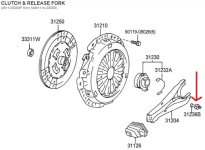
What would happen if one were to place a washer under the clutch fork's pivot bolt? (Indicated by an arrow in the picture.) It seems to me that if nothing else, such a washer - equal in thickness to the amount removed from the flywheel - would mean that the slave cylinder rod wouldn't have to extend quite so far. Thus there'd be slightly more adjustment left on the pushrod under the dash.

It's all just a thought. I didn't perform this modification. I invite correction to my thought.
 

Attachments

  • 4Runner2000clutch2.jpg
    4Runner2000clutch2.jpg
    78.7 KB · Views: 1,659
Figured it out had a blonde moment when doing the swap and left the top bolt from the clutch pedal assembly loose today I found it under my floor mat oops.... Explains why it was getting worse probably bending the crap out of the firewall but anyways bolt back in clutch engaging where it should thanks for all the help
 
Thanks man yeah it made it feel like a whole new truck loving it so far I'd say one little clutch pedal bolt isn't too bad considering all the crap I took out and put in have looked all over trying to find the ohms of the shift solinoids so that maybe I can get the cell to go away on the dashake it look like it was factory 5 speed that and the a/T oil temp
 
The easiest way to get rid of the cel is to put an ecu from a 97 manual in. I had access to a donor truck so I replaced the engine wiring harness too which gave me the proper plugs to the transmission and ecu. The plugs on the auto and manual 97 ecu are different and will not plug and play even though the wiring is in pretty much the same place. Just the STA and check engine/obd wire are on different plugs. The other two plugs on the engine wiring harness which run to the trans are plug and play. I took the park /neutral switch wire and ran it over and used it for the clutch start and clutch cancel switch. It looks and runs like factory because it essentially is. You can also find a used 97 ecu,go buy the plugs from toyota and repin the wiring harness. It took me 5 full days to do my swap,looked a lot easier in the write-ups!
 

Members online

Forum statistics

Threads
278,310
Messages
3,554,079
Members
248,016
Latest member
Advally Service

Trending content

Back
Top