crank won't rotate after removing heads

reluctant1

New member
I had blown head gaskets on a 3.4L '02. After removing heads and having them machined and valves adjusted I decided to remove the block, hone the cylinders and check the rings. Although the initial turn of the crank was difficult prior to removing the heads, it was able to turn with a moderate amount of effort in subsequent turns. However, a few days after removing the heads, I tried to rotate the crank to gain access to the torque converter bolts to remove the block and the crank would not turn. Much more torque was applied than the initial turn and it would not budge. The transmission is in neutral with parking brake applied. Disengaging the parking brake allows the vehicle to easily roll. The oil pan has been removed, PB Blaster applied to cylinders and connecting rods, all to no avail. Is there anything that could have "locked" the torque converter preventing it from turning?
 
Register to hide this ad
No there should not be any problem with rotating the motor with the TQ converter, keep looking around to see if there is something blocking the crank.

like around the timing belt area, up on the cylinder walls, under by the crank (oil pan area). it should freely spin even tho the converter is still attached.
Good luck and welcome 1st post.
 
Thanks for the prompt reply. I will look everything over again. Most everything is removed at this point (water pump, etc.). I have not removed the crankshaft sprocket or the oil pump, but, I assume nothing would be gained by removing them.
 
Since you turned it initially, what have you removed? There's no reason it shouldn't spin and obviously it hasn;t been run so I highly doubt anything has broken. Have you removed any of the flax plate bolts yet? If so, take a look and make sure the flax plate isn't getting hung up. Is the starter still installed?

I'm sure you'll get it sorted, doubt it's anything major.
 
Thanks for the input. The starter has been removed, however, no flex plate bolts have been. Ordinarily, would the flywheel rotate freely once the block is removed? There was water in a couple of cylinders and since the vehicle sat for several months all the cylinders have some slight rust. I can add more elbow grease once I am sure there is no risk of damaging anything.
 
Is the timing belt on or off?
If timing belt is off then there is no relief to engine compression.
These are non-interference engines so no worries of piston hitting the valves.
 
I've ran into this problem before. As you stated you had a blown hg did your engine overheated? If it did one of the piston might be seized. I would take the rod caps off and see if you can push the pistons up.
 
Thanks again for the input. The timing belt, heads, manifolds, etc. are all removed. When finding TDC prior to removing heads I was able to rotate the crankcase. The initial turn required substantial force, although additional turns reasonably firm. I have thought of removing some of the connecting rods bearings to see if that would free it up.
 
If it's that hard to turn, I would remove the entire rotating assembly (crank, rods, pistons) to check for damaged bearings, pistons, rings, bores, journals, etc. Then replace anything that is out of spec.
 
The Haynes manual says the engine must be removed before removing the crankshaft, but, removing rod caps one at a time and trying to rotate the crank would probably be less risky than trying brute force. Thanks.
 
Still trying to rule out transmission/torque converter explanations for not being able to rotate crankshaft. I have raised both front and rear wheels and all rotate freely regardless of where the shifter is positioned. I can see and hear the shift lever work on the transmission but the transmission is not engaged. I assume this is normal with no electrical power in the vehicle.
 
Still trying to rule out transmission/torque converter explanations for not being able to rotate crankshaft. I have raised both front and rear wheels and all rotate freely regardless of where the shifter is positioned. I can see and hear the shift lever work on the transmission but the transmission is not engaged. I assume this is normal with no electrical power in the vehicle.

Go look up how a torque converter works. Once you understand it you can rule it out right away.
Are you sure you don't have anything hidden somewhere? Dropped a wrench or a nut down somewhere or left it somewhere and it's wedged and completely hidden?

If your gonna end up takin the block maybe consider just pulling the trans with it and then try to fight fit out of the car?
 
Resolved - thank you

I thank each of you for your suggestions and assurance that I need not consider causes other than something related to the cylinders. I sprayed PB Blaster in the cylinders (top and bottom) and let sit for a couple of days. Since the crank still would not rotate, I removed two connecting rod caps from the cylinders that appeared to have the most corrosion and the pistons in the low and medium positions. Several mild taps on the connecting rod cap bolts allowed the piston to move upward and the crank to rotate enough for the Blaster to work on all the cylinders. After a couple of turns the crankshaft rotated freely. This allowed me to remove the flexplate bolts and remove the block for overhaul.

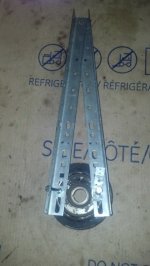
Since my mechanical expertise is minimal, I have very little to contribute back to this forum. From previous posts concerning making your own tool to remove the crankshaft pulley and several attempts to find a suitable tool from local auto stores, I realize there is still room for further suggestions. Attached is a late night improv using a couple of items I just happened to have at the house. It worked quite well for me and I hope it helps someone else. Thanks again.
 

Attachments

  • crankshaft pulley tool.jpg
    crankshaft pulley tool.jpg
    43.9 KB · Views: 1,062
Last edited:

Forum statistics

Threads
278,316
Messages
3,554,110
Members
248,016
Latest member
Advally Service

Trending content

Back
Top