Crawford Eco Block

See that's the thing with this thread. I'm sure Quirt is a good enough guy. I'm sure Crawford does some good things. For the life of me though I can't understand how they can sell an engineered product that they claim increases BOTH efficiency and power by a large margin over OEM performance. They do this with no real data to back it up either. Jeez, comission some independent dyno runs under several conditions at least. Instead they rely on testimonials. C'mon man. Those mean nothing except to the guy who spent forty bucks and wants to feel good about his purchase.
Bottom line is that if this spacer actually worked as advertised and nothing, such as reliability or emissions for example, had to suffer then the OEM boys would be all over this process. It would save them millions in CAFE credits.
In the end it's your money so spend it as you wish.
 
For the life of me though I can't understand how they can sell an engineered product that they claim increases BOTH efficiency and power by a large margin over OEM performance.

I guess I'm failing to understand how it's so hard to figure out? At WOT (or at least in open loop fueling) using less fuel = leaner AFR = more power. Also using less fuel = using less fuel = more efficiency AT WOT. Therefore it DOES do both, just as my WRX, my two STi's, and my 335xi, all of which were custom tuned did. They made better fuel economy than stock and also made much better power. I believe one of the biggest reasons the OEM's don't do it is because of emissions, not fuel economy. Same reason they stick restrictive catalytic converters in there which also rob power. They could easily do lots of things to free up the engine and make it run quite a bit stronger without any long-term issues.
 
I guess I'm failing to understand how it's so hard to figure out? At WOT (or at least in open loop fueling) using less fuel = leaner AFR = more power. Also using less fuel = using less fuel = more efficiency AT WOT. Therefore it DOES do both, just as my WRX, my two STi's, and my 335xi, all of which were custom tuned did. They made better fuel economy than stock and also made much better power. I believe one of the biggest reasons the OEM's don't do it is because of emissions, not fuel economy. Same reason they stick restrictive catalytic converters in there which also rob power. They could easily do lots of things to free up the engine and make it run quite a bit stronger without any long-term issues.

That's exactly it! It's not hard to figure out. At WOT, using long term trims in open loop fueling, this product will be negated. Same fuel = same AFR = same power = same emissions. Therefore it DOES nothing. A custom tune is very different from this product and most likely tweaks not just fuel scheduling but ignition timing and potentially other items depending upon what's available to tweak.

Take 10 335xi's fresh off the boat. Dyno and emission test them. Take 5 and add this product. 12 months later re dyno and emission test all 10. Measure variation. Did the ECU relearn the long term trim and negate this product? Obviously this will never happen. Get this product on Shark Tank!
 
I guess I'm failing to understand how it's so hard to figure out? At WOT (or at least in open loop fueling) using less fuel = leaner AFR = more power. Also using less fuel = using less fuel = more efficiency AT WOT. Therefore it DOES do both, just as my WRX, my two STi's, and my 335xi, all of which were custom tuned did. They made better fuel economy than stock and also made much better power. I believe one of the biggest reasons the OEM's don't do it is because of emissions, not fuel economy. Same reason they stick restrictive catalytic converters in there which also rob power. They could easily do lots of things to free up the engine and make it run quite a bit stronger without any long-term issues.

Actually at WOT you'd typically want more fuel to compensate for the additional airflow being ingested; otherwise the vehicle does not have an efficient enough combustion and that will translate into lack of power (after a certain point.) Then you need to take into consideration things like heat soaking, higher than average temperatures from a much leaner mixture, and/or the large increase in NOx as a result of running too lean/too hot a mixture. Not to mention things like RPM band, low vs. high rotational mass, inertia of the engine, ect.b The issue is far more complex than simply tuning your carburetor a little lean.

Most Japanese vehicles run on the leaner side from what I have seen (while some Europeans like BMW tend to be a bit richer), so leaning it too much further will probably result in thermal issues that could compound over the life of the vehicle. Also Toyota is extremely conservative when it comes to their focus of efficiency, the main goal of their vehicles is emissions and fuel economy; everything else is second in their design goals. The reality is your statement is only partially right under certain circumstances, if running "lean" was the key to additional power and MPG then high performance vehicles would not guzzle fuel down at WOT.

The basic point here is that no one is really saying that the company, Quirt, or the product is outright crap. But with no empirical data and/or independent testing, let alone a verifiable patent; it quickly throws red flags to a lot of the more "experienced" (in this case I am referring mainly to members who are familiar with OBDII, Engine Management, Product Design, Scientific Background, ect. and not denoting intelligence and/or ignorance) members who have come across many similar types of products. If it can't hold up under scrutiny and/or peer review, then it's little more than a pipe dream.

In this case the product is neither proven nor disproven, but because it is neither it automatically is cast with a lack of credibility; something that can easily be rectified with proper data. This is fairly common in science driven industries where something is essentially proven "guilty" until it can prove it's credibility through empirical data.

 
Last edited:
So far truck feels the same power wise. But have averaged 16.9 and 17.1 per gallon vs 15.8-16.3(best) before. No change in my commute traffic or speeds.
 
That's exactly it! It's not hard to figure out. At WOT, using long term trims in open loop fueling, this product will be negated. Same fuel = same AFR = same power = same emissions. Therefore it DOES nothing. A custom tune is very different from this product and most likely tweaks not just fuel scheduling but ignition timing and potentially other items depending upon what's available to tweak.
If the LTFT is only applied during closed loop, how would the ECU compensate for WOT (open loop) lambda adjustments?
 
If the LTFT is only applied during closed loop, how would the ECU compensate for WOT (open loop) lambda adjustments?

It wouldn't, but this is not how the system works. The LTFT is applied during open loop and hence the ECU does compensate for WOT (open loop) and appropriately adjusts lambda.

Google search "long term fuel trim toyota ecu" click first link that pops up.

"Long Term Trim is a learned value over time which changes gradually in response to conditions such as fuel oxygen content, engine wear, air leaks, variation in fuel pressure, altitude and so on. Long term trim is a component of what Toyota technical literature refers to as the "Basic Injection Duration". Basic Injection Duration data is stored in a nonvolatile RAM and is not erased even when the engine is shut down. This information is used during warm up and wide open throttle conditions."

Posted in May of 2004. What do our 2010+ vehicles get?
 
If the LTFT is only applied during closed loop, how would the ECU compensate for WOT (open loop) lambda adjustments?

In this case it does not, there are only a couple of vehicles on the market that run in close loop 100% of the time with the Prius being one of them.

When the ECU is in open loop it does not add any trims from the information it gathered from the Lambda sensor during closed loop.

The long term fuel trims are active at the same time as the short term fuel trims and both of these only happen when the ECU is in the closed loop fueling mode. When it transitions into open loop fueling, the ECU ignores the Lambda sensor as well as any of the trims created from the data supplied by the Lambda sensor.
 
Last edited:
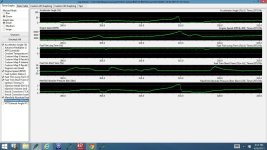
I have been tuning for the last three days straight, here is a screen shot of the fuel trims.
 

Attachments

  • 11153608_980792601939154_1744059192_o.jpg
    11153608_980792601939154_1744059192_o.jpg
    142.9 KB · Views: 415
I'm not saying it works or it does not... But every result I have seen indicates there is some gain in MPG. It's obviously not scientific results or even big enough gains to call it a breakthrough... but there does seem to be some improvement.

Everyone is really guessing on how the Toyta ECU works. It's not an open system like many others, so you really don't know unless you have access to the people who built it.

In fact, I think I read somewhere that the newer models actually use WB o2 sensors. If so, that would completely change things up, but I doubt that is the case.

In the end, I think this product changes the MAF curve. Which probably does lean it out a bit at WOT and throttle tip in. That is going to add some efficiency along with a little risk of detonation...

I don't know why people think they are so smart because they know a little science... and read a a few facts on the interwebs... For me, the more real world practical experience I get, the more I realize how wrong all the "experts" are. I learn to be more open minded every day. Especially when I'm dealing with "black boxes" that everyone assumes to know how they work.
 
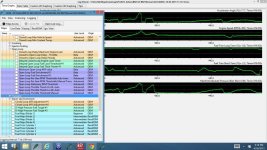
Some of the many open loop / closed loop parameters that can be adjusted in this particular 2015 ECU. The ECU's now days are very powerful!
 

Attachments

  • 11157050_980800448605036_1973678180_o.jpg
    11157050_980800448605036_1973678180_o.jpg
    147.7 KB · Views: 396
I'm not saying it works or it does not... But every result I have seen indicates there is some gain in MPG. It's obviously not scientific results or even big enough gains to call it a breakthrough... but there does seem to be some improvement.

Everyone is really guessing on how the Toyta ECU works. It's not an open system like many others, so you really don't know unless you have access to the people who built it.

In fact, I think I read somewhere that the newer models actually use WB o2 sensors. If so, that would completely change things up, but I doubt that is the case.

In the end, I think this product changes the MAF curve. Which probably does lean it out a bit at WOT and throttle tip in. That is going to add some efficiency along with a little risk of detonation...

I don't know why people think they are so smart because they know a little science... and read a a few facts on the interwebs... For me, the more real world practical experience I get, the more I realize how wrong all the "experts" are. I learn to be more open minded every day. Especially when I'm dealing with "black boxes" that everyone assumes to know how they work.

Well said... tuning ECU's is something I have been doing for a living going on 25 years now. I sell tuned maps for vehicles that cost the customer in the range of $750. Our Eco Block does not give near the gains as one of our tuned maps, but it does do the exact same things within the ECU only on a smaller scale. The price point is a lot smaller as well :)

The ECU is a computer so all it does is crunch numbers... It's all simple math, no magic and no science going on when it comes to tuning an ECU ;)
 
Last edited:
Everyone is really guessing on how the Toyta ECU works. It's not an open system like many others, so you really don't know unless you have access to the people who built it.

In fact, I think I read somewhere that the newer models actually use WB o2 sensors. If so, that would completely change things up, but I doubt that is the case.

I searched bosch for replacement O2 sensors for 2010 4Runner 4.0L.

It appears that there is a left and right downstream that uses a narrow band O2 sensor and then there is an upstream wide band O2 sensor.

If there is a performance boost in some category due to this product it could be as simple as placing the sensor in a cleaner air stream coming out of the filter box. Bottom line is that we don't know.

Interesting that Crawford's website now states "This product is intended for Off Road Use Only". I get about half my regular MPGs when in 4x4 mode :)
 
Most Japanese vehicles run on the leaner side from what I have seen (while some Europeans like BMW tend to be a bit richer), so leaning it too much further will probably result in thermal issues that could compound over the life of the vehicle. Also Toyota is extremely conservative when it comes to their focus of efficiency, the main goal of their vehicles is emissions and fuel economy; everything else is second in their design goals. The reality is your statement is only partially right under certain circumstances, if running "lean" was the key to additional power and MPG then high performance vehicles would not guzzle fuel down at WOT.

The Subarus were all tuned to around 11.0 to 11.5:1 at WOT while the BMW was tuned at 12.0:1 and some tuners were going up to 13.0:1. Direct injection allowed them to target more aggressive AFRs on the 335. The stock map on the Subarus had a target around 10.2:1 if I remember correctly. I'm not talking about running "lean", or on the borderline of safety, I'm talking about running less excessively rich. I realize what I'm saying is right only under certain circumstances, but it IS still right. Of course high performance vehicles are going to guzzle fuel at WOT, however with all other things being equal a 4runner with a 10.2:1 ratio is going to guzzle MORE gas at WOT than one at 11.5:1. The air flows aren't THAT much different, especially at the power levels we're talking about with the 4runner.

Like I said - all of those cars had better than stock fuel economy and better power, so it is achievable. I'd love it if someone would crack the ECU code and truly do some nice tuning to improve performance and fuel economy a bit (and remap the sluggish throttle sensitivity while they're in there), but that doesn't appear to be happening any time soon.
 
What I really don't understand is why people continue to post about non 5th gen Toyota 4Runners and not about the eco block in this thread.

We have Quirt posting how he is tuning an ECU on a non 5th gen Toyota 4Runner.
We have others posting about tuning ECUs on non 5th gen Toyota 4Runners.

Seriously we get it. If you custom tune an ECU you can do mobetter. That is not what this device does and no one is posting claims of custom tuning a 5th gen Toyota 4Runner in this thread!

I'm not posting what I've done, what I'm doing, or what I'm going to do on non 5th gen Toyota 4Runners in this forum. There are other sections of this site and the internet for doing so!

rant over
:driving:

If someone wants to address the wideband O2 sensor and ECU that applies long term trims to open loop operation on 5th gen Toyota 4Runners in relation to the crawford eco block, then I am all ears :)

I think it's exciting that a few folks are posting MPG improvements. I'd like to know total mileage with their new devices alongside their MPG numbers. :moon:
 
The upstream Lambda sensor is considered a wide band although it's not as good as the true wide band units we use for tuning, they are a little slow but do end up giving us a number to tune off of. The second down stream sensor is there to tell the ECU the condition of the cat only.
When doing a flex fuel setup, I / we remove the second Lambda sensor from the system and use that input for the flex fuel sensor and only have to shut off the DTC function so it does not throw a CEL. There is nothing else in the ECU that needs to be disabled by removing this sensor from the system.

I hope those of you reading this thread are learning from all the info that is being posted here by the various posters :)
 
Interesting that Crawford's website now states "This product is intended for Off Road Use Only". I get about half my regular MPGs when in 4x4 mode :)

Of course. It's pretty clearly emissions tampering. if it really reduced emissions it wouldn't need a disclaimer that basically says we know it's illegal - use at your own risk. What troubles me is then going on message boards and claiming otherwise hoping to (quite successfully) fool the ignorant.
 
Everyone is really guessing on how the Toyta ECU works. It's not an open system like many others, so you really don't know unless you have access to the people who built it.

In fact, I think I read somewhere that the newer models actually use WB o2 sensors. If so, that would completely change things up, but I doubt that is the case.
Pretty much every ECU operates in the same general way, Toyota is no different. The window dressing may differ, but the core ideas stay the same.

The front O2s are wideband, but a narrow wideband - if that makes any sense. From logging, I've found their range is ~0.8 lambda to 1.2 lambda. A true WB sensor runs ~0.5 to 1.5 lambda. Since the WOT lambdas drop below 0.8, the truck must run open loop, which I've verified while driving.
 

Members online

Forum statistics

Threads
278,312
Messages
3,554,086
Members
248,016
Latest member
Advally Service

Trending content

Back
Top