DESPERATELY NEED HELP! WONT START (long story/brief explanation)

Lol.... I'm a pretty humble dude and honestly just like being to help out here. I try to make it a point that I don't pretend to know everything and I definitely don't...... but I have a lot of resources, experience, and a general desire to get to the bottom of things.

Skimming over this thread the first time confused me... I thought it was being argued that a fail-safe is causing no compression on a few cylinders.

that is not the case.
_________

Now reading it over again it seems to be more of an argument of if a fail-safe of any sort exists on this engine.

Short answer.... Yes.

The models equipped with the electronic throttle bodies (like his 2002) have fail-safe mode programming for a few things. Mostly if it sees problem in the throttle position sensor or the like. It is there to limit throttle opening for well... obvious reasons. (there is still no engine oil failsafe)

__________

Something else I'm missing?
 
a fail-safe for say an overheated trans, that will shut down the vehicle if it gets too hot? or for coolant if it gets too hot, or too full/over filled?

or could an over filled coolant expansion tank cause the transmission to overheat triggering a fail-safe that would shut down a vehicle?

and if any fail-safe were to actually be triggered would it send a code to be stored in the ECU to be read at a later date for when a tech or anyone else hooks up to the OBD-II and ties to see what happened?
 
I think in this case the "fail-safe" is just being misunderstood.

If the transmission gets hot enough or is overfull either literally overfull or from heat expansion it can in some cases cause the SL solenoid in the valve body not to disengage causing stalling.

It's not a fail-safe however.... just not operating properly.

None of the 3rd gens have "fail-safes" or "limp modes" to the extent of later models. Some of the theories I've read through posted here about what the PCM/ECM does with information provided from the sensor inputs does exist but not to a great extent with any of the 3rd gens.

Before I speculate though I have a question for Mr. Slappy.

What did you bring your vehicle into the dealer for? Just to top off the coolant? Any other services performed?

Also what codes were stored during this failure?
 
Last edited:
hey smarty pants...

If you are so confident about the failsafes, please make a video of your truck with no oil in it and showing the motor shut off in it's failsafe mode.
(added 11/20. It may have been my Coolant Temp idiot light, but this does not change the fact that my engine did shut itself down to avoid damage).
Young man, my experience involved the A/T fluid temp gauge and on over-full coolant reservoir. Motor oil was not a variable. I don't reference motor oil.
If you look at my post #27, you can see that I am considering recreating the circumstances under which my engine shut down occurred. Because I think the A/T temp sensor was triggered not by overheating transmission fluid but by some false signal triggered by the overfull coolant reservoir, I think I will not cook and ruin the new tranny fluid i just installed. I would need to disconnect the transmission fluid lines from the transmission cooler I installed and reattaching them to the original radiator. This would be a nuisance but is doable.
Just so you know, it's is the contraction of 'it is', it's not the possessive form of 'it'.
 
Last edited:
I think in this case the "fail-safe" is just being misunderstood.

If the transmission gets hot enough or is overfull either literally overfull or from heat expansion it can in some cases cause the SL solenoid in the valve body not to disengage causing stalling.

It's not a fail-safe however.... just not operating properly.

None of the 3rd gens have "fail-safes" or "limp modes" to the extent of later models. Some of the theories I've read through posted here about what the PCM/ECM does with information provided from the sensor inputs does exist but not to a great extent with any of the 3rd gens.

Before I speculate though I have a question for Mr. Slappy.

What did you bring your vehicle into the dealer for? Just to top off the coolant? Any other services performed?

Also what codes were stored during this failure?
I went to buy some parts. I asked them to top up my coolant reservoir.
I do not recall any codes, but i can check my records and let you know in 2 weeks.
 
"Please, please tell me now" (Duran Duran)

I think in this case the "fail-safe" is just being misunderstood.

It's not a fail-safe however.... just not operating properly.

None of the 3rd gens have "fail-safes" or "limp modes" to the extent of later models. Some of the theories I've read through posted here about what the PCM/ECM does with information provided from the sensor inputs does exist but not to a great extent with any of the 3rd gens.
(added 11/20. It may have been my Coolant Temp idiot light, but this does not change the fact that my engine did shut itself down to avoid damage).
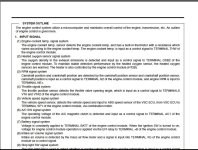
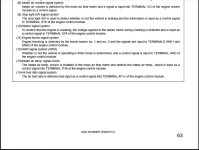
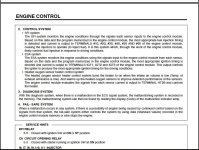
I am focussing on the Factory Wiring Diagram descriptions. Here are 3 screen shots.
This text breaks down the System into subsystems. The first subsystem described is the Coolant Temp System:
System Outline, 1. Input Signal, 1) Engine coolant temp. signal system. I believe my overfull coolant reservoir triggered the coolant temp sensor and caused the shut down, so this system would involved.
I see no reference to the transmission in any of the 14 subsystems listed. I have been saying my A/T fluid temp sensor idiot light was on but maybe I am mistaken in my recollection and the Coolant temp idiot light was on.
I see 4. Fail Safe System, which offers two ECM options if any of the 14 aforementioned subsystems malfunctions and such failure can lead to engine damage. One of the two options listed is stopping the engine. (can we agree the word 'damage' was lost in translation but should be inserted between "engine being" so it reads "engine damage being"?)
Can you tell me what this means if it does not mean there are fail safe systems which have the ability to shut down the engine to avoid engine damage?
I am not arguing with you. I am not refuting what you have said. I am asking for your help because I want to know. I need to know. I must know. Please, tell me so I know.
 

Attachments

  • FWD1.jpg
    FWD1.jpg
    131.8 KB · Views: 1,020
  • FWD2.jpg
    FWD2.jpg
    87.2 KB · Views: 1,018
  • FWD3.jpg
    FWD3.jpg
    135.7 KB · Views: 1,014
Last edited:
I might be way off track here but, wouldn't the oil pressure switch (if equipped) act as a fail safe of a sort? Did Toyota do anything like that in the 3rd gens?
 
Slappy, Your original assumption is off it seems to me. Assuming your coolant system is working properly even IF you overfill it and it expands it will not cause an overheating situation, it will just overflow. If it can't escape and pressurizes the system at most it would just blow a hose or seal. Still no overheating. Actually the extra pressure will just raise the boiling point even more. From what I can tell there's no way overfilling will cause any sensors to get triggered. Maybe it was your Batt light after the engine stopped that came on? The manual you're getting your info about failsafes from is for 2002 model year. The 01-02 models have VSC vehicle stability control which can affect certain systems based on safety concerns. Like Eaton has said I'm sure it's wired into the throttle body on those. Your 99 does not have this and that manual does not apply to yours.
 
i know this is gonna sound strange coming from me... but guys lets not start a poo slinging thread here or insult thread... i think there are some frustrations here, and some misunderstandings, but i dont think anyone here is unreasonable so lets not go down that road. i have been talking with slappy in PMs and im getting the impression that there is some use of terms and principles being twisted to try and suite a theory or conclusion -no offence and not trying to bash, thats just my take on things...

the point is being argued regarding something that happened to a 99 truck and using technical data from a 02... while most of the time id say yeah sure same same, but i think there are some other issues here that come into play. -ill be honest im not that familiar with 99 and newer trucks cause i have never owned one or played with one much. but i do know there are a lot of differences between the mid gen upgrade vehicles right down to window switches dont interchange and a lot of the wire harness is different ect. also between limited and base and sr5 there is a lot of differences. trying to reference something from a different vehicle to fit the vehicle you are working on is always hard.
 
Slappy, Your original assumption is off it seems to me. Assuming your coolant system is working properly even IF you overfill it and it expands it will not cause an overheating situation, it will just overflow. If it can't escape and pressurizes the system at most it would just blow a hose or seal. Still no overheating. Actually the extra pressure will just raise the boiling point even more. From what I can tell there's no way overfilling will cause any sensors to get triggered. Maybe it was your Batt light after the engine stopped that came on? The manual you're getting your info about failsafes from is for 2002 model year. The 01-02 models have VSC vehicle stability control which can affect certain systems based on safety concerns. Like Eaton has said I'm sure it's wired into the throttle body on those. Your 99 does not have this and that manual does not apply to yours.
Fundamentally I agree with you. A coolant reservoir has an overflow tube. Too much fluid too much expansion and it gets spit out. But the experience I had is what prompts me to ask these questions.
The Kid has pointed out that there is not a coolant temperature idiot light but there is a coolant temp gauge. I am confident my original recollection is correct and it was the A/T fluid temp idiot light.
I think nether the coolant nor the trans fluid were actually overheating. I think a sensor was (accidentally/falsely) triggered because of the higher level of coolant in the reservoir. I do not know how this could cause that to happen. The only commonality I can see between the coolant and the trans fluid is the radiator.
I do see that the FWD is for a 2002. I believe it is applicable to my 99 limited.
I need to go to the dealer and compare the 1999 FWD and the 2002 FWD, to see of the 99 FWD has the same description of the systems and subsystems.

Could some air trapped in the coolant system cause the cooling system to malfunction in some way? Could it hinder the coolant from properly circulating? Could an air bubble cause an abnormally hot spot which is read by the temp sensor, which then passes this extra high temp reading to the ECM or the coolant fluid temp gauge?
 
no air bubles will not affect the vehicle other than you might hear it in the heater core, but it would work its way out of the system back into the radiator and not cause any issues what so ever.
 
On the 1999 (and my 2000) the term fail safe is used in the following context:

example from 1999 FSM.

"If the ECM detects the DTC P0115 (Engine Coolant Temperature Sensor Circuit Malfunction), it operates fail safe function in which the engine coolant temperature is assumed to be 80°C (176°F)."

It is used again with several other scenarios, all of which are related to a trouble code. In some cases a safe assumed value for a failing sensor cannot be used and engine shutdown can occur. Again though that is really more of a stall related to component failure than a fail safe.

The term fail safe again is a way the engine continues to run not an immediate shutdown. It's commonly referred to as a limp mode because of the limited performance that is associated with it.

I don't dispute your vehicle died. And its easiest to assume it was related to topping off the coolant because that was the last thing done.

But in reality it could have been several things that intermittently occurred.
Without the freeze frame data (which is the engine data the ECM stores when setting a pending or current code). It's all speculation.

I overfilled my coolant overflow on my 2000 and drove to work today (30 miles) just out of silly curiosity. I didn't think anything would happen and nothing did (other than some coolant on the ground) but I just wanted to give it the old straight up no BS test lol.

Maybe someone smarter than me knows exactly what happened lol.
I'm just sharing what those terms mean in your case and how the system logic is used on these vehicles.

Without seeing the scan data at time of failure it's just impossible for me to nail exactly what was happening at that time and it's really just one for the X-Files.

Now where is Fox Mulder? :alien:
 
Last edited:
On the 1999 (and my 2000) the term fail safe is used in the following context:

example from 1999 FSM.

"If the ECM detects the DTC P0115 (Engine Coolant Temperature Sensor Circuit Malfunction), it operates fail safe function in which the engine coolant temperature is assumed to be 80°C (176°F)."

It is used again with several other scenarios, all of which are related to a trouble code. In some cases a safe assumed value for a failing sensor cannot be used and engine shutdown can occur. Again though that is really more of a stall related to component failure than a fail safe.

The term fail safe again is a way the engine continues to run not an immediate shutdown. It's commonly referred to as a limp mode because of the limited performance that is associated with it.

I don't dispute your vehicle died. And its easiest to assume it was related to topping off the coolant because that was the last thing done.

I overfilled my coolant overflow on my 2000 and drove to work today (30 miles) just out of silly curiosity. I didn't think anything would happen and nothing did (other than some coolant on the ground) but I just wanted to give it the old straight up no BS test lol.

First, I love that you topped up your reservoir as a test. Something about this has me chuckling. I would have been dumbfounded and elated if it had reproduced the event I described.

Second, I have no interest in diverting anyone else's further attention and energy towards my particular event. Maybe I will figure it out, maybe I won't, maybe I am forgetting something, maybe yadda yadda yadda.

Third, the reason I attributed the 3 successive engine shut downs to the overfilled reservoir is because I read some Googles about it. I had to to go 3 or 4 pages deep. Several results spoke of an overfilled coolant reservoir triggering the engine shut down and/or the A/T fluid temp light. I Googled on my phone as I sat in the stalled truck with the idiot light on. I removed some coolant from the reservoir, dropping the level a couple of inches below the full line. It never ever would have occurred to me that such a thing was possible had I not read about it (from more than one source). The most frustrating part of this whole thing is no matter how I vary my search terms I cannot find these. I know they exist because I read them. They are out there, somewhere…..

Fourth, I am interested in the more general matter of what 'fail safe' means as defined by Toyota. I appreciate your explanation. It is simple and clear. I understand the limp mode. Am I also to understand there is a second mode which will completely shut down the engine ("In some cases a safe assumed value for a failing sensor cannot be used and engine shutdown can occur")?
 
Last edited:

Members online

Forum statistics

Threads
278,316
Messages
3,554,120
Members
248,016
Latest member
Advally Service

Trending content

Back
Top