

jonorok
New member
Hey guys, last summer I needed to replace my clutch on my 99 runner. Reading all the write ups, I found people either buy a dedicated transmission jack, which was money I didn't want to spend, or they use the floor jack and 2x4 method. Everyone said that the 2x4 method worked, and they hated it and would never do it again. I did some brainstorming since I had to do this by myself, and had a different approach, halfway between these two ideas, and figured I found it really helpful, and perhaps I should share.
The transmission is cradled by the first cross member. I guessed that the center of gravity for the transmission was close to, if a little in front, of where the cross member attaches.
So, I supported the transmission on jack stands and some plywood, and removed the cross member.
I traced out three planes on the cross member that are important. The level plane, the plane that bolts on the driver's side, and the plane that bolts to the passenger side.
After this, I took a bunch of measurements and cut a frame of 2x4s to make a wooden support, identical to the cross member. I had a 10" plank forward from the frame to support the weight, along with a 1/2" bolt and a square of 1/2" ply to adjust the forward angle of the transmission.
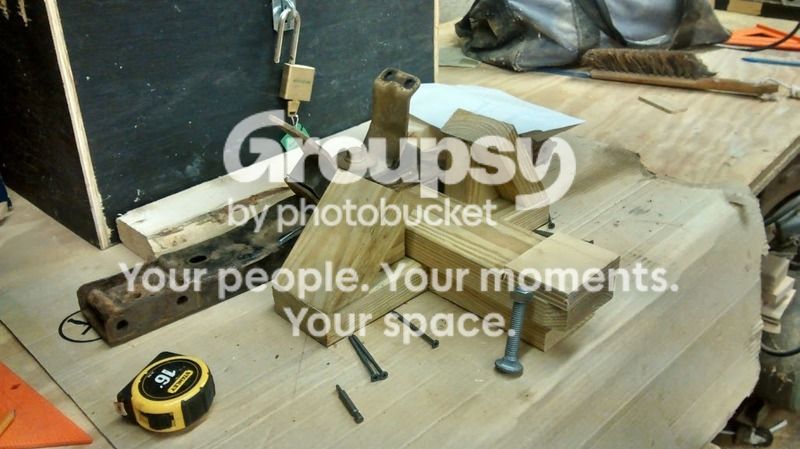
All I did was set the cradle on the floor jack, support the transmission and level the cradle, and then ratchet strap the transmission, cradle, transfer case and all, to the floor jack.


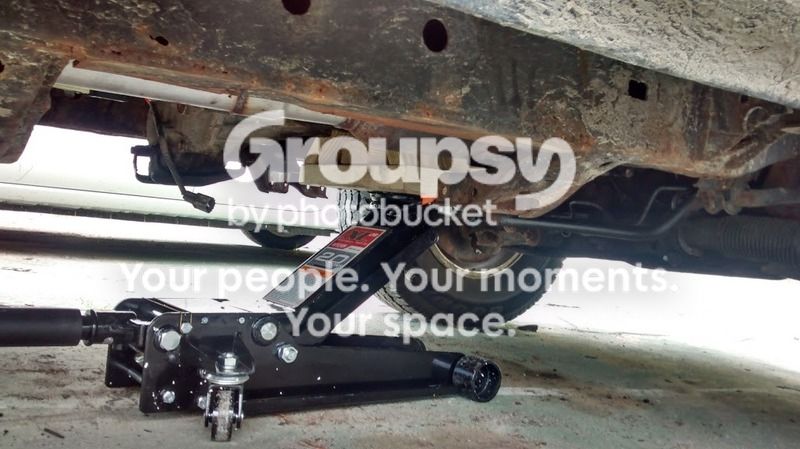
Once the drive shafts are removed and all the sensors are disconnected (don't forget the shifters!), I ratchet strapped the transfer case to the rear cross member. Using only me, I could slowly work the ratchet strap to pull rearward, and slowly lower the transmission to clear the bell housing, till the input shaft cleared. After that, I just lowered the floor jack to the ground, and rolled the transmission to the back of the truck so I could get to work! I don't have any pics of it out, though. I was busy working.
Getting it back on was still tricky, but again, I was by myself... I highly recommend a set of helping hands.
That, and I'm really glad I have the tall suspension! I hope this is helpful for someone. And if you're in lakes region New Hampshire, I still have the cradle if you want to borrow it.
- And if you read this much just to tell me I have a rust problem, I know. I call it "Rusty Runner."
The transmission is cradled by the first cross member. I guessed that the center of gravity for the transmission was close to, if a little in front, of where the cross member attaches.
So, I supported the transmission on jack stands and some plywood, and removed the cross member.
I traced out three planes on the cross member that are important. The level plane, the plane that bolts on the driver's side, and the plane that bolts to the passenger side.
After this, I took a bunch of measurements and cut a frame of 2x4s to make a wooden support, identical to the cross member. I had a 10" plank forward from the frame to support the weight, along with a 1/2" bolt and a square of 1/2" ply to adjust the forward angle of the transmission.

All I did was set the cradle on the floor jack, support the transmission and level the cradle, and then ratchet strap the transmission, cradle, transfer case and all, to the floor jack.


Once the drive shafts are removed and all the sensors are disconnected (don't forget the shifters!), I ratchet strapped the transfer case to the rear cross member. Using only me, I could slowly work the ratchet strap to pull rearward, and slowly lower the transmission to clear the bell housing, till the input shaft cleared. After that, I just lowered the floor jack to the ground, and rolled the transmission to the back of the truck so I could get to work!
I don't have any pics of it out, though. I was busy working.Getting it back on was still tricky, but again, I was by myself... I highly recommend a set of helping hands.
That, and I'm really glad I have the tall suspension! I hope this is helpful for someone. And if you're in lakes region New Hampshire, I still have the cradle if you want to borrow it.
- And if you read this much just to tell me I have a rust problem, I know. I call it "Rusty Runner."


