Do you drive with a gun?

Do you drive with a gun?

  • No and I would rather not

    Votes: 128 13.5%
  • No but I would like to

    Votes: 158 16.6%
  • No gun but I drive with a different weapon

    Votes: 60 6.3%
  • Yes I drive with a gun

    Votes: 479 50.4%
  • Yes I drive with multiple guns

    Votes: 126 13.2%

  • Total voters
    951
You mean like this?

hahaha perfect example! She's got me mesmerized :wow: :sniper:

Wow this thread is still going....I'd like to point out that since I started this thread, I have acquired 2 guns. Got a Browning Silver Hunter 12 gauge, its light and probably not for you hardcore enthusiasts but i'm happy with it for what I use it for, mainly skeet shooting. The gas action is flawless, I absolutely love it! Also got a great deal on a Ruger .22 for varment control.

Greats guns, happy to have them close by when sleeping at night but still don't feel the need to drive around with anything...maybe one day!
 
New owner here, but yup. Usually carry two guns. One on my hip and another one (throw down beater Glock) stashed somewhere in the truck.
 
So as I read through this it blows my mind. Some valid arguements on both sides...I am a free thinker. I look at whatever subject at as many angles as possible and make an informed decision. I own in the ball park of 10 guns and carry as much as often as possible. I am an Alaskan resident, so in my home state, I dont need a carry concealed, its legal for me to do so as a resident. I dont need anyone to validate my masculinity. Handguns will kill bears (.454 Casull does nicely) and bears are EVERYWHERE! I didnt always live in Alaska, I grew up outside of Chicago, where the laws were so strict only criminals really had guns. If you own a gun, you should shoot it regularly and practice, slow is smooth, smooth is fast. Twenty five feet is your decision maker also, through some rigourous testing, not by myself, although you should learn your individual distance. It has been tested and shown that you have to make a decision at 25 feet to shoot. The time an average person can sprint 25 feet is the time it will take you to draw and shoot. Individuals vary. The caveat to that is also, it should never leave the holster unless you intend on pulling the trigger. While some people carry knives(guns for show, knives for a pro), thats great if that is what works and thats what you are comfortable with. This is my recommendation to the masses, due to the fact that you will at a minimum do SOME damage if a struggle does insue. Less than 10% of the entire population of the world are hardwired properly to kill someone. I dont care who you are, psychology shows you will subconciously pull up and to the right and miss. This is due to a response in the brain known as Fight, Flight, Posture, or Submit. This is real.

Not everyone should carry a gun. I disagree with anyone that carries a gun based solely on the thought that it is truly an equalizer. Its not, spent many a hours learning disarms with blanks, and you have a solid chance of being disarmed and shot. Breaking the law is dumb, some rules are meant to be broken yes, some are here for the safety of you and those around you. Anytime I am pulled over, I inform the officer I am carrying so hes aware for his own safety. Not only that, but at that point you are no different than the man who bought a stolen gun from the guy on the corner and is carrying it around loaded. If you are underage/not able to own a gun/your state laws suck something terrible/are untrained, do everyone a favor, and dont carry. If you have ever been tazed or maced, you will understand that that is a wonderful supplment to carrying a pistol or knife. If I can avoid it for the rest of my life I NEVER want to be tazed or maced agin. Not to mention, if you can articulate to the police the threatening posture of the person. You are a lot less likely to go to jail over tazing or macing someone. If you do shoot someone, even if it is in self defense, almost every state will STILL take you to jail until everything is sorted.

If I hurt anyones feelings or offended anyone I apologize in advance. I try to root all my arguments in as much fact and common sense as possible.
 
Last edited:
I compete in USPSA and IDPA, so I train a lot with a shot timer. The whole "slow is smooth and smooth is fast" bushwa is just that -- bushwa.

Fast is fast, and the only way to get fast is to train at going fast, at times pushing yourself faster than you get good hits. One of the keys to going fast is to eliminate unnecessary movement.

But don't think for a minute that you will get fast by training slow.
 
I compete in USPSA and IDPA, so I train a lot with a shot timer. The whole "slow is smooth and smooth is fast" bushwa is just that -- bushwa.

Fast is fast, and the only way to get fast is to train at going fast, at times pushing yourself faster than you get good hits. One of the keys to going fast is to eliminate unnecessary movement.

But don't think for a minute that you will get fast by training slow.

You are missing the point of the phrase. Yes I agree, fast is fast, but slow is smooth, and smooth is fast.

You didnt start by drawing, finger on the trigger, dropping silohuettes immediately. It was a slow process, slowly getting the muscle memory down and making your actions smooth. After you have achieved smoothness of action, you can press on the gas and go faster through the motions. You do make a valid point though, and part of that inital slowly going through the motions is to eliminate time consuming movements. However, what I dont dont want is a loose cannon in the stack who just has no mechanics and is just trying to shoot fast. Everything you do is 90% technique first. Ever seen guys clearing a room? They dont start training at a run....thats how un-intended people get hurt. No disrespect either, but you are talking about a huge difference in what was clearly stated above. Anyone can shoot targets all day long....less than 10% of the population can pull the trigger on a person. Even after hundreds of hours of innoculation that statement still holds quite a bit of water.

So I guess you are correct in a huge way, if I want to competition shoot, I am going to press myself as hard as I can from the word go. I am ok with missing, because an errant round isn't going to hit some kid on his bike, or someones wife driving by. If my life is in danger, I want to neutralize the threat with as few shots as possible, without putting anyone else in danger. Not everyone will put the trigger time in needed to become that kind of a shot.
 
muscle memory

This.

Muscle memory is key. Practice doesn't make perfect, practice makes permanent, and if a noob starts training at speed he's going to train his muscles wrong. When I taught (not firearms, for the record) we always started slow, and we always used those exact phrases - "slow is smooth and smooth is fast" and "practice makes permanent". As students progressed, we'd push them to go as fast as possible and remain technically perfect - sometimes they'd push too hard on their own, and technique would suffer, and then they'd know where their boundary was and what they needed to do to get better. But I never ever encouraged a student to practice faster than their technique could support - that way lies sloppy technique and inability to execute actions in crisis.
 
I too compete in Practical Pistol and think you're missing the point of the statement. Speed does not come from the notion of simply being fast; it comes from repeatedly practicing motions at a slow enough speed that you ensure smoothness and fluidity. As the motions become familiar, they naturally become faster. You don't need to "try" to shoot faster, you just do. When I first started shooting steel, my on-target splits were around 0.48-0.50 seconds. Nowadays, I can usually squeak out a double X hit in the range of 0.24-0.26 seconds. I don't "try" to shoot faster and as a matter of fact, I try to record myself shooting every now and then just to simply prove to myself that I am shooting faster (because I feel like a slug!).

And for the record, Robbie Leatham uses the same "slow is smooth and smooth is fast" phrase...


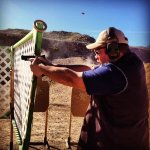
741296_591108380965264_652446831_o.jpg
 

Attachments

  • 741296_591108380965264_652446831_o.jpg
    741296_591108380965264_652446831_o.jpg
    135.5 KB · Views: 280
Interesting thread. The conversation about a 12 gauge and it's general lack of knockdown power is very revealing as to the total lack of experience and or testing done by individuals relative to weapons.

A shotgun is no way a long distance killer but it is the most effective tool for inflicting the most damage possible at less than 50 yards of all weapons available to the general public.

Buy some watermelons and do your own testing. A .308 on a watermelon at 50 years will take you some time to just see the entry and exit. With a 12 Gauge slug you will have a hard time finding the watermelon.

The beauty of those 9 little pellets at less than 25 yards is that all will hit the target and all will expend every ounce of their energy. You cannot say this about a 9mm round.

I have tracked many deer hit with a 30.06 round for hours on end, I have only tracked a few out of nearly a hundred with a 12 gauge slug. And on a number of occasions have had the deer do a back flip in its tracks and not move again with a 12 gauge slug.

The effectiveness of any caliber round is the ability to expend every ounce of energy at the distance of the target. There are not many cases in which a rifle round can do that under 100 yards.

If you carry less-than lethal solutions you had better use them before you decide to shot someone with a weapon or you will be in prison for a very long time. A jury and prosecutor will in nearly every case find that you had options to not kill the person and that you made the decision to KILL and not end the altercation.

Stop carrying the less-than lethal weapons or the gun. You should not carry both.
 
Yes I agree, fast is fast, but slow is smooth, and smooth is fast.

No. Slow is just slow. Slow and smooth is still slow. You only get fast by pushing yourself. Yes, you have to know the basics of the technique before you push yourself. Much of that pushing can (and should) be done in dry fire.

You didnt start by drawing, finger on the trigger, dropping silohuettes immediately. It was a slow process, slowly getting the muscle memory down and making your actions smooth. After you have achieved smoothness of action, you can press on the gas and go faster through the motions. You do make a valid point though, and part of that inital slowly going through the motions is to eliminate time consuming movements.

Of course you walk before you run. Yes, you have to eliminate wasted motion. But the only way to know how fast you can go is to go a little faster. You do that in practice, both dry and live fire, not in a match.

So I guess you are correct in a huge way, if I want to competition shoot, I am going to press myself as hard as I can from the word go. I am ok with missing, because an errant round isn't going to hit some kid on his bike, or someones wife driving by. If my life is in danger, I want to neutralize the threat with as few shots as possible, without putting anyone else in danger. Not everyone will put the trigger time in needed to become that kind of a shot.

Oh, please.

Action shooting teaches you how to tradeoff speed for accuracy and how to shoot in target time. Close easy shots can be taken very fast. Farther harder shots require more precise aiming. It becomes instinctive. I know the shots that I can make and I know the shots that I can't make. The shooting that I do is not just static, square range, flat on my feet. It is off balance, on move, sometimes in low-light with a flashlight.

I have shot police qualifying courses. They are pathetically easy. I have competed with police officers. While a few are good, most simply aren't and some are simply scarily unsafe. They aren't accurate and they aren't fast and they hit a lot more no-shoot targets than I do. The best law enforcement shooter that I know is outstanding. He was Special Forces and recently retired from the Federal Air Marshals. He is also an excellent action pistol shooter (at least USPSA master or grand master in production division).
 
Last edited:
I too compete in Practical Pistol and think you're missing the point of the statement. Speed does not come from the notion of simply being fast; it comes from repeatedly practicing motions at a slow enough speed that you ensure smoothness and fluidity. As the motions become familiar, they naturally become faster. You don't need to "try" to shoot faster, you just do.

I disagree completely. Simply doing the same thing doesn't get you significantly faster. Read Steve Anderson's book on dry firing:

Refinement and Repetition | Anderson Shooting

The basic idea is that you dry fire using a par timer. You start your repetitions with a long par time. But during each session, you keep lowering the par time until it is just faster than you can manage.

Ben Stoeger's books and Mike Seeklander's books teach the same thing. Set a par time for a drill. Then start lowering the par time.

When I first started shooting steel, my on-target splits were around 0.48-0.50 seconds. Nowadays, I can usually squeak out a double X hit in the range of 0.24-0.26 seconds.

My split times yesterday were 0.18, standard IDPA target at 7 yards. My splits are fine, but my draws are slow. I have to work on that. I used to shoot a 1911, these days I'm shooting a Glock and the difference in the grip and angle are such that it takes me a couple tenths more than it shoot to find the front sight.

And for the record, Robbie Leatham uses the same "slow is smooth and smooth is fast" phrase...

Robbie certainly knows his stuff. And while it has its point early on, I think you really do have to push to get faster -- a point that Grand Masters Ben Stoeger and Mike Seeklander made in the last two classes that I took.
 
Last edited:
I think you're trying to invalidate the "slow is smooth" approach by trying to apply it to all aspects of shooting and specifically being a competitive shooter. To quote you directly, you called it "bushwa", which honestly I had to Google to figure out what the heck that even meant.

Obviously there can be no "one phrase fits all", nor can the be a training approach that would apply to every shooter at every stage in their career. Training, progression through the sport, etc. is very dynamic and it needs to be. However, on a fundamental standpoint - the "slow is smooth" is a great approach to develop a new technique. It is also a great way to review techniques that are considered to be "mastered". I had some pretty impressive reload speeds for some time, specifically after I just switched from SS to Production. Well, I basically became all fingers and started slacking. I stepped back and slowed down during my dry-fire practice and really looked at what I was doing (sometimes I'd stop mid reload). I realized my grip on the mags were lackadaisical. Going back to the "slow is smooth" approach, I fixed my deficiency and went back on track. Simply lowering my par timer in this case would have not done anything but possible further reinforce poor habits.

To also say that doing the same thing won't get you significantly faster is also untrue. I do agree 100% in that it won't make you competitive and it is the reason that most B-ranked shooters and lower stay at that level - they don't push themselves to find that speed/accuracy tipping point (to which Robbie certainly finds and pushes in his advanced classes). There is value to the theory and it is simply another tool that shooters can and should utilize in their toolbox, even when they consider themselves "masters".

I do also agree that your "push the par" method is also very effective. While it does require solid fundamentals and some practical experience, it really is the only way I've been able to independently push myself to the next level in all disciplines. Using this method is how I've managed to get my 3Gun shotgun reloads down to sub 1-second/shell times (I'm still on the Load 4 method, but will try alternatives this winter).

Regarding your sub 0.2 second splits, I must say that is impressive. I couldn't manage two A-hits (sorry, I just realized I called them X-hits above - I've got F-TR on my mind this week!) sub-0.2 unless perhaps with a Limited gun in a minor power factor (shoot a 40 Major in both ESP and Production).

And you are correct. I get to shoot with a lot of LEO's and most (95%) are terrible shooters. The guys that come from Tempe SWAT are impressive, as is the older gentleman from the local station (who's also GM USPSA since the 90's), but for the most part they're horrible. Worse still, they often fumble very fundamental steps like reloading and finger-off-the-trigger.
 
[MENTION=6872]M1911[/MENTION] I will agree you have a lot of valid points from the perspective of a competitive shooter. I won't argue any of those because I don't shoot competitively. You do what you do and train how you do because it makes you effective, and give you the ability to succeed in competition. You are also absolutely correct about the vast majority of police competitions. No where you fail to understand what I have been placing on the table is something you are obviously not seeing, and cannot see, nor will you see. You see, I shoot fast, and accurate, and in competition. The last part of that is the key phrase, in competition. The stress you experience is the clock, not someone trying to take your life, or the life of someone in your family. Intangible stress. Can you push those times if someone is sprinting at you with a knife, or pulls a gun on you? Of course you will say you can, its natural, you can do it on a course. Why not with real people? What I am trying to tell you, is training to compete, and training for real life is different. I am sure a former SF guy can shoot, kind of a part of what they are trained to do. They also train that intangible that I speak of. You don't know when you are going to draw and fire, there is no anticipation. It has to be all reaction. Muscle memory....can you do it that fast without thinking about it? Thats where we learn slow is smooth, smooth is fast.....work the kinks out, then worry about your speed. So, I agree, you are correct, if you are shooting competition. However I will politely agree to disagree when it comes to a life threatening situation. People shooting back at you and or coming at you at full force to take your life changes the game, the rules and how your brain works. Oh, and since we are suggesting books. Read this little book called "On Killing", you may learn a lot.

Oh, and [MENTION=112450]RAWTAZ[/MENTION] just to clarify I wasn't saying carry both. I was simply stating that after some of what I read in here, and the psychology of it all. That there are quite a few who are better off carrying less than lethal.
 
Last edited:
I think you're trying to invalidate the "slow is smooth" approach by trying to apply it to all aspects of shooting and specifically being a competitive shooter. To quote you directly, you called it "bushwa", which honestly I had to Google to figure out what the heck that even meant.

Obviously there can be no "one phrase fits all", nor can the be a training approach that would apply to every shooter at every stage in their career. Training, progression through the sport, etc. is very dynamic and it needs to be. However, on a fundamental standpoint - the "slow is smooth" is a great approach to develop a new technique. It is also a great way to review techniques that are considered to be "mastered". I had some pretty impressive reload speeds for some time, specifically after I just switched from SS to Production. Well, I basically became all fingers and started slacking. I stepped back and slowed down during my dry-fire practice and really looked at what I was doing (sometimes I'd stop mid reload). I realized my grip on the mags were lackadaisical. Going back to the "slow is smooth" approach, I fixed my deficiency and went back on track. Simply lowering my par timer in this case would have not done anything but possible further reinforce poor habits.

To also say that doing the same thing won't get you significantly faster is also untrue. I do agree 100% in that it won't make you competitive and it is the reason that most B-ranked shooters and lower stay at that level - they don't push themselves to find that speed/accuracy tipping point (to which Robbie certainly finds and pushes in his advanced classes). There is value to the theory and it is simply another tool that shooters can and should utilize in their toolbox, even when they consider themselves "masters".

I do also agree that your "push the par" method is also very effective. While it does require solid fundamentals and some practical experience, it really is the only way I've been able to independently push myself to the next level in all disciplines. Using this method is how I've managed to get my 3Gun shotgun reloads down to sub 1-second/shell times (I'm still on the Load 4 method, but will try alternatives this winter).

Regarding your sub 0.2 second splits, I must say that is impressive. I couldn't manage two A-hits (sorry, I just realized I called them X-hits above - I've got F-TR on my mind this week!) sub-0.2 unless perhaps with a Limited gun in a minor power factor (shoot a 40 Major in both ESP and Production).

I wish the rest of my shooting was as impressive, but it isn't. I just haven't been dry firing anywhere nearly enough lately -- we are in the midst of a kitchen renovation. My draw times with the Glock are pathetic -- about 1.5 seconds at 7 yards. The grip angle is still screwing with me.

I think we are basically in agreement. When first learning a technique, yes you do it slow. But if you only concentrate on being slow and smooth you won't ever be fast. To get fast you have to push.

And you are correct. I get to shoot with a lot of LEO's and most (95%) are terrible shooters. The guys that come from Tempe SWAT are impressive, as is the older gentleman from the local station (who's also GM USPSA since the 90's), but for the most part they're horrible. Worse still, they often fumble very fundamental steps like reloading and finger-off-the-trigger.

That matches my experience.

I've shot with a number of police officers in matches and at classes, from the LA County Sheriff's Department, Nashua NH SWAT, Boston PD, small suburban forces, etc. The cops that I shot with were generally good, but they are gun guys who shoot in their spare time. Every one of them said that maybe 10% of the cops on their force are gun guys.
 
Code:
[MENTION=6872]M1911[/MENTION] I will agree you have a lot of valid points from the perspective of a competitive shooter. I won't argue any of those because I don't shoot competitively. You do what you do and train how you do because it makes you effective, and give you the ability to succeed in competition. You are also absolutely correct about the vast majority of police competitions. No where you fail to understand what I have been placing on the table is something you are obviously not seeing, and cannot see, nor will you see. You see, I shoot fast, and accurate, and in competition. The last part of that is the key phrase, in competition. The stress you experience is the clock, not someone trying to take your life, or the life of someone in your family. Intangible stress. Can you push those times if someone is sprinting at you with a knife, or pulls a gun on you? Of course you will say you can, its natural, you can do it on a course. Why not with real people? What I am trying to tell you, is training to compete, and training for real life is different. I am sure a former SF guy can shoot, kind of a part of what they are trained to do. They also train that intangible that I speak of. You don't know when you are going to draw and fire, there is no anticipation. It has to be all reaction. Muscle memory....can you do it that fast without thinking about it? Thats where we learn slow is smooth, smooth is fast.....work the kinks out, then worry about your speed. So, I agree, you are correct, if you are shooting competition. However I will politely agree to disagree when it comes to a life threatening situation. People shooting back at you and or coming at you at full force to take your life changes the game, the rules and how your brain works. Oh, and since we are suggesting books. Read this little book called "On Killing", you may learn a lot.

I've read Grossman several years back. Frankly, I wasn't that impressed. I think there is a fair bit that he pulled out of the air without anything to back up his opinions (and with a fair bit of counter evidence available).

As for training, I'm sorry but I really don't agree with you. Training teaches you to run your gun quickly and accurately while under stress. Is that stress the same as that of a gunfight? Of course not. But it is still stress and the more the better. I know that I can draw while moving, while standing up, while dropping to my knees, while moving to cover, while seated in a car, while wearing a cover garment, and do so quickly because I've done it, thousands of times. I know that I can hit my reloads quickly, whether flat footed behind cover or while on the move because I've done it, thousands of times. I know that I can clear malfunctions quickly because I've done it under stress.

Is competition the be-all and end-all of training? No, of course not. But it does add stress, it isn't square range, and our competitive instinct drives us to train more, and more training gets us better.

Here is Mas Ayoob, who has worked as a reserve police officer, explaining why he competes in IDPA, fast-forward to about 14 minutes.

https://www.youtube.com/watch?v=hC_VNi5ymo8

As Ayoob says, competition makes running of the gun second nature for us. We do it without having to think about it. If I'm ever in a gunfight, my mind will be busy thinking about the perp, cover, etc. I don't want to also have to think about the mechanics of running my gun.

If you haven't competed in action shooting, I suggest you give it a try.
 
Last edited:
This comment makes me wonder ....

Are you or have you ever been military or law enforcement?

Why are you so eager to kill someone?

What have you personally seen that has convinced you that every home intruder is there to physically harm your / family? I don't believe crime stats show that property theft is directly tied to physical assault or murder rates.

Now I will say that am not totally against Castle Laws ..

Is it all talk or what? --> meaning are you a cop that has seen horrors shaking you to this core? (that is how my uncle, an ex cop and ex recon marine sees the world; I believe him)

:hatsoff:
Sorry I was not monitoring this thread so I`ll answer with delay.
You bet I was in the military, trained with every weapon I can get my hands on.
are you saying that I should wait quietly when someone stealing my family belongins? or possibly kidnaping my kid? is it my duty to assume that a robber it`s just a robber and not planning any harm to occupants of MY home?
Luckily I don`t have to like you fine people of Kalifornia. I ask that person to identify himself and follow by my guts advice of the moment.
I don`t want to kill anyone but I will not hesitate if there no other option.
do I have to see my kid disappeared or family member throat slashed to justify self defence? **** no! and my state law permits me to stay my ground.
whoever braking in in people house in the middle of the night is asking to be shot.
 
USCCA

Check it out!

It's basically insurance for people that CC/open carry

I'm not a sales rep or anything, just spreading the word. They provide legal council and bail if you ever have to use your firearm.

Yes I carry, in the summertime it's a little .380 pea shooter that fits in my front pocket. It's not made for a gunfight, it's made for up close and personal contact and I know it will do the job if needed.
 
I don't leave a gun in my vehicle but I'm licensed to carry concealed in 38 states so I have one with me when I drive, especially when I travel.
 
USCCA

Check it out!

It's basically insurance for people that CC/open carry

I'm not a sales rep or anything, just spreading the word. They provide legal council and bail if you ever have to use your firearm.

Yes I carry, in the summertime it's a little .380 pea shooter that fits in my front pocket. It's not made for a gunfight, it's made for up close and personal contact and I know it will do the job if needed.

Pea shooter my A$$$...
I think that is one of my Favorite loads... might not be a .45.. but placed in the right spot.. the baddie will wish he picked on someone else.
 
^^^^lol^^^^

Truth be told...

The best, most effective gun to carry, is the one you have on you!
And that baby pretty much gets chosen every time. Now, if my journeys take me to the woods, then my .45 kimber is on my belt.
 

Members online

Forum statistics

Threads
278,313
Messages
3,554,090
Members
248,016
Latest member
Advally Service

Trending content

Back
Top