Downside of moving battery inside

cdrewferd

New member
So I'm thinking of running dual batteries soon. I was thinking of trying to relocate both to either where the stock spare was, or inside the cargo area in a storage setup.

Underneath would be easier, but not with getting a box that would protect it, but not breath. Pretty sure exposed batteries wouldn't do hood in deep water crossings, or snow and stuff being kicked up onto them.

In the cab is fine with me. I am going to build a set of drawers, and these could go in the space between the drawers and the back seats. Would make wiring harder as I might have to go through the body. Not sure how the battery would vent inside the cab though.

If I move the battery I would have a good spot for a dual ARB compressor for OBA.

What do you guys think?
 
Register to hide this ad
You could mount them inside but not without a little extra work. You would have to build a rack then seal them in a box that's only vented to the outside, maybe a rubber gasket lid for easy access?..
 
You will also want some really really big cables, if the run ends up being longer. You would need to research as to how big. I do know that copper prices are not cheap right now.
 
Use Odyssey batteries and you don't need to worry about venting issues. They are expensive but perfect for what you want.
 
Could try an AGM battery.
Welding cable works extremely well for battery relocation purposes, it is VERY flexible and high quality copper. I get mine at a place called Airgas in California, there may be a similar welding supply place near you.
 
Last edited:
I have always wanted to do dual battery inside of the rear of runner just because of easy mounting and the weight distribution. But my dad always always insist that I don't because he has a work van that has batteries mounted inside and he said the smell drives him crazy that it is the corrosion on the terminals. So I will probably be mounting them underneath near the spare tire location one day.
 
AGM batteries do not corrode terminals because they do not vent gasses. Which is why they would work perfect for the OP.


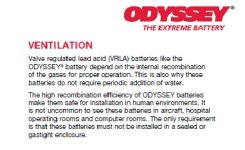
Straight from an Odyssey pdf:
 

Attachments

  • Odyssey ventilation.jpg
    Odyssey ventilation.jpg
    40.7 KB · Views: 1,393
Is there a specific reason you don't want to mount both batteries in the engine bay? Several guys have fit 2 in there by just relocating the tranny overflow reservoir and making/buying a custom battery mount bracket (easy sheet metal bending), it's a pretty easy mod.

High up in the engine bay should be fine for water crossings. If you are crossing water that is so high you need better than the stock location, then your battery is probably not the first thing that's going to get water logged and fail.

It sounds like you are trying to do too much mod to the point that you are going to make your rig worse. There's no reason to risk poisoning yourself; I mean honestly, how have 7 people responded to this post without questioning the sanity of possibly venting poisonous gases into the cab?

If it ain't broke, don't fix it.
http://www.toyota-4runner.org/3rd-gen-t4rs/63214-dual-battery-set-up.html
http://www.toyota-4runner.org/3rd-gen-t4rs/89245-dual-battery-setup-1997-4runner.html
 
Thanks everybody for the thoughts.

Is there a specific reason you don't want to mount both batteries in the engine bay? Several guys have fit 2 in there by just relocating the tranny overflow reservoir and making/buying a custom battery mount bracket (easy sheet metal bending), it's a pretty easy mod.

High up in the engine bay should be fine for water crossings. If you are crossing water that is so high you need better than the stock location, then your battery is probably not the first thing that's going to get water logged and fail.

It sounds like you are trying to do too much mod to the point that you are going to make your rig worse. There's no reason to risk poisoning yourself; I mean honestly, how have 7 people responded to this post without questioning the sanity of possibly venting poisonous gases into the cab?

If it ain't broke, don't fix it.
http://www.toyota-4runner.org/3rd-gen-t4rs/63214-dual-battery-set-up.html
http://www.toyota-4runner.org/3rd-gen-t4rs/89245-dual-battery-setup-1997-4runner.html

Yes, I know I shouldn't do regular batteries without sealing them and venting them outside. That's why I asked for thoughts. Yes, I know that I could fit them both in the engine bay, but then I don't have room for a compressor of any sort other than portable. I'm not trying to make this hard, just thinking of something different.

Since the Seard Diehard batteries are made by Odyssey, are they sealed as well and don't vent? If Odyssey is my only choice, then staying under the hood with regular batteries would be much easier, especially cost wise.

Thanks for all your thoughts, keep them coming.
 
Is there a specific reason you don't want to mount both batteries in the engine bay? Several guys have fit 2 in there by just relocating the tranny overflow reservoir and making/buying a custom battery mount bracket (easy sheet metal bending), it's a pretty easy mod.

High up in the engine bay should be fine for water crossings. If you are crossing water that is so high you need better than the stock location, then your battery is probably not the first thing that's going to get water logged and fail.

It sounds like you are trying to do too much mod to the point that you are going to make your rig worse. There's no reason to risk poisoning yourself; I mean honestly, how have 7 people responded to this post without questioning the sanity of possibly venting poisonous gases into the cab?

If it ain't broke, don't fix it.
http://www.toyota-4runner.org/3rd-gen-t4rs/63214-dual-battery-set-up.html
http://www.toyota-4runner.org/3rd-gen-t4rs/89245-dual-battery-setup-1997-4runner.html

I assume that's a typo?
and you meant coolant overflow?
 
Thanks everybody for the thoughts.


Yes, I know I shouldn't do regular batteries without sealing them and venting them outside. That's why I asked for thoughts. Yes, I know that I could fit them both in the engine bay, but then I don't have room for a compressor of any sort other than portable. I'm not trying to make this hard, just thinking of something different.

Since the Seard Diehard batteries are made by Odyssey, are they sealed as well and don't vent? If Odyssey is my only choice, then staying under the hood with regular batteries would be much easier, especially cost wise.

Thanks for all your thoughts, keep them coming.
couldn't you mount the compressor inside, where you're thinking of putting the batteries?
id think that would be a lot easier.
 
couldn't you mount the compressor inside, where you're thinking of putting the batteries?
id think that would be a lot easier.

Could, but the idea of running a compressor, even a small one, inside the vehicle doesn't make me very excited. Would suck if my 3yr old is sleeping and I need to fire up the compressor to air up the tires.
 
couldn't you mount the compressor inside, where you're thinking of putting the batteries?
id think that would be a lot easier.

Could, but the idea of running a compressor, even a small one, inside the vehicle doesn't make me very excited. Would suck if my 3yr old is sleeping and I need to fire up the compressor to air up the tires.

thats why you run the compressor in the spare tire location, thats what i did, and it works great- http://www.toyota-4runner.org/3rd-gen-t4rs/105400-rescue-runner-build-thread.html#post946825, its been back there for over two years and not a single issue, never skipped a beat, always comes on when i want it to ect. i think this is your best option. -i plan on putting dual spare batteries back there as well -dual yellow tops, and then use a red top just for the starting of the truck and the basics. everything else like the acc lights, winch, stereo, ect will be run off the two dual batteries. the plan is to do the CS144 upgrade so i have enough recharging power to keep them up and full, as well as have the dual yellow tops for reserve start-up if need be.
 
Is there a specific reason you don't want to mount both batteries in the engine bay? Several guys have fit 2 in there by just relocating the tranny overflow reservoir and making/buying a custom battery mount bracket (easy sheet metal bending), it's a pretty easy mod.

High up in the engine bay should be fine for water crossings. If you are crossing water that is so high you need better than the stock location, then your battery is probably not the first thing that's going to get water logged and fail.

It sounds like you are trying to do too much mod to the point that you are going to make your rig worse. There's no reason to risk poisoning yourself; I mean honestly, how have 7 people responded to this post without questioning the sanity of possibly venting poisonous gases into the cab?

If it ain't broke, don't fix it.
http://www.toyota-4runner.org/3rd-gen-t4rs/63214-dual-battery-set-up.html
http://www.toyota-4runner.org/3rd-gen-t4rs/89245-dual-battery-setup-1997-4runner.html

It was covered in the second post and then the OP was told to use AGM batteries.
Copy and paste below because I'm not that smart.

Why should you use an AGM battery?

• They are totally sealed against any type of leakage and classed as spill proof.
• Never need to check fluid level, ever! as previously stated they are recombinant.
• They can be mounted on their side or end to suit space or environment.
• They can be mounted inside your car, 4WD, caravan, camper or motor home, truck or marine vessel.
• They do not need to be in a sealed box vented to the outside.
• Because they have low internal resistance, they can be fully recharged at a lower voltage and accept a larger current (amps).
• From a standard car, 4WD or truck alternator they will recharge quickly from full use in about 2 to 3 hours. A deep cycle wet cell battery can take 8-12 hours to achieve only 70% to 80% of its potential charge.
• They can be drained (discharged) much deeper than conventional deep cycle batteries without any major damage.
• An AGM battery when left unattended will only discharge at a rate of up to 3% per month and even after 12 months sitting idle can be recharged and put back into full service with no ill side effects.
• A normal wet cell battery discharges at a rate of up to 4% per week. AGM batteries were originally developed for the military. They are designed and built tough, and will take an enormous pounding
 
Last edited:
questioning the sanAity

You ask this of a guy who grew up in the back seat of a VW squareback with the battery directly under my seat (rear seat) for the first 13 years of my life?

And it wasn't even an AGM!

I turned out okay... twitch, twitch :wacko:
 

Members online

Forum statistics

Threads
278,312
Messages
3,554,089
Members
248,016
Latest member
Advally Service

Trending content

Back
Top