Drive Train Fluids - Suggestions and Questions

dsfra

Member
I'm replacing the diffs, xfer case, and tranny fluids (30k miles on current fluids most of which were towing), and have a couple of suggestions and a few questions.

Tranny drain and check plugs - The 5 mm hex drive broke off trying to remove the check plug, but I was fortunately able to get it loose with a pair of smallish slip joint pliers. It was only torqued to 15 ft.lb., but that was 4 years ago, and it definitely wasn't in the mood to come out easily. I had bought 2 spare drain plugs and 2 spare check plugs when I first bought the vehicle, since it just felt like there could be problems with them sometime later. Bonus points for foresight. The drain plug has a nice big fat 14mm bolt head, so I plan to get rid of the 5mm hex check plug and use the 14mm plugs for both check and drain. Anyone know of any reason not to? Same threads, same thread depth, use same washers, same torque spec, same radius between the threaded section and the head of the plug. The only reason I can see that they are different is so they had room to stamp "CHECK" around the internal 5mm hex on the check plug. Might be a good idea to do this swap before you're stuck with being unable to get your 5mm check plug out. Just hope that no one later uses the drain plug as the check plug. Bad!
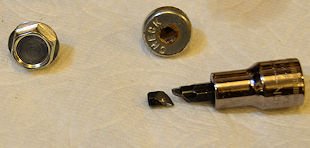
plugs.jpg

Front diff drain plug - this torques down to 48 ft.lb., and I thought I was going to snap my 18" breaker bar getting it loose. Anyone else run into this? I under-torqued it down to 44 ft.lb. with the new washer when finished draining. This (and the tranny check plug issue above) drives home the point that we really need to step away from that can of beer, get under the vehicle, and be diligent about fluid changes - need to make sure the plugs don't forget how to come lose.

Tranny fluid - Shortly after purchasing, I asked the dealer service department about flushing. "We have a special machine that does a pressure flush". Told him that I will want to do the drain-fill-run, drain-fill-run, drain-fill-run fluid replacement method. He said they never do that. Then I was in last week to discuss the driveshaft spline binding TSB, and luckily got hooked up with the "Service Drive Manager" guy who thankfully seemed to know what he was talking about. He said they do the drain-fill-run... method now - not pressure flush. He said he thought they do 3 drain-fill-run cycles and call it done. Anyone heard anything like this from your dealers? I picked up 3 cases of official Toyota WS ATF (for $6.99 per quart, many thanks to Mr. Haedt the Parts Manager at Kirkland Toyota), so have enough new fluid to do just about 10 drain-fill-run cycles, 5 now and 5 next time. Or 3 now, 3 next time, and 3 the time after that. Does anyone have reliable information about whether 3 cycles would be sufficient? Obviously, as you increase the number of cycles, you asymptotically approach 100% new fluid. Does anyone have a function that describes the relationship between number of cycles and percent of new fluid. It's been a long day, and my pea-brain can't handle it right now. On a related subject, pertaining to the "run" part of drain-fill-run: on past vehicles, i.e. ones that actually had a tranny dipstick and could be drained and filled without jacking the car up, it was easy to fill it appropriately using the dipstick and then drive it around for a while to get everything all mixed together, then pull it in and drain the fluid. With the 4Runner, you have to keep jacking it up and putting it on jack stands, a real PITA. So, any opinions on whether it would be reasonable to just let it run while up in the air on jack stands? Would want to let it run in each of the gears for a while. I think the point is to circulate the fluid, not so much to put it under load.

Gear Oil Capacity - According to Alldata, the front diff takes 1.6 qts, the xfer case takes 1.1 qts, and the rear diff (locker) takes 2.8 qts - total 5.5 qts. The previous time I did the fluids, I bought 6 qts and had .5 qts left over. This time, I bought 6 qts and I have a full quart left over. WTF? Anyone run into this before? I always stick my pinky into the filler hole before replacing the filler plugs, and my pinky came out covered in oil all 3 times. I let the oil ooze out of the filler holes for quite a while, and it sure looked like everything was full up. I have a good stash of new plug washers sitting around, so I guess I'll pull out the fill plugs and see if something is obviously amiss.

If anyone has any ideas to share about this stuff, please post replies asap - the vehicle is currently up on jack stands, and it really wants to get back down soon.

Thanks!
 

Attachments

  • plugs.jpg
    plugs.jpg
    27.2 KB · Views: 838
Last edited:
Register to hide this ad
Interesting points. I've never had a problem getting my drain plugs out - and I live in corrosion heaven. Not sure about others?

I do the diffs and t-case myself (Amsoil Severe Gear oil) - the capacities sound right. I wouldn't worry, as long as you can see/touch the fluid at the filler hole.

My tranny was just serviced at the dealer. They did the pressure method. I didn't know there was any other way. Haven't changed tranny fluid before other than the old Chevy's I used to drive. I'll have to look into the TSB you referred to and hope it's not going to affect me.
 
Wow, I wish I could be of more help buts its early and my legal addictive stimuli has not kicked in (caffenie).

Don't over think this.

There will be no issues with changing bolt head styles on the fill plug

I thought the Transmission was a sealed for life unit, but its been a while since I checked the manual. Changing it won't hurt anything and a 3x cycle seems more then enough and putting on my "eco" hat a waste of fluid....but coming from someone who's car gets 12-13mpg I won't be a hypocrite

Re-check the levels and if they are good don't worry about having a little fluid left over.

If you tow a lot several folks on here have installed aux. transmission coolers which is something you may want to consider
 
Update

Here's an update if anyone's interested...

I tried to pin down the dealer service department regarding pressure flush vs. drain-fill-run... fluid replacement. The service advisor confirmed that they definitely no longer do pressure flushes - only drain-fill-run... fluid changes - but nobody could explain why they no longer do pressure flushes. Specifically, they drain the old stuff out one time, fill it back up and call it done - it would "take too long" to do it more than once. I had all day and got the fluid for such a good price that I did it 5 times - don't know how close that got me to 100% new fluid, but I kind of got into the rhythm of the thing and actually enjoyed the last couple of cycles; got pretty good at messing around with the infamous temperature check mode business.

Just for fun, I kept track of how it went, correlating temperature check mode with indicated ScanGauge pan temperature and with IR thermometer readings at 7 places on the pan - at 55 degrees ambient temperature, hood closed, aux tranny cooler blocked off.


At the cool end of the check range:
=========================

Temperature check mode:
[D] indicator went from off to solid
104 degrees (per AllData)

ScanGauge indicated pan temperature:
96 degrees

IR thermometer readings:
90 at center of bottom of pan
92 at drain plug
94 at check plug
93 at first (i.e. bottom) 45 angle in side of pan
99 at 2nd (i.e. top) 45 angle in side of pan
104 half way up vertical side of pan
102 top flange of pan

After maybe 45 minutes at idle:
======================

ScanGauge indicated pan temperature:
111 degrees

IR thermometer readings:
103 at center of bottom of pan
104 at drain plug
106 at check plug
111 at first (i.e. bottom) 45 angle in side of pan
112 at 2nd (i.e. top) 45 angle in side of pan
122 half way up vertical side of pan (so hot cuz above fluid level? just measuring the air inside the tranny - not the fluid?)
117 top flange of pan

Much later:
========

Never got the [D] to blink - apparently it never got hot enough
Would have started blinking at 113 degrees (per AllData)
Of course, if the ScanGauge reads ~ 8 degrees lower than the Temperature check mode temperature, then when the ScanGauge is reading 111 the Temperature check mode temperature must be ~ 119, so the [D] should have started blinking, but it didn't.

========

Looking at a lot of data samples, there appears to be a consistent relationship between the ScanGauge and the IR thermometer. The ScanGauge and the IR thermometer read about the same when the IR is aimed about half way between the 1st and 2nd 45 angles in the side of the pan (passenger side, half way fore-and-aft along the pan).

And the mystery of the extra 1/2 qt of gear oil (as if anyone really cares): Turns out that instead of dumping the 1/2 qt of unused oil leftover from last time into the recycle can, it got mixed in with what I drained out this time. So I didn't really buy 6 qts and have 1 qt left over when done replacing the fluids - I bought 6 qts and had .5 qt left over when done plus the .5 qt left over from last time. That's what I get for turning 65, I guess.
 
Last edited:
Picking up my 2016 today so I have a little while before facing this. However I had similar issues on my 2001. Whomever specified hex head plugs needs a sentence to a deserted island for about ten years. The front diff was nothing but a mess. I would torque the hex to the specified torque (something like 28 ft lbs) and a year later I was jumping on a breaker bar. I did figure out that putting the front end on ramps gave me more space to apply leverage but there is zero reason to have a hex plug. A six sided bolt worked just fine on the other diffs and transfer case.
 
Tranny drain and check plugs - The 5 mm hex drive broke off trying to remove the check plug, but I was fortunately able to get it loose with a pair of smallish slip joint pliers. It was only torqued to 15 ft.lb., but that was 4 years ago, and it definitely wasn't in the mood to come out easily. I had bought 2 spare drain plugs and 2 spare check plugs when I first bought the vehicle, since it just felt like there could be problems with them sometime later. Bonus points for foresight. The drain plug has a nice big fat 14mm bolt head, so I plan to get rid of the 5mm hex check plug and use the 14mm plugs for both check and drain. Anyone know of any reason not to? Same threads, same thread depth, use same washers, same torque spec, same radius between the threaded section and the head of the plug. The only reason I can see that they are different is so they had room to stamp "CHECK" around the internal 5mm hex on the check plug. Might be a good idea to do this swap before you're stuck with being unable to get your 5mm check plug out.

I don't see anything wrong with the conversion for you but I may put the original 5 mm bolt back on before selling it. Looks like you are using a Craftsman 5mm hex socket. The newer Craftsman tools are made in China so I am not so sure about the quality - I am not saying all Chinese made tools are inferior. I would just spend the extra money and get the quality hex sockets - you only need two hex sockets for your 4Runner: 5mm and 10mm. Snap On hex sockets run about $10$15 a piece.
 
I don't see anything wrong with the conversion for you but I may put the original 5 mm bolt back on before selling it. Looks like you are using a Craftsman 5mm hex socket. The newer Craftsman tools are made in China so I am not so sure about the quality - I am not saying all Chinese made tools are inferior. I would just spend the extra money and get the quality hex sockets - you only need two hex sockets for your 4Runner: 5mm and 10mm. Snap On hex sockets run about $10$15 a piece.

Agreed - Craftsman has truly degenerated into Crapsman, sadly enuff.

And I was planning to put the 5mm hex plug back in when selling it. Buyer beware and all that, but there's no point in asking for trouble for the next guy.
 
If you're worried about plugs getting stuck, use some anti-seize on the threads. If you're worried about them coming loose, use a bolt with a head that is drilled for safety wire.
 
my guess is the scan gage is more correct than the Toyota light for the temp. 8 deg F is in the range of fluid temp/level. with a dip stick who measures the tranny fluid temp to have it exact ?

there are 2 tranny temp sensors so scan gauge could be reading the torque converter but I would expect the scan gauge to be reading higher than the pan. if so. I have been monitoring my tranny pan temps scan gauge and driving around those temps change very slowly esp if the air temps are around 40 deg F. then they lock in around 145 deg F... air temp 80 deg F they are 175 deg f but do not change much .. like parking the vehicle for 1 hr then start driving ..takes a long period of time for the pan temp to drop down on shutdown.

the diff's I removed the plugs had no problems but I was the only one to mess with them [no dealership messed with them] torque wrench did indicate proper torque. I only torqued them to 30 ft lbs. I also used the same metal washers. no leaks.

when I do the transmission I am dropping the pan . then fill with what came out plus 1/2 qt extra. then drive around the block 3 times put up on my leveling ramps and open the fluid check plug when at 110 deg F.

on the diff oil I rechecked the level after driving around a day.. I added 2 more OZ in the rear..

the gear oil does expand so that maybe why the amounts changed due to the temp of the gear oil.
 
Tip for those drainplug bolts. Tap them with a hammer before you go to loosen them if the are that stuck. They have crush washers so bumping it with a hammer will squish the washer some and they'll usually loosen up easier. Do the same thing with the diff plugs when then get a bit stuck (the copper washer on the front diff drain plug is probably the least compressible of the bunch, but it still works most of the time).
 
Tip for those drainplug bolts. Tap them with a hammer before you go to loosen them if the are that stuck. They have crush washers so bumping it with a hammer will squish the washer some and they'll usually loosen up easier. Do the same thing with the diff plugs when then get a bit stuck (the copper washer on the front diff drain plug is probably the least compressible of the bunch, but it still works most of the time).

Would it be safe to spray a small amount of a penetrating oil like pb blaster or aero kroil on drain plug bolts or is that something that shouldn't be done since those areas contain fluids?
 
Would it be safe to spray a small amount of a penetrating oil like pb blaster or aero kroil on drain plug bolts or is that something that shouldn't be done since those areas contain fluids?

over time these plugs do rust. so if you do not check these fluids every year or every oil change why not use a rust penetrating oil. better that damaging tools or the fill/drain plugs...

using a 6 point socket is best. wipe off the oil before unscrewing so less apt for the socket to slip. drain plugs will be removed less often so that washer can rust up and cause it to be harder to unscrew.

as was mentioned if hard to remove give it some light taps with a hammer..
 
Not sure if this is how you did it - but there is another method where you remove the trans cooler oil return line at the radiator and get to flush much more of the fluid than just draining the pan and refilling the 3-4qts it holds (even if you repeat the pan drain & fill procedure multiple times). I flushed like 12qts this way - and you will push a lot more of the old fluid out using this method (instead of just having it get all mixed with the new fluid)...

http://www.toyota-4runner.org/5th-gen-t4rs/139106-trans-fluid-drain-refill.html

That T4R.org thread (specifically MitchRobbins's post) also links to a thread with pictures on a Tacoma forum - I used that as my general guide. Used the same garden sprayer Mitch did, and used an old 5Qt Mobil1 oil carton to measure expelled fluid (you meter the input vs output and should end up close to perfect level this way). After 8qts is was looking pretty good, but was very clean after all 12qts made their way through...

:cool:
 
Not sure if this is how you did it - but there is another method where you remove the trans cooler oil return line at the radiator and get to flush much more of the fluid than just draining the pan and refilling the 3-4qts it holds (even if you repeat the pan drain & fill procedure multiple times). I flushed like 12qts this way - and you will push a lot more of the old fluid out using this method (instead of just having it get all mixed with the new fluid)...

http://www.toyota-4runner.org/5th-gen-t4rs/139106-trans-fluid-drain-refill.html

That T4R.org thread (specifically MitchRobbins's post) also links to a thread with pictures on a Tacoma forum - I used that as my general guide. Used the same garden sprayer Mitch did, and used an old 5Qt Mobil1 oil carton to measure expelled fluid (you meter the input vs output and should end up close to perfect level this way). After 8qts is was looking pretty good, but was very clean after all 12qts made their way through...

:cool:

It's not a bad method and doesn't really make a big difference in the long run (long story short, it's less about getting "every spec of bad fluid out", which is impossible, and more about replenishing the fluid and the fluid additive packages), but it is still important to perform the fluid check procedure when you do either method. I know a lot of these guys want to say "oh it's perfect every time" but there's a lot of variability (hose length, original fluid level in the vehicle, difference in fluid going in and fluid coming out, fluid temperature ect.) in that method that can lead to overfilled/underfilled when your done. The other drawback to that method is you may raise the transmission temperature above the fluid check temperature, which means you'll need to let it sit for hours before you can even check the fluid level.
 
It's not a bad method and doesn't really make a big difference in the long run (long story short, it's less about getting "every spec of bad fluid out", which is impossible, and more about replenishing the fluid and the fluid additive packages), but it is still important to perform the fluid check procedure when you do either method. I know a lot of these guys want to say "oh it's perfect every time" but there's a lot of variability (hose length, original fluid level in the vehicle, difference in fluid going in and fluid coming out, fluid temperature ect.) in that method that can lead to overfilled/underfilled when your done. The other drawback to that method is you may raise the transmission temperature above the fluid check temperature, which means you'll need to let it sit for hours before you can even check the fluid level.

Exactly. What people don't realize is, in any closed system, there is going to be areas that, unless disassembled on a bench, will never have fluid drained from them.

Take a simple hydraulic cylinder that has two hoses attached that are ten feet long. The simplest closed loop circuit. Pressurize the rod end and it fills with fluid. Now pressurize the base end of the cylinder and it now fills with fluid. Cycle it a few times. Now try to drain out all the fluid! It cannot be done without disassembling the circuit! Why? The difference of volume between the base end and the rod end will never be drained unless the hoses are disconnected at the cylinder.

Now, my above example is the simplest circuit. A transmission is much more complex but my point is there are places within the transmission that will do the same thing. ALL the old fluid will never be drained or replaced. [MENTION=66389]BlackWorksInc[/MENTION] point of additive replenishment is spot on. That's the most important because eventually the old and new fluids will mix.
 
Does anyone have reliable information about whether 3 cycles would be sufficient? Obviously, as you increase the number of cycles, you asymptotically approach 100% new fluid. Does anyone have a function that describes the relationship between number of cycles and percent of new fluid.

Asssuming the transmission holds 12 qts total (FSM is somewhat ambiguous, but that's close), and you drain and replace 4 qts each time you do it, then the percent of new fluid is given by the following formula

100*(1-(8/12)^N), where N = number of times you drain/fill.

Example. 1 drain and fill. (8/12=.667)

%new fluid = 100*(1-.667^1)=33%

Example: 3 drains and fills

%new fluid = 100*(1-.667^3) = 70%.

And so on... Takes about 6 cycles to get to 90%.

My plan going forward is to do a drain-fill at each oil change for the next 3 changes, and then every 3rd oil change after that. That should pretty much turn over the fluid every 100K miles, which for my driving model (<2000 miles of light towing/year) should be adequate.
 
Last edited:
If you're worried about plugs getting stuck, use some anti-seize on the threads. If you're worried about them coming loose, use a bolt with a head that is drilled for safety wire.

I did that on the front diff on my 2001 which needed the hex wrench. It didn;t make any difference the next time. I used a torque wrench per the manual and the next time I was still jumping on the breaker bar. It was literally like some gremlin came into the garage and torqued it down to 100 ft lbs...
 
Front diff drain plug - this torques down to 48 ft.lb., and I thought I was going to snap my 18" breaker bar getting it loose. Anyone else run into this? I under-torqued it down to 44 ft.lb. with the new washer when finished draining.

48 ft-lb sounds high for a drain plug. My 4th gen manual calls for 36 ft-lb rear and 29 ft-lb front. I rarely put a torque wrench on plugs like that - you can feel when they're as tight as they want/need to be, and they don't like being over torqued. I've never had a drain plug fall out unless it was just put in finger tight.
 
99 % of the time people strip the fill and drain plugs is because they don't have the socket on square , if you look at the end of a socket they are beveled for a few mm and the plugs are so short there is not much grabbing on , I took a 15/16 6pt and ground it down until it was into the actual socket area . and use this for plugs , as for the front drain I use antisizee on the threads and torque to 45 . Make sure you tap allen head socket in with hammer all the way first .
 
beviled edge i speak of , grind a 6 pt socket nice and square until that bevil dissapears , much less chance of rounding plug head
 

Attachments

  • image.jpg
    image.jpg
    136.2 KB · Views: 220
Last edited:

Members online

Forum statistics

Threads
278,311
Messages
3,554,082
Members
248,016
Latest member
Advally Service

Trending content

Back
Top