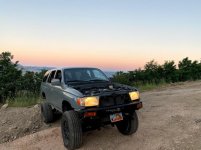
Driving in Extreme Heat with Heavily Modified Rig (Heavy)

mtbtim

Elite Member
Hey Dudes, I have a question for anyone who has a heavily modified rig, meaning lots of extra weight added to it. My 98 has front and rear CBI bumpers, dual swing-out in the rear, winch up front. I have a full belly of skids including a gas tank skid and rear diff skid. I also have a Gobi Style roof rack that was built heavier than a Gobi. I figure conservatively I’m carting around an extra 700 lbs all the time. I’m on 33” tires with 4:30 gearing.

What I have noticed is the extra weight makes the engine work much harder than my stock 2000 which has literally no mods other than different springs in the rear. If the ambient temps are moderate, it’s no big deal. When I start driving in the 90,s and into the 100,s my engine temp starts to spike under a load. I just did a drive from Zion to Bakersfield and I was driving in 110 - 117 degree heat. My engine was not liking it at all especially on any grade. I had my wife and mom in the rig with me and we were loaded down with gear for camping. So, my rig was extra heavy. There were times the only way I could get the temps down to a reasonable level is I had to turn the heat on full blast, turn the AC off and I could get the temp to drop down to around 203-208. I never broke 210. If I was oblivious of what my engine temp was by relying on the stock analog gauge, no doubt in my mind I would have overheated my engine big time. We saw lots of people on the side of the road who looked like they overheated their engine. Carnage on every sustained grade.

So, for you guys that maybe live in a hot area like Arizona, are heavily modified like I am, and you monitor your temps with either a scan gauge or phone app, what kind of temps are you seeing when driving in extreme heat and you’re loaded down with gear? I know my CBI bumper restricts some air flow through the radiator due to it’s design and also the winch restricts air flow as well. My cooling system is sound. Fan clutch, radiator, and thermostat have all been replaced. I do plan on re-gearing to 4:88 which I know will help. I’m wondering what else I might be able to do. I’ve heard the Champion radiator might allow me to run cooler. If you have any suggestions, I’d appreciate reading them.

Thanks!
 
Register to hide this ad
Hey Tim, love your vids and the info you document for the community.

Your post makes me feel pretty lucky, as only now am I getting ready to proactively replace my rad, and it's the first time I've thought about the cooling system at all in my truck. I also have an extremely heavy build with full armor, and crossed the scales at 5620 with a full camping load, full tank of gas, and me in the truck. I don't have a scangauge or anything, but I never noticed my temps getting out of hand, but I also didn't think to look at it. I don't have to contend with triple digit heat around here, but I'll have to plug my obd scanner in next time it's a hot day and see what my temps look like.

It's kind of an extreme idea, but I'm curious how effective it would be if you rerouted (or added an aux wiper bottle/pump) your wiper nozzle tubing to secondary nozzles aimed at your radiator and used a blast of fluid to bolster the efficiency of your radiator. Obviously it wouldn't last long if you sprayed continuously, but if you noticed temps spiking during a climb, you could proactively spray a bit to stay ahead of the extra heat load, etc.

Now I'm curious, I might have to try this at some point.
 
Never thought I'd see the day Tim would be asking us for help!
My first thought would be methanol or water injection but I'm not sure how much you'd really get out of it without running some boost, but they do drop temps. As far as I know rotaries are the only n/a engine that sees major benefits from it but it may be worth looking into if you haven't already. Though I can very easily see the maintenance required would be a bit tedious and a turn off for most.
I bet running a quality electric fan would benefit you too, then it could really pull some air whenever needed instead of being limited by the crank. Or maybe a bunch of that radioactive looking "super cool" coolant you always see next to the liquid aluminum, if you're redneck enough :eyebrows:
 
It's kind of an extreme idea, but I'm curious how effective it would be if you rerouted (or added an aux wiper bottle/pump) your wiper nozzle tubing to secondary nozzles aimed at your radiator and used a blast of fluid to bolster the efficiency of your radiator. Obviously it wouldn't last long if you sprayed continuously, but if you noticed temps spiking during a climb, you could proactively spray a bit to stay ahead of the extra heat load, etc.

Now I'm curious, I might have to try this at some point.

Thats a unique idea. But I feel it wouldn't really help, as I feel the water would just simply, fly through the radiators fins going highway speeds. If somehow the fins of the radiator would somehow capture the moisture and let it absorb somehow, I can see something there.

Tim, have you looked into upgrading the thermostat to a stant 170 degree thermostat? I have read about this helping a few people with aftermarket bumpers. I was thinking of doing this with my Savage front end, but I'm rarely driving in 117 degree heat. I'm usually poolside under a canopy sipping on a cold one.

On a side note, before you turned your heater full blast, what temps were you seeing? Is 220 still on the safe side for our engines, or is the limit 210 before we should turn the heater on?
 
I don't think that's solvable. You can tweak things but aside from the front bumper and winch issue it seems like a fundamental limitation to me. Using a normal vehicle for hot weather trips or taking it very gently through deserts while trying to get to mountain states seem like the only real solutions to me.
 
Thats a unique idea. But I feel it wouldn't really help, as I feel the water would just simply, fly through the radiators fins going highway speeds. If somehow the fins of the radiator would somehow capture the moisture and let it absorb somehow, I can see something there.

Tim, have you looked into upgrading the thermostat to a stant 170 degree thermostat? I have read about this helping a few people with aftermarket bumpers. I was thinking of doing this with my Savage front end, but I'm rarely driving in 117 degree heat. I'm usually poolside under a canopy sipping on a cold one.

On a side note, before you turned your heater full blast, what temps were you seeing? Is 220 still on the safe side for our engines, or is the limit 210 before we should turn the heater on?

I forgot to mention that I am running the Stant 170 degree thermostat. It does seem to help a little, but when the weather gets really hot, it doesn’t do much.

I have heard 230 degrees is kind of the danger level but I could be mistaken. The highest I’ve seen is 215 driving in Los Angeles on grades in 110 degree heat. I think 220 is still safe but you’re really starting to push it so that’s why I set the limit for my rig at 210. I was purposely driving 50 mph with overdrive off, heater on full blast, and windows rolled down so I didn’t kill my mom and wife. When the highway got flat or downhill, I cranked the AC, closed the windows and enjoyed it until the next grade. Nevada is much hillier than you think especially when you’re in the situation I was in driving up steep grades in 117 degree heat.
 
Last edited:
I don't think that's solvable. You can tweak things but aside from the front bumper and winch issue it seems like a fundamental limitation to me. Using a normal vehicle for hot weather trips or taking it very gently through deserts while trying to get to mountain states seem like the only real solutions to me.

You may be right. I was just glad I had the knowledge I have and was monitoring the coolant temps closely with the Torque Pro app. I know the air restriction from the bumper and winch is having an effect on the cooling efficiency but the big culprit in my opinion has to do with all the weight I’m hauling around. The re-gear will help, but how much is the question.
 
An electrical fan might help because it's constant air flow. Also the engine doesn't have to turn the clutch fan so it will lessen the load on the motor even though it might not be significant. [MENTION=168172]sleepydad[/MENTION] has a champion aluminium' radiator with a electric fan set up and he mentioned in his video that he hasn't seen temps higher then 190's.
 
I think that the E-fans would help more than you’d think.
Cause then you’d be getting rid of the original fan and fan clutch and in turn removing load off the engine.
And you can wire the fans to your temp sensor so that you don’t have to worry about remembering to turn them on or off.
Upgraded radiator and e fans I think will be plenty honestly.
Or try the fans first just to see how much difference it makes.
 
Hmmm...I said that because you mentioned Zion, so I was like "well, how often do you do Bay Area to Zion or to Salt Lake in summer."

However, I assume you are set up with those mods for the rocky Sierra Nevada trails and boy is the drive between the Bay Area and the mountains for a weekend trip nasty slow and tedious (which I guess helps with temps but it is also very hot in the middle).

So I see your problem now. To do the rocky trails you need those mods and those trails are summer trails. In addition to what [MENTION=50279]spartacus[/MENTION] says, is it realistic to get good money for that CBI bumper and get a lighter solution? Do you use the winch, especially in summer?

As for the exact temps...I don't know that I would be too afraid of 220 from time to time. Our Subarus on I-17 Phoenix to Flagstaff in summer do 220-230 easily at the speed limit of 75. The final climb to Flag is very long. My H6 5EAT transmission was getting north of 250 like it is nothing when moving spiritedly on long dirt road climbs. I stopped after 250 and let it idle. I don't know what temps the 4R gets; my device is not reading its transmission and I have not looked at the coolant either. But it has much better cooling system than a Subaru, that's for sure.
 
Last edited:
An electrical fan might help because it's constant air flow. Also the engine doesn't have to turn the clutch fan so it will lessen the load on the motor even though it might not be significant. [MENTION=168172]sleepydad[/MENTION] has a champion aluminium' radiator with a electric fan set up and he mentioned in his video that he hasn't seen temps higher then 190's.

That might be the way to go. I’m going to check out his video.
 
I have only had experience getting my 4Runner hot with a blown head gasket, 2 cracked heads, low coolant, universal green coolant, and a faulty dash ground making me not believe it was as hot as it was. That being said, I don't think the dummy gauge went above 1/3 until it was already vapor-locked and majorly overheated. It went from the operating temperature mark to above the hot mark in the span of 20-30 seconds. I idled it briefly and shut it off. Unfortunately, it got so hot that it burned 4/6 plugs up. I would second that your engine would have suffered severely had you only watched the factory gauge.

That being said, I have been a part of solving a few cooling issues (Those damn Jeeps). A few possible solutions I could see would be:

-Coolant type and properly flushing the coolant system every few years. This has always made the largest impact. You do amazing maintenance, so I doubt this is going to be an issue for you. We saw differences in 100+ degree weather anywhere from 8-15 degrees just by switching the Jeeps from the universal green to the Toyota Pink/Red coolant.

-Stant 14077 (170 degree thermostat) is the go-to for the supercharger boys. I have never run this, but they speak of a few degrees improvement in cooling versus the factory 180 degree thermostat. Correctly clocking the thermostat has made a noticeable difference for people on here too (I believe the theory is that it does a better job of burping air out of the system).

-Colder spark plugs. It is not the solution to your problem, so I do not think you should start with this. But if you are not planning to make any changes, it will slightly improve how the vehicle runs when those engine temperatures start to get too high.

-High-quality full synthetic oil in the correct viscosity for your area. If you do not burn or leak oil like crazy, the reduction in friction will make almost everything in the engine produce less heat. There are tons of other benefits you will find with this, but that is not what this post is about. I would recommend that you watch Project Farm's oil tests to see which one would suit you best.

-New radiator cap and radiator hoses. Your symptoms pretty much guarantee this is not your issue.

-Cleaning, flushing, filling, and properly sealing the overflow system (clamps, overflow lid hose, and the hose on the radiator) This is also not your problem. You would know it is if the overflow tank had dropped below the fill line.

-Testing the water pump. Safely testing this way requires the thermostat to be removed. This test is something I do to make sure I am not needlessly throwing money away on unnecessary parts. Make sure the vehicle is completely cold before trying this. Take the radiator cap off, start the vehicle, and run back to the radiator. You should see the coolant slowly + steadily moving from the passenger side to driver's side. Revving the vehicle up slowly should produce an increasing rate of flow to match the RPM.

-Cutting relief holes in the CBI for better airflow. Don't do it!!!!!!

-Champion radiator. You have a lot of extra strain on your vehicle. Normally the factory cooling system would be enough to accommodate for that, but the CBI bumper is seriously restricting your airflow. It probably doesn't make much of a difference in low-speed/idle cooling, but it will harshly restrict the cooling capacity of the radiator when you hit those higher speeds. My guess would be that the thicker, 3-row radiator would bring you right back to where you need to be.

A word of caution: There is such a thing as running the cooling system too cold. High load at low temperature will wear the engine out exponentially quicker. This was a problem we had in my buddy's WRX. He put a 3 inch 1000+ hp endurance racing radiator in his bone-stock "Hawk Eye." The coolant temperature was running < 150 at 70 MPH. We could not even get the thermostat to open until the engine was already overheating. Blocking a huge portion of that radiator off was our temporary solution until he decided to swap the factory radiator back in.

-The wrong/emergency way to "fix" the overheating issue.
Step 1) Yank the A/C condenser and any of the other fancy crap in the way of the radiator out (I was lucky, the previous owner already did this step for me. Rest in peace Mr. Wallet).
Step 2) Pull the hood off the vehicle. You don't need a hood when you live in the hood, right?
Step 3) Pull the skid plates, grille, and fender liners (Thanks again, PO).

I don't know who would be foolish enough to do that :shrug:
Best overheating solution.jpg

In all seriousness, if this was me I would try a combination of the stant thermostat, Champion Radiator, a rigorous triple cooling system flush (test the water pump during the second flush), and switch to a synthetic oil that better meets the high demands of 110-120 degree heat.

What is the lowest temperature your vehicle is going to be seeing? My '96 would not hit operating temperature unless I ran the vehicle >3000 rpm for 15+ minutes after my rebuild. My cooling system was set up way too efficiently with the combination of no thermostat and all of the crap in the picture above done to it.
 

Attachments

  • Best overheating solution.jpg
    Best overheating solution.jpg
    134.4 KB · Views: 569
I think the gearing will help the most, it will basically give your truck more torque and will be able to climb hills much easier.
 
Last edited:
How is the front end airflow over the radiator with the bumper compared to stock? I’m not familiar with the design but is it restricting air flow in combination with the weight?

In my experience the electric fans are nice in that they can run all the time if you wish and you can adjust when then trigger. But in general they are more fragile and prone to failure than the comparatively simple stock setup. Maybe try to find one with pretty robust blades and what not. Haven’t some people dropped in the fans from a Taurus or something?
 
Tim,
I don't live in AZ, so I can't speak directly from that experience. But I do live in NC where we see extremely humid 95-100 degree summers.

The probable and unfortunate answer is an expensive one- re-gearing. I went from 3.91 (15" wheel base SR5) to 4.88's.

My coolant temps with the old gears hung around 193-198 (which is normal!).
With the 4.88's, I'm rarely if ever over 188 degrees, even in the dead of summer while wheeling with low airflow.

I'm thinking that with your weight + 33" tires, your truck is simply working way too hard to stay at speed.
 
That might be the way to go. I’m going to check out his video.

[MENTION=50279]spartacus[/MENTION]

I spent last last summer in the sand dunes. Nothing I have seen so far can cause temp spikes like the sand dunes. your working the rig hard all the time and ambient temps in the sand dunes... well have you ever burnt your feet walking on hot beach sand?

the champion Rad has an extra gallon of capacity over stock so that is a huge part of it's cooling bonus.

Don't cheap out on a namby pamby fan controller. I know there is a fine line between aero space level stuff and my truck but; no not really. my truck is aero space quality, I would drive it to the moon if possible no questions asked.

I feel a new sick mods vid in the works?
 
Though not the 4runner, I have discovered things about hot weather driving since moving back to AZ three years ago.
I work in the hottest part of AZ (126° yesterday). My commute includes a 12 mile, 6% grade.
My 68 Ford gets really hot (hasn't overheated, yet) when I drive home in the afternoon.
I've added a larger radiator (width) and recently had it recored to a 3 row. It has an 18" electric fan that was held on with the plastic tiles through the core. Fine for paved streets, but not where we now live (primitive dirt roads). The fan is going to destroy the new radiator. So I made some sheet metal brackets to support the fan by the radiator frame.
It worked well, but ran just a tiny fraction hotter (according to the OEM, 50 year old, analog gauge). So I decided to make a fan shroud that supported the fan and draw air through the entire core. It worked splendidly! Sort of. Consistent temperature around town and at idle. Climbing "the hill" not so much. The fan just couldn't move enough air at highway speeds. It ran hotter on "the hill".
So I made a new mounting bracket out of rebar (teaching myself to weld). This securely supports the fan to the radiator frame and allows airflow at speed. The fan kicks on when needed and draws through the 18" circle in the middle of the core.
Here's my fan mount progression:
fan alone, mounted through radiator
2370674f9ce611bc2fe20f4deeb7a6b2.jpg

Sheet metal side brackets
976f6cddd0b935c1044ccef2f280b93d.jpg

Full shroud (cake pan)
62c2ec416f4d7f7ccf1e797ad7e555b9.jpg

Final rebar, redneck solution
b249ff59991cb98e13798f7454bbeb52.jpg

Yes, 126° yesterday
9e64ee7ac758d9ea97fd5ef66305a1eb.jpg
 
Last edited:
I forgot to mention that I am running the Stant 170 degree thermostat. It does seem to help a little, but when the weather gets really hot, it doesn’t do much.

I have heard 230 degrees is kind of the danger level but I could be mistaken. The highest I’ve seen is 215 driving in Los Angeles on grades in 110 degree heat. I think 220 is still safe but you’re really starting to push it so that’s why I set the limit for my rig at 210. I was purposely driving 50 mph with overdrive off, heater on full blast, and windows rolled down so I didn’t kill my mom and wife. When the highway got flat or downhill, I cranked the AC, closed the windows and enjoyed it until the next grade. Nevada is much hillier than you think especially when you’re in the situation I was in driving up steep grades in 117 degree heat.

Have you tried cleaning your condenser? They can get clogged up and restrict airflow to the radiator.

One thing to consider when switching to electric fans is the additional electric load required. There is still a load on the engine in the form of increased load on the alternator. You may need to upgrade your alternator in order to keep up with the demand. There's no such thing as a free ride.

The Koyo or Champion radiators are a thicker radiator core (advertised 33% thicker) which will greatly increase heat transfer. Combine that with a 170 degree thermostat, fresh coolant with water wetter, and a properly functioning fan clutch and I don't see a reason for electric fans. I don't think Koyo or Champion have provisions for an internal transmission cooler, and they may require a different radiator cap.
 

Members online

No members online now.

Forum statistics

Threads
278,316
Messages
3,554,121
Members
248,016
Latest member
Advally Service

Trending content

Back
Top