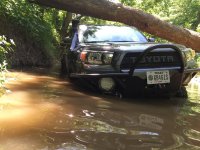
Driving through water

Sphonaut

New member
I own a 2015 4runner trail edition. Driving through deep sand, mud and water requires a fluid change according to the maintenance manual.
But what is the definition of "deep" ?
At what height of water do we have to change our transmission, transfer and differential fluids?
Center of the wheel? Up to the step bar?

I am looking for a guide line, you never know what the future brings.

Thanks Adrian
 
Register to hide this ad
I don't see why it needs to be changed if it hasn't gotten contaminated. I think they mean that it needs to be changed sooner if you drive in these conditions frequently.
 
if your differential was submerged I would change the fluid.

My 4th gen diff. blew up shortly after a water crossing.

I would suggest get some breathers if you plan on doing it again.
 
If you submerge the top of the diff in water, you should replace it immediately, unless you have a diff breather relocation kit or hose or aftermarket breather like this one:
140207-1-KIT_trail-gear_creeper-breather_ID_LR.jpg


And even if you don't submerge it completely, it would be wise to change the oil out as soon as you get back. There's no real way to check if you got a little or a lot of water into the diffs without actually pulling the drain plug, as no amount of staring into the fill hole will make you confident enough to say its clear of all water!

If you're doing this more than twice a year, it would just be cheaper and smarter to get the relocation kit and not worry about it again!
 
With no mods... Any time the rear diff is submerged you need to worry.

If you relocate the diff breather for the rear, you should be OK several inches above the bottom of the doors (almost to the top of the fenders) if you keep moving. Water is always risky (even with a snorkel....)

I'm pretty sure the breathers for the front diff and ADD, transfer case... are all routed in the engine bay up to a height near the top of the fender wells (similar to the air box) If you need more height than that you are in a full swamp situation anyway... A snorkel will avoid a hydro lock of the motor, but if you are in water deep enough to need it other things are going to go bad pretty fast anyway. I still may end up with a snorkel for dust reasons....

BTW, I have my rear diff breather converted to a two way and relocated into the gas cap filler area. The stock rear breather is a one way and causes a vacuum to form in the diff and water to suck in around the gasket when submerged in cold water. Not a big deal of you change the fluid soon after.
 
Last edited:
There is a max fording depth for these, I seem to remember something between 14-18 inches. However even is shallow water as mentioned above, your diff can suck water in if submerged quickly. The diff is warm from driving, quenching it in water cools the inside down creating a vacuum and pulling water in through the breather.

Even with a snorkel, there is more to worry about in water than just The intake. Like wet carpet.....ask me how I know.
 

Attachments

  • image.jpg
    image.jpg
    137.5 KB · Views: 5,729
Last edited:
Bah this thread reminds me I need to get off my lazy butt and install a rear diff breather hose on my 4Runner...


I agree! Now I need to change my diff fluid and get a breather hose for mine too. I've been going in some pretty deep mud the past month. I'm not in it for vary long but I am sure it doesn't take long to cause damage.
 
The wading depth spec for a fifth gen is 27 inches. That's above the top of your wheel rims.

On my Land Rover Discovery the spec was the same. On it all of the breather tubes (both differentials, the transfer box and the transmission) were routed to the top of the engine firewall just behind the engine intake manifold (about 40 inches above the ground. I would imagine the Toyota does the same thing although I haven't found it yet.
 
The wading depth spec for a fifth gen is 27 inches. That's above the top of your wheel rims.

On my Land Rover Discovery the spec was the same. On it all of the breather tubes (both differentials, the transfer box and the transmission) were routed to the top of the engine firewall just behind the engine intake manifold (about 40 inches above the ground. I would imagine the Toyota does the same thing although I haven't found it yet.

Yes, but not for the rear diff. Toyota decided to be stupid about that one and do a one way valve to save a few bucks. Oh wait, they never make any design flaws (must just be my own ignorance again) LOL.
 
The wading depth spec for a fifth gen is 27 inches. That's above the top of your wheel rims.

On my Land Rover Discovery the spec was the same. On it all of the breather tubes (both differentials, the transfer box and the transmission) were routed to the top of the engine firewall just behind the engine intake manifold (about 40 inches above the ground. I would imagine the Toyota does the same thing although I haven't found it yet.

The Toyota rear diff breather port is not tubed to a high point. Look at the link for installing a breather tube. You'll see the safe depth for emersion is much lower than 27". The point is somewhere on the diff', between 10" and maybe 18", or the height of the diff.
http://www.toyota-4runner.org/1721720-post13.html

I need to do this too. Great thread. Thanks to the person who linked it here.
 
Yes, but not for the rear diff. Toyota decided to be stupid about that one and do a one way valve to save a few bucks. Oh wait, they never make any design flaws (must just be my own ignorance again) LOL.

Thanks; I didn't know that.

Is that one way valve on top of the third member or along the top of one of the axle housings? That should put its height about 20 inches or better above ground level.
 
Thanks; I didn't know that.

Is that one way valve on top of the third member or along the top of one of the axle housings? That should put its height about 20 inches or better above ground level.

Its up on the axle housing, but the sudden vacuum can suck in water around the 3rd member seal. That is the lowest point on the vehicle.
 

Members online

Forum statistics

Threads
278,306
Messages
3,554,045
Members
248,016
Latest member
Advally Service

Trending content

Back
Top