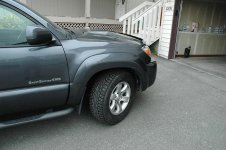
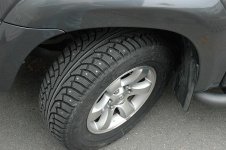
failing in the winter

I appreciate all the responses, so I will try to answer the ones that need it:

Corrado,
I'd reserve judgment before writing off either the tires or the 4Runner. Maybe you can report back at the end of winter with more of your impressions.
This is my 2nd winter on the tires, I replaced the oem rubber after the first few big storms last year and was never impressed w/ their performance over the 45k mile old oem's.

The best thing to do when stuck on a slick spot in the parking lot - tires were warm when parked, melted snow and then froze - is to put in R and get out and push.
Actually when I parked it, i had only gone a mile up the access road super slow on a cold motor. no way the tires were that warm. Plus, I was parked in a parallel spot, so no pushing.

But I also feel like you can't blame the 4runner. VSC is the only electronic nanny that gets in the way and you could have locked the center diff and then been fine. Traction control on the T4R is a good thing. Without it your truck's front/rear diffs are open which is asking to get stuck.
I'm not wanting to blame the 4R, just trying to be as objective as possible. Like I said, locking the center diff was the first thing I did when it wouldn't move, and after that I could feel the power transfer L to R, but it couldn't move me more than a few inches, and not nearly enough to pull forward out of the parallel parking spot. Also like I said, all my other 4x4 trucks had open F&R diffs and I never had a problem rocking them out of similar situations. I agree trac control can be good, but I also feel very strongly like sometimes you need some old school wheelspin techniques to save yourself. I would never describe it as "asking to get stuck" considering I have never been stuck in a traditional 4x4 configuration w/ open f&r diffs.

I would only point out that, rather than an all-season, the performance in question is of an A/T, which should close some of the gap.
That is what I originally thought, but after feeling the oem tires vs. the "snowflake" A/T tires in successive days of snow and ice, I now don't feel that way. I actually think the bigger tread blocks and larger voids hurt slippery conditions and only slightly help in deep fresh, dry snow.

But here is a thought: go to the TireRack website and pull up a pic of the Wrangler and a Revo II. You'll notice that the Revo has alot more siping and varying tread design. The Revo has perhaps more than 100% greater siping.

Just a consideration if you are thinking a single set of tires is better for you, perhaps consider the various tires on the market that may offer better performance in these conditions.

As I said, I always thought the revo "looked" like a better winter design, but since the wrangler SA's were "severe snow rated" and the revos were not, I figured the SA's had to be better. That was my attempting to get a single set of tires that offer better performance in winter conditions. Seemed logical to me at the time..

If you want the best performance in snow and ice, then get a snow tire.
Was trying to avoid that, but looks like its the only way to get what I need.
 
Last edited:
Was trying to avoid that, but looks like its the only way to get what I need.
When you think about it, over time, the only real expense is the second set of wheels. When your winter tires are mounted, your summer tires aren't being used, so they will last longer.

The expense can be minimized if you shop for a used set of wheels. I found a fellow selling a set of like-new OEM 4th gen alloys. With shipping, I think they cost me less than $400.

One pain is that you have to put on your winter wheels and tires in the fall, and take them off in the spring. The 4Runner wheels and tires are heavy. I don't mind changing the tires on Mrs. M1911's Mercedes C-class, as those are light. But the 4Runners are just a pain in the back.

The benefit of snow tires is that you get around a 30% increase in stopping and turning performance (along with added traction going up hills).
 
I have general grabber at2 for a while now and the are great in snow and ice. They have the snow flake rating and I have never felt like I was out of control. I live in Maine so we get ice and snow. They are cheap and last forever! They do have a lot of road noise but totally worth it. Some say the are hard to balance bit at $115 a tire you can't beat it in my opinion.
 
I would only point out that, rather than an all-season, the performance in question is of an A/T, which should close some of the gap.

That is what I originally thought, but after feeling the oem tires vs. the "snowflake" A/T tires in successive days of snow and ice, I now don't feel that way. I actually think the bigger tread blocks and larger voids hurt slippery conditions and only slightly help in deep fresh, dry snow.

Yeah, it's weird. That particular tire seems to have less siping than many A/Ts. It certainly doesn't add support to the idea that the snowflake is a very useful indicator. I see now that Silent Armor received a "poor" ranking (lowest) for ice braking in the 2008 Consumer Reports A/T tire tests. Could have saved myself some writing if I had dug that up earlier.

It sounds like dedicated winters are what you want and, given your experience, you might not want to go down the A/T path again but, just as an FYI, Consumer Reports recently had another tire test covering most categories. For A/Ts, looking at just the snow and ice traction measurements, the top performers were: Kuhmo Road Venture KL78 -- Hankook Dynapro ATM -- Nexian Roadian ATll. As you might expect, scores were higher for snow than ice, but all three received a "good" ranking for ice braking and "excellent" for snow. That's a 3 and 5, respectively, on a 5 point scale. As you also might expect, each tire has noticeably more siping than SA.

ATtiresiping.jpg~original
 
Ugh, Consumer Reports, terrible reviews.

its really not that difficult, dedicated snow tire is best, pic your brand.

or a goot A/T, preferably one with snow cert/symbol, they usually have more siping.

or stay home.

tires are usually purchased with cost in mind as well, most snows you can get decently cheap if you watch in the summer. spare rims are easy to drift across.
 
Yeah, it's weird. That particular tire seems to have less siping than many A/Ts. It certainly doesn't add support to the idea that the snowflake is a very useful indicator. I see now that Silent Armor received a "poor" ranking (lowest) for ice braking in the 2008 Consumer Reports A/T tire tests. Could have saved myself some writing if I had dug that up earlier.

It sounds like dedicated winters are what you want and, given your experience, you might not want to go down the A/T path again but, just as an FYI, Consumer Reports recently had another tire test covering most categories. For A/Ts, looking at just the snow and ice traction measurements, the top performers were: Kuhmo Road Venture KL78 -- Hankook Dynapro ATM -- Nexian Roadian ATll. As you might expect, scores were higher for snow than ice, but all three received a "good" ranking for ice braking and "excellent" for snow. That's a 3 and 5, respectively, on a 5 point scale. As you also might expect, each tire has noticeably more siping than SA.

ATtiresiping.jpg~original
Comparing the "best" A/T - A/S tires in regards to snow & ice capabilities, and observing their sipes compared to dedicated snow tires, like the Hankook i-Pike RW11 (which I have), the General Altimax Arctic, and the Bridgestone Blizzaks below..... You can clearly see the drastic difference in siping with the dedicated snow tires. Like was already mentioned, the only up-front cost is a 2nd set of wheels, which can be found cheap. The tires will last twice as long, since you'll be swapping out between 2 sets each year (summer/winter). And remember, the other main factor is the softer rubber compound that you don't get with A/T - A/S tires

hankook_IPikeRW11.jpg

general_altimaxartic.jpg

Blizzak2.jpg
 
Ugh, Consumer Reports, terrible reviews.

its really not that difficult, dedicated snow tire is best, pic your brand.

or a goot A/T, preferably one with snow cert/symbol, they usually have more siping.

or stay home.

Kind of an awkward time for you when the 2008 CR report predicted the subject of this thread.
 
Comparing the "best" A/T - A/S tires in regards to snow & ice capabilities, and observing their sipes compared to dedicated snow tires, like the Hankook i-Pike RW11 (which I have), the General Altimax Arctic, and the Bridgestone Blizzaks below..... You can clearly see the drastic difference in siping with the dedicated snow tires. Like was already mentioned, the only up-front cost is a 2nd set of wheels, which can be found cheap. The tires will last twice as long, since you'll be swapping out between 2 sets each year (summer/winter). And remember, the other main factor is the softer rubber compound that you don't get with A/T - A/S tires

All true, of course.

There isn't one way to do it. In the end it's about what the OP wants and you may have noticed some lingering reluctance on his part to go to two sets of wheels. He apparently knew at purchase time that the SA A/T wouldn't give him dedicated snow tire performance but expected it to be closer than it turned out to be.

I was simply pointing out that the A/T he thought he was getting, originally, may in fact exist.

No one is arguing for an A/T as a straight performance replacement for dedicated winters.
 
  • Like
Reactions: TSO
All true, of course.

There isn't one way to do it. In the end it's about what the OP wants and you may have noticed some lingering reluctance on his part to go to two sets of wheels. He apparently knew at purchase time that the SA A/T wouldn't give him dedicated snow tire performance but expected it to be closer than it turned out to be.

I was simply pointing out that the A/T he thought he was getting, originally, may in fact exist.

No one is arguing for an A/T as a straight performance replacement for dedicated winters.
Hey man, that wasn't a "shot" at you... I wasn't trying to argue a point against you. I only recently "learned" about winter tires... always heard of them, but was never actually "schooled" as to their development and/or purpose. I was just trying to provide an aspect that may have been overlooked or ignored.

:hatsoff:
 
There isn't one way to do it. In the end it's about what the OP wants and you may have noticed some lingering reluctance on his part to go to two sets of wheels. He apparently knew at purchase time that the SA A/T wouldn't give him dedicated snow tire performance but expected it to be closer than it turned out to be.

I was simply pointing out that the A/T he thought he was getting, originally, may in fact exist.

No one is arguing for an A/T as a straight performance replacement for dedicated winters.

Exactly! On the audi sport sedan, I didn't mind having 2 sets of wheels/tires. I had awesome summer performance w/ low profile 17" performance tires and awesome winter performance w/ oem 16" wheels and snow tires. When I made the switch to an SUV, I already sacrificed summer spirited driving. So I wasn't as willing to bother with 2 sets of wheels because I no longer would be getting "the best of both worlds" regardless. I figured I could save myself a little $, some time, physical labor, and storage space, by finding a compromise A/S, A/T tire that would be fine on dry roads, fine for moderate off-roading, and acceptable in the winter.

I agree with J.B. that the other 3 tires he posted all look superior to the SA's in terms of winter tread design with more siping, and way less area of smooth, flat rubber blocks.

Hopefully someone else in my position can read this thread and learn a thing or 2. The SA was regarded here as the pinnacle of winter performance for an A/T tire. Most of that was probably due to the snowflake rating. Maybe now, someone else will opt for the hankook dynapro and be more satisfied than I was. Maybe they will opt to buy a more reasonably priced A/T tire (I was willing to spend some $ on the SA's mostly due to the snowflake rating), and a 2nd set of snows as well. The more info we have, the better off we all are. I just wish I made a less frustrated and more direct title to better get the info out... :ybrick:

thanks again
 
I personally like the Wrangler Silent Armors and just had a set put on last month. Now I live in Oklahoma and we don't typically see harsh winters, but the wet and dry performance of the tires is far better than that of the OEM duellers. I also have an '05 Jeep Rubicon with the more aggressive Wrangler MT-R and they are wonderful in deep snow and icy conditions.
 
In Alaska we like Nokian Hakka's - available in studded and non studded. Uber $ and worth every dime.
 

Attachments

  • DSC_0003.jpg
    DSC_0003.jpg
    135.1 KB · Views: 1,477
I agree with J.B. that the other 3 tires he posted all look superior to the SA's in terms of winter tread design with more siping, and way less area of smooth, flat rubber blocks.

Hopefully someone else in my position can read this thread and learn a thing or 2. The SA was regarded here as the pinnacle of winter performance for an A/T tire. Most of that was probably due to the snowflake rating. Maybe now, someone else will opt for the hankook dynapro and be more satisfied than I was. Maybe they will opt to buy a more reasonably priced A/T tire (I was willing to spend some $ on the SA's mostly due to the snowflake rating), and a 2nd set of snows as well. The more info we have, the better off we all are. I just wish I made a less frustrated and more direct title to better get the info out... :ybrick:

thanks again
Well, really we are back to one tire being better at one thing, and another being better at another. The SA's as pictured have significantly more gap for gripping in snow than the others pictured, so while they have less sipes and may perform more poorly on ice, they may very well be considerably superior in heavier snow conditions. The driver recognizing the conditions and adapting to them is probably a better defense in very icy conditions, as any A/T will not be great.
 
Not really that noisy on snow and ice. naturally on dry they are clicking along. I always figure it's better to be loud and safe than peaceful and compromised...but that's me.
 
I thought about this thread on Friday as i drove up to VT for a little weekend getaway. As I drove onto route 89 from route 93 in New Hampshire the road conditions deteriorated significantly, with a small amount of blowing snow, but mostly just roads completely covered in black ice. Traffic generally slowed to about 40 miles per hour or so and both sides of the road were littered with cars in the ditches and ravines. There was a truck out salting, but it was going so slowly, that people generally just passed it and continued on.

Anyway, the point is that the Silent Armors performed fine on ice, when driving for the conditions. My traction control never even came on, nor did my ABS. I drove generally sensibly, keeping up with the faster flow of traffic and down shifting on the downhills. Who knows what would have happened if I'd had to slam on my brakes,probably would have lost traction somewhat, but short of studded snows, that would haven happened on that kind of road with any tire.

I also pulled easily out of a parking spot that was glare ice on a slight downhill between two cars without any difficulty whatsoever and only broke the tires free for a little fun after i was out.

Just thought I would share, since it seemed germane.

p.s. It was -12F yesterday when I woke up and the 4Runner ran perfectly except for the windshield washer freezing (odd, since i use the de-icer kind).
 
A very good test of your tires. Glare ice and competent grip is rare so I think your tire choice is a very good one. Try washer fluid rated to -40. Should work.
 
The alcohol in your windshield washer fluid may have evaporated out, allowing it to freeze at higher temps than original.
 

Members online

Forum statistics

Threads
278,312
Messages
3,554,085
Members
248,016
Latest member
Advally Service

Trending content

Back
Top