
You are using an out of date browser. It may not display this or other websites correctly.
You should upgrade or use an alternative browser.
You should upgrade or use an alternative browser.
Finally some legal offroading in Central New Jersey!
- Thread starter Gamma Ray
- Start date




Gamma Ray
Banned
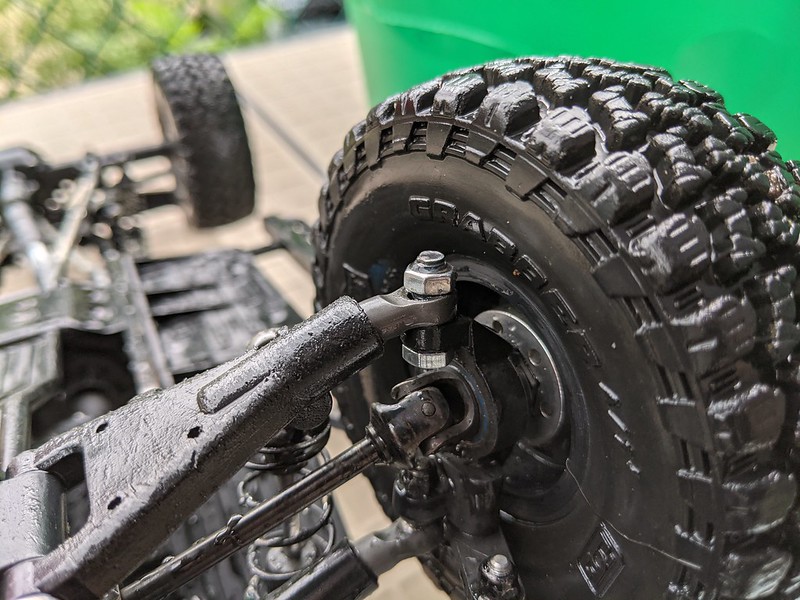
I've been dealing with the lower arms of the IFS falling apart on my Enduro Trailrunner for the past while. They're held together by a metal ball stud and a plastic rod end. The original rod ends held together for almost a year, but then they started going. I got a pack of replacement rod ends, but they weren't holding together so great. Either the pack of rod ends was no good or the metal ball studs wore down. However it actually went, I was having problems, and it was ruining my RC outings. I got some hardware from the hardware store to try some things. It turns out the simplest thing I tried first appeared to work the best. You can use a 4mm nut and bolt. The length of the nut isn't so important as long as it's not too short. You're going to want to have a little bit coming down in the end after you cut off the excess. Disassemble the suspension and remove the CV axle. Remove the ball stud and put the bolt downwards into the hole of the steering knuckle. Reinsert the CV axle and get it into assembled position. Then put the bolt into the rod end of the lower arm. Use a bit of thread lock on the bolt where the nut's going to rest, and put the nut on. Putting the nut on requires finesse. You don't want it too tight or too loose. Try a few positions before you leave the thing alone to let the thread lock set. After the thread lock sets, take a dremel and cut off the excess part of the bolt hanging down below the nut. This will keep your tire from rubbing on it while it's squished. Then do this all over again on the other side.
I went to NJ Devils Way this morning to test it out, and it went very well. I had nothing to worry about. It stayed together like it was new. the nut and bit of bolt does hang lower than the original ball stud/rod end combination, but it's a small price to pay for much better durability. And it's so far over to the side that the tires are going to be negating the extra bit of stuff hanging lower anyway.
Potential drawbacks to this include the following: The ball stud and rod end on the upper arm may be more prone to being popped apart now. Sometimes you get a branch between the arms and the CV axle, and the bottom would always torque itself apart. It was always the bottom that torqued apart. Performing the same modification on the upper rod end may be appropriate to mitigate potential future separation. There's a similar setup for the steering linkage near the upper arm, but that's probably at far less risk for popping apart than the upper arm. The rod ends themselves may also break apart under the extra stress. Replacing the rod ends with something sturdier like metal rod ends may be an appropriate fix. Other plastic parts further down the line may be increasingly affected by modifications, so that's a concern. Also, once the nut and bolt modification gets performed, the most practical way to access the CV axle becomes removing the skid plate and the pins that hold in the lower arms. The pins will have to be removed while letting the lower arms swing out to allow for further accessibility. However, the area of the CV axle only becomes a point of concern when major failure occurs like bearing failure or front differential failure. Should the CV axle itself fail, it will potentially snap in such a way that three or even two wheel drive in the rear will still be possible. All in all, I believe the simple nut and bolt modification will prove to be a benefit to the durability of the Enduro IFS system. I will be continuing to put this modification to the test when taking my Trailrunner out.


I went to NJ Devils Way this morning to test it out, and it went very well. I had nothing to worry about. It stayed together like it was new. the nut and bit of bolt does hang lower than the original ball stud/rod end combination, but it's a small price to pay for much better durability. And it's so far over to the side that the tires are going to be negating the extra bit of stuff hanging lower anyway.
Potential drawbacks to this include the following: The ball stud and rod end on the upper arm may be more prone to being popped apart now. Sometimes you get a branch between the arms and the CV axle, and the bottom would always torque itself apart. It was always the bottom that torqued apart. Performing the same modification on the upper rod end may be appropriate to mitigate potential future separation. There's a similar setup for the steering linkage near the upper arm, but that's probably at far less risk for popping apart than the upper arm. The rod ends themselves may also break apart under the extra stress. Replacing the rod ends with something sturdier like metal rod ends may be an appropriate fix. Other plastic parts further down the line may be increasingly affected by modifications, so that's a concern. Also, once the nut and bolt modification gets performed, the most practical way to access the CV axle becomes removing the skid plate and the pins that hold in the lower arms. The pins will have to be removed while letting the lower arms swing out to allow for further accessibility. However, the area of the CV axle only becomes a point of concern when major failure occurs like bearing failure or front differential failure. Should the CV axle itself fail, it will potentially snap in such a way that three or even two wheel drive in the rear will still be possible. All in all, I believe the simple nut and bolt modification will prove to be a benefit to the durability of the Enduro IFS system. I will be continuing to put this modification to the test when taking my Trailrunner out.
Gamma Ray
Banned
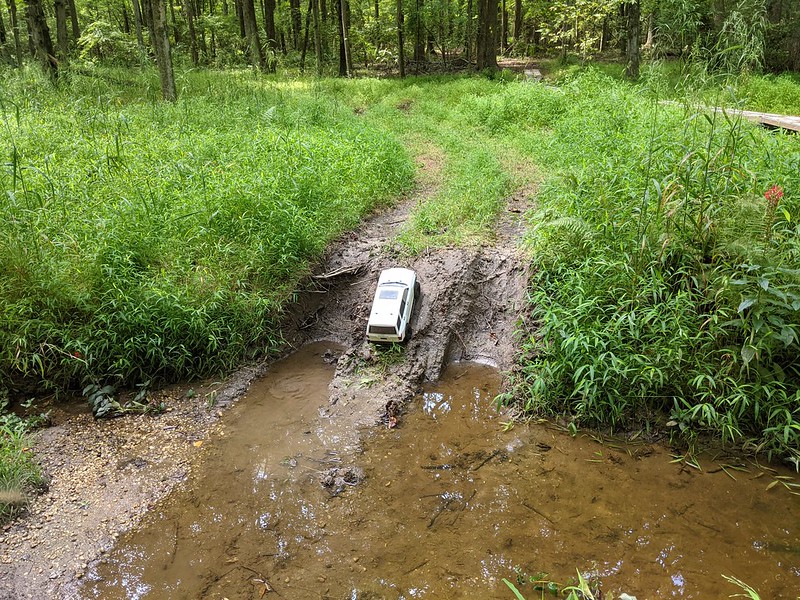
My lower arm modification seems to be working great. I went to Walter D. Faith Memorial Field today, and it did fine on all the rocky gravel and anything else I threw at it. I even got stuck in some grass in a deep puddle, and nothing popped apart when I had grass torqued around the axles. I'm very happy with my Trailrunner right now.
I also saw a Nissan Skyline R32 on my way to the place. Nice!


And here's a video: Enduro Trailrunner - 9/12/21 - PFC Walter D. Faith Memoria… | Flickr
I also saw a Nissan Skyline R32 on my way to the place. Nice!
And here's a video: Enduro Trailrunner - 9/12/21 - PFC Walter D. Faith Memoria… | Flickr
Gamma Ray
Banned
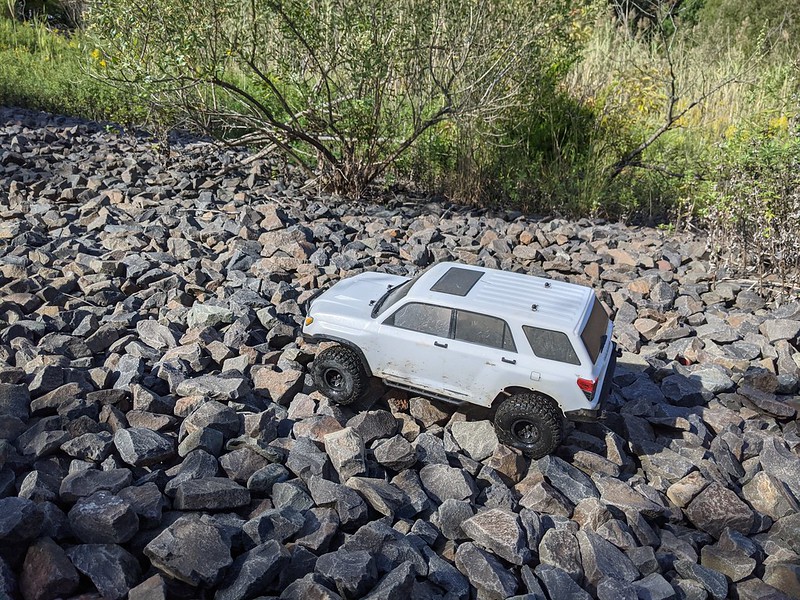
I did some Enduro Trailrunner stuff at Kennedy Park today. It was fun! The hill is pretty much inaccessible now with all the growth on it. I'll have to try it again in the winter. There's still plenty to do there, though. I didn't even do it all, and I was there for nearly two hours.


Gamma Ray
Banned
I thought I wasn't going to run my Trailrunner for a few more weeks, but I got its repairs and upgrades done ahead of schedule. It now has a fresh pinion and spur gear. I went with stock parts, but the pinion actually looks different from what the truck originally came with. I also got a different motor. The stock motor got some extra life out of it with the WD40 trick, but I decided to get ahead of any potential future failures and swap it with something close to the stock motor but is fully rebuildable. It appears there's some exposed stuff on the end that faces the front of the truck, so we'll see how long that lasts. However, if I'm able to more effectively clean it by being able to take it apart then it should be a good upgrade. Finally, I got some M3 hex cap screws and M3 lock washers that I had to special order from Fastenal for mounting the motor. It originally came with allen key head screws, and I always strip those things. I couldn't get the stock motor tight enough after cleaning it, and I lost gear mesh and stripped the original spur. These new hex cap screws and lock washers let me get the motor mounted up really securely. I'm hoping this lasts a long, long time. I gave the gear mesh the paper measurement trick, and everything was fine, so I should be good to go!
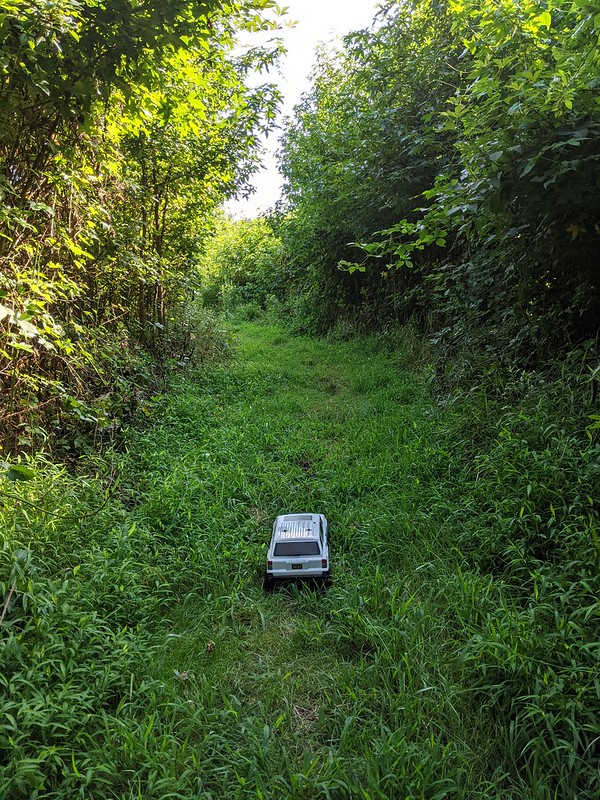
Today's outing was Julian Capik Nature Preserve in Sayreville, NJ. I went in through the back route, but it was challenging. The brush really grows in thick over the summer. At one point I had to pick up my Trailrunner and wade through the brush. It was up to my nipples! I was out for a couple hours, and everything was fine. The truck held up to everything I threw at it. There were no signs of gear mesh slippage. My front end stayed together with the lower arm modification I made last summer. Twigs got into the IFS a couple times and seized things up, but nothing popped or grinded. One time a twig even got stuck in there, the truck came to a stop, and the twig got snapped as it exerted force on the twig and moved forward while a piece of the twig went flying out the side. Nice!


Today's outing was Julian Capik Nature Preserve in Sayreville, NJ. I went in through the back route, but it was challenging. The brush really grows in thick over the summer. At one point I had to pick up my Trailrunner and wade through the brush. It was up to my nipples! I was out for a couple hours, and everything was fine. The truck held up to everything I threw at it. There were no signs of gear mesh slippage. My front end stayed together with the lower arm modification I made last summer. Twigs got into the IFS a couple times and seized things up, but nothing popped or grinded. One time a twig even got stuck in there, the truck came to a stop, and the twig got snapped as it exerted force on the twig and moved forward while a piece of the twig went flying out the side. Nice!
Gamma Ray
Banned
I recently got my spare tire attached to the tire carrier of my Knight Customs rear bumper. I used an M4x30mm hex cap screw I got from Home Depot, drilled out a hole straight through the mount, and melted the plastic around the screw as I was pushing it into the back while getting the screw hot with my soldering iron.
It originally was set up to drill a couple holes in the body and then put an additional mount that'll clip on with a body clip to help stabilize the spare tire. However, I didn't want to have to drill into the body. I decided to try a couple magnets instead. I glued one inside the body and another one onto the outer half of the mount that clips into the spare tire carrier. The magnets seem to be holding on okay. I gave the thing a try at NJ Devils Way this morning, and the spare tire wasn't flopping around. It's obvious there's a magnet there if you look close enough. I'm not sure what I'm going to do with it yet. I gave thought to putting a smaller magnet on the outer mount, but I'd rather not mess with what I've got too much. I might just paint the visible portion of the magnet black to help it blend in. Up to this point, though, I'd say this is a successful experiment. It doesn't seem to affect the truck very much, and I've got s spare with me that I can pop on if I ever tear up a tire on fishing wire or something. I think I'm going to eventually put some stiffer springs in the back to compensate for the extra weight, but everything's okay right now.
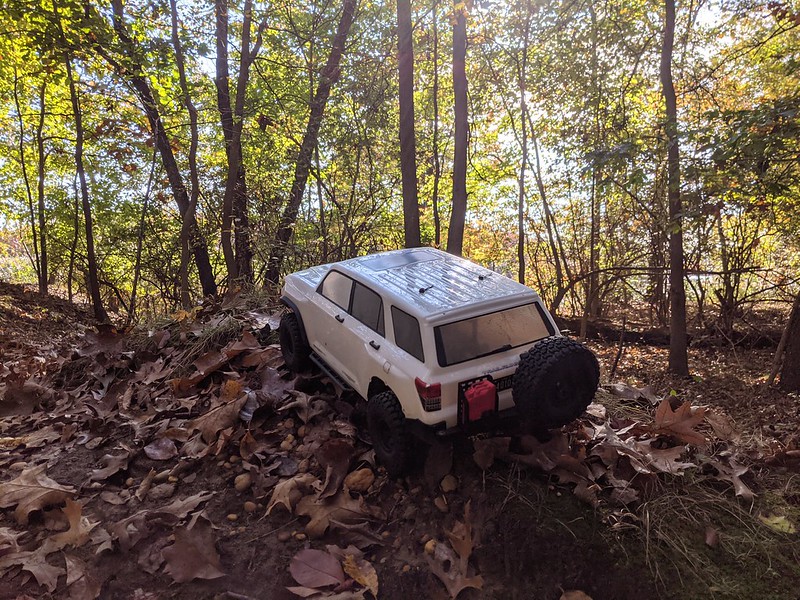


It originally was set up to drill a couple holes in the body and then put an additional mount that'll clip on with a body clip to help stabilize the spare tire. However, I didn't want to have to drill into the body. I decided to try a couple magnets instead. I glued one inside the body and another one onto the outer half of the mount that clips into the spare tire carrier. The magnets seem to be holding on okay. I gave the thing a try at NJ Devils Way this morning, and the spare tire wasn't flopping around. It's obvious there's a magnet there if you look close enough. I'm not sure what I'm going to do with it yet. I gave thought to putting a smaller magnet on the outer mount, but I'd rather not mess with what I've got too much. I might just paint the visible portion of the magnet black to help it blend in. Up to this point, though, I'd say this is a successful experiment. It doesn't seem to affect the truck very much, and I've got s spare with me that I can pop on if I ever tear up a tire on fishing wire or something. I think I'm going to eventually put some stiffer springs in the back to compensate for the extra weight, but everything's okay right now.
Gamma Ray
Banned
I got my Enduro Trailrunner reworked with a new Fire body and a whole bunch of stuff going on under the hood. I did a single layer of the drywall tape and shoe goo reinforcement. I may do more, but I don't want to add a whole lot more weight up top. The shoe goo was really sticky, but it's interesting when it's dry. It still retains flexibility. When gluing the spare tire holder magnet into the inside of the body this time, I only used shoe goo. I glued it first directly contacting the drywall tape and existing shoe goo, and then I gave the magnet a covering of shoe goo. I'm hoping this stays in one spot now. I also redid the placement of the outer magnet. You can barely see it now. All of the hard plastic body accessories got glued in place except for the front grill which never needed gluing. I finally got the rear fender flare modified to go with the rear bumper, too. This is probably the nicest this body is ever going to look. I can't wait to take it outside!


Gamma Ray
Banned
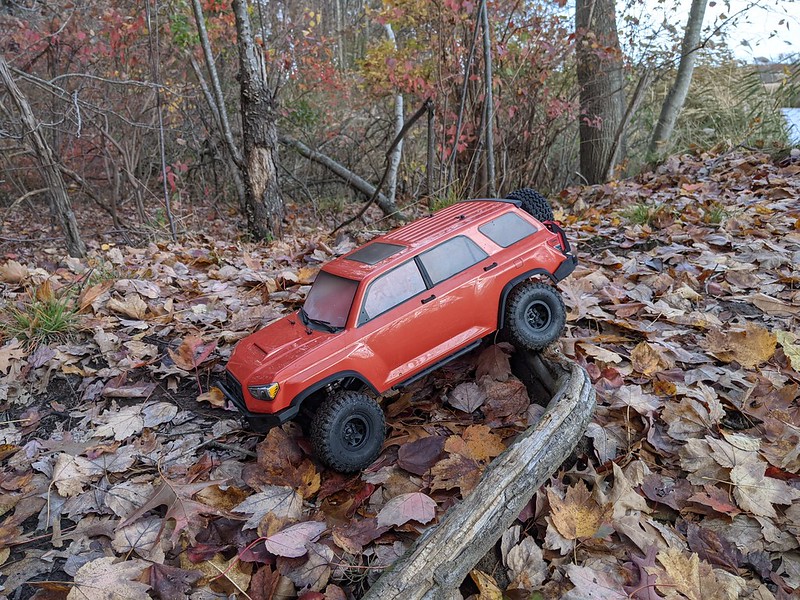
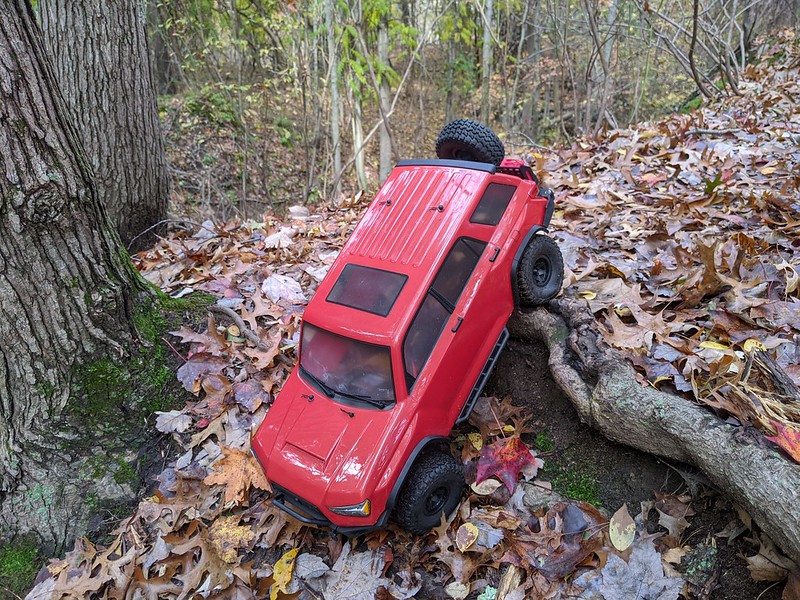
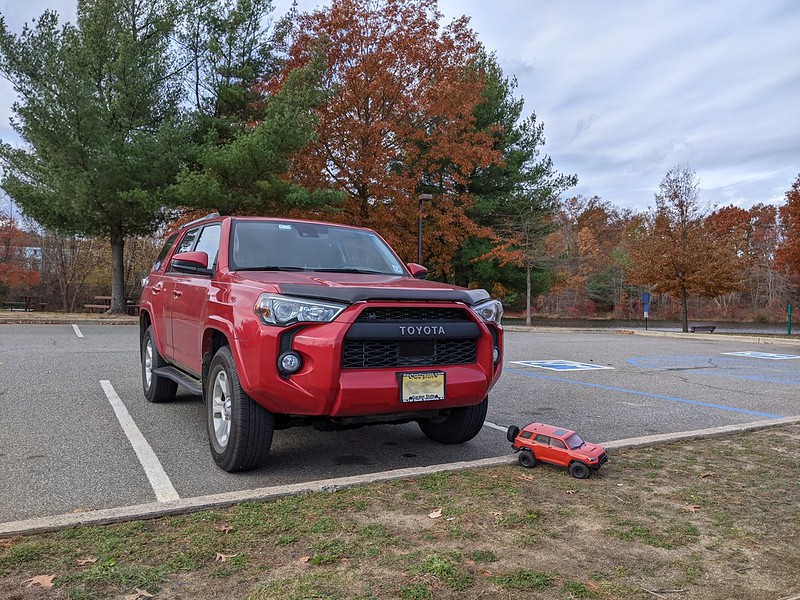
I did a short run at NJ Devils Way this morning with my newly improved Trailrunner. New body, new accessories, new shoe goo, new rear springs. I'm happy with everything so far. The springs are helping out the rear end. I got the stiffest ones Element offered. The leaves are making things difficult this time of year. I got stuck due to the leaves a couple times.




Gamma Ray
Banned
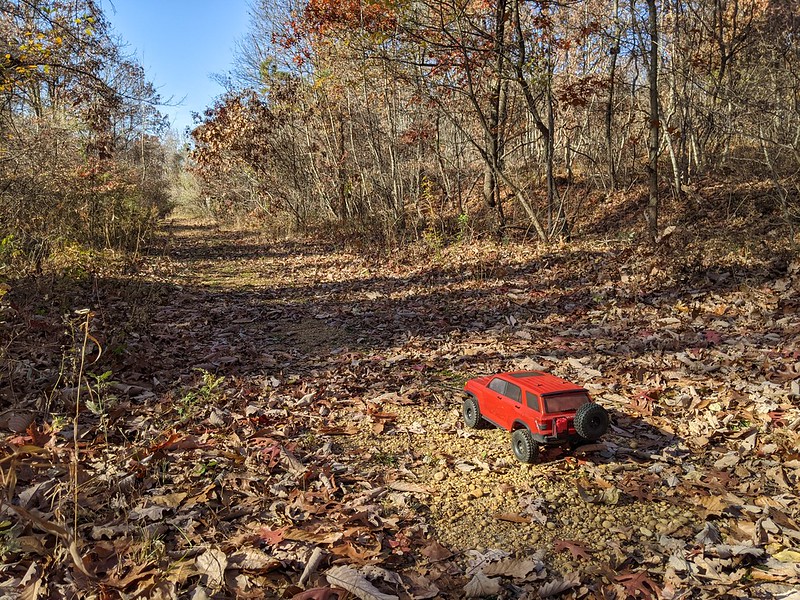
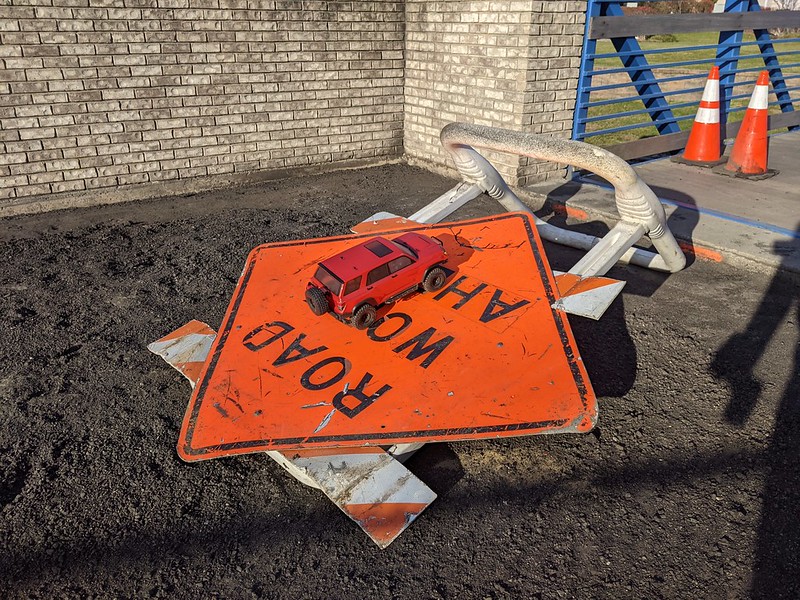
I took my Trailrunner out for its first non-test drive since getting everything set up the way I want it. I think I'm finally done mucking with this truck. It's exactly what I want it to be. Everything's working well. It performed great in the fall weather. This is one of the hardest times of the year to do this stuff because so many things you'd rather avoid are being obscured by all of the leaves on the ground, but my Trailrunner still did great. I'm very happy with it.






Gamma Ray
Banned
I went to John A. Phillips Preserve in Old Bridge, NJ today. It was a trail run more than anything. There wasn't too much that was challenging, but it wasn't totally flat land either. Most of the challenge came from all the leaves on the ground. A lot of the water crossings are impassable either through the water or over the foot bridges, so I had to pick the truck up sometimes. I ended up missing the trail that leads to Route 18, so I went on another trail loop which was pretty fun.


Gamma Ray
Banned
I went out to the John A. Phillips Open Space Preserve hiking trails with a fellow RC offroad hobbyist. It was a lot of fun! East met West on the dirt with my Toyota and his Chevy. I was impressed by his big tires and wide stance, and he was surprised by how capable my very scale IFS rig was. Terrain was conquered, trucks were broken and fixed, helpful pushes were given, good stuff! We were going to go on an unmarked trail, but we decided against it when we saw signs saying that hunting could be going on there. We went back and went on another trail instead.


Gamma Ray
Banned
I went to NJ Devils Way early this morning while waiting to pick my dad up from the doctor. (He's okay.) I had a nice little trip around the park. I think a part of the woods is opening up now. I didn't want to go exploring deep in the woods today because I knew I was going to get a phone call to pick my dad up, but I was able to get my Trailrunner up a hill that has been inaccessible since last spring. The leaves don't help, but they're not going to keep me from exploring that spot some more next time.


Gamma Ray
Banned
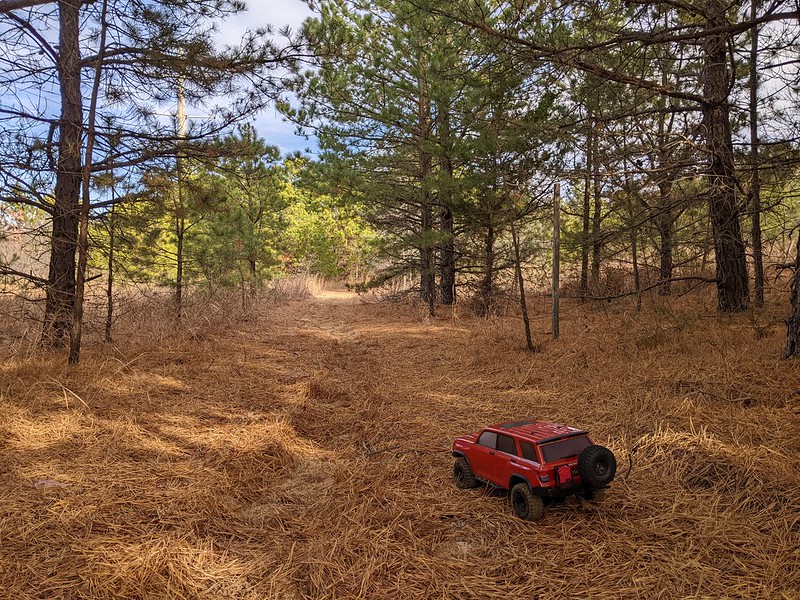
I went to Julian L. Capik Nature Preserve today. It's the coldest I've been out for Trailrunner trailrunning in a while. I went the opposite direction I usually go, so I got to see a couple side trails that I don't usually check out. I had to give it a few more hands of god than I would have liked due to all the leaves obscuring a lot of obstacles, but it was a good outing. There was one really great sandy area. It wasn't too wet and it wasn't too dry. It was pocked out from horses galloping through it, and it was a great challenge area to drive through. It went on for several hundred feet, but I had to go slowly so I didn't high center and get stuck. I was choosing my lines carefully and not going in too fast so I would still be able to back out if I got stuck. It was a great challenge, and I didn't have to rescue the Trailrunner once in that spot.



Gamma Ray
Banned
This year's Christmas Eve outing was decidedly less dangerous than last year's. There was no driftwood with rusty nails sticking out of it that I almost slipped and fell on! I went to Frost Woods today. Frost Woods is more of an easy hike than anything else, but there's some fun to be had there. It has one big trail loop, but there are additional unmarked trails within the loop. Some of those trails opened up with the change of the season. I found a couple really fun little spots because of this. There was one spot with a bunch of built up hills. They're probably for jumps for bikes, but they were nice little things for my Trailrunner to drive over. It would actually be interesting to drive that trail with a trophy truck or a buggy, something fast to get some air. One of the other trails still had green leaves! It was like I wasn't in Central NJ at all!
I decided to try some SXT Slime tire prep last night and SXT Baja traction compound before I went out. The Baja stuff is more for racing, but finding traction is hard this time of year with all of the leaves on the ground. So far I don't know how much it did to help, but I didn't often have problems finding grip, so maybe it is helping, just not blowing my mind.
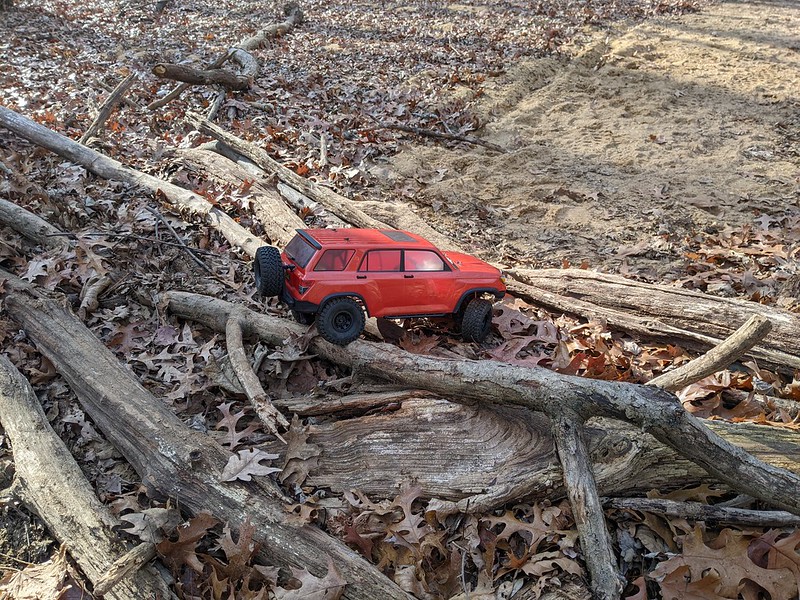
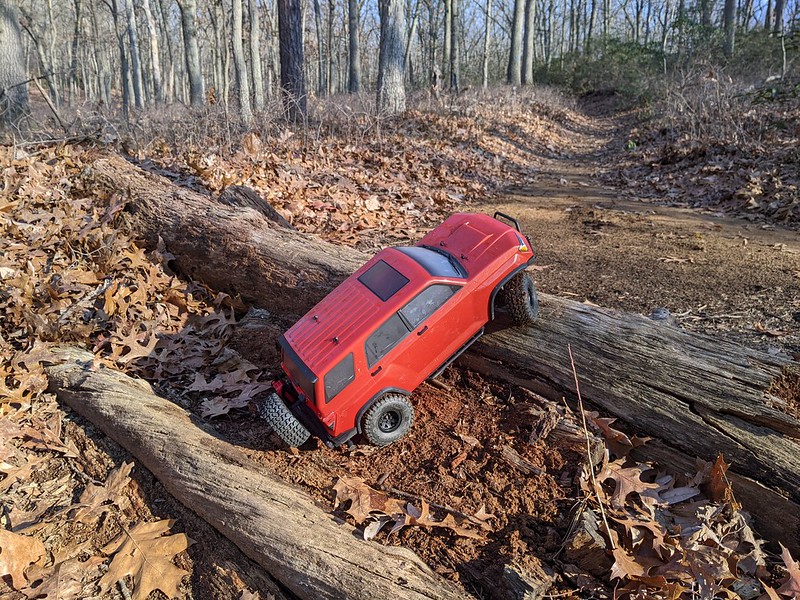


I also got up to some truly stupid crap: Enduro Trailrunner - 12/24/21 - Frost Woods | Gamma'='Ray | Flickr
I decided to try some SXT Slime tire prep last night and SXT Baja traction compound before I went out. The Baja stuff is more for racing, but finding traction is hard this time of year with all of the leaves on the ground. So far I don't know how much it did to help, but I didn't often have problems finding grip, so maybe it is helping, just not blowing my mind.
I also got up to some truly stupid crap: Enduro Trailrunner - 12/24/21 - Frost Woods | Gamma'='Ray | Flickr
Gamma Ray
Banned
I went to the beach at Keansburg today. Specifically the area west of the amusement park. I was going to walk all the way east, but I found out that the beach directly behind the amusement park is private property and is fenced off. Oh well. Walking back and forth on the west end took about an hour anyway, but the dunes are the best part. I should go exploring on the dunes some more next time and then maybe park east of the amusement park and see what's going on over there.


Gamma Ray
Banned
I did not have a good sleep last night. I couldn't get to sleep until 3:30AM, and then I didn't wake up until 11:00AM. So what's a guy to do to help tire himself out today so he can get a better sleep tonight? Go on a later day hike in the winter, of course!
I took my Trailrunner to Julian L. Capik Nature Preserve again today. I intended to take the trail that led to the little bridge, but I turned right when I should have turned left and took another longer trail towards the police shooting range. I didn't want to go all the way to the bridge after taking that wrong trail, so I headed back along a different trail instead. I ended up finding the sandy challenge area from last time and took a video of it. I got stuck at the very end of the video, but I blame trying to drive one handed while taking a video at the same time. I meant to go slowly to the right, but it's hard to control everything with nuance one handed.


I took my Trailrunner to Julian L. Capik Nature Preserve again today. I intended to take the trail that led to the little bridge, but I turned right when I should have turned left and took another longer trail towards the police shooting range. I didn't want to go all the way to the bridge after taking that wrong trail, so I headed back along a different trail instead. I ended up finding the sandy challenge area from last time and took a video of it. I got stuck at the very end of the video, but I blame trying to drive one handed while taking a video at the same time. I meant to go slowly to the right, but it's hard to control everything with nuance one handed.
Gamma Ray
Banned
I went out for my last outing of 2021 to Walter D. Faith Memorial Field and had a pretty easy but fun time. I actually busted my motor a couple days ago and had to fix it which sent me down to Toms River to get a new ESC because I thought that I busted the ESC. The motor is only a couple months old, and the ESC stopped beeping when the battery got connected. Apparently it won't beep when there's a motor problem. It was just that I blasted the motor with muddy sand, and the brushes took a hit. It's a rebuildable motor, so I was able to clean it out, but I don't know if it's any hardier than a conventional motor. At least I learned some things and I might have a temporary in the field remedy the next time it happens. My gear mesh is okay now. It's a little looser than I usually like it, but I did the paper trick and it's still holding onto the paper without tearing it and also not letting the paper fall out. I am a little concerned I overtightened one of the bolts that holds the motor in place, but nothing has shifted yet. At least I have a couple of spare holes on the motor to use to mount the motor so I can be more careful screwing it in place next time. I just hope it doesn't slip because I'll tear up a spur gear, and the reason I wanted to get so tight on those bolts is because I lost a spur gear in the past due to the motor slipping.


And here's a video of my truck getting wet:
And here's a video of my truck getting wet:
Similar threads

- Replies
- 0
- Views
- 1K
- Replies
- 0
- Views
- 2K


