Finding studs behind drywall and plywood

bofa

New member
This one has me baffled... I'm trying to hang some shelves in a finished garage and apparently the builder put OSB on the walls that are shared with the interior, and then dry-walled on top of it. I have a stud finder that supposedly can find studs behind plywood but it's been useless. I tried a magnet to locate nails that attach the drywall but those seem pretty random and I still drilled around a few of them and the didn't have studs, and now I have some patching to do.

Any ideas? Where's Superman when you need him?
 
Register to hide this ad
This one has me baffled... I'm trying to hang some shelves in a finished garage and apparently the builder put OSB on the walls that are shared with the interior, and then dry-walled on top of it. I have a stud finder that supposedly can find studs behind plywood but it's been useless. I tried a magnet to locate nails that attach the drywall but those seem pretty random and I still drilled around a few of them and the didn't have studs, and now I have some patching to do.

Any ideas? Where's Superman when you need him?

ok, dumb question... why do you need to hit studs. I am a superintendent for a general contractor and we almost never worry about hitting a stud when there is plywood behind the drywall. The alternative if you need the pull out strength is to use "togglers." They are really handy and dont fall out like typical toggle bolts. Here is the link.

Also what type of screws are you using? What is the shelf going to be holding?

Regards,

Mike
 
ok, dumb question... why do you need to hit studs. I am a superintendent for a general contractor and we almost never worry about hitting a stud when there is plywood behind the drywall. The alternative if you need the pull out strength is to use "togglers." They are really handy and dont fall out like typical toggle bolts. Here is the link.

Also what type of screws are you using? What is the shelf going to be holding?

Regards,

Mike

I just don't trust osb to hold a screw. The shelves are rated for 200 lbs each and I'm hanging 4 of them. While I probably won't hit that mark, I don't want surprises in an area with expensive tools and vehicles.

The included hardware is 1/4" lag screws. The shelves will be holding tools, hardware, raw materials, liquids etc... usual garage stuff. They have hooks to hang things underneath like bicycles, ladders, etc too. I don't have big plans for those yet but would want to know that they wont tear out if I used them that way.

The newer togglers are a good suggestion though.. completely forgot about those. If there's no good way to locate studs, I may have to go that route.
 
Last edited:
since you already have some patching to do, you could just drill a large...ish hole(3/8"), and stick in a piece of wire until you locate a stud. just bend the wire slightly stick it in the hole, and twist it, if you are even remotely close to the stud, you'll hit it. I used a coat hanger because it was handy :D

I recently mounted a few LCD tvs onto wall mounts, but it was over lathe and plaster, which my stud finder wouldn't work on. I used the above method, it worked well.
 
I picked up some of the "other" brand a Home Depot, by Hillman. I'm not sure if I'm going to use them or just go to Lowes and get the original ones. The originals are rated for more weight and I'm all for overkill on this one.

since you already have some patching to do, you could just drill a large...ish hole(3/8"), and stick in a piece of wire until you locate a stud. just bend the wire slightly stick it in the hole, and twist it, if you are even remotely close to the stud, you'll hit it. I used a coat hanger because it was handy :D

I recently mounted a few LCD tvs onto wall mounts, but it was over lathe and plaster, which my stud finder wouldn't work on. I used the above method, it worked well.

Luckily I got some pics before they drywalled and there is one plumbing pipe and 2 air vent shafts in that wall. Not sure I could trust the wire method. I did think about it, thought about using a bunch of small nail holes too, but it's a bit tricky.

Studs should be 16" apart center to center. Find one, move 16" inches over, there should be another. If not, try 24".

I can't even find the beginning stud. I thought about measuring from the end or a corner of the wall too, but I noticed the spacing is not exactly even from there, based on the framing pics.

My only other thought is to find the studs on the opposite side of the wall, and drill some very small holes all the way through, but then I'll have twice the holes to patch and one cranky wife. :D
 
On walls my stud finder fails on, I use sound. Tap the wall with finger tips or a hammer lightly, listen for the sound change as you move across. Also notice the recoil (bounce) off the wall, it becomes stronger at the stud
 
I'm just going to throw this out there .....

perhaps you don't have a good stud finder? I'd try going to home depot and buying a higher end one and seeing if it works.

Worst case you can just return it.
 
I'm gonna go ahead and say it cause someone has too!

When ever I pick up a stud finder it just starts beeping and flashing lights everywhere! :banana:

Sometimes and it might be different with your case cause if there is plywood behind the drywall then glue might have been used to hang the drywall. However, if nails or screws where used and used properly every 6-8" on the boarder and 10-12" in the field then try this. At night or when dark, get a regular old flashlight (filament type) new led is harder, but hold the light at a 45 degree angle or somewhere close and look for divits any change in surface structure, 9 times out of 10 you can find either a seam or a improperly mudded nail. Even with some type of texture on the wall a good eye will find a starting point. You also know the deminsion of drywall so measure out possible patterns and work from there. ( the nail and screw dimensions might be for a ceiling? It's been way too long sense I've hung drywall.)
 
do the pics also show the studs? post the pics.
I always use the knuckle rap and super skinny nail method.

They do, but not straight on. Not sure why I didn't get better pics out there .

On walls my stud finder fails on, I use sound. Tap the wall with finger tips or a hammer lightly, listen for the sound change as you move across. Also notice the recoil (bounce) off the wall, it becomes stronger at the stud

Doesn't work well with plywood behind the drywall

Do you have any electrical outlets on any of the walls?

Dumb idea by the owner, but could be worse.

No outlets on that wall at all.

I'm just going to throw this out there .....

perhaps you don't have a good stud finder? I'd try going to home depot and buying a higher end one and seeing if it works.

Worst case you can just return it.

Totally possible. I bough it based on consistent reviews and a compare article I found but there may be better ones out there.

A good magnet works for finding the nails or screws.

Yeah the patterns just weren't consistent enough to trust it.
 
can you ask the builder? maybe he can swing by? any blueprints?
can you see the top plate and studs from above? via access above the ceiling?
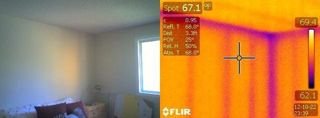
Thermal imaging, like that used to asses heat loss in walls? Maybe this is rentable?
bedroom-side-by-side-IR.jpg
Can infrared really see through walls? | Home Inspection Infrared Service Mississauga
the pics show 1 plumbing pipe and 2 vent pipes. Do you know where these are behind the wall? If so, even though the pic is from an angle you can certainly closely estimate where the studs are and do some probing.
As long as you know you are in no danger of breeching any of these 3 pipes you could use the skinny nail or skinny drill bit method. If you know how thick the drywall is plus the OSB thickness, you know how deep you need to nail or drill to just get through both layers. Put a piece of tape around the drill bit to mark the depth and add 1/4''. Just probe an inch apart. Use a level and hash mark every inch. You'll figure out where the studs are quickly. once you find one, go a little left and a little right so you know where the edges are so you can anchor into the middle of the stud.
you can use the skinny nail as a drill bit method, also.
This is what i would do.
 

Attachments

  • bedroom-side-by-side-IR.jpg
    bedroom-side-by-side-IR.jpg
    10.8 KB · Views: 7,931
Last edited:
Just find the studs on the other side of the wall as you said. No need to drill a small hole, just measure from a common point like a doorway or corner.
 
I really thought I had this one in the bag with the togglers. I got the first row of holes drilled (12x 1/2" holes)... went to mount the first bracket and the damn bolt wouldn't grab. I noticed some resistance from the insulation when putting them in, but was pretty sure I had them engaged, pulled enough, and taut.. but nope. This has turned into a pain in the arse.
 
... I'd try going to home depot and buying a higher end one and seeing if it works.

Worst case you can just return it.

^ This.

I've never had your same problem, but I find it hard to believe that someone doesn't make a high end device. You can't be the first to have this problem.
 
I ended up ordering a couple of rolling shelf systems to put in the garage. I was trying to keep stuff off the floor, but being able to roll it around is the next best thing. I may end up using these in the basement, where at least I can see the studs. :D Or if anyone is local, I can offer them up at a reasonable price.

Any outlets in the whole garage? Is this wall an exterior or interior one or is the garage detached?

Attached garage and this in an interior wall that is shared with the mud room, hallway, and a bathroom. There are half a dozen outlets out there, but none on this particular wall. I'm not really sure why it ended up that way. It's a 3 car tandem garage and literally the only wall segment without an outlet.

^ This.

I've never had your same problem, but I find it hard to believe that someone doesn't make a high end device. You can't be the first to have this problem.

I looked through some of the middle tier scanning devices and they were around $600 or so and, based on the reviews, about as reliable as a $20 stud finder. I am interested to see if Lowes or HD rents anything higher end. I searched online but came up empty.

Just find the studs on the other side of the wall as you said. No need to drill a small hole, just measure from a common point like a doorway or corner.

I know I sound like I'm coming up with excuses, but this proved challenging too. This wall is adjacent with another wall that jets out about 8" to accommodate major ducting. On the other side (the inside of the house), it's all one wall. I think I could probably get it pretty close, but any slight variance in the framer's work makes hitting a 1 1/2" target hard.
 

Members online

Forum statistics

Threads
278,312
Messages
3,554,085
Members
248,016
Latest member
Advally Service

Trending content

Back
Top