Flat Towing 3rd Gen -- What's Needed?

Putting the tcase in neutral with rear driveshaft connected - not good!
The typical 3rd gen part-time transfer case has a pump in it, driven from the input shaft. So, if you put the tcase in neutral with the rear drive shaft still connected, the tcase will be running dry and risk damage. Also, to put the tcase in neutral you first have to shift it to the 4wd position, so the front drive shaft is locked to the rear drive shaft, and will be spinning as well. The ADD will be connected, so the front and rear axles will be connected together. Not a good thing on dry pavement.

Putting the transmission in neutral and tcase in H2 with rear driveshaft connected - not good!
In this case the output shaft of the tranny is spinning. The tranny also has an oil pump driven by the input shaft. With the tranny in neutral, the output section will be spinning with poor lubrication and risk damage.

Tcase in H2, rear driveshaft disconnected - good!
With the tcase in H2, the ADD in the front diff is disconnected. The front end is operating exactly the same as when you are driving down the highway in 2wd. The front drive shaft will be motionless. The only things spinning up front are the CV half-shafts and the spider gears in the diff. They're made to do just that and get plenty of splash lubrication. With the rear drive shaft disconnected, the tcase and tranny are motionless. The rear diff is spinning and getting splash lubrication just as it does in normal driving operation.
 
And just to clarify, transmission in neutral?

Doesn't matter, as long as the rear drive shaft is disconnected and the tcase is in H2. There will be nothing trying to turn anything in the transmission. From the point of view of the engine and tranny, the vehicle is the same as parked in your garage.
 
Lots of misinformation in this thread. I tow my 2000 4Runner with auto tranny and multi-mode transfer case behind my motor home. It's been from Washington to Arizona and back 1-1/2 times and several other long trips. I'm half way back home now and happen to have been towing it all day for the last three days with a few more towing days yet to come this week. I have a Remco driveshaft disconnect which allows me to easily disengage the rear driveshaft. I don't use the Remco shift linkage because it's easy enough to slide under and disconnect the Remco coupler. That way I don't have the claptrap of the Remco shift linkage hanging down and waiting to get smashed on a rock. I put the tranny in park, unlock the steering wheel, and make sure the transfer case is in 2WD. I've added a switch to shut off most power so that the battery doesn't go dead and miles are not accumulated by the odometer. I also have a towed vehicle brake system so that my 5,000 pound "trailer" does have some brakes. The brake system isn't working very well at the moment and needs a little tuning. I use a Demco tow bar and I made adapters so I can tow the T4R off the tow rings of my ARB bumper. This is the third vehicle that I've towed behind my motor home over the last ten years. The previous two were Cherokees which are much simpler to tow but aren't near as comfortable as the T4R.

You can simply remove the rear driveshaft as I did for my first trip south last year. With the driveshaft out, you can put the transfer case in 4-Hi and drive fwd if you don't want to hassle with the driveshaft. I've driven it this way up to 60mph with no issues. Let me know if you need more info.
 
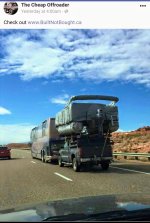
Speaking of flat towing .... I figure I'll share this.
 

Attachments

  • Screenshot_20180321-213124~2.jpg
    Screenshot_20180321-213124~2.jpg
    130.7 KB · Views: 2,212
Add a trailer with sand toys behind the truck and he will be complete. It's not uncommon to see a snowbird with a truck pulling a 5th wheel and a trailer carrying sand toys behind the 5th wheel.
 
Lots of misinformation in this thread. I tow my 2000 4Runner with auto tranny and multi-mode transfer case behind my motor home. It's been from Washington to Arizona and back 1-1/2 times and several other long trips. I'm half way back home now and happen to have been towing it all day for the last three days with a few more towing days yet to come this week. I have a Remco driveshaft disconnect which allows me to easily disengage the rear driveshaft. I don't use the Remco shift linkage because it's easy enough to slide under and disconnect the Remco coupler. That way I don't have the claptrap of the Remco shift linkage hanging down and waiting to get smashed on a rock. I put the tranny in park, unlock the steering wheel, and make sure the transfer case is in 2WD. I've added a switch to shut off most power so that the battery doesn't go dead and miles are not accumulated by the odometer. I also have a towed vehicle brake system so that my 5,000 pound "trailer" does have some brakes. The brake system isn't working very well at the moment and needs a little tuning. I use a Demco tow bar and I made adapters so I can tow the T4R off the tow rings of my ARB bumper. This is the third vehicle that I've towed behind my motor home over the last ten years. The previous two were Cherokees which are much simpler to tow but aren't near as comfortable as the T4R.

You can simply remove the rear driveshaft as I did for my first trip south last year. With the driveshaft out, you can put the transfer case in 4-Hi and drive fwd if you don't want to hassle with the driveshaft. I've driven it this way up to 60mph with no issues. Let me know if you need more info.
Awesome, this is exactly what I was hoping to hear!
 
The short answer is no. See post #21 above for why it's not a good idea. Jeeps and Ram pickups are set up for flat towing. Toyotas are not. You'll need to remove the rear drive shaft.
 

Members online

Forum statistics

Threads
278,310
Messages
3,554,078
Members
248,016
Latest member
Advally Service

Trending content

Back
Top