
You are using an out of date browser. It may not display this or other websites correctly.
You should upgrade or use an alternative browser.
You should upgrade or use an alternative browser.
Fording water
- Thread starter Friedom
- Start date

Antman
Elite Member
I swear, some of the people on this forum are the biggest over calculating pussies I've ever seen
We will need some mathematical proof of that, or at least some charts with data. :nerd:
Thanks for your observation, feel free to GTFO now.

marshal
New member
We will need some mathematical proof of that, or at least some charts with data. :nerd:
Thanks for your observation, feel free to GTFO now.
I appreciate your technical contributions to the forum, and your endless tidbits of qualified information, but you can go **** yourself this go around.
There is no reason why anyone should lessen the capabilities of the 4Runner vs other vehicles. It's a 150 series Land Cruiser Prado, not a soccer mom mobile that someone dreamed up. The only reason why a specific fording depth is applied to the 4Runner is because of its breather lines, otherwise once raised - your limiting factors is pretty much only the air intake. Yes there are specific electronic components that are not waterproofed entirely, but those are located in the cabin or are higher than the air intake.
Do you people really believe a properly maintenanced vehicle that fords water regularly is any less reliable than one that doesn't?
Antman
Elite Member
I appreciate your technical contributions to the forum, and your endless tidbits of qualified information, but you can go **** yourself this go around.
Got a good chuckle outta that one!
Calm down dude!
Oh, and regarding this statement:
"Do you people really believe a properly maintenanced vehicle that fords water regularly is any less reliable than one that doesn't?"
ABSOLUTELY YES.
Last edited:
marshal
New member
How? Grease isn't whisked away because there is water, grease is only forced out in high pressure situations. Grease is hydrophibic in any other regard. With that joints that are invaded by water are not destroyed by water, it's the contaminants that comes with it that do. Again, proper maintenance would solve this.
Electronics. All the electronics on this vehicle are sealed shut with deutsch waterproof connectors. Not just weatherproof, but waterproof. They're all IP68 rated connectors. Proper maintenance says that if you regularly put to test the connectors abilities youd also jam them full of dielectric grease. Since you know, grease is hydrophibic and halts corrosion...
Then steel corrosion. I'd actually go out on the limb here to claim that fording water is better for your vehicles steel and aluminum sections purely from the stand point that that water is much cleaner and acting like a bath than 1-2foot standing water that probably has a higher salt and alkalinity content than sea water.
So by bombing into water fast are you going to break something? Of course. Mirrored water has the same surface tension as concrete at half of terminal velocity. But with care and maintenance is it any worse that one that doesn't? Give me a break.
Think that Humvees components are any more durable than our 4Runners? Trust me, your 4Runner can hold it's own. I worked on them for years, I should know.
Don't forget to plastidip
Electronics. All the electronics on this vehicle are sealed shut with deutsch waterproof connectors. Not just weatherproof, but waterproof. They're all IP68 rated connectors. Proper maintenance says that if you regularly put to test the connectors abilities youd also jam them full of dielectric grease. Since you know, grease is hydrophibic and halts corrosion...
Then steel corrosion. I'd actually go out on the limb here to claim that fording water is better for your vehicles steel and aluminum sections purely from the stand point that that water is much cleaner and acting like a bath than 1-2foot standing water that probably has a higher salt and alkalinity content than sea water.
So by bombing into water fast are you going to break something? Of course. Mirrored water has the same surface tension as concrete at half of terminal velocity. But with care and maintenance is it any worse that one that doesn't? Give me a break.
Think that Humvees components are any more durable than our 4Runners? Trust me, your 4Runner can hold it's own. I worked on them for years, I should know.
Don't forget to plastidip
Last edited:

Intruder
New member
With that joints that are invaded by water are not destroyed by water, it's the contaminants that comes with it that do. Again, proper maintenance would solve this.
Yeah, I agree it's the sediment and stuff mixed in the water that's the worst part (I mean, people clean their vehicles with water right?) unless you're talking about water getting into the diff or the air intake. Proper maintenance will solve it, but a lot of people don't do that or just plain don't realize it. I wash my truck right after I go off roading to get rid of mud and grit from any moving parts. Lots of people have that "it looks better when it's muddy" mentality and drive around as long as they can with it dirty not realizing the unnecessary wear they're putting on everything. And yeah, washing it is part of the preventive maintenance stuff.
Of course, at the same time I see lots of people being stupid about water crossings - not checking the depth if they can't see the bottom, bombing into it not knowing if there's a massive log or pointy stick aimed at their CV boots in there. I'll avoid mud puddles if I can, but when there is one that we can't get around I'll still go through it treating it as I would any other obstacle on the trail.
Discussions like this are good for people who don't have a lot of off road experience. Even better if they don't get out of hand or devolve


Curly Jefferson
New member
How? Grease isn't whisked away because there is water, grease is only forced out in high pressure situations. Grease is hydrophibic in any other regard. With that joints that are invaded by water are not destroyed by water, it's the contaminants that comes with it that do. Again, proper maintenance would solve this.
Electronics. All the electronics on this vehicle are sealed shut with deutsch waterproof connectors. Not just weatherproof, but waterproof. They're all IP68 rated connectors. Proper maintenance says that if you regularly put to test the connectors abilities youd also jam them full of dielectric grease. Since you know, grease is hydrophibic and halts corrosion...
Then steel corrosion. I'd actually go out on the limb here to claim that fording water is better for your vehicles steel and aluminum sections purely from the stand point that that water is much cleaner and acting like a bath than 1-2foot standing water that probably has a higher salt and alkalinity content than sea water.
So by bombing into water fast are you going to break something? Of course. Mirrored water has the same surface tension as concrete at half of terminal velocity. But with care and maintenance is it any worse that one that doesn't? Give me a break.
Think that Humvees components are any more durable than our 4Runners? Trust me, your 4Runner can hold it's own. I worked on them for years, I should know.
Don't forget to plastidip


KidVermicious
New member
I swear, some of the people on this forum are the biggest over calculating pussies I've ever seen
See, you're talking about proper maintenance, and I'd respond that approaching a water crossing in a calculated way to minimize damage or wear on my truck is part of proper maintenance, and splashing around in muddy puddles of unknown depth is not. I don't think that makes me a *****, does it?

Jetboy
New member
Sometimes you can't really tell how deep murky water is. My worst deep water encounter was driving on thin ice - literally. Broke through into a muddy swampy hole. About 4" shy of the windows and over the hood. It was cold as hell climbing out, breaking more ice to get down to the winch and fortunately the winch worked like a champ even completely submerged. Once we got back out to dry land the engine fired up (in my experience the distributor type ignition almost always dies on gas engines before hydrolock no matter how well you seal them- though I wouldn't count on it with my new one).
All in all it really didn't damage anything other than the interior. Mud came up through the drain holes under the carpet and made a huge mess.
Having owned Jeeps and Toyotas - Toyotas are exceptionally well sealed for water crossings. I have no hesitation going up to the intake depth. If they didn't look so goofy on 5th gens I'd probably add a snorkel. It'd be nice to develop a nice sealed way to pull intake air from the cowl or the hood scoop. If nothing else it would probably help with the primary purpose of snorkels - taking in less dusty air on dirt roads.
No matter what you do - going fast into deep or unknown water is asking for trouble.
All in all it really didn't damage anything other than the interior. Mud came up through the drain holes under the carpet and made a huge mess.
Having owned Jeeps and Toyotas - Toyotas are exceptionally well sealed for water crossings. I have no hesitation going up to the intake depth. If they didn't look so goofy on 5th gens I'd probably add a snorkel. It'd be nice to develop a nice sealed way to pull intake air from the cowl or the hood scoop. If nothing else it would probably help with the primary purpose of snorkels - taking in less dusty air on dirt roads.
No matter what you do - going fast into deep or unknown water is asking for trouble.
Last edited:

KiruxaT4R
New member
I did too. Until I got older...and theoretically wiser.
This right here.
I used to bomb around puddles in my previous SUV until I hit a hole which made the front fall in and throw a connecting through the oil pan. Yes expensive lesson.

1engineer
Moderator
Yeah, I agree it's the sediment and stuff mixed in the water that's the worst part (I mean, people clean their vehicles with water right?) unless you're talking about water getting into the diff or the air intake. Proper maintenance will solve it, but a lot of people don't do that or just plain don't realize it. I wash my truck right after I go off roading to get rid of mud and grit from any moving parts. Lots of people have that "it looks better when it's muddy" mentality and drive around as long as they can with it dirty not realizing the unnecessary wear they're putting on everything. And yeah, washing it is part of the preventive maintenance stuff.
Of course, at the same time I see lots of people being stupid about water crossings - not checking the depth if they can't see the bottom, bombing into it not knowing if there's a massive log or pointy stick aimed at their CV boots in there. I'll avoid mud puddles if I can, but when there is one that we can't get around I'll still go through it treating it as I would any other obstacle on the trail.
Discussions like this are good for people who don't have a lot of off road experience. Even better if they don't get out of hand or devolve
See, you're talking about proper maintenance, and I'd respond that approaching a water crossing in a calculated way to minimize damage or wear on my truck is part of proper maintenance, and splashing around in muddy puddles of unknown depth is not. I don't think that makes me a *****, does it?
Sometimes you can't really tell how deep murky water is. My worst deep water encounter was driving on thin ice - literally. Broke through into a muddy swampy hole. About 4" shy of the windows and over the hood. It was cold as hell climbing out, breaking more ice to get down to the winch and fortunately the winch worked like a champ even completely submerged. Once we got back out to dry land the engine fired up (in my experience the distributor type ignition almost always dies on gas engines before hydrolock no matter how well you seal them- though I wouldn't count on it with my new one).
All in all it really didn't damage anything other than the interior. Mud came up through the drain holes under the carpet and made a huge mess.
Having owned Jeeps and Toyotas - Toyotas are exceptionally well sealed for water crossings. I have no hesitation going up to the intake depth. If they didn't look so goofy on 5th gens I'd probably add a snorkel. It'd be nice to develop a nice sealed way to pull intake air from the cowl or the hood scoop. If nothing else it would probably help with the primary purpose of snorkels - taking in less dusty air on dirt roads.
No matter what you do - going fast into deep or unknown water is asking for trouble.
This right here.
I used to bomb around puddles in my previous SUV until I hit a hole which made the front fall in and throw a connecting through the oil pan. Yes expensive lesson.
Alright, how many of you use my patented "bent stick" method of checking water depth and bottom conditions?

wfo9
New member
I see two types of people who off-road their trucks. The kind that bolt towards ever water crossing and mold hold they can find with joy to play in it, and those that TRY to avoid those types of obstacles whenever possible.
The only difference between the two is that the second group usually work on their own trucks.
The only difference between the two is that the second group usually work on their own trucks.


STX4Runner
New member
I see two types of people who off-road their trucks. The kind that bolt towards ever water crossing and mold hold they can find with joy to play in it, and those that TRY to avoid those types of obstacles whenever possible.
The only difference between the two is that the second group usually work on their own trucks.
And if you read most of the "whoops", "worst stuck" and "WTF was I thinking stories!" in the 4x4 magazines and forums, they mostly involve water, mud, expensive repairs and/or ruined interiors. I've said it before, needless mudding or bombing through water is for high school kids in jacked up pickup trucks, rocks are for men. If it's part of the trail, approach like any other obstacle and determine the best solution. There's a reason that other forum is named IH8mud.
Antman
Elite Member
How? Grease isn't whisked away because there is water, grease is only forced out in high pressure situations. Grease is hydrophibic in any other regard. With that joints that are invaded by water are not destroyed by water, it's the contaminants that comes with it that do. Again, proper maintenance would solve this.
Electronics. All the electronics on this vehicle are sealed shut with deutsch waterproof connectors. Not just weatherproof, but waterproof. They're all IP68 rated connectors. Proper maintenance says that if you regularly put to test the connectors abilities youd also jam them full of dielectric grease. Since you know, grease is hydrophibic and halts corrosion...
Then steel corrosion. I'd actually go out on the limb here to claim that fording water is better for your vehicles steel and aluminum sections purely from the stand point that that water is much cleaner and acting like a bath than 1-2foot standing water that probably has a higher salt and alkalinity content than sea water.
So by bombing into water fast are you going to break something? Of course. Mirrored water has the same surface tension as concrete at half of terminal velocity. But with care and maintenance is it any worse that one that doesn't? Give me a break.
Think that Humvees components are any more durable than our 4Runners? Trust me, your 4Runner can hold it's own. I worked on them for years, I should know.
Don't forget to plastidip
So all of these components are perfectly sealed and will get no water in them after repeated dunkings in water, right? Don't think so.
The chances of water getting into places it shouldn't is increased 100% by driving into water.
Something will fail eventually, just the way it goes. Someone that doesn't play in the h20 will not have this problem.
I'm sure you will have another snappy comeback since you seem to be the water god here, so go for it. I'm waiting, lol.
Water is by far my most common trail obstacle (I'm in the swamps of SW Florida....go figure). Fortunately for me, I go to the same places consistently for my photography, so I know the bottom conditions well, and the depth. If I happen to go to a new location and I cant tell what the bottom or depth are, I put on some waders and check it out before driving through. I took the advice of the folks over on the FJ forum years ago when I got my FJ, and did the scuba mod. that was the first thing I did to my 4Runner as well. Just common sense there, as those diff breathers will definitely be exposed to water if you don't. I stay out of the deeper stuff. If it's much over the axel, you're asking for it in my opinion.
That said, I didn't buy my 4Runner to park it in the driveway and keep it waxed. It's a work truck, and I drive it through water all the time. I just clean the undercarriage with a hose after I'm done. The worst part is getting the mud off the top of the skid plates (what a pain!). These trucks are tough, but I'm sure they're not invincible. YMMV.
That said, I didn't buy my 4Runner to park it in the driveway and keep it waxed. It's a work truck, and I drive it through water all the time. I just clean the undercarriage with a hose after I'm done. The worst part is getting the mud off the top of the skid plates (what a pain!). These trucks are tough, but I'm sure they're not invincible. YMMV.
Jetboy
New member
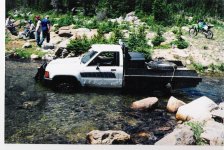
My water crossings tend to look a lot like this - a 10 yr old pic I had of my previous trail rig I just happen to have on my google drive. Depends a lot on time of year. In the summer it's pretty easy. Those are 35's so it's maybe 32" deep? In the spring you could add another foot at times. In the winter it might be frozen with 2 feet of ice. My newer trail rig sits a bit higher, so it's not much concern. I'd do it in my 4runner - probably will run the same trail this summer if I get a chance. Slow is always preferable. Also - clean clear mountain water is a lot easier on things than mud.
Attachments
Intruder
New member
Spring water crossings in the mountains are so unpredictable. I remember a few years ago we crossed a creek early in the morning when it had been below freezing the night before so the water was pretty low. During the day it warmed up quite a bit and by the time we crossed the same spot on the way back the water had come up about a foot higher along with some extra current.In the spring you could add another foot at times.
marshal
New member
I see two types of people who off-road their trucks. The kind that bolt towards ever water crossing and mold hold they can find with joy to play in it, and those that TRY to avoid those types of obstacles whenever possible.
The only difference between the two is that the second group usually work on their own trucks.
I try to avoid mud, but water is fair game. Obstacles are the fun part
So all of these components are perfectly sealed and will get no water in them after repeated dunkings in water, right? Don't think so.
The chances of water getting into places it shouldn't is increased 100% by driving into water.
Something will fail eventually, just the way it goes. Someone that doesn't play in the h20 will not have this problem.
I'm sure you will have another snappy comeback since you seem to be the water god here, so go for it. I'm waiting, lol.
I prefer Rain King.
The waterproofed electronic connections all use IP68 connectors. That's the best you can do. Further aided by the application of dielectric grease, even if there were intrusion of water nothing would go wrong. I'm not saying the 4runners can be dunked to their roof tops without something goig awry - but they're perfectly capable of regularly fording water will no ill effect.
Mud is a different story entirely, and a point I won't argue your stance on - but a clear water or even murkey stream has less contaminants in it, especially for the short duration that a ford takes place in; compared to driving for 300 miles in heavy rain. Water spray is one of the tuffest tests to pass for water sealing and corrosion. Fording water is easy to get by.
Obviously you won't budge on your standing, and that's fine, but you're wrong anyway you look at it. WITH proper maintenance your vehicle is no less reliable, no less capable, and no less able of accepting plastidip than one that has not forded water before.


