Head gasket failure on the V8?

bergs

New member
How common are head gasket failures on the V8? I ask because my temp spiked when towing a small tractor on the highway and the way the temp gauge is acting, I am fearing a head gasket issue.

Temp goes up when the engine is under a moderate load.
Temp returns to normal when cruising
I cannot confirm at this time whether or not the overflow tank was needed however the coolant level is at the designated "full" level.
 
Register to hide this ad
Bergs I don't have the V8, but a similar experience happened to me a few years back when on a trip from San Francisco to Denver. Under normal cruising or event high downhill speeds, the temp was normal. Then as soon as the engine was under ANY duress the temp would go straight through the roof...

Eventually I found a shop in BFE NV/UT area and it turned out I had not thoroughly washed out the space between the radiator and it was not getting enough air passing through to cool the fluid. The mechanic grabbed a hose and jammed it up and under and at full pressure a bunch of dried up caked on mud came falling down. Temp was fine for the rest of the trip. I dodged a huge bullet and learned a good lesson there, not sure if you do any wheeling, but it's a cheap thing to look out for, before thinking of something much pricier.

I hope it's not your head gasket, good luck!
 
First thing I would check is what Pritchnakoff stated. debris, leaves, and crap settle in between the radiator and evaporator, the fins clog up and the stuff rots away into a mud that packs stuff up. A partially clogged radiator will exhibit symptoms similar to yours.

The 2UZ-FE doesn't have many headgasket issues as far as I know unless you overheat them, but that doesn't mean its not impossible.

After letting the vehicle sit for a long time and when you start it, is there a puff/cloud of white smoke? What about a rough idle? Low coolant level? These are all possible indicators of a failing headgasket, a thermostat could be an issue, but unlikely as they usually fail open rather than closed and would cause lower than average temperatures.
 
Hummm.. My old Kubota tractor weighed about 3500#, trailer weighed about 750#. That should be no problem with the v8.

Are your coolant levels at the right level? Any past issues with the truck?
 
Also, it is possible that your fan clutch is starting to go out - maybe its slipping when it shouldn't and isn't pulling enough air. There is a way to test it but its been a while since I dealt with fan clutches. Just another option though - you said that the temps come down at cruising speeds.

Don't forget to change coolant regularly too, if you haven't.
 
The water pump was replaced about 30,000 miles ago when the t-belt was done.

The area between the radiator and condensor(?) appears to be clean however I did not inspect from the underside. I do go offroad but thoroughly clean after every trip. Regardless, it is something I will check in the morning.

Fan clutch is new.


BlackWorksInc- I will look for a white cloud the next time I start it. Idle doesn't feel terrible but how rough is "rough"? As far as low coolant, I added about a pint to the radiator once I was home. (The adding of coolant in my case is somewhat to be expected since I have an ever-so-slight leak at the t-stat housing.)
My question for you is, if this is a head gasket, would I be able to essentially over-pressurize the cooling system using hard acceleration which would force the coolant to purge into the overflow and possibly overcome the radiator cap? This question is based on what I was experiencing with my ATV when that head gasket failed...curious of the chances of replicating the scenario with my 4Runner. 15psi on the ATV versus ?? psi on the 4Runner


Thank you all for the help so far! I have a few thing to check still.
 
This issue HAD to be related to a steam pocket, though I'm not sure how it would have gotten into my cooling system.
Went for a drive today, performed some hard accel tests without issue. Got on the highway, floored it from 30 to 90 and the temp did not budge.

Guess it's not a head gasket...:shrug:
 
I recommend stop trying to convince yourself its the head gasket. There not known to go, your not showing definitive signs of a head gasket and its the most expensive part to change so it makes no sense to start there.

My question for you is, if this is a head gasket, would I be able to essentially over-pressurize the cooling system using hard acceleration which would force the coolant to purge into the overflow and possibly overcome the radiator cap?

The only way you over pressurize the system would be to over heat the fluid. Hard acceleration wouldn't be enough to over heat the fluid unless there's a malfunction somewhere. I would start by making sure there's no air in the system and make sure the fan clutch is working. Just because a part was changed doesn't mean its not the problem, fault part (especially if its aftermarket) or improper installation could be the cause. You could also try flushing the system, maybe the rad is internal blocked.
 
Change the thermostat- it's cheap. If that thing is sticking, it could overheat at anytime. You can test it in a pot of boiling water on the stove to see if it opens.
 
I recommend stop trying to convince yourself its the head gasket. There not known to go, your not showing definitive signs of a head gasket and its the most expensive part to change so it makes no sense to start there.
Not trying to convince myself of anything. The symptoms I was experiencing on the road emulated a head gasket issue.
I replaced the t-belt, water pump, etc about 30,000 miles ago and had no reason to suspect that there was a steam pocket (or other issue) within the cooling system.
My vehicles are always maintained so caked up dirt, internal radiator blockage or some other maintenance scenario is not highly likely.
As far as the 2nd part of your post, yes, hard accel can over pressurize a cooling system due to a combination of heat and increased cylinder pressure as a result of additional fuel/air being introduced to the combustion chamber that needs to be burned. This is exactly what was happening to my ATV(most recently) which resulted in the coolant overflow and the rad cap being overwhelmed by pressure. My question was out of curiosity of this occuring with the V8.

Disagreements aside, I do appreciate your response.

:)
 
The system is designed to overpressurize naturally, that's the purpose of the overflow bottle. The issue is when the coolant doesn't go back in, i.e. you see crust around the cap or something simlar where the coolant is getting out.

An air pocket is quite possible as you stated your thermostat is leaking, anywhere coolant can seep out when cool or hot is a place air can go in. As for the headgasket, normally if the headgasket is leaking, when the engine cools or sits after a while it will leak coolant into the cylinder (usually cylinders that have negative pressure in them) and thus will show a puff of smoke at start-up. This is often the most common pre-cursor, symptom to indicate a possibly failing head gasket.
 
Not trying to convince myself of anything. The symptoms I was experiencing on the road emulated a head gasket issue.
I replaced the t-belt, water pump, etc about 30,000 miles ago and had no reason to suspect that there was a steam pocket (or other issue) within the cooling system.
My vehicles are always maintained so caked up dirt, internal radiator blockage or some other maintenance scenario is not highly likely.
As far as the 2nd part of your post, yes, hard accel can over pressurize a cooling system due to a combination of heat and increased cylinder pressure as a result of additional fuel/air being introduced to the combustion chamber that needs to be burned. This is exactly what was happening to my ATV(most recently) which resulted in the coolant overflow and the rad cap being overwhelmed by pressure. My question was out of curiosity of this occuring with the V8.

Disagreements aside, I do appreciate your response.

:)

Thanks for taking my post well, I try to disagree with respect :D

In my line of work, when a problem arises you always go to the books and see if a part was recently changed, if it was then that's where you start your troubleshooting. 30,000 miles ago isn't necessarily "recent" but that's my thought process anyways.

I may have misinterpreted your "hard accel" question. Your correct, on a motor with a bad HG you could definitely over pressurize the coolant, (most the time it will just come out of the overflow as BlackWorks said) in some instances of really bad HGs, with the engine running and rad cap off you'll see bubbles. I was saying on a perfectly serviceable motor, it is impossible to over pressurize coolant system just from hard acceleration. Cuz if it was possible I'd have experienced it many times by now, especially since I got the duals

when the engine cools or sits after a while it will leak coolant into the cylinder (usually cylinders that have negative pressure in them) and thus will show a puff of smoke at start-up. This is often the most common pre-cursor, symptom to indicate a possibly failing head gasket.

Exactly, also explains why you get rough idle for a few secs on the first start of the day. Coolant doesn't burn so well lol.
 
You would pretty much have to bake this engine in order for the head gasket to blow. This V8 is going to go down as one of the most bullet proof engines Toyota has developed.
Glad to see that all is ok.
 
Looks like my previous post was lost.

Here's the latest:

T-stat housing gasket (NOT the o-ring) was replaced yet over temp condition still exists.

Seems to happen when the engine is under added stress such as highway with A/C or towing.

Appears to be affected by ambient temps in that it will take longer to happen on cooler days/ nights.

Full throttle acceleration tests make this issue appear as if there isn't enough flow as the temp does not spike under full throttle, only partial.

So, before my post was lost I got to wondering...what would it take to cause a blockage in the cooling system?
 
I'm posting this more to learn than advise, but it seems there must be some way to test flow rate, no? Pull a bottom hose and keep water coming in the top?

I suppose you wouldn't have anything to compare the flow to, but I'm guessing you have a rough idea of what it should look like. At least you'd have another data point.
 
Has the proper coolant always been used? I ask as I have seem sludgy systems when people mix/match the wrong antifreezes.
 
I'm posting this more to learn than advise, but it seems there must be some way to test flow rate, no? Pull a bottom hose and keep water coming in the top?

I suppose you wouldn't have anything to compare the flow to, but I'm guessing you have a rough idea of what it should look like. At least you'd have another data point.
Recently I have been considering doing this....might end up going that route soon.

Has the proper coolant always been used? I ask as I have seem sludgy systems when people mix/match the wrong antifreezes.

What is the likelyhood of this happening within a year? I performed the t-belt/ water pump service last year and emptied everything minus the engine block so, admittedly, there was some leftover orange (pink?) coolant in the system prior to introducing green coolant.

When the t-stat gasket was fixed, as a note, nothing in the coolant path looked abnormal once the housing was removed...:shrug:

Thoughts?
 
T-stat housing gasket (NOT the o-ring) was replaced yet over temp condition still exists.

Are you saying that you recently, as in the last couple of days, changed the gasket? Or was this done 30k ago during the TB change?

Either way, I would check/replace the entire T-Stat with an OEM, and drain all the green coolant out. Following that I would replace with OEM Pink coolant from your local dealership.

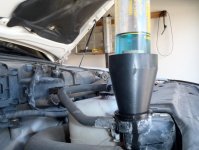
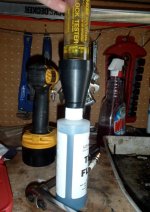
Just prior to doing this, warm up the engine and do a hydro carbon test on the coolant system. Your auto parts store should have the tester and the fluid. At least you can say you knocked that check out in regards to your concern about the HG. Blue fluid = no hydro carbons / Yellow fluid = hydro carbons present.

A failing T-Stat, leaking T-Stat could do it. The OEM coolant from my experiance seems to work a lot better in these toyota engines, so since you're going to be in there might as well change it.
 

Attachments

  • Screen shot 2013-09-02 at 9.07.41 AM.jpg
    Screen shot 2013-09-02 at 9.07.41 AM.jpg
    95.2 KB · Views: 985
  • Screen shot 2013-09-02 at 9.08.04 AM.jpg
    Screen shot 2013-09-02 at 9.08.04 AM.jpg
    74.5 KB · Views: 985
What is the likelyhood of this happening within a year? I performed the t-belt/ water pump service last year and emptied everything minus the engine block so, admittedly, there was some leftover orange (pink?) coolant in the system prior to introducing green coolant.
?

It's hard to say. I came from the landrover world and I saw several clogged radiators. Many of them had sludgy crap in them, it was linked to non compatible fluids. If it were my truck I would flush it completely and refill after with oem fluid.
 

Members online

Forum statistics

Threads
278,312
Messages
3,554,087
Members
248,016
Latest member
Advally Service

Trending content

Back
Top