High negative LTFT - fuel injectors? = SOLVED!

High negative LTFT - fuel injectors?

Go to the injectorshop.com and type Toyota 3.4l in the search box

I’m pretty sure this is the place I got them from. It’s like 15.95.


Sent from my iPhone using Tapatalk
 
Thanks for the great replies guys, I think you nailed it. I came to this thinking that since the LTFT changed from 0% to -18%, then something must be "wrong". But I think the reality is much simpler, and that like you are suggesting, the new injectors are simply flowing more fuel.

I dug up the data on my old injectors. Best as I can tell, the OEM 23250-62030 grey injectors for my '97 had a flow rate of 240 cc:


I "assumed" that the replacement injectors would flow the same, since their description claims that it's a "direct replacement". Although I was a little concerned by the fact that they list them for all 3rd Gen years, even though the '99-02 brown injectors flow more fuel than the grey '96-98 injectors:


So I did a bit more sleuthing, and lo and behold, the card included with my Osidetiger injectors showed that they flow 250 cc, not 240 cc like my old ones:


So do you think that the extra 4% fuel flow would account for the negative LTFT I'm seeing now?

I'm no physicist and don't fully know the effect of a fully atomized spray vs the stock stream pattern. My guess, and it's only a guess, is that the multi-hole injectors must interact differently with the O2 sensor than the stream spray. Perhaps the finer mist is easier to detect by the O2 sensor? It could be that these injectors are just that much more efficient to the tune of 14% that it's cutting back fuel that it doesn't need to inject anymore.

I am interested in the long-term effects of these injectors such as the MPG and 'butt dyno' power change, if any. I'm not always on the boards though so if you do post up anything to that extent can you shoot me a PM or mention me in the post so that I get a notification? I have had these injectors bookmarked as a possible injector upgrade for several years now but have not known anyone else that installed them. Like I had mentioned, I changed from a stream to spray injector on my old pickup and even that old thing showed a marked improvement.
 
I thought I had that kit info in there. Crap!

Edited - I found them at theinjectorshop.com, but only for '99-04, not 96-98. Maybe the rebuild kits are the same?

So I did some more diagnostics today, and I think I found a smoking gun (?). Or at least a symptom, though not the cause.

After taking off the TB, I found fuel on the metal gasket surface. Not a puddle, but definitely more than just fumes. There's also fuel inside the TB itself, right by the throttle plate. Pictures below.

I don't think there's any (good) reason for fuel to be in that area, correct me if I'm wrong? It seems to me that fuel in the TB (which should not be there) would richen the mixture and cause the LTFT drift.

I can see fuel getting there in only one of two ways - via the hoses from the charcoal canister, or via the IAC air passage around those %$#(*^$ing injectors.

I did run the truck earlier with all the hoses from the charcoal canister disconnected, and saw no change in the LTFT. Plus I'm not seeing any fuel in those hoses. So I'm more and more suspecting the injectors without that tip o-ring.

More editing: there's also fuel behind the metal gasket and inside the plenum. I also pulled off the air hose connecting the intake plenum to the IAC. It's hard to see, but there's definitely fuel in there, and a strong smell of raw gas. I don't see any (good) reason for fuel to be in the IAC air circuit.

Thoughts?

067jBBph.jpg


B5PZjB2h.jpg


SgMtMfVh.jpg


0WJAqYsh.jpg


HcfJFsJh.jpg


3Fp1gbqh.jpg
 
Last edited:
Edited - I found them at theinjectorshop.com, but only for '99-04, not 96-98. Maybe the rebuild kits are the same?

So I did some more diagnostics today, and I think I found a smoking gun (?). Or at least a symptom, though not the cause.

After taking off the TB, I found fuel on the metal gasket surface. Not a puddle, but definitely more than just fumes. There's also fuel inside the TB itself, right by the throttle plate. Pictures below.

I don't think there's any (good) reason for fuel to be in that area, correct me if I'm wrong? It seems to me that fuel in the TB (which should not be there) would richen the mixture and cause the LTFT drift.

I can see fuel getting there in only one of two ways - via the hoses from the charcoal canister, or via the IAC air passage around those %$#(*^$ing injectors.

I did run the truck earlier with all the hoses from the charcoal canister disconnected, and saw no change in the LTFT. Plus I'm not seeing any fuel in those hoses. So I'm more and more suspecting the injectors without that tip o-ring.

More editing: there's also fuel behind the metal gasket and inside the plenum. I also pulled off the air hose connecting the intake plenum to the IAC. It's hard to see, but there's definitely fuel in there, and a strong smell of raw gas. I don't see any (good) reason for fuel to be in the IAC air circuit.

Thoughts?

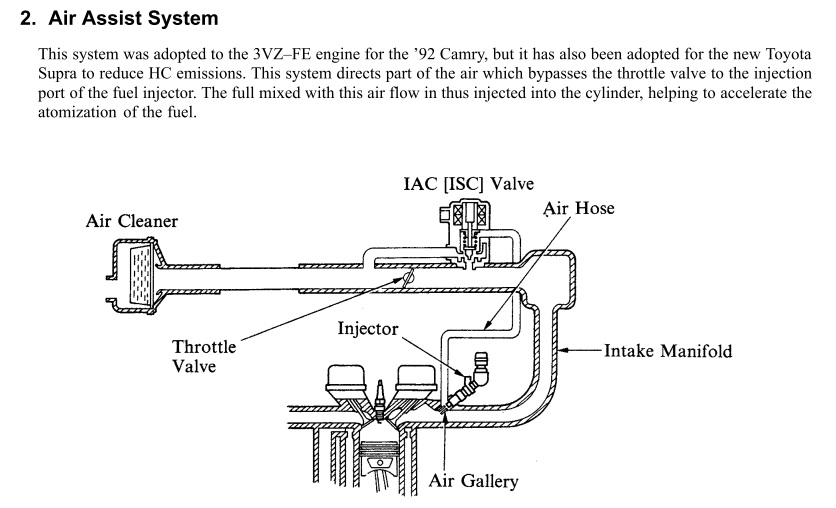
Oh, no! Yes, that would make sense. I just saw the photo comparison before seeing this and that would most definitely cause problems. The Toyota Air-Assist system looks like this:

432315d1307578359-injector-atomization-pipe-2jz_atomization_2.jpg


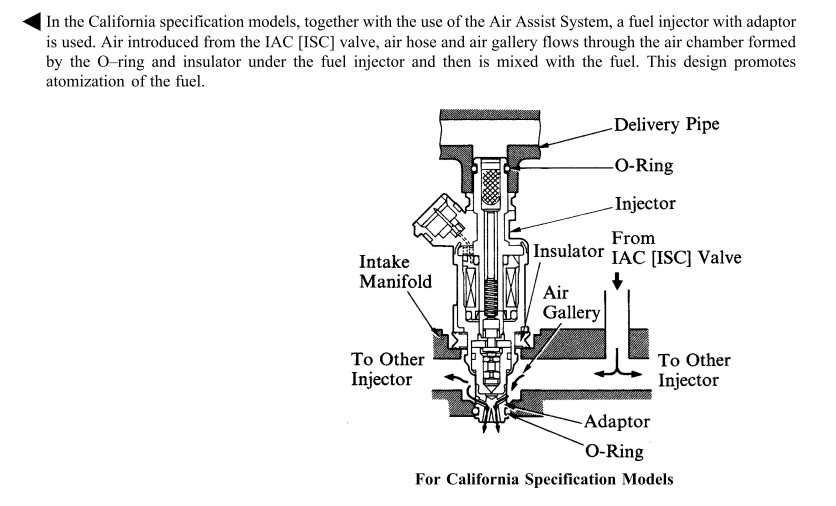
And the injector close up is like this:

432314d1307578359-injector-atomization-pipe-2jz_atomization.jpg


Without that lower o-ring it creates a vacuum leak with the lower intake manifold and the air-assist system itself. Fuel mixture would then go through the IAC and, you found it, right into the throttle body.

Before you go through all the work of pulling out the injectors, try this - put vacuum caps over the black hose with no clamps that comes out of the back of the IAC. The coolant hoses have clamps, leave those alone. Put a cap on the metal pipe coming out of the IAC. Then the hose snakes around and goes into the very back of the intake manifold on each fuel bank. Again, no clamp on it just pull it off and put a vacuum cap on both metal pipes. That will eliminate this vacuum leak that's allowing fuel back into the intake. Then drive it around and see if those numbers change.

EDIT: If you are in communication with the seller, you can share those diagrams. That will alert him of the problem. He's probably not aware of how the Toyota Air Assist system works as it's a rather old piece of tech that was used sporadically on Toyota models. All 5VZ-FE engines have it.
 
Last edited:
[MENTION=115347]gamefreakgc[/MENTION], yup, I think we're on the same page. I think these injectors are just not suited for my engine, as they create a path for fuel to get into the throttle body. It's odd though because when I discussed this with the seller, he was fully aware of this air assist system and just kept saying that their injectors don't need it.

I just ran the experiment, with that IAC air hose disconnected and plugged, and the IAC port capped. Nothing changed in the STFT or LTFT values.

So now what?
 
Last edited:
[MENTION=115347]gamefreakgc[/MENTION], yup, I think we're on the same page. I think these injectors are just not suited for my engine, as they create a path for fuel to get into the throttle body. It's odd though because when I discussed this with the seller, he was fully aware of this air assist system and just kept saying that their injectors don't need it.

I just ran the experiment, with that IAC air hose disconnected and plugged, and the IAC port capped. Nothing changed in the STFT or LTFT values.

So now what?

When I think it through a bit more, and look at the diagrams you posted, it's hard to picture fuel flowing from the manifold to the IAC, since that's opposite of the "vacuum" direction. So most likely the fuel I'm seeing in the IAC hose is not moving from the manifold to the TB like I thought, but from the TB to the manifold.

So why is there fuel in the TB?

I responded in the PM but I'll put a short version here for others helping. I think there's air flowing backwards through the air assist as the pressure of the lower intake manifold, even under vacuum, is higher than the air assist and causing it to flow backwards. It can happed also for those of us with supercharged engines although that's under boost and may not be the same scenario.

Now that you have that hose capped, it would be good to see if there's still fuel in the throttle body after repeating whatever drive cycle you did before to find the fuel in the first place. As the seller said, you don't need the air assist and that's the only function of that hose that you removed.
 
Good idea, I'll do a little drive with the IAC air hose disconnected and see if that eliminates the fuel in the TB.

Also, it hit me this morning that while there was fuel in the TB on the downstream side of the throttle plate, the upstream side of the plate was completely dry. So I think that eliminates the possibility of fuel coming into the TB through the air duct via EVAP hoses.

So the fuel is either coming into the TB through the IAC hose, or through a reverse flow in the intake plenum - the latter seems almost physically impossible.
 
Good idea, I'll do a little drive with the IAC air hose disconnected and see if that eliminates the fuel in the TB.

Also, it hit me this morning that while there was fuel in the TB on the downstream side of the throttle plate, the upstream side of the plate was completely dry. So I think that eliminates the possibility of fuel coming into the TB through the air duct via EVAP hoses.

So the fuel is either coming into the TB through the IAC hose, or through a reverse flow in the intake plenum - the latter seems almost physically impossible.


What if an intake valve is hanging open?


Sent from my iPhone using Tapatalk
 
What if an intake valve is hanging open?


Sent from my iPhone using Tapatalk

I thought about that too. Having the injectors unsealed could give the air/fuel mix a shortcut straight to the throttle body. It's possible. I think he'd have some other major symptoms though.
 
I have a fairly negative opinion of these fuel injectors that supposedly have better spray patterns. I tried some injectors from Flamethrower and my truck ran like crap. He sent me another set and same result. I threw the stock injectors back in and it ran perfectly.


Sent from my iPhone using Tapatalk
 
I have a fairly negative opinion of these fuel injectors that supposedly have better spray patterns. I tried some injectors from Flamethrower and my truck ran like crap. He sent me another set and same result. I threw the stock injectors back in and it ran perfectly.


Sent from my iPhone using Tapatalk

Oh, that is surprising and unfortunate. The Flamethrowers in my 91 Pickup with the 3VZ-E engine did amazing. He sold so many of those sets. It even increased MPG's. Sorry to hear that the 5VZ-FE ones were no good.
 
I'm sending my original injectors to MotorWest to be cleaned, then will put them back in as soon as I get all the gaskets and crush washers delivered. Can't wait to see what that does to my LTFT (not to mention the fuel in the TB).
 
Last edited:
I'm sending my original injectors to MotorWest to be cleaned, then will put them back in as soon as I get all the gaskets and crush washers lined up. Can't wait to see what does that to my LTFT (not to mention the fuel in the TB).

I think it will fix your problem. Toyota definitely put that bottom oring there for a reason, it was even on both injector designs..
 
I'm sending my original injectors to MotorWest to be cleaned, then will put them back in as soon as I get all the gaskets and crush washers delivered. Can't wait to see what that does to my LTFT (not to mention the fuel in the TB).
I think you'll be quite happy with the results... Stock Toyota/Denso fuel injectors are very reliable, but can get dirty. A good cleaning (not just a bottle in the tank) does wonders in those situations.

-Charlie
 
I think you'll be quite happy with the results... Stock Toyota/Denso fuel injectors are very reliable, but can get dirty. A good cleaning (not just a bottle in the tank) does wonders in those situations.

-Charlie


Most of the good cleaning is replacing the inlet screens. They are a very low micron.


Sent from my iPhone using Tapatalk
 
[MENTION=636945]Spiker Engineering[/MENTION] Sorry for your woe's, Thanks for the possible What not to do thread. :)

Good info, Injectors are in my future Oside MotoWest experience worth hearing!
 
[MENTION=636945]Spiker Engineering[/MENTION] Sorry for your woe's, Thanks for the possible What not to do thread. :)

Good info, Injectors are in my future Oside MotoWest experience worth hearing!

My pleasure, I'm always happy to share any good tips I learn along the way, even if its via the school of hard knocks.

I'm still withholding my final position on this until I get the cleaned OEM injectors back in, then we'll see :).
 
My pleasure, I'm always happy to share any good tips I learn along the way, even if its via the school of hard knocks.

I'm still withholding my final position on this until I get the cleaned OEM injectors back in, then we'll see :).


My Saturn always runs negative fuel trims. -10 to -15 at idle to -3 to -8 while driving.


Sent from my iPhone using Tapatalk
 

Members online

No members online now.

Forum statistics

Threads
278,310
Messages
3,554,080
Members
248,016
Latest member
Advally Service

Trending content

Back
Top