High negative LTFT - fuel injectors? = SOLVED!

Spiker Engineering

official vendor
Edited 6/9/23 - Yup, it ended up being the aftermarket fuel injectors causing the high negative LTFT.

Original Post:

I'm tracking down my next gremlin after the engine bay refresh - high negative LTFT. I'm seeing about -18%. Prior to the project it hovered around 0%.

So it's running rich, which I think eliminates causes such as vacuum leaks. At this point, I'm strongly suspecting the new fuel injectors I put in, which are the Osidetiger injectors - eBay

They claim to be genuine Denso, with a modified spray pattern to improve atomization. So they don't have that lower o-ring that the OEM injectors have, because they supposedly don't need the atomization boost. That bothered me at first, because that seems to open a potential leak path of fuel back into the intake. But Charlie at Osidetiger convinced me that that's not an issue. Another thing that still bothers me is that these injectors are said to be for '96-02, but I thought that OEM units are different for '96-98 and '99-02. So are these truly one-size fits all, or am I perhaps getting too much fuel because of that?

FWIW, I read this very similar thread which ended up being fuel injector related - What causes a -20% fuel trim? | Tacoma World

So, having ruled everything else out (I think), I'm planning to tear these out and put my OEM injectors back in, to see how that changes the LTFT.

Is there anything else I should be looking at before tearing into the injectors? All other readings look normal to me (MAF, throttle, load), here's the data at idle. Is there anything here that I should be concerned about, other than LTFT?

F7OL8HBh.jpg
 
Last edited:
Register to hide this ad
Since it’s at idle and it’s not coding for it it could be excessive fuel vapor from the EVAP system.

We’re you in gear or is that rpm in park/neutral?

My Saturn on occasion will go negative 13-15 at idle and go back to normal during a drive.

You could always throw a bottle of good injector cleaner in it and see if anything changes.


Sent from my iPhone using Tapatalk
 
I would say you are on the correct track..:-) Makes logical since its the injectors. Always pluses and minuses for using aftermarket parts.
 
Pulling the EFI fuse under the hood for a minute or two will reset the ecu and the ltft data memory. Long shot but could work.
 
Since it’s at idle and it’s not coding for it it could be excessive fuel vapor from the EVAP system.

We’re you in gear or is that rpm in park/neutral?

My Saturn on occasion will go negative 13-15 at idle and go back to normal during a drive.

You could always throw a bottle of good injector cleaner in it and see if anything changes.

That reading is at idle in gear. When I rev the engine, the LTFT does drop, but from everything I read, LTFT readings only make sense at idle, not at higher RPM.

And again, the LTFT was at 0% before my project. So something changed pretty drastically.

Interesting point about EVAP, I did consider it (since I removed/replaced all hoses, and replaced one of the valves). I ran the engine with all the EVAP hoses disconnected for a bit (to get the canister out of the equation), and the LFTF did not change. So I think (?) that clears the EVAP pressure as a culprit.
 
I would say you are on the correct track..:-) Makes logical since its the injectors. Always pluses and minuses for using aftermarket parts.

Thanks, we'll soon find out. I'll be less than happy (to say the least) if it turns out to be these injectors, although I'll be happy to have found the cause.
 
Pulling the EFI fuse under the hood for a minute or two will reset the ecu and the ltft data memory. Long shot but could work.

Thank you, I should have mentioned this upfront - I did pull the EFI fuse to clear the ECU. After that, the STFT immediately shot up from 0% to -18%, and within a minute pulled the LTFT up from 0% to -18%. So the issue is still there, not an artifact of a prior fault.
 
I ignore the STFT because it’s insignificant in the overall fuel map.

Does it (LTFT) go to normal when driving or does it still show a lot of fuel trim pull back.

I’ve considered the LTFT in all aspects of driving.

Have you pulled all the spark plugs and looked at how even the signature is?
81065b82bdf7cf27a3b7b2af7823a8dc.jpg

This is a good burning plug. Anything darker is rich and anything lighter is lean.

I rebuilt my old injectors……it’s too easy to do. The kit is cheep.


Sent from my iPhone using Tapatalk
 
The max the ECU can compensate is a bit higher than what you are seeing. Although it's not normal levels, you did significantly change the fueling system. In my experience, you'll only get codes at over +/-30% LTFT. I also think these injectors were sized bigger than before. The seller claims more power and torque and I suppose that's due to slightly oversizing the injectors for more fuel at open loop. Does it feel like you have more power when you floor it? If yes that would confirm my suspicion. I recommend looking into ways to increase the airflow. Taking out the intake elbow on the stock airbox is a good start. More air coming in = more fuel needed and your LTFT will go down as it'll start to need that extra fuel.

In my OBD-I 91 Toyota Pickup with the 3VZ-E engine I did a similar injector change. I put in 12-hole Flamethrower injectors into my engine replacing the 2 stream style injectors. I gained more power but the thing would run rich and throw a code. I had to manually adjust the VAF sensor 3 clicks back on the gear to reduce tension on the vane-style sensor (I had also put a Supra VAF on it). All that to say these little fuel and air upgrades are worth the effort in the long run but require a little more work than advertised. That being said, you could run it another 30 years like you have it at -18% LTFT. There's nothing wrong with it except for causing anxiety for those with OCD tendencies, which I include myself in that statement.
 
The max the ECU can compensate is a bit higher than what you are seeing. Although it's not normal levels, you did significantly change the fueling system. In my experience, you'll only get codes at over +/-30% LTFT. I also think these injectors were sized bigger than before. The seller claims more power and torque and I suppose that's due to slightly oversizing the injectors for more fuel at open loop. Does it feel like you have more power when you floor it? If yes that would confirm my suspicion. I recommend looking into ways to increase the airflow. Taking out the intake elbow on the stock airbox is a good start. More air coming in = more fuel needed and your LTFT will go down as it'll start to need that extra fuel.

In my OBD-I 91 Toyota Pickup with the 3VZ-E engine I did a similar injector change. I put in 12-hole Flamethrower injectors into my engine replacing the 2 stream style injectors. I gained more power but the thing would run rich and throw a code. I had to manually adjust the VAF sensor 3 clicks back on the gear to reduce tension on the vane-style sensor (I had also put a Supra VAF on it). All that to say these little fuel and air upgrades are worth the effort in the long run but require a little more work than advertised. That being said, you could run it another 30 years like you have it at -18% LTFT. There's nothing wrong with it except for causing anxiety for those with OCD tendencies, which I include myself in that statement.
What does the cat do with the extra richer fuel? Just burn it up or does it itself burn out or through? I am just curious. :)

Sent from my SM-A536V using Tapatalk
 
The "right" way to do this is to take your old and new injectors and send them out to get cleaned and tested... That'll tell you spray patterns, flow, etc. RC Fuel Injection did my 3s-gte injectors a couple years back. They weren't in great shape since that car sits a lot...

Cd0Vkp5h.jpg


I'm guessing along with others that the new injectors just flow more.

-Charlie
 
What does the cat do with the extra richer fuel? Just burn it up or does it itself burn out or through? I am just curious. :)

Sent from my SM-A536V using Tapatalk

It isn't actually running rich. The O2 sensor sees that extra fuel is put in so the ECU is pulling fuel out which we see as the -18% LTFT. It's perfectly stoich at the correct fuel ratio just like the stock injectors were before. The O2 sensor is king when it comes to fuel adjustments, followed by the MAF sensor. There is no longevity or fuel issues. The plugs will come back clean and not fouled as it is all within the ECU's range to adjust.

The only time it'll run rich is in open loop when the ECU ignores the O2 sensor under open loop. It then relies entirely on the MAF sensor and pre-set fuel values which are now modified with higher flowing injectors. He'll see 18% more fuel under open loop than compared to his stock injectors. That's how drop-in Toyota Supra injectors work for the supercharged version of our engine, completely tame and stock around town and then extra fuel when you stomp on the throttle. Kind of like a poor man's tune.
 
It isn't actually running rich. The O2 sensor sees that extra fuel is put in so the ECU is pulling fuel out which we see as the -18% LTFT. It's perfectly stoich at the correct fuel ratio just like the stock injectors were before. The O2 sensor is king when it comes to fuel adjustments, followed by the MAF sensor. There is no longevity or fuel issues. The plugs will come back clean and not fouled as it is all within the ECU's range to adjust.

The only time it'll run rich is in open loop when the ECU ignores the O2 sensor under open loop. It then relies entirely on the MAF sensor and pre-set fuel values which are now modified with higher flowing injectors. He'll see 18% more fuel under open loop than compared to his stock injectors. That's how drop-in Toyota Supra injectors work for the supercharged version of our engine, completely tame and stock around town and then extra fuel when you stomp on the throttle. Kind of like a poor man's tune.
Ok..:)

Sent from my SM-A536V using Tapatalk
 
Thanks for the great replies guys, I think you nailed it. I came to this thinking that since the LTFT changed from 0% to -18%, then something must be "wrong". But I think the reality is much simpler, and that like you are suggesting, the new injectors are simply flowing more fuel.

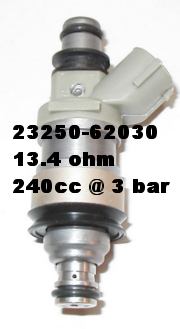
I dug up the data on my old injectors. Best as I can tell, the OEM 23250-62030 grey injectors for my '97 had a flow rate of 240 cc:

d2325062030.jpg


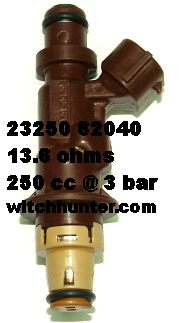
I "assumed" that the replacement injectors would flow the same, since their description claims that it's a "direct replacement". Although I was a little concerned by the fact that they list them for all 3rd Gen years, even though the '99-02 brown injectors flow more fuel than the grey '96-98 injectors:

d2325062040.jpg


So I did a bit more sleuthing, and lo and behold, the card included with my Osidetiger injectors showed that they flow 250 cc, not 240 cc like my old ones:

DoJGbeIh.jpg


So do you think that the extra 4% fuel flow would account for the negative LTFT I'm seeing now?
 
Just get injectors from Motorwest Performance and call it a day. Beware fake OEM injectors sold on Ebay. If the price is too good to be true, that's because it is. I hate to say it Leon, but buying off Ebay was probably a mistake. Even though the ones you got look the same as the ones Motorwest sells, it's my guess they're inferior.

I have been referring people to Motorwest Performance for years and I have not heard one negative thing said about them on Toyota forums or Toyota Facebook pages. They come very highly recommended.

<iframe width="560" height="315" src="https://www.youtube.com/embed/N-lhZIWOkyU" title="YouTube video player" frameborder="0" allow="accelerometer; autoplay; clipboard-write; encrypted-media; gyroscope; picture-in-picture; web-share" allowfullscreen></iframe>
 
Last edited:
The old grey 96-98 and the new 99-02 injectors are interchangeable. The Osidetiger injectors 250cc at 43 psi is right in line with oem but I suspect they are faulty. The pcv valve good? If it we're clogged it would throw of the ltft.
 
Just get injectors from Motorwest Performance and call it a day. Beware fake OEM injectors sold on Ebay. If the price is too good to be true, that's because it is. I hate to say it Leon, but buying off Ebay was probably a mistake. Even though the ones you got look the same as the ones Motorwest sells, it's my guess they're inferior.

I have been referring people to Motorwest Performance for years and I have not heard one negative thing said about them on Toyota forums or Toyota Facebook pages. They come very highly recommended.

Hey Tim, I think that Osidetiger is nothing like many ebay sellers who sell fake "OEM" injectors, but who knows. I don't really have a way to test them, and don't really feel like doing it.

If I can't figure out the issue and if I put my old ones back in and the LTFT goes back to 0%, I may just keep the originals in there, or get a set from Motorwest; I've bookmarked them long ago thanks to your video.

The old grey 96-98 and the new 99-02 injectors are interchangeable. The Osidetiger injectors 250cc at 43 psi is right in line with oem but I suspect they are faulty. The pcv valve good? If it we're clogged it would throw of the ltft.

That's helpful - so the ~10 cc difference would not be causing this much of an LTFT change?

I did check the PCV, it's clean as a whistle. Thanks for the tip.
 
My 97 SR5 repair thread shows how to rebuild them yourself

Thanks, I may give that a shot. Where did you get the repair kit, I couldn't find that info.

Browsing your thread, especially this post, brought up the very concern I had with my new injectors even before putting them in.

As you noted, the OEM injectors have an o-ring at the tip, to seal around that passage that connects to the IAC air passages. The new injectors I have do not have that o-ring:

ooG5Aadh.jpg


I discussed this with the vendor even before putting the injectors in, and he assured me that their improved design does not need that bypass air to go through, so they don't need the o-ring. That made sense to me.

But there's something about this setup that bothers me. It seems that Toyota designed the system to isolate the fuel spray from the IAC air tube by means of those o-rings. Removing the o-rings, while perhaps OK from the standpoint of atomization, now creates a theoretical fuel passage from the injectors to the IAC air, which I wouldn't think is a good idea.

I'm going to put the old injectors back in today and see what happens.
 
I personally only use oem injectors with toyota seals. My thought is they lasted this long. They have to be decent quality. :)

Sent from my SM-A536V using Tapatalk
 

Members online

No members online now.

Forum statistics

Threads
278,309
Messages
3,554,071
Members
248,016
Latest member
Advally Service

Trending content

Back
Top