How do I run high current wires to my trailer?

180amps?! WTH are you trying to do, charge a Tesla while you haul it cross country?!
I also very much hope that you already have the DC Power & Engineering 270amp alternator installed. Otherwise drawing that much power, even on surge, is going to kill your truck battery and/or the OEM alternator eventually. Even with the 270A you're going to need "the big three upgrade" AND a dedicated run to the trailer to handle that level of amperage. Obviously the 7-pin trailer connector isn't good enough as it's only fused at 30A.
[MENTION=149860]Discovery[/MENTION] ran an 8AWG line with Anderson connectors to his trailer seen in this thread.

How big of a cable you need for the 180A at 14v is really a question of length. I always try to use a voltage drop calculator like this one. Just ensure you've got it set to DC 14v at the start, and to account for any vertical distance as well as horizontal. You can change the cable size and watch the voltage drop increase or decrease. Remember that LiPO usually require 13.5+v in order to charge properly, so you're not going to have much tolerance for that voltage drop. Having the LiPO near the tongue of the trailer will simplify your voltage problem by reducing the overall distance.
 
Thanks all for your comments. I'm building a LIFEPO4 battery pack with a 180A BMS. And yes, I have upgrade my alternator to handle the current output. My thinking is that after a few days camping in one spot, I only need to drive about 2 to 3 hours to fully top off the batteries. Specifically I was asking how I should route the wires to the hitch. Do other people zip tie the cables to the frame? What other method is best to secure the cable? Where along the frame is best to mount the wire?

TIA
 
Thanks all for your comments. I'm building a LIFEPO4 battery pack with a 180A BMS. And yes, I have upgrade my alternator to handle the current output. My thinking is that after a few days camping in one spot, I only need to drive about 2 to 3 hours to fully top off the batteries. Specifically I was asking how I should route the wires to the hitch. Do other people zip tie the cables to the frame? What other method is best to secure the cable? Where along the frame is best to mount the wire?

TIA

having a 180A BMS does not mean that you can just connect it to your vehicle in a dual battery setup and charge at 180 Amps, you still need a DC-DC charger that is rated for Lithium and the amperage capacity of the wiring will need to match the charging capacity of your DC-DC charger
 
having a 180A BMS does not mean that you can just connect it to your vehicle in a dual battery setup and charge at 180 Amps, you still need a DC-DC charger that is rated for Lithium and the amperage capacity of the wiring will need to match the charging capacity of your DC-DC charger

Lol

You hit the nail on the head lifep04 batteries have a circuit (built into the battery) to control charge and discharge rates

You could put a million amps and 2 million volts at it and the on board circuit controls the Amps and voltage rate... So most of these batteries have like a peak 20 amp charge at 60% DOD . What are you going to do with the extra 160 lol
 
Lol

You hit the nail on the head lifep04 batteries have a circuit (built into the battery) to control charge and discharge rates

You could put a million amps and 2 million volts at it and the on board circuit controls the Amps and voltage rate... So most of these batteries have like a peak 20 amp charge at 60% DOD . What are you going to do with the extra 160 lol

In case ha wants a spectacular meltdown. Need amps for that. 20A is meh. :D
 
he specifically mentioned 180Ah and wanted to put it on a trailer. i would say he will need around 25-30 foot wire from the front to the trailer. a 6 gauge wire is what is needed and a 25A dc-dc charger and a 6 gauge wire.

in my case, i have another agm battery with at least 70Ah and i use a redarc 25A dc-dc charger to charge it and used only 15 feet of wire and it works really great during my road trip. the op i think still don't understand it yet but he will once he starts his project.


why are you recommending a wire gauge without knowing anything about the charging capacity of whatever charge controller he is using?
 
he specifically mentioned 180Ah and wanted to put it on a trailer. i would say he will need around 25-30 foot wire from the front to the trailer. a 6 gauge wire is what is needed and a 25A dc-dc charger and a 6 gauge wire.

he actually said 180 Amps, that's why everyone is confused


(and didn't say he has a 25A dc-dc charger)
 
Lol

You hit the nail on the head lifep04 batteries have a circuit (built into the battery) to control charge and discharge rates

You could put a million amps and 2 million volts at it and the on board circuit controls the Amps and voltage rate... So most of these batteries have like a peak 20 amp charge at 60% DOD . What are you going to do with the extra 160 lol

I have a Daly BMS charger that is capable of charging LIFEPO4 at 180Amp at the correct voltages. The battery is capable of handling 280Amps of charging.
 
probably the discharge rating, but more importantly you still need something protecting your starting battery
 
Are you sure you are doing it right?

What am I doing wrong? The BMS should be able to charge at the correct voltages and current. And the batteries I have are well over the limits of the BMS. Should I connect the BMS to a DC/DC charger? What are the disadvantages or dangers of connecting the BMS directly to the alternator?

TIA
 
are you building your own lifepo4 battery with bms on it? give us the details on what hardware you currently have.

What am I doing wrong? The BMS should be able to charge at the correct voltages and current. And the batteries I have are well over the limits of the BMS. Should I connect the BMS to a DC/DC charger? What are the disadvantages or dangers of connecting the BMS directly to the alternator?

TIA
 
Last edited:
Per your original question about wire, I would research someplace like WiringDepot. Maybe Marine wire or SXL Cross-Linked wire. Consider enclosing it in sheathing or some kind of flexible conduit if running it externally.

Wire & Cable
 
I am looking at the thread and still do not see the answer to the question of what is the best path to run cables from the battery to the back of the car,

I am getting started on my project where I have a DC Power Alternator running through a CB and relay to an Anderson connector on the rear of the car.

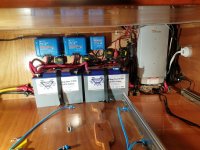
The Alternator is installed but still have not found the perfect path to run the cables. My trailer has 2- 100 amp LiFe batteries and 2- 30 amp Victron Orion Smart controllers, and will be a 50 ft run, So the cable is quite large ( 2/O) and I still want to protect it .

Any Pictures?
 
the best path for your wiring is through the frame. inside will be best to protect it from the elements, outside too is okay and use a wireloom and zip tie it and make sure it's not loose anywhere. make sure it's not in the way when you need to do maintenance to the car.

I am looking at the thread and still do not see the answer to the question of what is the best path to run cables from the battery to the back of the car,

I am getting started on my project where I have a DC Power Alternator running through a CB and relay to an Anderson connector on the rear of the car.

The Alternator is installed but still have not found the perfect path to run the cables. My trailer has 2- 100 amp LiFe batteries and 2- 30 amp Victron Orion Smart controllers, and will be a 50 ft run, So the cable is quite large ( 2/O) and I still want to protect it .

Any Pictures?
 
the best path for your wiring is through the frame. inside will be best to protect it from the elements, outside too is okay and use a wireloom and zip tie it and make sure it's not loose anywhere. make sure it's not in the way when you need to do maintenance to the car.

Thanks,

This is good direction, So far I saw a YouTube video of a F150 job yesterday. The cables are big and if done right could be fairly clean.

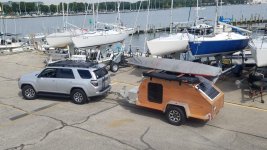
Before posting, I Put my T4R on the lift and took a 5 minute look and decided this would need some research and experience of others to do it the cleanest way possible. On my trailer I used stainless cable clamps and drill tapped machine screws into the frame for the power and tie-wrapped the ground to it, Keeping it inside the frame so it would never ground out .
 

Attachments

  • 20211004_122521.jpg
    20211004_122521.jpg
    145.3 KB · Views: 287
  • 20220220_174006.jpg
    20220220_174006.jpg
    130.1 KB · Views: 307
Last edited:
Attempting to resurrect this thread to see if anyone else has run higher gauge wires to the rear for their trailer. I am installing a Bluetti Charger 1 in our camping trailer. Believe I plan on running 2awg wires x 2, with an anderson connector at the trailer hitch. Could not find many people who did this.
 

Members online

No members online now.

Forum statistics

Threads
278,316
Messages
3,554,120
Members
248,016
Latest member
Advally Service

Trending content

Back
Top