How Does VVTI Technology Work?

JP4RNR

New member
I am trying to understand the concept of VVTI. The part I am having trouble understanding is the idea of variable valve timing. How can valve timing be variable? When installing a timing belt the alignment of the timing gears has to be precise as even a tooth off the engine will barely run and so by this logic if you vary the timing of the valves, how does the valve timing of the engine remain intact with VVTI if the timing is varied? Is changing the timing belt on a VVTI engine more complicated?

 
Register to hide this ad
Found this info on TIS.
Summary:

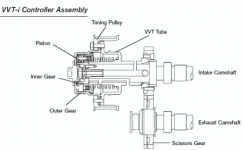
VVT-i actually changes the movement of the intake camshaft ever so slightly. A VVT-i controller is attached to the end of the intake camshaft using hydraulics (pressurized engine oil) and gears to make the timing of the camshaft change.

Details:

VVT-i uses the crankshaft position sensor and Variable Valve Timing (V V T ) sensors (camshaft position sensor) to measure the amount of camshaft movement. This feedback is necessary for the ECM to know how much and which direction to move the camshaft, and for diagnosis.

A continuously variable valve timing mechanism, called a VVT-i controller or actuator, is used to adjust the camshaft from the starting stage to the high speed traveling state.
 

Attachments

  • vvt-i controller.gif
    vvt-i controller.gif
    20.5 KB · Views: 5,170
Last edited:
(continued...)

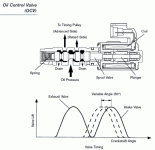
The Camshaft Timing Oil Control Valve (OCV), controlled by the ECM, directs engine oil pressure to the advance or retard side of the VVT-i controller. The spool valve position is determined by the magnetic field strength opposing the spring. As the ECM increases the pulsewidth (duty ratio), the magnetic field moves the spool valve overcoming spring pressure and directing more oil to the advance side. To retard the timing, the ECM decreases the pulsewidth, and spring pressure moves the spool valve towards the retard position. When the desired camshaft angle is achieved, the ECM will generate a pulsewidth signal to move the spool valve to hold position. In the hold position, the oil is trapped in the controller maintaining the desired angle. When the engine is stopped, the spring pushes the spool valve to the most retarded state.
 

Attachments

  • vvt-i oil control valve.gif
    vvt-i oil control valve.gif
    32.8 KB · Views: 10,959

Members online

No members online now.

Forum statistics

Threads
278,306
Messages
3,554,045
Members
248,016
Latest member
Advally Service

Trending content

Back
Top