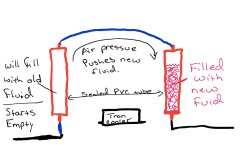
The only thing I can think is the pressure of the outlet is pushing in the new fluid. So it doesn't have to suck it up because it is still a closed system.
Sent from the drivers seat of my 05 4runner.

That's a good point. I didn't think about the pump pushing, rather than pulling.
So theoretically, if I were to do the bucket meathod, the pump would drain, but not fill. I wander what kind of pressure those lines build... I could probably build a closes pressure PVC pipe system to get the same affect as the thing they used. Hold on and I'll draw my theory out.
@%1; does the pump push rather than pull? Do you know?
Edit:
View attachment 217988
Pardon the roughness. I did this quickly on my phone. The blue would represent clear lines which could be used to monitor old vs new fluid.
Be gentle. I'm at work, so only so much time to think through this.

You'd need a barrier and a hydraulic fluid of some type between the chambers, the air would just compress in your diagram.
That's a good point. I didn't think about the pump pushing, rather than pulling.
So theoretically, if I were to do the bucket meathod, the pump would drain, but not fill. I wander what kind of pressure those lines build... I could probably build a closes pressure PVC pipe system to get the same affect as the thing they used. Hold on and I'll draw my theory out.
@%1; does the pump push rather than pull? Do you know?
Edit:
View attachment 217988
Pardon the roughness. I did this quickly on my phone. The blue would represent clear lines which could be used to monitor old vs new fluid.
Be gentle. I'm at work, so only so much time to think through this.
You'd need a barrier and a hydraulic fluid of some type between the chambers, the air would just compress in your diagram.
It is physically impossible to compress air in a closed system. The air would pressurise and force the new fluid into the return line.
Edit: I think you mean the system will decompress somehow, but the whole system would be sealed
It is absolutely possible to compress air in a sealed system although, what you drew may work depending on how much resistance the new fluid encounters while being pushed into the transmission. A hydraulic/hydraulic setup that uses a floating piston like that earlier pic would be ideal as there is no way to compress a liquid such as ATF, so what you put in is what you get out.
Except that the transmission and associated cooling lines are NOT liquid full. You cannot guarantee you're replacing equal amounts.
Any idea what kind of machine was used to flush your transmission? Did the machine "force" the new fluid in the transmission, or did it use the transmission to suck in new fluid? Also was this at a Toyota dealer, or a independent shop? Still on the fence as to full flush, or repeated drain and fills on mine.Was having issue's with my trans, 220k miles, and I went in and had a full flush done. The old fluid was brown and sludge! All my issue's have gone away now and it shifts like new! Wish I had done it when I first bought the truck, but I just didn't think of it. New fluid on top, old crappy stuff on bottom!
<a data-flickr-embed="true" href="https://www.flickr.com/photos/132186222@N08/28963647370/in/datetaken/" title="20160826_165942"><img src="https://c3.staticflickr.com/9/8024/28963647370_48ca4e720d_z.jpg" width="480" height="640" alt="20160826_165942"></a><script async src="//embedr.flickr.com/assets/client-code.js" charset="utf-8"></script>
It was an independent oil change shop. You'll never see me touch a stealership outside of warranty work that I deem necessary. I've worked for two different dealerships and very few mechanics, 2 out of 30 in my experiences, knew more than I do. (side note, I was extremely interested in trucks growing up and worked with my uncle, a master auto and diesel mechanic, for quite a few years and I have always done my own work)Any idea what kind of machine was used to flush your transmission? Did the machine "force" the new fluid in the transmission, or did it use the transmission to suck in new fluid? Also was this at a Toyota dealer, or a independent shop? Still on the fence as to full flush, or repeated drain and fills on mine.
It is absolutely possible to compress air in a sealed system although, what you drew may work depending on how much resistance the new fluid encounters while being pushed into the transmission. A hydraulic/hydraulic setup that uses a floating piston like that earlier pic would be ideal as there is no way to compress a liquid such as ATF, so what you put in is what you get out.
Except that the transmission and associated cooling lines are NOT liquid full. You cannot guarantee you're replacing equal amounts.
If they're not liquid filled, what's in them? If you use two cylinders that were both marked, you should be able to tell how much is coming out vs. how much is being pushed back in. Of course you would want to verify the level using the temp check method and add or drain as needed.
Can anyone else confirm that the pump PUSHES fluid to the transmission cooler, as opposed to pulling FROM the cooler?
agreed.I think BlackWorksInc said this, and I may be paraphrasing, but it makes sense one way or the other - to us, "lifetime" means as long as the vehicle lasts. To the manufacturer, it means the time they're responsible to fix it if something goes wrong.
yep. I was just coming in here to say just that.Then there's this quote from "They Convince You They Use A Lifetime Fluid!", which is the very first item on this list titled Eight Ways Automakers Make Cars Obsolete: When automakers use the term "lifetime" to describe their engine coolant and transmission fluids, they strictly mean the lifetime of their warranty.
Finally, we must always consider the potential consequences, which in this case is transmission malfunction or failure. I'll take the most conservative approach to preventing that and just change the fluid.
Haynes repair manual.