1engineer
Moderator
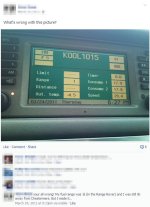
I have read comments in another current thread about this 4Runner function from several members. Rather than clutter up another thread with a description I sat down last night to try to explain the logic of this device and hopefully it will help some of you new guys.
Here is a quote on my explanation from awhile back:
It does not work that way. This is just supposition on my part but here is how I think it works:
Your "miles to empty" readout uses an average of several (let's call it 1000) hundred miles and in conjunction with your "mpg" readout calculates an approximate miles to empty.
You can watch your "miles to empty" readout and your odometer and they will not be 1:1. Sometimes you can go several miles and your "miles to empty" remains the same. Now, if you reset your average mpg that function will reset but the miles to empty does not take the new numbers into effect except as part of an average.
I normally get about 15-17 mpg (calculated bu hand) in the winter and 20+ in the summer. My miles to empty readout kept the winter number of about 320 (full tank) miles up there well into spring. It took several weeks to creep towards 400 miles and it did not do it all at once, validating my belief that it drops a number and adds a number for a moving average. I also think the mpg readout samples about four times a minute, not constantly. Hopefully this clears things up a bit.
Now, after a road trip of a few thousand miles recently I still think this is how the "Miles to Empty" indicator operates:
-It has a preset sampling number programmed into it's function. For the sake of clarity, let's say it's 1000 samples.
-These samples take place around four times a minute. Over the course of a minute what goes into the program could be 22, 18, 14 and 20 mpg let's say.
-After it gets to 1000 samples of instant mpg, it drops the first number and adds the newest number. If my random number of 1000 is close, then that would mean about 4 hours of actual driving.
My description of operation above would explain the inconsistencies people experience. For example:
You drive around in the city for 4 hours and you have 1000 samples that average, for the sake of an easy number, 15 mpg. Your "miles to empty" indicator after fill up would be 300 miles.
Now here is where it gets fun:
You then go on a road trip, all level interstate let's say, and you average 22 mpg for the next 4 hours (at 70 mph) or 1000 samples of mpg. Even though you started at 300 miles to empty as indicated on your display you drove 280 miles and your indicator still says you have 100 miles to go before empty! How??? Why??? WTF???
Well, as your computer is working off a moving average that every minute is adding the last four numbers and dropping the first four numbers you can see that the further you go at your new mileage of 22, you are dropping the old numbers of 15 mpg you are gradually extending your range. If you watch the odometer and your miles to empty display they do not change together. Every time you fill up and you have been driving at a higher mpg than 15 you will see your range increase. If you go back to the city and drive you will see it gradually decrease. All in all though it gives you a decent guideline of how far you can go safely, meaning a range and not an absolute number. Use it for a guideline, not a law.
I used 1000 as the number of mpg samples as just an arbitrary number. I personally think the number of samples is 4000-5000 samples of mpg used in the moving average. At around 4 per minute this means you need to drive 16 hours of different type of driving before you fully purge the old data. This jibes with my last trip. All this is just supposition from me but it does seem to explain what you guys (and me) observe correct?
Here is a quote on my explanation from awhile back:
It does not work that way. This is just supposition on my part but here is how I think it works:
Your "miles to empty" readout uses an average of several (let's call it 1000) hundred miles and in conjunction with your "mpg" readout calculates an approximate miles to empty.
You can watch your "miles to empty" readout and your odometer and they will not be 1:1. Sometimes you can go several miles and your "miles to empty" remains the same. Now, if you reset your average mpg that function will reset but the miles to empty does not take the new numbers into effect except as part of an average.
I normally get about 15-17 mpg (calculated bu hand) in the winter and 20+ in the summer. My miles to empty readout kept the winter number of about 320 (full tank) miles up there well into spring. It took several weeks to creep towards 400 miles and it did not do it all at once, validating my belief that it drops a number and adds a number for a moving average. I also think the mpg readout samples about four times a minute, not constantly. Hopefully this clears things up a bit.
Now, after a road trip of a few thousand miles recently I still think this is how the "Miles to Empty" indicator operates:
-It has a preset sampling number programmed into it's function. For the sake of clarity, let's say it's 1000 samples.
-These samples take place around four times a minute. Over the course of a minute what goes into the program could be 22, 18, 14 and 20 mpg let's say.
-After it gets to 1000 samples of instant mpg, it drops the first number and adds the newest number. If my random number of 1000 is close, then that would mean about 4 hours of actual driving.
My description of operation above would explain the inconsistencies people experience. For example:
You drive around in the city for 4 hours and you have 1000 samples that average, for the sake of an easy number, 15 mpg. Your "miles to empty" indicator after fill up would be 300 miles.
Now here is where it gets fun:
You then go on a road trip, all level interstate let's say, and you average 22 mpg for the next 4 hours (at 70 mph) or 1000 samples of mpg. Even though you started at 300 miles to empty as indicated on your display you drove 280 miles and your indicator still says you have 100 miles to go before empty! How??? Why??? WTF???
Well, as your computer is working off a moving average that every minute is adding the last four numbers and dropping the first four numbers you can see that the further you go at your new mileage of 22, you are dropping the old numbers of 15 mpg you are gradually extending your range. If you watch the odometer and your miles to empty display they do not change together. Every time you fill up and you have been driving at a higher mpg than 15 you will see your range increase. If you go back to the city and drive you will see it gradually decrease. All in all though it gives you a decent guideline of how far you can go safely, meaning a range and not an absolute number. Use it for a guideline, not a law.
I used 1000 as the number of mpg samples as just an arbitrary number. I personally think the number of samples is 4000-5000 samples of mpg used in the moving average. At around 4 per minute this means you need to drive 16 hours of different type of driving before you fully purge the old data. This jibes with my last trip. All this is just supposition from me but it does seem to explain what you guys (and me) observe correct?


 eep:
eep: