Huge loss in power after every oil change

fullboogie

New member
I've posted three threads about this problem and have realized it only happens when I change the oil. After every oil change since I purchased my '08 V6 two years ago, I have a massive loss of power/acceleration. It is intermittent, and lasts for several days then goes away until the next oil change. It feels like the truck is taking off in second or third gear - the higher the rpm, the better the power feels. This never happens at any other time - only immediately after an oil change. I'm using Mobil 1 in the proper viscosity, and various filters from Wix to Fram, etc. Oil level is spot on.

So what would be affected by an oil change? The only thing I can think of is the VVT system, specifically the solenoids. If one or both of the solenoids are on their last leg, can draining the oil cause this issue? Maybe an air pocket that causes the cams not to advance properly - and when the air pocket clears after a few days the engine runs properly? Clogged VVT filters that are somehow affected by the oil being drained?

This is really driving me crazy and I can't think of anything else that would cause this problem. Any suggestions would be greatly appreciated.
 
Register to hide this ad
Weird. Is the oil filler cap tight and not damaged?

Yep.

What oil are you using? Also when doing an oil change are you disconnecting the battery?

Mobil 1 10-30. More on that below.

Are you disconnecting your battery and resetting your ECU when you change your oil?

Never heard of having to reset the ECU for an oil change on any vehicle I've ever owned. Why would I have to do that??


Took the truck to a local Toyota guru suggested by Preacher. He hooked up a SnapOn scan gauge and found nothing - no codes either current or in memory. What he did say, emphatically (over and over), is that my use of 10-30 is the problem. He says it's causing the VVT to act up. Specifically, he said that the ever so slight change in viscosity is causing the VVT solenoid to keep the cam timing retarded, thus the massive loss of power down low and shitty gas mileage. The guy said our VVT system is extremely sensitive to oil viscosity just like certain F150's, and that all my problems stem from that. As I was getting in my truck to leave he shouted (in his Korean accent) "You go change your oil NOW!"

So I just drained $30 worth of one-day oil and substituted some conventional 5-30 and I'm going to take it for a drive. I'm really dubious about this being the cause, but at this point I'll try anything.
 
Last edited:
From what I can see OP is from Texas (yehaw) and 10w30 is a suggested oil weight recommended in constantly over 30*F weather. 5w30 is also a recommended temperature for all climates, but 10w30 is still fine for warmer states.
 
why would you purposely use a weight of oil not recommended by the manufacturer?

Because I'm hell bent on causing myself problems and destroying the engine. Read the manual - it calls for 10-30 in my climate. But thanks for the intelligent contribution.

From what I can see OP is from Texas (yehaw) and 10w30 is a suggested oil weight recommended in constantly over 30*F weather. 5w30 is also a recommended temperature for all climates, but 10w30 is still fine for warmer states.

Exactly.
 
it gets to 120* where im at and 5w-30 all day long.

never an issue with my oil changes nor loss of power. Sorry about your attitude tho, you can figure this out on your own.
 
Have you, for some reason, been disconnecting your battery cable while you change your oil? If the battery is disconnected the vehicle automatically resets the ECU which temporarily causes the engine to idle and run differently for a few miles.
 
Yep.


Mobil 1 10-30. More on that below.


Never heard of having to reset the ECU for an oil change on any vehicle I've ever owned. Why would I have to do that??


Took the truck to a local Toyota guru suggested by Preacher. He hooked up a SnapOn scan gauge and found nothing - no codes either current or in memory. What he did say, emphatically (over and over), is that my use of 10-30 is the problem. He says it's causing the VVT to act up. Specifically, he said that the ever so slight change in viscosity is causing the VVT solenoid to keep the cam timing retarded, thus the massive loss of power down low and shitty gas mileage. The guy said our VVT system is extremely sensitive to oil viscosity just like certain F150's, and that all my problems stem from that. As I was getting in my truck to leave he shouted (in his Korean accent) "You go change your oil NOW!"

So I just drained $30 worth of one-day oil and substituted some conventional 5-30 and I'm going to take it for a drive. I'm really dubious about this being the cause, but at this point I'll try anything.

The reason we are asking about the battery is because if the battery is disconnected for about 5~10min or longer the learned values are typically reset/erased. This means that the ECM needs to relearn idle position of the throttle, as well as a few other features. This is also why I recommend everyone to let the vehicle idle for at least 5minutes with NO loads on and then drive it normally (not rough, but don't baby it either) for a good couple miles so that the vehicle can relearn it's base measurements.

If you're disconnecting the battery every time you do a service (Not sure why, perhaps for example to clean the terminals on the battery or whatever) and it's disconnected long enough for the memory to be lost that could cause that issue.

As for running 10w-30 in your vehicle, I have no idea why you're running that oil. According to the owner's manual for a 2008 4Runner, Section 8, page 464; the correct oil is an SAE 5w-30 oil that should cover a temperature range in excess of -30°F to 110°F (the arrows seem to extend beyond the end of the chart, but the last lines on the chart indicate those temperatures). Running a thicker oil than is recommended by the manufacturer will result in possible performance issues and engine issues.

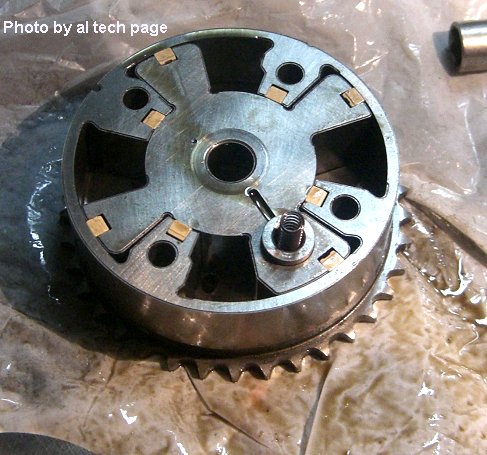
You need to realize something about the VVTi system and why many vehicles with it tend to be sensitive to the oil viscosity. The VVTi system works by using pressurized engine oil to fill a chamber in the VVTi Actuator Assembly and push the internal cam clockwise or counter clockwise.

9148.jpg


The ECM calculates the desired amount that the VVTi system will change your camshaft timing and applies oil through passages in the camshaft to fill the actuator chambers. The system is programmed for a 5w-30 oil, so it assumes this is the oil in the vehicle; based on it's internal programming and tables it will calculate how long to keep the VVTi control valves open to allow oil in and drain it out. If the flow of the oil is incorrect, then not enough or too much oil can enter/drain out and the timing will not be correct. If this occurs enough times or too drastically it will set a DTC for the issue, the direct symptom of this is the vehicle feeling as though it has poor performance; mainly because the valve timing is not correct.

Toyota's system is not as sensitive as I have seen in other vehicle brands that will pretty much pop a check engine light and not run correctly at all (some Chry-crap engines, particularly the Hemis with their cylinder deactivation may even run with completely dead cylinders because of this.) Oil flow is critical in this instance for letting the engine operate as designed, flow is affected by many variables, including what the actual oil is rated for.

What I keep having to point out to people and even my own co-workers is that oil is not the same as it was a few decades ago; it's far more complex today than it was back then. Going strictly by SAE viscosity rating is for the most part a worthless exercise if the manufacturer is calling for a specific type of oil (i.e. VW's 502.00, 504.00, or 507.00; Mercedes 229.5 or 229.51; ect.) Toyota is nice in that they are very easy on oils typically, just run the specified SAE & API rating (typically all Toyota engines call for an API of SN or higher) and they run just fine; unlike say putting a VW 504.00 (5w-40/5w-30 oil meant for VW/Audi Diesels) in a vehicle calling for VW 502.00 (5w-40/5w-30 oil meant for some gasoline VW/Audis), which will basically trash the engine.

Here's a post I made from a thread talking about using 0w-20 in our vehicles. I linked a couple interesting videos to watch about a static flow test at freezing temperature for various 5w-30 oils. It gets far more complicated as the oils warm up, but the basic idea here is to show that oils are not created equal and that 5w-30 barely means that at about -30°C it's a 5 weight and at about 100°C it's a 30 weight. Hell, in between those two measurements the oil might act as a completely different weight all together, it's not at all linear as you would expect.

Something else to note that people don't seem to realize is that not all 5w-30 oils are equal.

5w-30 simply means that at their measured extreme ranges the oil will be roughly those weights. At varying temperatures, depending on it's design it can be much different in between. This is why MANY VW 502.00 oils tend to show up as "5w-30" or "5w-40" but the rating is inconsequential to the oil specified by VW, because their 504.00 diesel oil is also often sold as a 5w-30 or 5w-40. But if you run that oil in a 502.00 spec'd vehicle you're going to have problems and vice versa because the additives and flow characteristics of those oils is vastly different.

What does all that have to do with running 5w-30, 5w-20, or 0w-20 in your vehicle? Well, the engine was designed for an SAE 5w-30 oil that meets API Rating SN or better. Running oil that deviates from specification means that the oil will not have the same flow characteristics that the engine was designed for and could cause issues in the near or far future (VVTi equipped vehicles can be more sensitive to non-specified oils, though most Toyotas seem to be more forgiving than other vehicles I have seen in that respect). The variance between a 5w-20 oil and a 5w-30 oil is not as straight forward as you would think; hell you could grab a half dozen 5w-30's and they'll all flow different than each other at varying temperatures and needs. Oil, like other fluids in the vehicle have gotten far more complicated than they were a few decades ago; back in the old days you'd just throw a thicker or thinner oil in the vehicle because you felt it would help, these days that could be inviting more issues than simply running what the vehicle was designed for.

Some interesting videos for similar 5w-30 oils being test for flow at cold temperatures:

https://www.youtube.com/watch?v=yX7RTLn_QCE

https://www.youtube.com/watch?v=uQ_vxdO_9nc

Note- That's just a static flow test at a cold temperature, in my post I am mainly referring to the dynamic flow of the oil; but the videos show the variance I am talking about at even a basic level.

 
Blackworks, thanks a ton for the info. I am very familiar with how VVT works, as I've had it in several vehicles including several late model 4.6 GT's and my current GT500. I've even installed cam phaser lockouts on my GT's for aftermarket cam use. None of them have been hyper sensitive to such a minor change in oil viscosity as going from 5-30 to 10-30. In any event, the PDF version of the manual that I have states that either 5-30 or 10-30 is acceptable (page 421 for the 2007). I can do a screenshot if that helps.

As far as disconnecting the battery, no - I would have no reason to do that for an oil change. I was reading the comments as asking why I wasn't disconnecting the battery. In any case, I'm hoping that today's oil change will fix the problem. If it does, I'll be very happy, but stunned at the drastic effect of such a seemingly minor difference in oil.
 
Last edited:
Pull your spark plugs and check them for oil. I was experiencing the same symptoms, it turned out to be leaking valve cover gaskets. They leak into the spark plug galley, around the threads and base of the plug effectively killing spark. I would start there, it's free.
 
Found it, apparently they changed the pages around in the 2008 vs. 2007 owner's manuals (I can see the .pdfs for them.)

Though in the owner's manual it states:

"If SAE 5W−30 is not available, SAE
10W−30 may be used. However, it
should be replaced with SAE 5W−30 at
the next oil change
"

That sounds more like, if you just can't find 5w-30 oil use 10w-30; but they state they want you to switch back to the 5w-30 by the next oil change.

The ECM might adjust for the inconsistencies it find when using the 10w-30, but to be honest I don't know how accurate it will be and thus performance in the long run with that oil may be affected (it may feel better because the ECM is able to compensate some and because you get used to it.)
 
Pull your spark plugs and check them for oil. I was experiencing the same symptoms, it turned out to be leaking valve cover gaskets. They leak into the spark plug galley, around the threads and base of the plug effectively killing spark. I would start there, it's free.

Always willing to take recommendations - I'll check it out tomorrow.

Found it, apparently they changed the pages around in the 2008 vs. 2007 owner's manuals (I can see the .pdfs for them.)

Though in the owner's manual it states:

"If SAE 5W−30 is not available, SAE
10W−30 may be used. However, it
should be replaced with SAE 5W−30 at
the next oil change
"

That sounds more like, if you just can't find 5w-30 oil use 10w-30; but they state they want you to switch back to the 5w-30 by the next oil change.

The ECM might adjust for the inconsistencies it find when using the 10w-30, but to be honest I don't know how accurate it will be and thus performance in the long run with that oil may be affected (it may feel better because the ECM is able to compensate some and because you get used to it.)

We just read that differently, Black. If using 10-30 caused such a serious problem as mine, I wouldn't think Toyota would be OK with it staying in for 5K or more miles. But I see your point, and I'm hoping I can say "lesson learned" in a few days. The quirks on this truck are endless...
 
The same thing just happened to me. I changed my oil Sunday morning and almost immediately noticed power loss. When trying to accelerate from a stop, the engine seemed to miss or hesitate before the vehicle started moving, and the same trying to accelerate from say 35 to 55 to merge onto the highway. And once at 55, it was obvious the truck was working hard to maintain speed - it practically refused to upshift and lock the torque converter.

Strange thing was that while I did use 10w-30, this was also what I used on the previous oil change and had no trouble (same brand too).

It was driving me nuts and I never gave a second thought that it was oil related. I was hoping the thing would just throw a code. I reset the ECU as some have mentioned, along with cleaning the TB and MAF and I also changed the air filter. Once I did that and put about 50 miles on it, the 4runner was driving as normal again.

That being said, I will be swapping back to 5w-30 in the morning. I'd rather just spend the $20 and have piece of mind.
 
I cannot offer a response to power loss after oil change as I usually steer clear of oil threads but this one became too tempting after reading some of the responses regarding oil weight.

FWIW, I have been using Traveller 10w-30 here in New England in every single 4 cycle engine I've owned over the last 8-ish years, my V8 4Runner included, a 600cc race bike, lawn mowers, turbo cars, the Kubota, Honda GX engines on the snowblower as well as the wood splitter and on and on. I have yet to experience a single issue with any engine considering any given Mfg's recommended oil weight. Keep in mind the area's temps range from -10° to 105°F.

On the 4Runner, the VVTi works as it should and the "data" I've collected exceeds 100,000 miles.....more like 130,000 or so.

There is a certain beauty in the simplicity of buying a single 5 gallon bucket of oil and not worrying about it.

:shrug:
 
Do you get any check engine light? Do you burn any oil afterwards? I would do a compression check to ensure engine is getting adequate compression.
 

Members online

Forum statistics

Threads
278,316
Messages
3,554,124
Members
248,016
Latest member
Advally Service

Trending content

Back
Top