KDSS vs Non-KDSS?

Thanks for the info and feedback on all the various trails you've ran it on! It seems like finding a ORP w/o KDSS in AZ is like trying to find a unicorn. I may just go this route (ORP w/ KDSS) and if in a couple years I get crazy with the lift, I can always just remove KDSS if I have to.

We'll need to go wheeling soon once I get my rig!

No problemo. Good luck and yeah, when you pick one up send me a message and we can hit the trails!
:yo:
 
I don't think so, I read his post. There's a ton of misconceptions being posted in this thread.

Here's what KDSS is: It's an automatic sway bar removal system (or proxy). Some makes/models actually feature sway bars you can disconnect (and there are aftermarket kits that offer this too) on 4xs of all kinds of makes/models.

Essentially, you have the sway bar connected (which aids in anti roll on pavement) you roll off the pavement, you stop, you disconnect the sway bar and now your vehicle's suspension is allowed to behave more independently, which results in greater geometric disparity between the two sides of the vehicle (which is KINDA a way of saying more wheel travel, but really it just means the wheels can move more freely without help or hinderence from the other side via the sway bar).

Rather than the crude old school kits that either allow you to disconnect, or the rednecks who drive around in Tacomas with their sway bar removed permanently (and rolling like crazy around every turn),

KDSS offers a bit of the best of all worlds, it allows for a very robust/stiff sway bar (for on road purposes) but at LOW(er) speeds it essentially acts to disconnect the sway bars effect/contribution and allow the vehicle to behave as if it has no sway bar.

Then, rather than having to get out of the vehicle and either reinstall the sway bar (or reconnect it with the quick disconn kits) you're vehicle simply reengages the KDSS (and the thick/heavy sway bar) at a certain vehicle speed level.

My personal opinion is that an OPERABLE KDSS system would have been great (i.e. you could control when it would engage or disengage). This would not only benefit OR adventures for slow rock crawling, but also help a little with high speed OR scenarios too.

I'm willing to BET that Toyota looked at this option and determined it would be a safety hazard (can you imagine someone inadvertently deactivating it at highway speeds and then rolling over around a high speed turn?).

In summary, all the KDSS is.....is an AUTOMATIC (tied to vehicle speed) way of synthetically removing the effect of a stiff sway bar....which allows the vehicle to behave more refined for high speed on road conditions, while relaxing and behaving more like a vehicle with no sway bar for slow offroad/crawl conditions.

This is where misconceptions come from. Physically KDSS is quite different from a disconnected sway bar. It's also a lot better than a disconnected sway bar within the range of available motion. KDSS offers significant advantages in body stability in slow speed flex scenarios. It does not remove the effects of the sway bars at any time. Off camber flex situations are a great spot to demonstrate how effective KDSS is.

It's closer in concept to a BMW or Range Rover active sway bar than it is to Jeep's disconnect sway bar. The two ideas have some cross over but are also quite different in function. A pair of BMW rear active sway bars with crossed hydraulic plumbing would be a pretty good way to perform a similar function to KDSS - except they're BMW quality so they leak a lot and don't work very well. But the idea is similar. Jeep tried to build a KDSS copy called "DHS" but as far as I know it never made it into a production vehicle.
 
Last edited:
its a great piece of kit, but completely unnecessary if you are only doing a lift of 3 inches or less.

This has nothing to do with lift height, it adds movement. You could install the Trac/PanHard Bar and Custom Radflo on a stock truck and increase articulation.

Since they are the same compressed length as factory, you can run this stuff on a stock 4Runner.
 
This has nothing to do with lift height, it adds movement. You could install the Trac/PanHard Bar and Custom Radflo on a stock truck and increase articulation.


I'm going to head over to your thread and read up.. I got lots to learn
 
Last edited:
This is where misconceptions come from. Physically KDSS is quite different from a disconnected sway bar. It's also a lot better than a disconnected sway bar within the range of available motion. KDSS offers significant advantages in body stability in slow speed flex scenarios. It does not remove the effects of the sway bars at any time. Off camber flex situations are a great spot to demonstrate how effective KDSS is.

It's closer in concept to a BMW or Range Rover active sway bar than it is to Jeep's disconnect sway bar. The two ideas have some cross over but are also quite different in function. A pair of BMW rear active sway bars with crossed hydraulic plumbing would be a pretty good way to perform a similar function to KDSS - except they're BMW quality so they leak a lot and don't work very well. But the idea is similar. Jeep tried to build a KDSS copy called "DHS" but as far as I know it never made it into a production vehicle.

Agreed, I was using the extreme ranges to illustrate what the system is "doing" or trying to accomplish. Obviously the KDSS can operate somewhere in between no connection and full connection.

My point is, all the KDSS really is, is an adjustable sway bar that automatically combines or releases the two sides depending on the conditions.

It has drawbacks though, at high(er) speeds over rough terrain, it makes the ride rougher. I think TRD always intended for the TRDOR to be more slow/rock crawling than the Pro which is more geared for "Baja" style.
 
am I the only one that doesn't feel this "rough ride at higher speeds over rough terrain?"
When did this become accepted? I see this regurgitated a lot on here

I did a 5 day trip at highway speeds over washboard gravel up north. Tires were aired down to 20psi, and nobody could keep up with me. Stayed nice and flat on the turns.
 
am I the only one that doesn't feel this "rough ride at higher speeds over rough terrain?"
When did this become accepted? I see this regurgitated a lot on here

I did a 5 day trip at highway speeds over washboard gravel up north. Tires were aired down to 20psi, and nobody could keep up with me. Stayed nice and flat on the turns.

It all depends on what you're comparing it to....

If you take a vehicle with a hefty sway bar that turns nice and snug and tight at high speed and run it over washboards and rough terrain, it's going to ride rougher than the vehicle that has a nice soft(er) suspension and sways a little more in turns but the two sides are more independent. Bumps and bruises are going to telegraph through more with a vehicle that's setup for on road.

My sports car has magnetic ride and different settings. When in the track mode, it'll beat your kidneys to death because it's setup to be ultra performance turning. The normal or touring modes are less harsh, but not as planted when cornering.

It's very difficult to find a suspension that's all things to all conditions (and do it cheaply/reliably). That's where the KDSS comes in and tries to make it a stiffer setup at higher speeds (or at least more connected from both sides) and then less connected at low(er) speeds.

When you ride a swamp buggy at high speeds, it feels like riding on a pillow, BUT if you try to take a turn at high speed, it seems like you plant your face in the dirt when going round.
 
am I the only one that doesn't feel this "rough ride at higher speeds over rough terrain?"
When did this become accepted? I see this regurgitated a lot on here

I did a 5 day trip at highway speeds over washboard gravel up north. Tires were aired down to 20psi, and nobody could keep up with me. Stayed nice and flat on the turns.

it's because you aired down, at normal pressure you would feel more washboarding than you will without KDSS because of the bigger swaybar (that's just how they work)

I think TRD always intended for the TRDOR to be more slow/rock crawling than the Pro which is more geared for "Baja" style.
they could put a thin swaybar with KDSS on the PRO and it would feel exactly the same at speed as the Pro does now, but there is no reason to when people will pay a $10k premium for some minor changes. it's marketing and model differentiation
 
Last edited:
am I the only one that doesn't feel this "rough ride at higher speeds over rough terrain?"
When did this become accepted? I see this regurgitated a lot on here

I did a 5 day trip at highway speeds over washboard gravel up north. Tires were aired down to 20psi, and nobody could keep up with me. Stayed nice and flat on the turns.

Totally agree with that point!

I have also drove miles on the similar to “washboard gravel” roads (trail) while enjoying vacation with my family in Moab this spring. I was not aired down as much as I you (mine was at 25 PSI) when I come up at the group of Jeeps (couple Wranglers unlimited, Cherokees and Grand Cherokees) … I think it was around 7-8 vehicles total.

I did not want to drive in their dust, so I past them and pushed it a bit to stay ahead… it was funny to watch them for a while as they tried to keep up… but after couple the Grand Cherokees fishtailed pretty hard (almost lost it) they slowed down and disappeared from my rear-view mirror.

At the same time, 4Runner felt smooth and very surefooted (in turns or not).
 
I'm a big fan of KDSS - but I do think it has a harsher ride in the mid speed range. In particular in very rough terrain from 10-25mph is where I notice a much harsher ride. And that makes a lot of sense. While KDSS combines the spring rates of all 4 tires and redistributes that spring rate in part in all scenarios (why it's not similar to disconnected sway bars) - that has the down side of having effectively higher spring rates at any individual tire when it hits a bump at medium and higher speeds. It's simply more jarring.

Once you hit a certain speed that is going to be more specific to your shocks, the shocks become the primary resistance to those bumps and the springs take a lesser role. At that speed and higher KDSS has less effect on individual bumps - just as heavier spring rates start to have less effect as compared to the shocks. The best bet would be to have ideal shock valving with less compression valving and more rebound dampening. In higher speed scenarios the effect of a heavy sway bar is higher effective spring rage above the center point (the other side of the sway bar) and lower effective spring rate below the center point (other side). As a result of the greater effect of this provided by a much higher spring rate sway bar on KDSS, shock valving should ideally be adjusted to help compensate. In a perfect world you would have internal bypass shocks that are soft in compression in the top end of the stroke, heavy in compression at the bottom end, and the reverse for rebound valving. Combined with air bump and/or secondary bypasses that will dampen at the very top end of the stroke more.

Unfortunately I don't have the $ for custom KDSS specific internal bypass shocks. So that becomes a compromise of KDSS.

Once you blow past that mid speed, KDSS works well again. Toyota ran the BAJA with KDSS despite custom shocks and springs all around and the opportunity to both remove the sway bars or to put in different sway bars. It would be interesting to know why and how much they tested with and without the sway bars. It's so easy to disconnect them that I think it's nearly certain that they ran that same 4Runner without them to see how it handled. KDSS was originally developed by winning a lot of rally car races under Citroen and Mitsubishi cars. So it should be perfectly suited for high speed dirt racing.
 
Last edited:
Kdss and Aussie up front

Does anyone have the KDSS and an Aussie up front? I am curious because I want the get a KDSS TRD but want the ability to engage 4wd on road when it’s iced in some areas but not all such as bridges and chit but don’t want to feel a diff when in 2wd mode (Will be wife’s new car toting kid around).

Thanks all
 
Does anyone have the KDSS and an Aussie up front? I am curious because I want the get a KDSS TRD but want the ability to engage 4wd on road when it’s iced in some areas but not all such as bridges and chit but don’t want to feel a diff when in 2wd mode (Will be wife’s new car toting kid around).

Thanks all

wut?
 
Does anyone have the KDSS and an Aussie up front? I am curious because I want the get a KDSS TRD but want the ability to engage 4wd on road when it’s iced in some areas but not all such as bridges and chit but don’t want to feel a diff when in 2wd mode (Will be wife’s new car toting kid around).

Thanks all

For a $40,000 vehicle I would splurge for a selectable front locker like an ARB or Harrup.
 
For a $40,000 vehicle I would splurge for a selectable front locker like an ARB or Harrup.

That’s a choice but too many for her lol. She will then need to slap it in 4h and flip the switch. I know this is easy chit for us but we take for granted the difference from what we do and understand vs what most moms out there do and understand so I need to keep it simple. With a lunchbox locker she will just set it in 4h and be done and have the ability to leave it in 4h regardless if she forgets to take it out and ends up on high traction surfaces for that day.
 
Last edited:
That’s a choice but too many for her lol. She will then need to slap it in 4h and flip the switch. I know this is easy chit for us but we take for granted the difference from what we do and understand vs what most moms out there do and understand so I need to keep it simple. With a lunchbox locker she will just set it in 4h and be done and have the ability to leave it in 4h regardless if she forgets to take it out and ends up on high traction surfaces for that day.

Well she is going to need to hit 4Lo to turn the rear e-locker in unless you hack it then, 4 high and hit e-locker. You could just say 4 hi and hit these 2 switches. Hard to turn, turn this one off. Just an FYI if you put the rear e-locker on and turn atrac on, the atrac actually does do a very good job with the front end.
 
Well she is going to need to hit 4Lo to turn the rear e-locker in unless you hack it then, 4 high and hit e-locker. You could just say 4 hi and hit these 2 switches. Hard to turn, turn this one off. Just an FYI if you put the rear e-locker on and turn atrac on, the atrac actually does do a very good job with the front end.

I would second this. MTS or ATRAC do a great job up front. It's 90% of a locker. I think you should try it before doing a front locker. I've been really happy with it- much better than I thought it would (Ive had many double locked vehicles so I have a reasonable basis for comparison).
 
I currently own a trail with KDSS and enjoy the on road benefits. I had the opportunity to rent an SR5 without KDSS for 4 months and noticed a slight difference in cornering on road.

The SR5 I rented seemed to lean more into turns even though the suspension seemed slightly stiffer when driving it on the road. Offroad, I think the non KDSS version was slightly better. I did not scrape the skid plate as much, and the suspension seemed to perform a little better.

My KDSS equipped trail version does really well offroad considering it has the locker in the back. I am unhappy with how the front skid plate hangs about an inch lower and sits farther forward from the axle than the non KDSS versions (This increases the approach angle). I have bottomed hard several times on the skid plate after going too fast over a water bar and nose driving onto the flat trail. I hope once I get bigger tires the problem will not be as bad and the truck bottoms more on the bumps stops instead of the skidplate on the ground.

I ultimately choose the KDSS version because I drive 99% on the road (including driving up to off road trails). The sway bar in front was enough to sell me as it twice as thick as the non KDSS version. After driving the SR5 for a fair amount of time and then getting back in my KDSS trail, the difference was noticeable on road. The offroad benefits are negligible due to the lousy front skidplate. I think the KDSS and non KDSS versions are about equal as far as capability, it’s just the KDSS version will have you clenching your teeth every time you scrape the skidplate on something stupid.

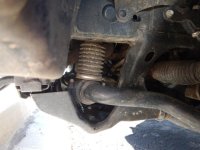
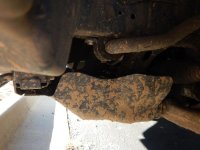
In the pictures below, the KDSS skid hangs down about inch lower than the SR5 at the lowest point, which happens to be the apex of the approach angle. Copy these photos and toggle between the two of them to see the difference.
 

Attachments

  • DSCN1132.JPG
    DSCN1132.JPG
    63.2 KB · Views: 1,288
  • DSCN1134.JPG
    DSCN1134.JPG
    59 KB · Views: 1,200

Members online

Forum statistics

Threads
278,309
Messages
3,554,075
Members
248,016
Latest member
Advally Service

Trending content

Back
Top