
Kudos To Toyota For Giving the V8 the Boot!

Not true.

What is your definition of "more power"? There is horsepower, and there is torque. As I mentioned above, the new 4.0L V6 will be seeing 32 additional HP, but only 7 additional ft lbs of torque. The new horsepower rating will get the new V6 on par with the 4.7L V8, but it still falls well short of the 330 ft lbs of torque the V8 produces.

Another important issue to point out is that people often overlook where that power is achieved. It's often referred to as the "power curve" or "power band". If that power band is too high (close to red line) it is not as desirable, especially for truck and SUV applications. Yes, there are a lot of V6's out there that have the same, or better, HP ratings than V8's. However, if that peak HP comes at 5k or 6k rpm's, it is not as usable.

Toyota is moving in the right direction regarding power, mileage, and efficiency. But again, there is no replacement for displacement. I'd really like to see the 4.6L V8 as an option down the road with the 4R.

If you've ever compared the two, you'd know that the powerband of the V6 is very similar to the powerband of the V8. It's not like the V6 is a high-strung motor at all. It is actually more V8-like than most people would believe in terms of it's powerband. The V6 engine was designed with a very long stroke, which is one of the reasons for the way it delivers it's power.
 
Do you understand the difference between torque and horsepower? Do you know what a torque curve is and why a lot of torque at low RPM is a good thing, especially when towing? Did you compare the peak torque ratings of the new V6 with the old V8?

Might I suggest that you investigate those subjects and then revisit your post?

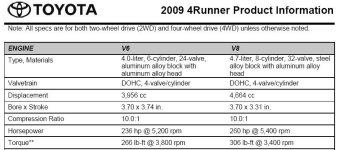
Maybe you should do your homework on the subject. Do you have graphical HP/TQ curves of both engines? If so, post 'em up. If not, here's Toyota's own specs that show peak HP and Torque for the '09 V6 & V8. Notice that the peak torque numbers are within a few hundred RPMs on both engines. Sure, the V6 has less overall torque, but the torque it does make comes on almost as low in the rev range, making it not all that different than the V8 in it's power delivery. Surprisingly, the HP numbers on the V6 peak at a lower RPM than the V8.
 

Attachments

  • specs.JPG
    specs.JPG
    63.4 KB · Views: 547
That statement is asenine. They do not even sound remotely the same.

Are you braindead? Where did I say they sounded the same? All I said was that the exhaust system is the same on both the V8 and the V6. Actually, that's one of the reasons why the V6 doesn't sound as good, because it's exhaust system was designed for the V8. Did you ride the little yellow bus to school?
 
I must conclude that the exhaust system on the 4R V6 is also the same as on the Taco and the FJ because they all sound like a plugged up vacuum cleaner. I'm not criticizing, just making an observation.

By way of example 2 years ago I was parked out at the ski hill with the 4R idling while I was taking off my boots. Two spots away was a V6 4R also idling. A buddy who was with me and who doesn't know very much about vehicles said to me " what's wrong with that 4Runner, the engine doesn't sound as good as yours ?".

I think the V6 is a good engine and I think it should have a good exhaust note to go along with it. There are lots of other companies that have good sounding V6 engines so it can't be that difficult to tune the exhaust. Is it a case of Toyota cheaping out? Having said that I know that it is much easier to have a good sounding V8 without much effort. I guess the real test will be to see if Toyota gives the 4.0 a tuned exhaust of it's own now that it doesn't have to worry about doing one for the V8 in the 4R.
 
Last edited:
I must conclude that the exhaust system on the 4R V6 is also the same as on the Taco and the FJ because they all sound like a plugged up vacuum cleaner. I'm not criticizing, just making an observation.

By way of example 2 years ago I was parked out at the ski hill with the 4R idling while I was taking off my boots. Two spots away was a V6 4R also idling. A buddy who was with me and who doesn't know very much about vehicles said to me " what's wrong with that 4Runner, the engine doesn't sound as good as yours ?".

I think the V6 is a good engine and I think it should have a good exhaust note to go along with it. There are lots of other companies that have good sounding V6 engines so it can't be that difficult to tune the exhaust. Is it a case of Toyota cheaping out? Having said that I know that it is much easier to have a good sounding V8 without much effort. I guess the real test will be to see if Toyota gives the 4.0 a tuned exhaust of it's own now that it doesn't have to worry about doing one for the V8 in the 4R.

I think it's just a matter of Toyota not designing a specific exhaust system for both the V6 and the V8. They obviously designed it for the V8 and since it is capable of flowing well for the V8, it is certainly more than adequate for the V6's exhaust flow. Sure, it doesn't sound as good, but in general a V6 will never sound like a V8 and that is especially true when the V6 is basically using an exhaust system designed for a V8.
 
What is your definition of "more power"? There is horsepower, and there is torque. As I mentioned above, the new 4.0L V6 will be seeing 32 additional HP, but only 7 additional ft lbs of torque. The new horsepower rating will get the new V6 on par with the 4.7L V8, but it still falls well short of the 330 ft lbs of torque the V8 produces.

The 4.7L V8 with VVT-i produces only 306 lb-ft torque, 33 more than the 273 lb-ft torque produced by the new 4.0L V6 with Dual VVT-i. However, the new 4.6L V8 with Dual VVT-i, which would have replaced the 4.7L in the 2010 4Runner, produces a whopping 327 lb-ft torque @ 3400 rpm and 310 hp @ 5400 rpm in the 2010 Sequoia. The 4.0L V6 definitely falls well short of those numbers!
 
If you've ever compared the two, you'd know that the powerband of the V6 is very similar to the powerband of the V8. It's not like the V6 is a high-strung motor at all. It is actually more V8-like than most people would believe in terms of it's powerband. The V6 engine was designed with a very long stroke, which is one of the reasons for the way it delivers it's power.

I was speaking in generalities, as I don't know the specifics of the new 4.0L V6 or where it achieves it's peak horsepower and torque. But regardless where the new V6 achieves it's peak torque, roughly 40 ft lbs of torque is a rather large delta between the new V6 and the 4.7L V8.
 
The 4.7L V8 with VVT-i produces only 306 lb-ft torque, 33 more than the 273 lb-ft torque produced by the new 4.0L V6 with Dual VVT-i.

You are correct and I realized I misquoted the HP and torque ratings in one of my earlier posts. I went back and double checked my '07 brochure, and the 4.7L with VVT-i makes 260hp and 306 ft lbs of torque.
 
On the subject of exhaust sound, I have to admit Nissan's VQ sounds damn good. IMO, the best sounding V6 out there from the factory.
 
I was speaking in generalities, as I don't know the specifics of the new 4.0L V6 or where it achieves it's peak horsepower and torque. But regardless where the new V6 achieves it's peak torque, roughly 40 ft lbs of torque is a rather large delta between the new V6 and the 4.7L V8.


Okay, that's fine. But since you mentioned the subject of powerbands and power delivery, I think it's worth mentioning that the 4runner's V6 is an undersquare engine design (because of it's long stroke), which means it makes it's power/torque low in the rev range. If you look at the numbers, the bore is the same on the V6 and V8. The stroke is longer on the V6 than the V8. That's basically the reason that the smaller displacement V6 comes close to matching the V8 in peak torque RPM, with two less cylinders.

I agree with your comment that a engine that makes it's peak HP/TQ in the upper rev range (5,000 to 6,000 RPM like you mentioned) is not as usable as an engine that produces similar HP/TQ numbers lower in the rev range. But this statement obviously doesn't apply to the 4Runner's V6 because it's an undersquare engine design and makes it's power relatively low in the RPM range.
 
Maybe you should do your homework on the subject. Do you have graphical HP/TQ curves of both engines? If so, post 'em up. If not, here's Toyota's own specs that show peak HP and Torque for the '09 V6 & V8. Notice that the peak torque numbers are within a few hundred RPMs on both engines. Sure, the V6 has less overall torque, but the torque it does make comes on almost as low in the rev range, making it not all that different than the V8 in it's power delivery. Surprisingly, the HP numbers on the V6 peak at a lower RPM than the V8.

If you think that 266 ft-lbs at 3800 RPM is the same as 305 ft-lbs at 3400 RPM and therefore "the new V6 has more power than the V8 did," which is what a previous poster put up, then I simply don't know what to say to you.

266 < 305
3800 > 3400

It is simple math.

I realize that you are a toyota tech and that you are loyal to your brand. But come on.
 
Last edited:
If you think that 266 ft-lbs at 3800 RPM is the same as 305 ft-lbs at 3400 RPM and therefore "the new V6 has more power than the V8 did," which is what a previous poster put up, then I simply don't know what to say to you.

266 < 305
3800 > 3400

It is simple math.

I realize that you are a toyota tech and that you are loyal to your brand. But come on.


I don't even know where to start with you. Maybe you need to go back and ready MY words again, and not the words of another forum member.

There's no debate that 1<2 or 266<305 or whatever random numbers you want to throw up there. Congratulations, you must've passed 2nd grade math.

If you can't understand the point that I made, then our conversation is finished. If you really wanted to make a point of your own for once, then you'd post up graphs of the power/torque curves to actually illustrate your point. Until you do that, then you basically have no argument on a power/torque curve debate. I simply PROVED to you that PEAK torque values are within a few hundred RPM on the V6 engine, in direct comparison with the V8 engine. Why is that so hard for you to get through your thick skull?

I'll say it for you in simple terms in the hope that you just might finally understand: The V6 in the 4Runner is not a high-strung, high RPM engine that makes it's power high in the rev band. If you want to see an engine that like that, just pop the hood of a Honda S2000.
 
I havent seen this mentioned yet.

Ive had both. The V6 is no slouch by any means. We can compare numbers and curves and dynos (of which Ive found none doing a direct comparo) all day BUT, you need to compare apples to apples: Compare the V6 in 4HI with the V8 in 4HI, then again V6 in 2HI with a V8 in 2HI. There is quite a noticeable difference inbetween the two irrespective of how close the numbers may be. And just because the torque values may be similar, Im willing to go on record and say that the V8 has more area under the curve pre-peak than the V6. Anyone run their V6 in 4HI for a week or two? It loses quite a bit of its punch. I wonder if that fact is lost on many of you, being that your comparing mostly apples to pears when the V6 will be in 2HI most of the time and the V8 (a 4WD one anyway) will be in 4HI all the time.

Anyone have 4wd dynos of a stock V8 and V6 to compare?
 
Anyone run their V6 in 4HI for a week or two? It loses quite a bit of its punch. ?

Loses quite a bit of it's punch? You're kidding us, right? The engine puts out the same power whether it is in 2 or 4 wheel drive. It feels exactly the same to me, with the ONLY difference being a very slightly heavier steering feel when running in 4wd.

I keep my 4Runner in fulltime 4wd from Dec. through Apr. every year. It definintely does not lose any of it's punch. Sending power to the front wheels does not make a vehicle feel any less powerful and it certainly doesn't make it peform slower either.
 
Loses quite a bit of it's punch? You're kidding us, right? The engine puts out the same power whether it is in 2 or 4 wheel drive. It feels exactly the same to me, with the ONLY difference being a very slightly heavier steering feel when running in 4wd.

I keep my 4Runner in fulltime 4wd from Dec. through Apr. every year. It definintely does not lose any of it's punch. Sending power to the front wheels does not make a vehicle feel any less powerful and it certainly doesn't make it peform slower either.

Are you kidding me Mr Tech? You mean to tell me a RWD will have the same driveline loss as a like configured AWD? You are right, the engine will put out the same amount, but the amount that gets to the ground will be less due to more driveline loss. Or are you trying to tell me that it takes the same amount of power to drive 4 wheels as it does 2? Come on...

Tell you what, find a place with a AWD dyno and Ill split the cost with you to do a 2wd/4wd dyno run to see. What say you?

Edit: I see you missed the point of my post completely, in wanting a AWD/2WD dyno of a V6 and V8 to see the torque curve and the area under it pre peak for the two engines.
 
Last edited:
Are you kidding me Mr Tech? You mean to tell me a RWD will have the same driveline loss as a like configured AWD? You are right, the engine will put out the same amount, but the amount that gets to the ground will be less due to more driveline loss. Or are you trying to tell me that it takes the same amount of power to drive 4 wheels as it does 2? Come on...

Tell you what, find a place with a AWD dyno and Ill split the cost with you to do a 2wd/4wd dyno run to see. What say you?

Edit: I see you missed the point of my post completely, in wanting a AWD/2WD dyno of a V6 and V8 to see the torque curve and the area under it pre peak for the two engines.

We're not discussing driveline losses. We're discussing your point that a V6 'loses it's punch' when switched from 2wd to 4wd.

Let me tell you a little bit about dynos. Sure, they can give you an estimate of the HP/TQ curves in any given vehicle. And sure there are drivetrain losses. The typical drivetrain loss for an average RWD vehicle with a manual trans is about 15%. This number is slightly higher for similar vehicles with automatics transmisssions, usually around 18%. But you have to understand that the drivetrain losses are throughout the entire drivetrain, from the flexplate and torque converter (in an automatic) all the way to the tires on the dyno's rollers. If you want to talk 4wd versus 2wd, then fine. There's no doubt that there will be more driveline loss when a vehicle is switched from 2wd to 4wd. But that loss will be completely and totally insignificant. And even the most sensitive driver in the world will not be able to notice such a small amount of drivetrain loss out on the road.

Anyway, we don't need a dyno to prove that. Anyone with a V6 4Runner can prove it easily. All you have to do is bring a V6 4Runner to a dragstrip and make a few passes in 2wd and a few in 4wd. There will be no difference in performance. The vehicle will run the same times either way. This is especially true because the 4Runner will have no problem with traction whether it is in 2wd or 4wd because it simply doesn't make enough power to light up the tires, therefore there's no advantage or disadvantage to running it in 4wd.

Now if you still think you can feel a loss of power when you switch a V6 4Runner into 4wd, there's nothing else I can say to you except that it's all in your head.
 
Okay, that's fine. But since you mentioned the subject of powerbands and power delivery, I think it's worth mentioning that the 4runner's V6 is an undersquare engine design (because of it's long stroke), which means it makes it's power/torque low in the rev range. If you look at the numbers, the bore is the same on the V6 and V8. The stroke is longer on the V6 than the V8. That's basically the reason that the smaller displacement V6 comes close to matching the V8 in peak torque RPM, with two less cylinders.

I agree with your comment that a engine that makes it's peak HP/TQ in the upper rev range (5,000 to 6,000 RPM like you mentioned) is not as usable as an engine that produces similar HP/TQ numbers lower in the rev range. But this statement obviously doesn't apply to the 4Runner's V6 because it's an undersquare engine design and makes it's power relatively low in the RPM range.

Do you happen to have the specs for the new 4.0L V6 and where it achieves it's peak torque and HP now that Toyota has beefed it up? I would reason to guess that now that they have added some ponies, that the peak power has moved north in the RPM range. That is not based on science or engineering, just my own personal hunch. I'll be curious to find out when more info is released on the new V6.
 

Members online

Forum statistics

Threads
278,317
Messages
3,554,129
Members
248,016
Latest member
Advally Service

Trending content

Back
Top