thecole1098
New member
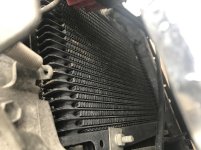
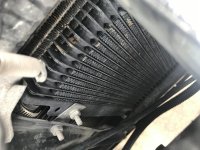
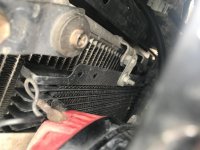
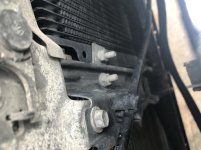
As promised [MENTION=198376]4Runner4Leon[/MENTION] here is pics of my setup. Notice how the only thing separating the cooler from the condenser is little foam pads.



I wouldn't skip on a cooler, at least in the long run. Nothing kills auto trannys like heat.
If you are looking for one, try and get one that has a LPD (low pressure drop valve built in) that won't open until a certain temp to allow the ATF to warm up (the popular B&M 70264 begins to open at 170F and fully opens at 180F).
the placement of [MENTION=136902]thecole1098[/MENTION] cooler is good, and the temps he sees prove it.
 .
.


Did you tape off the sight glass on the drier before painting?
).
There are no moving parts in the LPD coolers. It works solely on tube diameter and oil temperature/viscosity.
Fluid is always flowing through the cooling circuit. Did you possibly get your top/bottom lines swapped (you want in on the bottom and out on the top to clear the bubbles quickly).Good point, and thanks for clarifying! I shouldn't have said "opened", I should have said that the fluid was too viscous to pass through the cooler (and thus fill it).
I'm a bit surprised that 5 miles of driving (including uphill) was not enough for the fluid to start going through the cooler, but apparently it wasn't.
Fluid is always flowing through the cooling circuit. Did you possibly get your top/bottom lines swapped (you want in on the bottom and out on the top to clear the bubbles quickly).
-Charlie
B&M is really cagey about what exactly the "LPD" coolers do. But, my understanding of fluid dynamics is this:Interesting, my (limited) understanding of LPD was that cold fluid is too viscous to pass through the LPD orifices, and is sent right back out the return line. That's why I thought that the cooler itself might have still been full of air on initial (dry) startup.
Is that not correct?
I will also triple check my hoses, but I am 99% sure that I have trans send > to radiator in > radiator out > magnafine > B&M cooler inlet (bottom) > B&M outlet (top) > trans return.
B&M is really cagey about what exactly the "LPD" coolers do. But, my understanding of fluid dynamics is this:
There are some number of larger diameter passages in the cooler and the rest (most of them) are smaller. When fluid is at a higher viscosity, the 'boundary layer' of flow is thicker than at a lower viscosity. That thicker layer of fluid that is slowed down by the walls of the tube much more in the thin tubes than the thick tubes. It doesn't fully stop flow though.
Think of it like this: Thin straw vs. thick straw and a thick ice cream shake. You can still pretty easily get it through the thick straw compared to the thin straw, but you can always get some through the thin straw. Now, melt that ice cream shake - both can suck up fluid pretty easily, and the small straw flows 'more' compared to itself when the shake was thick. Maybe the thick straw is 2:1 more flow with the thin shake vs. thick, but the thin straw is 10:1 with the thin shake vs. thick.
The thicker passages in the cooler take up much less of the frontal area, and thus a lot less cooling happens when the fluid is cold.
Its just a ratio thing, not a hard stop when the fluid is cold.
-Charlie