Lift options without replacing UCA

Nom4Runner

New member
Oh look another lift thread! Haha... I wanted to get some opinions on the best Spring/Coil combo option with Bilstein's without replacing the stock UCA. I would like to stay close to the factory alignment. Close to level if possible, no negative RAKE.

I was considering just running Bilstein's in the Front at 1.75" (with stock springs) and a rear SAW 1.5 Coil but I wanted to get some other opinions.

Struts/Shocks:
Bilstein 5100's
Front: 24-196499
Rear: 33-187174

Spring/Coil Options:
Front: OME 884 (3"), TOYTEC/EIBACH FRONT COIL LIFT SPRINGS (3") or Stock
Rear: TOYTEC "SUPERFLEX" REAR COILS (2"), SAW (1.5") or OME 2895E (2")

This was an option but I already ordered bilstein's... I guess I could cancel them.
http://www.toyota-4runner.org/5th-gen-t4rs/164379-anyone-tried-tjm-2-lift-3.html

Opinions? Experiences?
 
Last edited:
Register to hide this ad
Are you getting bigger tires or need more clearance? If not, just go with the bilsteins and nothing in the back. Did you see my thread? Link below. If you put the coils in the back and stay at 1.75 in the front, you are still going to have a pretty significant rake. Based on my experience yesterday (and every rig is a little different), even if you go to 2.5" in the front, you will still have rake even with the coils in the back.

http://www.toyota-4runner.org/5th-gen-t4rs/165886-leveling-new-tires.html
 
why don't you want UCA's? do you like having to replace your tires due to uneven wear? do you like your truck wandering all over the road?
any time you lift, no matter how small a lift, you are changing your suspension geometry. The stock UCA's only have so much ability to compensate for that change. This is why aftermarket UCA's are necessary - they are designed to have a greater range of adjustment to accommodate suspension geometry changes, allowing for alignment to remain within spec.
here is my alignment report (complete with the tech's comments) after loading up my 5100's to 1.75 before I added UCA's
IMG_0710.jpg~original

if you think you can get away without UCA's, I wish you luck. After you go through a set of tires in 7,000 miles, look me up, I'll probably be selling my Total Chaos units after I upgrade to long travel.
 
Caster shouldn't wear your tires out like toe and camber. Caster out of spec will affect drivability though.
 
Seems like from my reading countless threads here, when you start getting north of 2" of lift up front, you should plan on getting the UCAs.

Since we are discussing UCAs, what are the drawbacks of using aftermarket UCAs? Do they required constant maintenance and upkeep/rebuilding? I know I'd prefer to not use them if I didn't have to just so there wouldn't be one more thing to have to worry about.
 
why don't you want UCA's? do you like having to replace your tires due to uneven wear? do you like your truck wandering all over the road?
any time you lift, no matter how small a lift, you are changing your suspension geometry. The stock UCA's only have so much ability to compensate for that change. This is why aftermarket UCA's are necessary - they are designed to have a greater range of adjustment to accommodate suspension geometry changes, allowing for alignment to remain within spec.
here is my alignment report (complete with the tech's comments) after loading up my 5100's to 1.75 before I added UCA's
IMG_0710.jpg~original

if you think you can get away without UCA's, I wish you luck. After you go through a set of tires in 7,000 miles, look me up, I'll probably be selling my Total Chaos units after I upgrade to long travel.

If that's at only 1.75" lift with stock UCAs, I think your tech is just lazy...it's as if he didn't even try to move the LCA adjustment cams, lol :tape:
 
Too much misinformation in this thread.

1. Of course you can lift your vehicle WITHOUT aftermarket UCA's. They are NOT necessary. They will, however, give you more adjustment and in some cases improve driveability.
2. Caster setting does NOT determine tire wear.
3. Yes, lifting does change suspension geometry but anything up to 2 1/2" lift does not require anything special.
4. OEM UCA's are the most reliable and require the least amount of maintenance under normal operating conditions. Rock crawling or high speed desert running is a different world and requires specialized components made for a specific purpose with the understanding of increased maintenance.

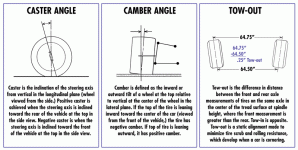
Here is a basic primer on what each alignment setting does:
 

Attachments

  • How-CasterAngle.gif
    How-CasterAngle.gif
    72.2 KB · Views: 8,439
If that's at only 1.75" lift with stock UCAs, I think your tech is just lazy...it's as if he didn't even try to move the LCA adjustment cams, lol :tape:

I agree i got 2.8 on the left and 2.9 on the right with stock UCA's and that was with camber in-spec. My alignment guy was suprised it even had the caster adjusment.
 
I agree i got 2.8 on the left and 2.9 on the right with stock UCA's and that was with camber in-spec. My alignment guy was suprised it even had the caster adjusment.

Right on. I saw you have an OME 3" lift. Which springs/coils did you use?

BTW, thanks for all the information guys it's greatly appreciated. I'm still up in the air how high I want to lift. But seeing as my 4Runner is on the pavement 95% of the time I imagine it's going to be a max 2" lift.
 
If that's at only 1.75" lift with stock UCAs, I think your tech is just lazy...it's as if he didn't even try to move the LCA adjustment cams, lol :tape:

Beat me to it. His tech probably did move the adjustment cams. He only moved the front ones.

I agree i got 2.8 on the left and 2.9 on the right with stock UCA's and that was with camber in-spec. My alignment guy was suprised it even had the caster adjusment.

Caster and Camber is one in the same when it comes to adjustments for our trucks. I'm betting you misheard him. Caster/camber/toe is always adjustable. It may require a ton of work on some vehicles, but it can always be adjusted. Some vehicle require grinding of strut towers or chevy trucks used to require "knock outs". This usually entailed more work for the tech so they usually found a short cut or got the alignment 'close enough', because they didn't get paid for the additional labor.
 
Right on. I saw you have an OME 3" lift. Which springs/coils did you use?

BTW, thanks for all the information guys it's greatly appreciated. I'm still up in the air how high I want to lift. But seeing as my 4Runner is on the pavement 95% of the time I imagine it's going to be a max 2" lift.

I have the 884(lights) in the front and the toytec 2'' superflex in the rear. There's that new TJM 2'' lift that you want to consider looking at. OME full suspension -- Click here for details
 
Caster and Camber is one in the same when it comes to adjustments for our trucks. I'm betting you misheard him. Caster/camber/toe is always adjustable. It may require a ton of work on some vehicles, but it can always be adjusted. Some vehicle require grinding of strut towers or chevy trucks used to require "knock outs". This usually entailed more work for the tech so they usually found a short cut or got the alignment 'close enough', because they didn't get paid for the additional labor.

What i think he meant was that a lot of newer vehicles caster is no longer adjustable. What i've read though is that its mostly newer fwd vehicles and sports cars.
 
What i think he meant was that a lot of newer vehicles caster is no longer adjustable. What i've read though is that its mostly newer fwd vehicles and sports cars.

I'm sorry, but this makes absolutely no sense. Sports cars would definitely have multiple adjustments for alignment. That defeats the purpose of a sports car if you're going to take it to the track. That particular car may require additional parts to make it adjustable, but it's available and adjustable none the less.

As I stated before, you might have to grind parts, install new ones, or replace complete control arms, but it's always adjustable. For example, the rear of a Lexus LS430 require new parts to set the toe. If you wanted to adjust that, you would have to call Lexus and replace the lower control arm. Lexus has different part numbers with different lengths.

Back on track with the OPs question. Just read [MENTION=66316]1engineer[/MENTION]'s post. That sums it up.
 
Have you found a source for extended fenders? Or are you going to custom fab them?

2" Total Chaos LT kit, no fibreglass required on 275's
If that's at only 1.75" lift with stock UCAs, I think your tech is just lazy...it's as if he didn't even try to move the LCA adjustment cams, lol :tape:
could well be. when I spoke with him, I was told he ran out of adjustment. Caster in itself cannot affect tire wear, however when other specs are sacrificed in order to get everything "close enough" you absolutely will get premature tire wear.
I can't find the alignment sheet, however on a subsequent alignment/zero point calibration job at my dealership, but still prior to my UCA install, a different tech managed to get caster closer to spec, but camber was out of wack. The excuse I was given was that my springs were too stiff. uh-huh :rolleyes: this is when I managed to burn through a set of winter tires
IMG_20140403_142745_zpsda2b5198.jpg~original

you'll note the degree of wear on the inside (bottom in the photo) relative to the outside.
Since getting my UCA's and yet another alignment, I have had no abnormal tire wear issues whatsoever.
 
I'm sorry, but this makes absolutely no sense. Sports cars would definitely have multiple adjustments for alignment. That defeats the purpose of a sports car if you're going to take it to the track. That particular car may require additional parts to make it adjustable, but it's available and adjustable none the less.

As I stated before, you might have to grind parts, install new ones, or replace complete control arms, but it's always adjustable. For example, the rear of a Lexus LS430 require new parts to set the toe. If you wanted to adjust that, you would have to call Lexus and replace the lower control arm. Lexus has different part numbers with different lengths.

Back on track with the OPs question. Just read [MENTION=66316]1engineer[/MENTION]'s post. That sums it up.

you are correct, i was referring to vehicles in an "oem" state from the factory may not have caster adjustment.
 
2" Total Chaos LT kit, no fibreglass required on 275's

could well be. when I spoke with him, I was told he ran out of adjustment. Caster in itself cannot affect tire wear, however when other specs are sacrificed in order to get everything "close enough" you absolutely will get premature tire wear.
I can't find the alignment sheet, however on a subsequent alignment/zero point calibration job at my dealership, but still prior to my UCA install, a different tech managed to get caster closer to spec, but camber was out of wack. The excuse I was given was that my springs were too stiff. uh-huh :rolleyes: this is when I managed to burn through a set of winter tires
IMG_20140403_142745_zpsda2b5198.jpg~original

you'll note the degree of wear on the inside (bottom in the photo) relative to the outside.
Since getting my UCA's and yet another alignment, I have had no abnormal tire wear issues whatsoever.

Did you rotate those tires frequently enough? The picture look like possibly your front toe was off more so than camber. Granted I've never tried this on an SUV, but in the past on my small cars I could get away with plenty of camber (-2 degrees or more) on one end as long as I rotated frequently enough. Camber does not create uneven wear nearly as fast as excessive toe in/out. Especially at what you had it set to, 0.5 degree of camber is insignificant in the grand scheme of things :)

To my understanding the camber and caster are the only two settings that need to compromise with each other due to the factory adjustment design, and neither one should cause that kind of wear you experienced. There should be plenty of toe adjustment left at the tie rods regardless of whatever you set the LCA cams to...I think your alignment techs are jerking you around, lol. I kind of understand why though, it seems like a major pain in the arse to do correctly...I watched my guy move one cam, and the other one goes off; move the other one and sure enough the original one is off again. Seems like a lot of patience is required to dial it in nicely :(

The three main causes for premature tire wear are improper toe, improper pressure and improper rotation schedules.

EDIT: Sorry I misread your post, I just realized you said that you were talking about another alignment where they really messed up your camber even further, not the original one you posted. That sucks that it costed you a set of tires to find out!
 
Last edited:

Members online

Forum statistics

Threads
278,307
Messages
3,554,054
Members
248,016
Latest member
Advally Service

Trending content

Back
Top