
You are using an out of date browser. It may not display this or other websites correctly.
You should upgrade or use an alternative browser.
You should upgrade or use an alternative browser.
LT Tire Pressure
- Thread starter Muddy Duck
- Start date


1engineer
Moderator
The class was dynamics. Look, "E" rated tires, by virtue of having thicker casings, are not designed to flex like a "P" rated tire. Over time, the constant flexing of an underinflated tire will cause the tire to degrade through both heat and flex. If you insist on running your tires at a low pressure you might be ok or you might not. Your chances are much better of having no failure with proper inflation. Now, about your "calculations" of proper inflation: are you familiar with safety factors? Would you rather be suspended from a cable with a breaking strength of 250 lbs or a cable with a breaking strength of 1000 lbs? Remember your life depends on it, just like your tires. Tire pressures are calculated using safety factors too. Your tires can change pressure by several psi daily. I just took a trip and my tires changed 6 psi within 4 hours and I never touched them.
If you really want to calculate something calculate how much true pressure is required to hold up your vehicle. I have and its not much, like 10-12 psi but even though that's enough to support your vehicle I know my tires would not last long at 10 psi. There. You wanted an explanation and I hope you understand it.
If you really want to calculate something calculate how much true pressure is required to hold up your vehicle. I have and its not much, like 10-12 psi but even though that's enough to support your vehicle I know my tires would not last long at 10 psi. There. You wanted an explanation and I hope you understand it.

Jeremy556
New member
So, you track hot .vs cold pressure, huh?I just took a trip and my tires changed 6 psi within 4 hours and I never touched them.
Do you also carry an IR thermometer to track temp and change pressure based on ambient temperature, load, speed, and terrain? Maybe I'm not the only one... :nerd:
1engineer
Moderator
So, you track hot .vs cold pressure, huh?
Do you also carry an IR thermometer to track temp and change pressure based on ambient temperature, load, speed, and terrain? Maybe I'm not the only one... :nerd:
Naw, I have a range...

Misterquad
New member
I am still looking at the chart that was provided here and it says different.
And these vehicles are half the weight of the that an E Rated tire is designed to carry. I find your thought process in question. Because the data does not support you.
Afterall, it is a chart you agree with.
And these vehicles are half the weight of the that an E Rated tire is designed to carry. I find your thought process in question. Because the data does not support you.
Afterall, it is a chart you agree with.
Last edited:

BlackWorksInc
New member
So, you track hot .vs cold pressure, huh?
Do you also carry an IR thermometer to track temp and change pressure based on ambient temperature, load, speed, and terrain? Maybe I'm not the only one... :nerd:
You forgot humidity, barometric pressure, and quantum diffraction anomalies. (I made the last one up.
 )
)
Jeremy556
New member
My data shows that humidity and barometric pressure have effects within the margin of error of my test equipment, so I choose to ignore them.You forgot humidity, barometric pressure, and quantum diffraction anomalies. (I made the last one up.

Jhalko
New member
I've been running 44psi based on this chart on my C load LT tire and I'm getting the best wear of any set of tires I've ever owned. I'm sure there are so many other factors it means nothing, but I'll stick with the science suggesting I'm doing it right as it seems to be working.
No fancy math here, I'll leave that to the engineers.
:driving:
No fancy math here, I'll leave that to the engineers.
:driving:
Jeremy556
New member
I have to agree, based on the load tables, it is above the GAWR even below 35psi. I would still recommend you experiment with higher pressures. In my experience, the road noise and rolling resistance difference between 35 and 45 on stock size Duratracs was huge, like 2+mpg and loud roar .vs gentle hum. I would bet on a 15-25% difference in highway tread temperature and life, as well.I am still looking at the chart that was provided here and it says different.
1engineer
Moderator
I am still looking at the chart that was provided here and it says different.
And these vehicles are half the weight of the that an E Rated tire is designed to carry. I find your thought process in question. Because the data does not support you.
Afterall, it is a chart you agree with.
Does the chart tell you WHY the pressures are what they are? No. That is what I'm attempting to tell you. You probably should just run whatever you think is right because logic and physics and dynamics are not important. Again, 10 psi or so will support your vehicle. Why run 32 psi? Good luck man.
Misterquad
New member
I ran 45 psi on previous sets of tires. The ride is too rough for me. E-rated are great to prevent punctures and haul heavy loads. I see neither on my commute. My mpg never changed much because I commute mostly in traffic.
P-metric to LT conversion
Most of this information is pulled from ToyoTires Load Inflation Table PDF file located here:
(http://www.toyotires.ca/sites/default/files/loadinflationtable.pdf)
P-Metric or hard metric tires on Light Trucks
When a P-metric or metric tire is installed on a light truck (SUV, pickup, minivan), the load capacity of the tire is reduced by a factor of 1.10 as prescribed by the Federal Motor Vehicle Safety Standards (FMVSS). For example, 305/50R20 has a maximum load capacity of 3086 lbs. If this tire is fitted to a light truck, then the actual allowable load capacity for the tire is 2805 lbs. (3086 lbs. divided by 1.1). If you replace the original tires with the exact same type (P-metric, hard metric, LT-metric, or flotation), size designations, and ply as the tires that were originally installed, just follow the vehicle’s tire information placard for proper inflation pressures. If, however, you apply a ‘Plus zero’ or plus-1, etc., fitment to a light truck, you must discount the replacement tire’s load by the 1.10 factor and ensure that the replacement tire has sufficient load capacity by inflation to support the load of the originally installed tires.
Toyota spec'd two tire sizes for the 4Runner:
SR5/Trail P265/70R17 = 2535 lb standard load capacity. So 2535 / 1.10 = 2305 lb load rating on a light truck.
Limited P245/60R20 = 2149 lb standard load capacity. So 2149 / 1.10 = 1954 lb load rating on a light truck.
Now armed with these load ratings go find your tire size in the tire manufacturer's catalog and compare tire pressures to load ratings.
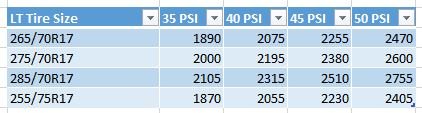
LT-Tire-Size----35-PSI--40-PSI--45-PSI--50-PSI
265/70R17-------1890----2075----2255----2470
275/70R17-------2000----2195----2380----2600
285/70R17-------2105----2315----2510----2755
255/75R17-------1870----2055----2230----2405
I posted the table as a JPG as well in case it didn't turn out nice with HTML spacing.
Most of this information is pulled from ToyoTires Load Inflation Table PDF file located here:
(http://www.toyotires.ca/sites/default/files/loadinflationtable.pdf)
P-Metric or hard metric tires on Light Trucks
When a P-metric or metric tire is installed on a light truck (SUV, pickup, minivan), the load capacity of the tire is reduced by a factor of 1.10 as prescribed by the Federal Motor Vehicle Safety Standards (FMVSS). For example, 305/50R20 has a maximum load capacity of 3086 lbs. If this tire is fitted to a light truck, then the actual allowable load capacity for the tire is 2805 lbs. (3086 lbs. divided by 1.1). If you replace the original tires with the exact same type (P-metric, hard metric, LT-metric, or flotation), size designations, and ply as the tires that were originally installed, just follow the vehicle’s tire information placard for proper inflation pressures. If, however, you apply a ‘Plus zero’ or plus-1, etc., fitment to a light truck, you must discount the replacement tire’s load by the 1.10 factor and ensure that the replacement tire has sufficient load capacity by inflation to support the load of the originally installed tires.
Toyota spec'd two tire sizes for the 4Runner:
SR5/Trail P265/70R17 = 2535 lb standard load capacity. So 2535 / 1.10 = 2305 lb load rating on a light truck.
Limited P245/60R20 = 2149 lb standard load capacity. So 2149 / 1.10 = 1954 lb load rating on a light truck.
Now armed with these load ratings go find your tire size in the tire manufacturer's catalog and compare tire pressures to load ratings.
LT-Tire-Size----35-PSI--40-PSI--45-PSI--50-PSI
265/70R17-------1890----2075----2255----2470
275/70R17-------2000----2195----2380----2600
285/70R17-------2105----2315----2510----2755
255/75R17-------1870----2055----2230----2405
I posted the table as a JPG as well in case it didn't turn out nice with HTML spacing.
Attachments
Last edited:
Misterquad
New member
Does the chart tell you WHY the pressures are what they are? No. That is what I'm attempting to tell you. You probably should just run whatever you think is right because logic and physics and dynamics are not important. Again, 10 psi or so will support your vehicle. Why run 32 psi? Good luck man.
You talk about flex, temperature, etc. but never mention loading. The chart shows psi v. loading. I don't want to blindly follow someone because they speak with authority yet the data they provide differs.
1engineer
Moderator
You talk about flex, temperature, etc. but never mention loading. The chart shows psi v. loading. I don't want to blindly follow someone because they speak with authority yet the data they provide differs.
I have provided no data. I have attempted to explain WHY the data is what it is and I have not bought up loading because even in lightly loaded conditions a tire needs a minimum pressure to function correctly depending on design.. Apparently either I am doing a poor job or you just can't comprehend simple logic. Its me I'm sure. Again, good luck.
BlackWorksInc
New member
You talk about flex, temperature, etc. but never mention loading. The chart shows psi v. loading. I don't want to blindly follow someone because they speak with authority yet the data they provide differs.
Flex is a consequence of loading and psi. As was stated, you can effectively support the vehicle weight with 10psi, but the tire is not designed to operate at that psi (despite physically holding the load up) for any length of time.

This type of sidewall cracking is commonly seen on "dry rotted' tires, but also results from prolonged underinflation as the heat will start to dry the tire up and also separate the interior of the tire structure.
Another example (this picture is from a article on a legal issue, but the damage is the plys breaking away from the rubber compound which does occur from prolonged underinflation, granted not typically to this extent):
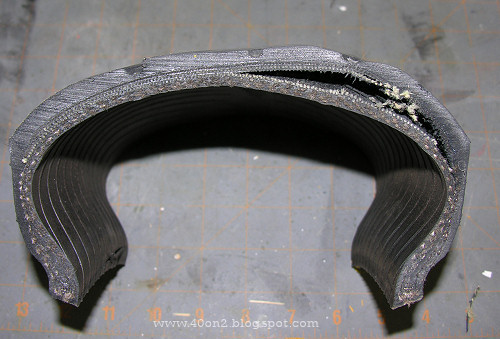
An example of a larger "Thicker & Stronger" tire that has failed due to prolonged underinflation:

The caption for this reads: "Under heavy loads and high speeds, a tire just 13% underinflated will begin to incur damage that can
eventually lead to catastrophic failure such as this."
Another example from Bridgestone's Website:

A diagram of tire construction as a reference:

Source Material in Order of Appearance (as a show for transparency):
Buying Used Tires | Buy Used Tires | Buy Used Tire
San Diego Jury Awards $14.4 Million in Faulty Tire Case ? San Diego Injury Law Blog
OTR Tire Supply Comes Under Pressure
Examination and Recommended Action | Aircraft Tires | Bridgestone Corporation
Tire Terminology - Lots of Information about Tires
I'm trying to show ore extreme examples of tread & sidewall ply separation because this is the type of damage that occurs within the tire when run for prolonged periods underinflated. It is typically not noticed until the tire does fail, which can be a catastrophic blow out on the freeway.
This is also part of the reason why many tires have speed ratings (that most people ignore or will never achieve) because the internal friction of the tire becomes too great for its construction and the tire starts to break down, which basically ends up presenting as accelerated aging (premature dry rot) and/or separation/breaking down of the rubber/plys.
Post Note-
I would like to point out that even purposefully underinflating the tires to get better grip off-road is actually harmful to the tire; which is why when off-roading to reduce premature wear caused by excessive heat and flexing, the vehicles are driven at very low speeds.
Last edited:

Misterquad
New member
I looked at the chart once more this more and it clearly points out that an E-Rated tire should be inflated between 65-80 psi.
So, running it at 40-45 psi is underinflated by 20-25 psi, but you claim this is the correct air pressure.
So, running it at 40-45 psi is underinflated by 20-25 psi, but you claim this is the correct air pressure.
Last edited:
Misterquad
New member
Toyota spec'd two tire sizes for the 4Runner:
SR5/Trail P265/70R17 = 2535 lb standard load capacity. So 2535 / 1.10 = 2305 lb load rating on a light truck.
Limited P245/60R20 = 2149 lb standard load capacity. So 2149 / 1.10 = 1954 lb load rating on a light truck.
Now armed with these load ratings go find your tire size in the tire manufacturer's catalog and compare tire pressures to load ratings.
LT-Tire-Size----35-PSI--40-PSI--45-PSI--50-PSI
265/70R17-------1890----2075----2255----2470
275/70R17-------2000----2195----2380----2600
285/70R17-------2105----2315----2510----2755
255/75R17-------1870----2055----2230----2405
I posted the table as a JPG as well in case it didn't turn out nice with HTML spacing.
Great Post!!! I could not see all this on the phone last night.
Okay, now I have a few questions.
1. Are Toyota's number per axle? or per tire? Because it looks like per axle.
2. Are Toyo's number per axle? or per tire?
As I showed above, my calculated numbers for my 4Runner are 1,463 - 1,775 per tire. Actual, are closer to 1,300 lbs./tire. And if Toyo's number are per axle then nothing works. But if Toyo's numbers are per tire then 35 psi is acceptable.
Last edited:
A
Those numbers in my chart are per tire. All the weights are per tire... No axle ratings are used when doing this calculation method. Although it would be smart to verify your 2 tire's load capability at the PSI you select are greater than the axle rating shown inside your door jamb!
Great Post!!! I could not see all this on the phone last night.
Okay, now I have a few questions.
1. Are Toyota's number per axle? or per tire? Because it looks like per axle.
2. Are Toyo's number per axle? or per tire?
As I showed above, my number for my 4Runner are 1,463 - 1,775 per tire. And if Toyo's number are per axle then nothing works. But if Toyo's numbers are per tire then 35 psi is acceptable.
Those numbers in my chart are per tire. All the weights are per tire... No axle ratings are used when doing this calculation method. Although it would be smart to verify your 2 tire's load capability at the PSI you select are greater than the axle rating shown inside your door jamb!
Last edited:
Misterquad
New member
A
Those numbers in my chart are per tire. All the weights are per tire... No axle ratings are used when doing this calculation method. Although it would be smart to verify your 2 tire's load capability at the PSI you select are greater than the axle rating shown inside your door jamb!
I agree.
Similar threads
- Replies
- 8
- Views
- 6K
- Replies
- 5
- Views
- 6K


- Replies
- 9
- Views
- 11K


