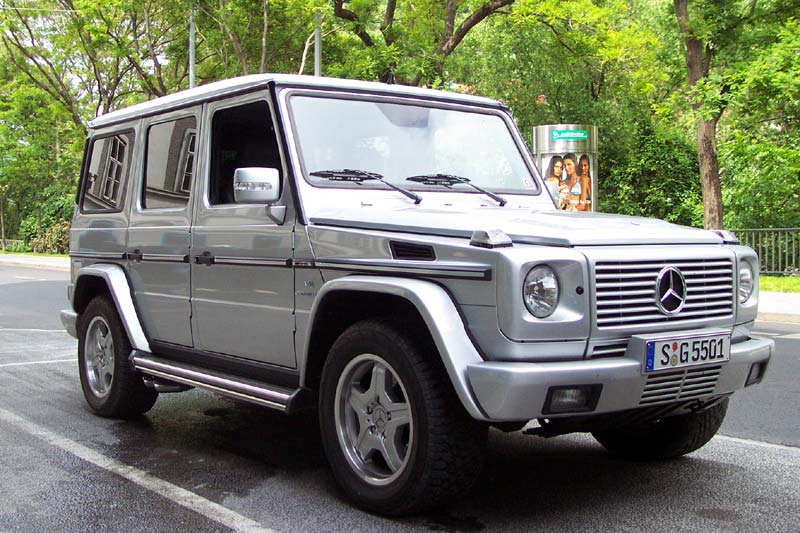
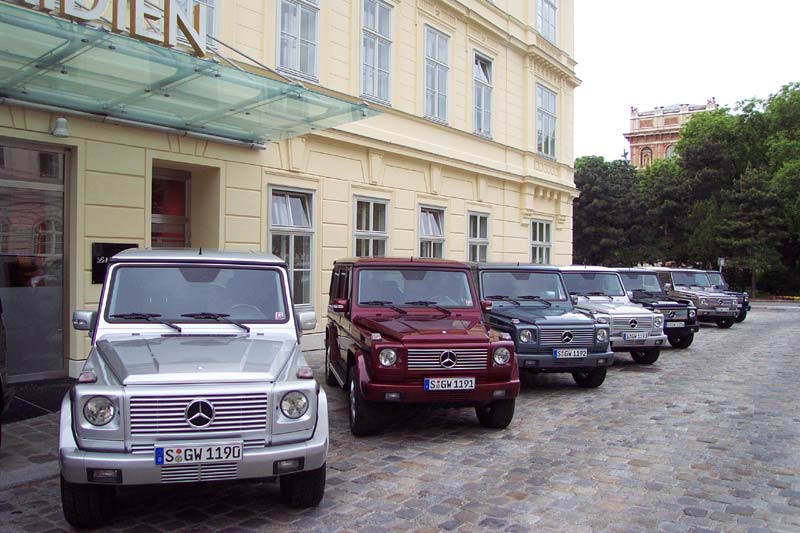
Mercedes G-wagen

Thai

Elite Member
New Mercedes Benz G Wagons arrive in Kabul to replace aging Iltis jeeps

New Mercedes Benz G Wagons arrive in Kabul to replace aging Iltis jeeps
08:30 PM EST Mar 14
LES PERREAUX

KABUL (CP) - Canadian soldiers drove in air-conditioned comfort from the Kabul airport Friday in the first of the beefy new jeeps that will replace the aging Iltis.

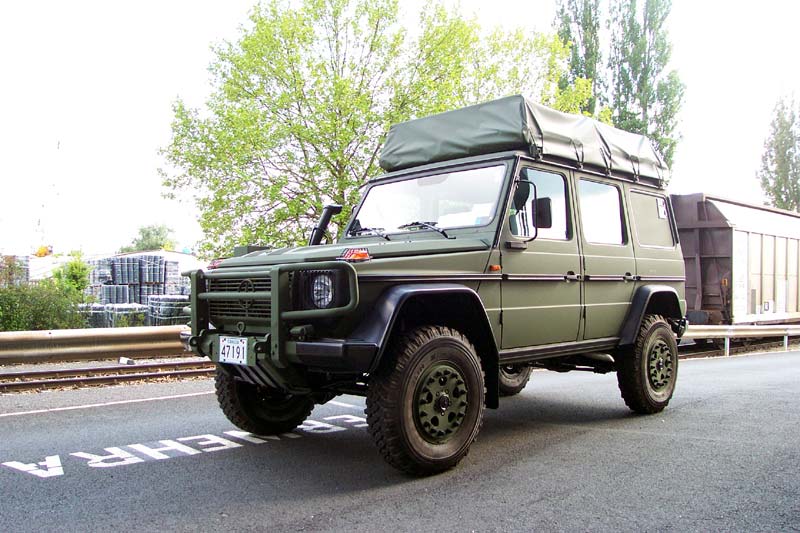
Eighteen new Mercedes-Benz G Wagons, featuring armour plating, bullet-resistant glass windows and a grenade-proof roof, were delivered to Canadian troops in Afghanistan. Over the next week 60 of the vehicles will arrive by transport aircraft. The jeeps will replace the 20-year-old topless Iltis, a vehicle that offers a great view and a quick exit but almost no protection from the elements or shrapnel.

"You don't feel like you're in a Pepsi can in this one," said Warrant Officer Alain Blanchette, an army mechanic.

"You feel like you've got something around you that is going to protect you. I know one thing for sure. Everybody will be more confident and secure in this vehicle than the Iltis."

Happy Canadian soldiers tested the jeep on the 20-kilometre drive back to Camp Julien through downtown Kabul. The roomy G Wagon has an automatic transmission, shifts to four-wheel-drive with the push of a button and accelerates around moving traffic far more quickly than the Iltis.

The basic G Wagon costs $44,000 Cdn. The full armour kit adds another $86,000 to the pricetag.

"I love it," said Pte. Martin Lavoie, an army driver who is out in light jeeps almost every day. "It's really impressive. It's really really good, superior to the Iltis in every way."

About 800 G Wagons, including 160 with the armour, and 1,060 GM Silverado utiltity vehicles will gradually replace 1,900 20-year-old Iltis jeeps through August 2005.

Three Canadian soldiers have died in the past six months in explosive attacks targeting the Iltis. In October, two soldiers died when at least one anti-tank mine was set off. In January, a soldier died when a suicide bomber targeted his jeep. The arrival of the new jeeps was sped up after the October attack.

Col. Alain Tremblay, the head of the Canadian contingent in Afghanistan, said the new armoured jeep probably would not have saved the soldiers in the mine attack. However it might have made a difference in the suicide attack Jan. 27 that killed Cpl. Jamie Murphy and injured three soldiers.

"In that case, it is highly likely this vehicle would have made a difference," Tremblay said.

However a car bomb carrying hundreds of pounds of explosives blew up next to a heavier British jeep the next day and killed a British soldier. Tremblay pointed out that a bigger explosive weapon can always be found to take out light armoured vehicles.

"This is not a tank," Tremblay said. "It has a limited anti-mine capability. But it's better than the Iltis, obviously."

The G Wagon has armoured plating and thick bullet-resistant windows that do not open. Tremblay said a big blast can often do more damage to people inside such a vehicle because there is nowhere for the wave of pressure from a blast to escape. One Canadian soldier survived the October mine attack when he was thrown out of the Iltis.

The G Wagon will be used to bolster Canada's fleet of vehicles for patrols and transport in Afghanistan but some of the smaller Iltis jeeps will remain in use on Kabul's narrow streets.

While breakdowns have plagued the Iltis on the Afghanistan mission, the old jeep still has fans. The armoured G Wagon offers more protection but some soldiers like the open-topped jeep because it allows them to quickly jump out and shoot back in an attack.

Sgt. Daniel Parenteau, a driving instructor and member of Alpha Company of the 3rd Battalion, Royal 22nd Regiment, said the soldiers will get used to having doors, windows and a roof.

"Sure, with the Iltis you could see all around and get out fast," he said.

"Now people will learn that it's inside the vehicle where you are safe. You have to fire eight rounds from a rifle in the exact same spot to finally break the glass. People will adjust their thinking."
 
Register to hide this ad
G Wagon Technical Specifications

VARIANTS: 3 (Basic, Command and Reconnaissance, Military Police)
TYPE: 4 Pax Station Wagon
ENGINE: 5-cylinders
DRIVETRAIN: 4X4 permanent all-wheel drive, 5-speed automatic
TIRES: Michelin XZL 8.25R16 with optional run-flat inserts.
FORDING ABILITY: 600mm
GROUND CLEARANCE: 43.9cm
SIDE SLOPE ANGLE: 30
 
According to a forum reader:

There was a competition held, and GM (Humvee) withdrew their bid - this left Mercedes the winner by default.

March 10, 2004: Germany has it's own version of the U.S. hummer (HMMWV, or humvee.) You could call it "hummer lite." The Mercedes G500 Gelaendewagen ("cross country vehicle") is an SUV design adapted for military use. It's lighter (2.5 tons) and smaller than the hummer. And cheaper as well (about $35,000 for the military version). If you add the armor package, the price goes to about $66,000. Dozens of armies are replacing their old style jeeps with the G500. Unlike jeeps, which are essentially "convertibles," the G500 is a hard top. That means air conditioning, which is a big plus for the troops. But the troops also complain about the decreased visibility (compared to a jeep with the top down). An optional armor package makes up for a lot of those fears. The G500 is still a good cross country vehicle. But it's more of a transport vehicle than a "battle wagon" as the hummer often is.

The Canadian army just bought 800 G500s (or "G-Wagons"), including 160 of the armored models. Some 60 of the armored G-Wagons were promptly shipped off to Canadian troops in Afghanistan. The civilian version of the G500 costs about $73,000 in the United States (with all the required anti-pollution and safety devices, but no armor). The idea for the G500 came from the late Shah of Iran in the late 1970s. The Shah was deposed before Mercedes could get the G500 to market, but once it did, the vehicle became hugely popular.
 
MARINE CORPS AIR STATION NEW RIVER, N.C. (October 15, 2003) -- With a little help from 2nd Reconnaissance Battalion and Marine Heavy Helicopter Squadron 464, Marines from the 24th Marine Expeditionary Unit observed a demonstration of whether or not a CH-53 Super Stallion helicopter had the ability to transport an Interim Fast Attack Vehicle (IFAV) in its cargo hold.

During the demonstration, drivers from 2nd Recon Bn., tried to load the two types of IFAVs, the high suspension and low suspension versions, in the cargo hold area. Engineers from Advanced Vehicle System, Annapolis, Md., were on hand to offer technical assistance.

Photo by: Lance Cpl. Sarah A. Beavers
031015-M-1250B-007.jpg

031015-M-1250B-001.jpg

031015-M-1250B-002.jpg
 
Caption:
Marines assigned to 2nd Battalion, 8th Marine Regiment disembark a CH-47 helicopter in order to conduct security operations in Tagab Valley, Afghanistan. The Marines and sailors of the battalion have been conducting operations to destroy terrorist organizations and infrastructures and humanitarian assistance since arriving in Afghanistan late last year.
Photo by: Lance Cpl. Eric R. Martin
040308-M-1195M-003.jpg

040308-M-1195M-011.jpg
 
Twenty-five years of the 'G'
Story and photos by Grant Yoxon

On road or off, the 'G' is top of the class

GRAZ, Austria - In Europe, where the Mercedes Gelaendenwagen has been sold for 25 years, the boxy Benz has achieved cult status.

But the G-Class, as it is known today, is a rare sight on our roads. It has been available in North America for just two of those 25 years, and its price in Canada starts above $110,000.

So it can be well understood if the importance of a quarter-century run for a vehicle that few people in Canada have even seen, let alone can afford, is lost on the average motorist here.

Yet the anniversary is doubly significant for Canada. The G-Class is built by a Canadian-owned company, and in its military version will serve as basic transport for the Canadian Armed Forces.

Its manufacturer, Magna-Steyer AG, is the descendant of Steyer-Daimler-Puch AG, with which Mercedes-Benz worked to develop and produce the Gelaendenwagen. For most of its history, the G-Class was built under contract by Steyer at its factory here.

Canada's Magna International Inc. acquired control of Steyer-Daimler-Puch in 1998, giving Magna, one of the world's largest auto suppliers, the ability to produce whole vehicles. Today, Magna-Steyer also produces the Mercedes-Benz E-Class, Jeep Grand Cherokee, Chrysler Voyager, BMW X3 and Saab 9-3 convertible.

Production of the G-Class began in 1979, with all of the vehicle's components being manufactured at the plant in Graz, a tradition that continues today. Only 24 of these mostly hand-built vehicles leave the assembly line each day.

The G-Class was originally conceived as a civilian vehicle, but Mercedes and Steyer soon started thinking about military applications after the Shah of Iran - a major Mercedes-Benz shareholder - placed an order for 20,000 units in 1975, just as construction on the factory in Graz began. That contract was later cancelled by the revolutionary government, but nearly a third of all G-Class vehicles built have been purchased by other nations for military or emergency use.

The most recent client is the Canadian Armed Forces, which placed an order for 802 long-wheelbase G-Class wagons in October 2003. Sixty have already been delivered to Afghanistan, while another 40 have arrived in Canada. The remainder will be delivered over the next four years, and Mercedes-Benz hopes the Canadian Forces will be pleased with its purchase and execute an option to buy 499 more of the sturdy, capable four-by-fours.

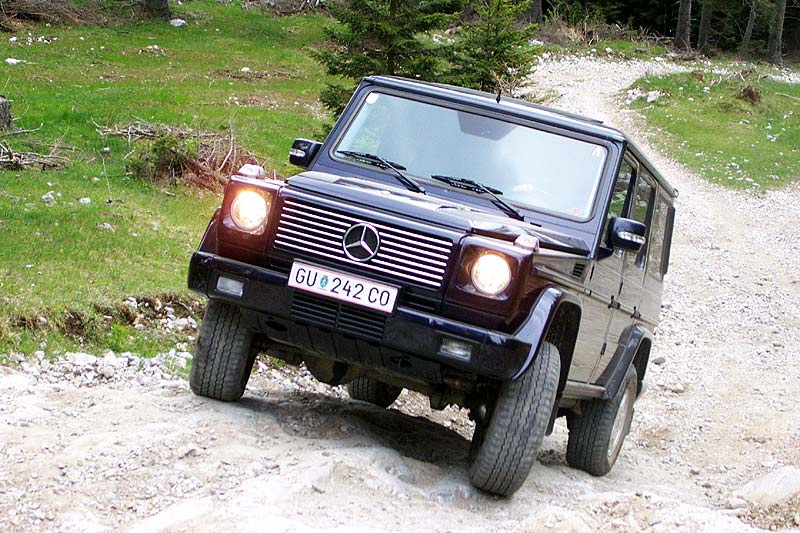
How capable? With a strong ladder frame, rigid axles, coil springs and gas shocks, three electronically locking differentials, a synchronized transfer case, a low-range off-road gear ratio, electronic traction control, stability control and brake assist, the G Wagon can go just about anywhere.

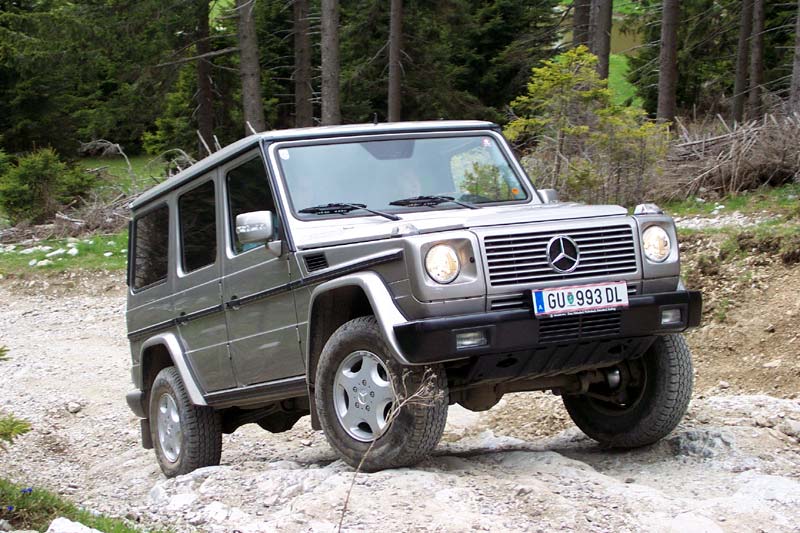
In civilian trim, it is able to climb or descend slopes of up to 80 per cent. Its maximum stationary tilt angle is 54 degrees. Ground clearance is 29 centimetres (11.4 in.) It can ford streams 50 cm (19.7 in.) deep. On military versions, ground clearance bumps up to 43.9 cm (17.2 in), and its fording capability is 60 cm (23.6 in.), according to the Department of National Defence. However, with its high-mounted snorkel air intake, it could probably go much deeper.

Magna-Steyer has an off-road test site outside Graz, atop a mountain with panoramic views looking toward Slovakia. It was here at the Schöckl test site that the off-road prowess of the original Gelaendenwagen was perfected and where Mercedes-Benz and Magna-Steyer still test the durability and capability of the G-Class.

Schöckl is a network of rocky trails and near-impossible boulder-strewn slopes. Stopped on an incline with a 40- or 50-degree angle, our G 500 (5.0-litre gas engine) tester climbed effortlessly away and straight up. The descent was moderated by the low-range gear and copious engine braking, as we crawled over the rocks without the aid of the wheel brakes.

It is easy to understand this vehicle's attraction for the military. But as capable as it is off-road, the civilian G-Class has all the comforts one would expect in an ultra-luxury vehicle -- integrated navigation system, heated leather seats, walnut wood trim, automatic climate control and electrically adjustable steering column, to name a few.

In Europe it's available in a short-wheelbase two-door wagon, short-wheelbase cabrio and long-wheelbase four door wagon with a choice of three gasoline engines and two diesels.

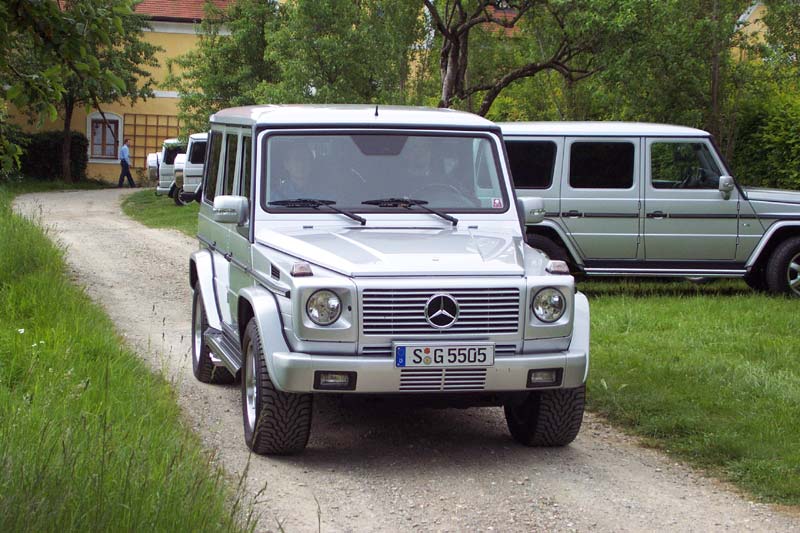
Canada gets only the long-wheelbase four-door, offered with two gas V-8s: a 296-horsepower 5.0-litre (G 500), and the new 2005 AMG supercharged 5.5-litre (G 55 AMG) that produces 476 h.p. and 516 pound-feet of torque.

Compared to the original Gelaendenwagen that debuted in 1979 with four engines and a maximum 150 h.p., the G-Class has come a long way. In that time, Mercedes-Benz has never felt the need to change the G's form-follows-function exterior appearance. The square, angular shape provides a good field of vision for the driver and makes excellent use of interior space.
05g55amg_1.jpg

05gclass_1.jpg

05gclass_2.jpg

05gclass_3.jpg

05gclass_4.jpg

05gclass_5.jpg
 
First Drive: 2005 Mercedes-Benz G 55 AMG Kompressor

Graz, Austria – As if it wasn’t enough that the Mercedes-Benz G-Class is one of the most rugged and capable off-road vehicles on the planet, it is now also one of the fastest, if not the most powerful SUV money can buy.

Mercedes-AMG is the hot rod division of Mercedes-Benz, designing high performance variants for most of the vehicles the company builds. First offered in 1999, the G 55 AMG came with a 5.5-litre V8 producing 349 horsepower and 387 foot-pounds of torque. To mark its 25th anniversary, Mercedes-Benz has a new G 55, the 2005 G 55 AMG Kompressor.

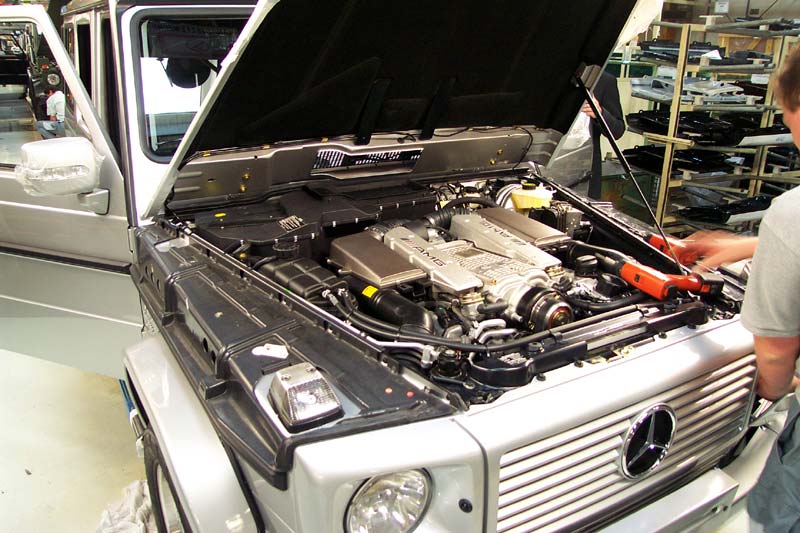
Kompressor is Mercedes-speak for supercharger. With the help of an intercooler and two low-temperature coolers to lower air temperatures at the intake, the supercharged engine produces 476 hp at 6,100 r.p.m. and 516 lb.-ft. of torque from 2,650 r.p.m. to 4,500 r.p.m., putting the 2,550 kilogram (5,621 lb.) G 55 into the same league as some world class super cars.

Zero to 100 kilometres per hour is achieved in 5.6 seconds. We stop watch checked 80 to 120 km/h at three seconds flat. Passing, needless to say, is quick and effortless. Top speed is an electronically governed 210 km/h.

The off-road capability of the G 55 remains the same as all other G-Class variants. And on-road performance has been improved with higher rate front springs and re-tuned shock absorbers. But in reality, the G 55's strong suit is straight ahead performance. While it handles extremely well for a big, heavy SUV, it is still an SUV, with a high centre of gravity and a preference for cautious cornering. Large and effective disc brakes bring the G 55 back from too fast to just right whenever the need arises.

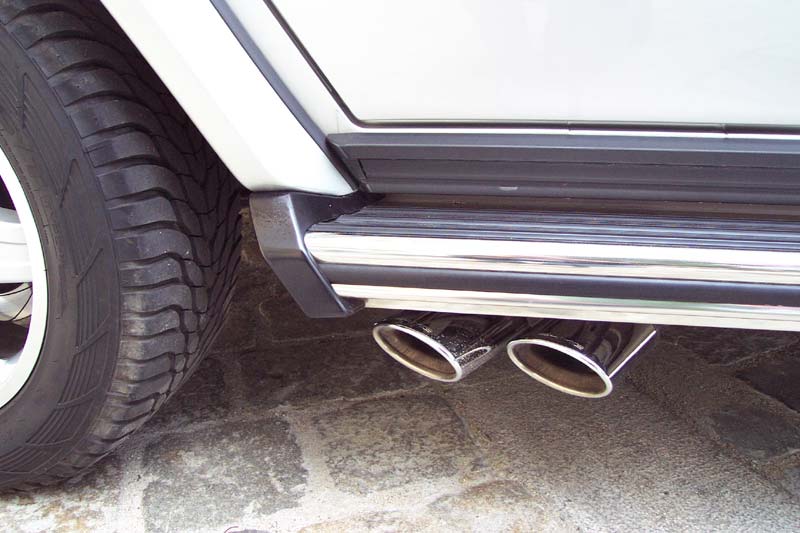
A new exhaust system provides greater flow and reduced back pressure, while more efficient catalytic converters reduce exhaust emissions. Twin oval tail pipes protrude diagonally in front of each rear wheel and are the only clue, other than its distinctive and robust sound, that this G Wagon is the ultimate performance Gelaendenwagen.

The naturally-aspirated 2004 G 55 retails in Canada for $138,950. Prices for the 2005 G 55 AMG Kompressor, expected in showrooms early this Fall, have not been announced.
05g55amg_2.jpg

05g55amg_3.jpg

05g55amg_4.jpg


Preview: the military G Wagon

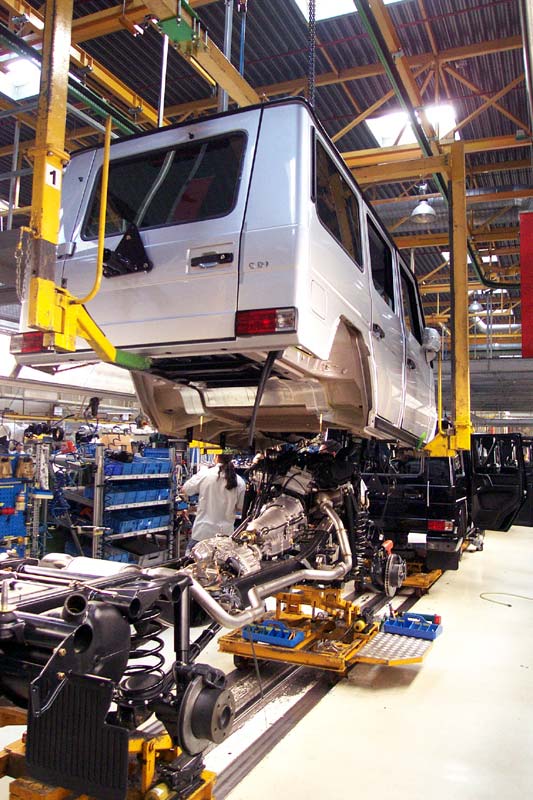
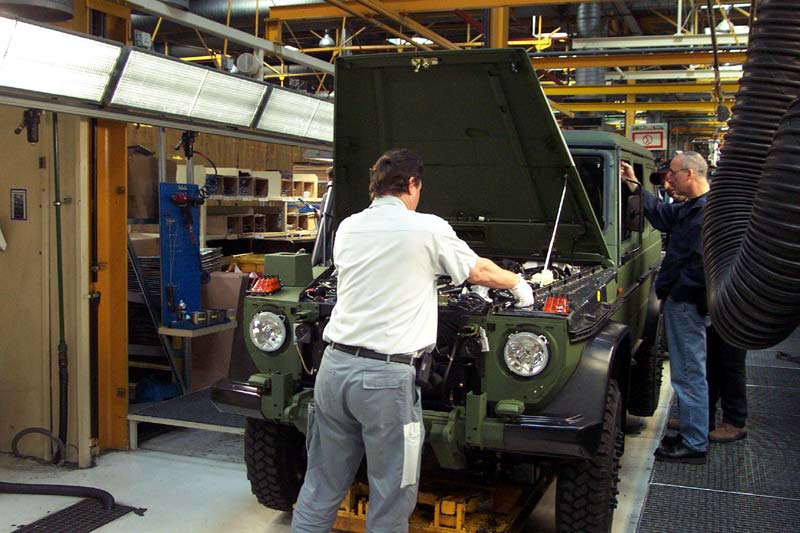
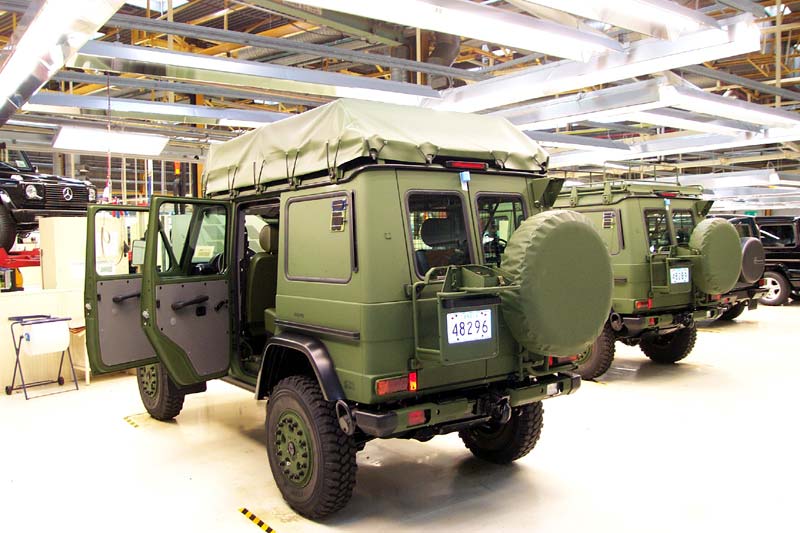
Graz, Austria – At the Magna-Steyer factory in Graz, Austria, G Wagons painted Canadian Army Green move slowly along the assembly line alongside more luxurious versions of the Mercedes-Benz G-Class.

At one station, workers install a 5.5-litre Kompressor engine and drive train onto a frame that will become a $140,000 G-55 AMG. On the next vehicle, the same workers bolt in the 2.7-litre 5-cylinder diesel drivetrain that will power the G Wagon through the streets of Kabul, Afghanistan.

In early March, Army units stationed in Afghanistan took delivery of the first 60 Mercedes-Benz G Wagons, while another 40 were delivered to Canada. They are the first of 802 military G Wagons to be built on the Magna-Steyer assembly line for Canada as part of a $130.4 million contract to replace the aging and often-criticised Iltis.

The contract also includes 160 modular armour protection systems (APS) designed specifically for the Canadian vehicles. The APS, which stores in three boxes and can be installed in the field by three soldiers in as little as eight hours, gives the G Wagon protection against small arms fire, hand grenades and anti-personnel mines. The modules add nearly a ton of weight to the 3.9 ton (8,598 lb.) vehicles, but the benefits include reduced manufacturing costs, much improved fuel economy and better performance for non-armoured vehicles.

Like the APS, the G Wagons are custom built to Canadian Army specifications, with several hundred parts being designed and installed specifically for the Canadian production run. The Canadian G Wagons are equipped with the standard G-Class all-wheel-drive system, front disc and rear drum brakes, dual 12- and 24-volt electrical systems, 24-volt starter, solar trickle charger, two piece wheels with run flat tires, automatic transmissions, special radio communications equipment, roof racks and frame attachments to allow air-lifting the vehicles. Air conditioning is a necessity, as armoured windows don’t roll down.

While we didn’t get a chance to drive the new military G Wagon, we did go for a short ride outside the factory in Graz. With just 156 horsepower, the turbocharged and intercooled 5-cylinder 2.7-litre diesel engine appears anaemic on paper, but the small powerplant produces big torque numbers at low r.p.m. – 295 foot-pounds of torque at just 1,800 r.p.m.– and moved the non-armoured vehicle surprisingly well.

Although the G Wagon is built in Austria, terms of the contract require Mercedes-Benz to purchase 100 percent of its value - currently $130.4 million - in goods and services from all provinces and territories of Canada. As well, the G Wagons can be serviced and maintained through Mercedes-Benz’ worldwide network of dealers and service depots - a parts supply infrastructure as good as any army’s.

Hmm... a Mercedes-Benz franchise in Kabul might be a good investment.

G Wagon technical specifications

Variants: 3 (basic, command and reconnaissance, military police)
Type: 4 Passenger Station Wagon
Engine: 2.7-litre, 5-cylinder diesel, turbocharged and intercooled
Drivetrain: 4X4 permanent all-wheel drive, 5-speed automatic
Tires: Michelin XZL 8.25R16 with optional run-flat inserts.
Fording ability: 600 mm
Ground clearance: 43.9 cm
Side slope angle: 30º
Approach angle: 40º
Grade: 60 percent
Payload: 1500 kg max. (incl APS)
g_wagon_1.jpg

g_wagon_4.jpg

g_wagon_2.jpg

g_wagon_3.jpg
 
Thai said:
the supercharged engine produces 476 hp at 6,100 r.p.m. and 516 lb.-ft. of torque from 2,650 r.p.m. to 4,500 r.p.m., putting the 2,550 kilogram (5,621 lb.) G 55 into the same league as some world class super cars. [/IMG]

That's some serious cheese under the hood :eek2:
 
I'd rather have a hummer

I sure hope that the problems those guys had on the MB forum aren't on the same ones the poor Canucks are getting in Afghanistan. Crappy steering and bad tranny's are just what you need when some jack##s is lobbing RPG's at you.

If I was the CO over there and read that thread i think this what I would be doing in Ottawa.

:goinposta
 
From what i hear, some of the electrical problems have been fixed for 2003-up models. 2002 G-wagons were truly a bad batch!

I am currently looking at a '04 G500...it's very tempting...solid axles and full lockers! Like Hummer H1, all G's are made to last at least 12 years of full military service. Steel on G-wagons is thicker and stronger than regular production SUVs. The frame is unbelievably strong. It meets Mercedes strict crash testing criteria, which is impressive for a vehicle designed in 1979.
 

Members online

Forum statistics

Threads
278,312
Messages
3,554,089
Members
248,016
Latest member
Advally Service

Trending content

Back
Top