Mercedes G-wagen

FirstToyz, G-wagon: luxury + capability. It's capability is second to none. About the only vehicle that G-wagon loses is the Rubicon (due to size and weight). Lockers make a huge difference in off-roading over unknown terrain. Luxury is pretty good too. Don't forget, the G-wagon is in the same league as Hummer H1 in terms of powertrain, thickness of steel, frame strength, and durability. It was designed foremost for military duty...thus, it's steel thickness far exceeds any civilian requirements.

G-wagon costs a lot for a reason...same reason why H1 is so expensive. They are built on another level. For most people, they do not see this...thus, "assuming" that it's overpriced. You really have to testdrive one and off-road it to see where the money went. G-wagon is also handbuilt from beginning to end. FJ80 may have advantage in aftermarket options, but the G-wagon is built from beginning with heavy duty gears...just peak under the G-wagon and look at the axles and frame...you will see the difference to other "ordinary" SUVs! G-wagon weighs as much as the Lexus LX470, yet it is smaller than 4th gen 4runner...heavy duty gears!

Just a note...despite designed 25 years ago, the G-wagon surpasses ALL of Mercedes crash tests, which is stricter than federal's.

I am very close to buying one. I have looked at all alternatives, including FJ80, FJ100, Range Rover, and Touareg. G-wagon is very impressive in that company.
 
FirstToyz said:
Big waste of money, imo. In the company of those you listed, the G-wagen finished dead last because the price is ridiculous. That price, btw, is NOT because it is "heavy-duty". Yes it is a great 4x4 wagon but that is not why the price is high. That price is jacked up for the poser market, plain and simple.

You are telling me you would be ok wheeling a G-Wagon as hard as a modded FJ80? NOT.
A modded FJ80 is going to have better ground clearance, fully locked, steel bumpers, sliders, winch, CO2, etc,etc,etc over a stock G-Wagen. I would not care if I got rock rash on it and the aftermarket is huge- and you still have $50,000 left over.

As for the H1, we aren't in the military and as such the H1 isn't great for off-roading. It's too wide for alot of trails, it isn't particularly comfortable, it sucks gas, doesn't have much room. Yeah it's tough but if it's designed for military use not civilain off roading. If it plain doesn't fit on the trail, what good is it?

I appreciate your enthusiasm for off-roading...but, please learn about the vehicles BEFORE putting them down.

First, H1 uses diesel...thus, fuel economy is not far behind your 4runner (may even be better!). If you care about size for off-roading, then the 4th gen 4runner is NOT the best choice either! The 3rd gen was far better for this. G-wagon is better. H1 is now available with E-locker in front and rear! Truly cool.

Well, if i am into financial savings, then i would get a Wrangler Rubicon and modify it. This will then run circles around ANY modified FJ80...in REVERSE! Aftermarket for Jeeps is superior to anything else on the market.

G-wagon...price jacked up?? Maybe...but consider it's EQUIPMENT. It's axles are equivalent to Dana 60. It's lockers are specific for G-wagon (not one size fits all, as in aftermarket lockers). The axles themselves are designed to have lockers from the very beginning (not the case with FJ80). Did you know that prior to 2002, G-wagons fetched a price north of $130K? THAT's jacking up! G-wagons are NOT selling well because it is too specific and appeals to only a select few (me and the pimps). Range Rovers and LX470 are selling much better...but Mercedes have not lowered their prices. Instead, they will discontinue the production of civilian G-wagons after 2005...only military versions will be produced till 2025. In 2006, Mercedes will produce a wimpify "G-wagon" based on the next ML platform (unibody, independent suspension, etc.).

Now, add in the thicker, stronger body + ultra-stiff frame...it's not THAT overpriced. Don't forget the luxury equipment that comes with the G-wagon (top-notch materials inside...EVERYWHERE you touch is soft and i mean everywhere, including ANY panels inside).

It's powertrain is also top-notch. Transfer case and axle ratios are ultra strong. Remeber, this is STOCK equipment.

Think about this...it's SMALLER than 4runner, YET weighs as much as LX470. Think about it. That's a lot of steel!!

So, for trails, the G-wagon is superior to FJ80 simply for it's smaller size. Of course, the frame and axles are far superior to FJ80...FJ80 was NOT known for it's stiff frame (this is where FJ100 is much better than FJ80).

Again, modified FJ80 are great. However, let's compare stock vs. stock. Oh yeah, modifications do NOT always go smoothly. Why do you think almost all off-roaders want FJ80 that came from factory with lockers, instead of putting one in by themselves. Why do you think the Jeep off-roading crowd is buying Rubicon?? Factory warranty and craftsmanship are far better than any aftermarket vendor. It's worth it to pay a little more for peace of mind.

Do yourself a favor...visit your local Mercedes dealership and take a peek UNDER the G-wagon. Look at the frame or axles. I will assure you that you will be impressed...IF you know anything about off-roading gears.

Thanks.
 
FirstToyz said:
It's great off road for sure but it is no where near worth $100K.
I agree, but the '04 MSRP for the G500 is "only" :D $77,620 ($94,170 for the AMG G55 :eek2: ). The folks who got really screwed are the ones who paid approx. $130K for them back when they were being privately imported :arrow:

IMO $77,620 is a relatively fair MSRP when you take into account the premium MB charges for anything with their 3 pointed star on the hood. MSRP for an '04 LX470 is $65,100 and will climb over $70K when you add options.

There's always the argument that someone could take another vehicle and mod it to be better - I could probably take the Civic in the current 4ROTM pic and with $100K in mods make it go faster than a brand new Ferrari, but I can assure you that Mrs. GG wouldn't want to be seen in it or allow me to park it in our driveway :p Come to think of it, she probably wouldn't want to be seen in or allow me to park the G500 in the driveway either - it's kind of ugly (sorry Thai :D )

Thai, if you do get a G500 I'd recommend you get an old 4Runner so you can have something to go off-roading in and have fun without worrying about scratching the MB :)
 
GatorGreg said:
she probably wouldn't want to be seen in or allow me to park the G500 in the driveway either - it's kind of ugly (sorry Thai :D )

Thai, if you do get a G500 I'd recommend you get an old 4Runner so you can have something to go off-roading in and have fun without worrying about scratching the MB :)

GG, yeah, the G-wagon is an "acquired" taste...some hate it and some love it. There is no in between with the G.

If i do get the G, then i will use it for national park off-roading (like Utah, Big Bend, etc.). GG, you're right. I may also get a used 2nd gen 4runner in the near future for the local "explorations" into the woods. But, first, i have to deal with the salesman....
 
Mercedes-Benz G-Class completes extremely tough challenge on the “New Silk Road with flying colours
DaimlerChrysler aid transport for Afghanistan

Stuttgart, Nov 06, 2003
As part of the aid convoy for Afghanistan initiated by DaimlerChrysler, five Mercedes-Benz G-Class models passed another endurance test with flying colours: the cross-country vehicles accompanied the convoy along the 6000-kilometre route from Brussels to Hayraton in Afghanistan, in the process demonstrating their reliability under extreme conditions. The Stuttgart-based automotive company chose to transport the aid supplies along the so-called “New Silk Route”. Almost half of the journey was routed along unpaved roads; the vehicles travelled a distance of approximately 1000 kilometres through the Karakum Desert along sand and gravel tracks. Once again the G-Class, equipped with permanent four-wheel drive, an electronically-controlled traction control system, differential locks and the ESP® stability program, proved that it ranks amongst the best off-road vehicles in the world.

The aid convoy with a total of ten Actros articulated trucks, five Mercedes-Benz Sprinter vans, a Unimog and five G-Class cross-country vehicles started out from Brussels at the beginning of September and reached its destination in the Afghan city of Hayraton three and a half weeks later. Under the aegis of the European Union (EU), the Mercedes vehicles carried some 220 tonnes of technical equipment to Afghanistan for reconstruction work. At the same time, the modern caravan revealed possibilities for the economical overland transportation of goods between Europe and Central Asia.

The route chosen by DaimlerChrysler was the so-called “TRACECA” Corridor, otherwise known as the “New Silk Road”. The “Transport Corridor Europe Caucasus Asia” is a transport project sponsored by the European Union with 13 participating states from Eastern Europe and Asia. In memory of the legendary ancient “Silk Road” trading route, the project aims to revive the shortest overland route between the continents. The Mercedes convoy carrying aid supplies for Afghanistan has performed some important groundwork for this.

The tough conditions made it plain just how demanding the task facing the four G 500 and G 270 models was: almost half of the journey was on road surfaces reminiscent of building sites; vibrations or hard knocks tested the body and chassis to the limits. In the Karakum Desert, the vehicles traversed some 1000 kilometres of terrain on tracks made of just sand and gravel.

For the Mercedes vehicles, the 6000-kilometre journey could not have come to a more successful conclusion: there were no breakdowns and no spare parts were required.
 
Last edited:
Stewart & Stevenson Announces Sales Agreement with DaimlerChrysler
Stewart & Stevenson TVS Gains Exclusive Right to Market Mercedes-Benz Military Gelandewägen to U.S. Government Agencies

HOUSTON – December 11, 2003 – Stewart & Stevenson Tactical Vehicle Systems, LP (TVS), a manufacturer of medium tactical vehicles for the U.S. Army, announces that it has entered into an agreement with DaimlerChrysler, which gives TVS the exclusive right to market the Mercedes-Benz Military Gelandewägen (G-Wagen) series of vehicles to United States Government authorities, including all federal, state, and local government agencies.

The G-Wagen military series includes the Open Wagon, Van, Station Wagon, Light 4x4 Tactical Wheeled Vehicle, and a Chassis with Cab. Since 1979 more than 60,000 of these vehicles have been sold to military customers worldwide. The G-Wagen has been continuously upgraded with the latest in automotive off-road and on-road technology.

The G-Wagen provides superb mobility, reliability, and economy, both off-road and on-road. It optimally fulfills its intended mission as a vehicle for transporting personnel or loads at a maximum two metric tons, and for towing trailers or artillery. Designed for air landings, the vehicle can be transported easily as an external load below a helicopter or as an internal load for aircraft, including the U. S. Marine Corps V-22 Osprey. It can also be air-dropped by parachute. The G-Wagen is offered in several armored versions, with protection ranging from small arms to mine blast protection. It has performed successfully for German special forces in Afghanistan and U.S. Marine Corps Force Recon Units in the Afghanistan and Iraq conflicts. Powered by a modern turbocharged common rail diesel engine, the G-Wagen military series meets the latest requirements of modern armed forces with respect to fuel efficiency and exhaust emissions.

The G-Wagen series complements the existing FMTV product line made by TVS, which includes 15 active variants and weight capacities ranging between 2.5 and 11 tons. Planned FMTV models under development will extend the product range to 15 metric tons in an 8 X 8 configuration.

Stewart & Stevenson has been the exclusive supplier to the U.S. Army of the FMTV since 1991, including trucks and companion trailers for on- and off-road use. The FMTV is produced in Stewart & Stevenson’s state-of-the-art facilities located 50 miles west of Houston in Sealy, Texas. The company has manufactured and delivered more than 22,000 trucks and trailers and has achieved 42 consecutive months of 100 percent on-time delivery of trucks and 33 consecutive months of on-time trailer delivery performance.
 
US Army Special Forces and G-wagons....
 

Attachments

  • august04.jpg
    august04.jpg
    31 KB · Views: 10,819
The classic Cross-Country Vehicle celebrates an impressive anniversary: 25 years of the Mercedes-Benz G-Class

Stuttgart, May 24, 2004
It is now 25 years since production began of the Mercedes-Benz G-Class. The Stuttgart-based car maker unveiled the robust Cross-Country Vehicle to the pubic for the first time in 1979, since when it has delivered a total of some 175,000 units of the G-Class to customers the world over. Its striking appearance – unchanged throughout its 25-year lifespan – and outstanding engineering has secured the Mercedes Cross-Country Vehicle cult status in the automotive world and earned it a reputation as one of the most coveted classics on the market. Mushrooming demand in the USA saw G-Class sales skyrocket in 2002 and 2003.

A policy of continuous renewal has allowed the G-Class to keep pace with advances in technology to the point where the Mercedes classic can now be ordered with the most powerful drive system in the brand’s product range. With a combination of permanent four-wheel drive and the electronically controlled traction system 4ETS, ESP®, the Low Range gear ratio and three manually selectable differential locks, the G-Class is the master of all it surveys off the beaten track whilst at the same time offering the driving safety you would expect of a Mercedes-Benz on the road. The new G 55 AMG is standing by to round off the model range from the middle of 2004, its eight-cylinder supercharged engine developing 350 kW/476 hp and a maximum torque of 700 Newton metres.

The development programme for a new cross-country vehicle was launched in 1972 with a cooperation agreement between Daimler-Benz and the Steyr-Daimler-Puch company based in the Austrian city of Graz. Series production was given the green light in 1975, as was the construction of a new plant in Graz, where the G-Class is still built today – and still predominantly by hand. Market launch in the spring of 1979 saw the new off-road expert available with a choice of four engine variants – with outputs ranging from 53 kW/72 hp to 110 kW/150 hp – and in either Cabriolet, short-wheelbase Station Wagon or long-wheelbase Station Wagon guise. Today, the G-Class range spans five models, including three powerful eight-cylinder variants.

Flawless off-road ability anchored in robust engineering

From the outset, the G-Class has been designed to take on and conquer even the most challenging terrain. Providing the formidable basis for the Mercedes-Benz Cross-Country Vehicle is a frame consisting of closed longitudinal profiles and cross members, which ensures exceptional bending and torsional stiffness. The frame supports robust rigid axles with large coil springs and long spring travel, technology which comes into its own off road. Sufficient climbing ability to put grades of up to 80 percent within range, a maximum tilt angle of 54 percent, 21-centimetre ground clearance and impressive angles of approach (36 degrees) and departure (27 degrees) equip the G-Class to negotiate the trickiest off-road terrain with majestic ease. At the same time, the chassis also provides safe and comfortable handling on smooth tarmac.

As the G-Class celebrates the 25th anniversary of its entry into production, the proven technical concept underpinning the off-road Mercedes remains untouched. What the engineers have done is constantly upgrade the technology and equipment features of the Cross-Country Vehicle since its introduction in 1979. An automatic transmission and air conditioning system were made available back in 1981, for example, and the G-Class has been fitted with permanent four-wheel drive, differential locks on the front and rear axles and a fully locking central differential as standard since 1990. ESP®, 4ETS and Brake Assist were added in 2001, allowing the off-roader to offer a combination of high-performance traction and driving safety systems unmatched in the automotive world.

New G 55 AMG with 350-kW/476-hp supercharged V8 engine

Marking its arrival at the summit of the engine range in mid-2004 will be the new G 55 AMG. Its V8 power unit develops 350 kW/476 hp and puts a maximum torque of 700 Newton metres on tap from 2650 rpm. These performance credentials enable the G 55 AMG to outstrip its naturally aspirated V8 predecessor model by 34 percent in the output stakes and by 32 percent in terms of torque. In other words, the new G 55 AMG can call on generous reserves of power both on the road and over loose terrain, generating unparalleled authority, exclusiveness and driving dynamics. Indeed, its performance figures may well draw some envious glances from the sports car market, the G-Class accelerating from 0 to 100 km/h in just 5.6 seconds on its way to a maximum speed of 210 km/h.

Soaring sales between 2001 and 2003

Mercedes-Benz has produced a total of some 175,000 units of the G-Class since 1979, with global sales reaching a peak of 8700 in 2002. That was on top of the 7500 G-Class vehicles delivered by the Stuttgart-based manufacture to their owners the previous year – already an increase of around 87 percent on the figure for 2000. The catalyst for this stunning growth in sales was the immense popularity enjoyed by the G-Class in the USA, where the robust Cross-Country Vehicle had been on sale since November 2001. In Europe, demand for the G-Class rose by some 26 percent compared to 2000, whilst sales in Asia and Australia jumped by more than 30 percent.
 
The G-class has been a member of the Mercedes-Benz passenger car range for a quarter of a century now and has retained more or less the same exterior appearance over its entire lifespan.

This makes the G-Class one of a small and elite band of high-quality products which have resisted the influence of fleeting stylistic trends through the decades – and thus come to set trends itself. It is no exaggeration to refer to the G-Class and the other members of this exalted echelon as classic examples of design, providing a reassuring yardstick in a fast-changing world. Preserving a tried-and-tested recipe for success, they continue to set the standard in their sectors, the benchmark against which all new developments must be measured. They embody the cast-iron virtues of quality, originality and, more often than not, peerless exclusivity.

It is no surprise that only a small number of products can be considered part of this club. After all, only a small number can claim to be true design classics, since only a small number stand apart from the crowd by virtue of classic, that is to say timeless, design. In the worlds of fashion and furniture, such classics have cemented a place in history and have fended off the challenge of fashionable, but often short-lived, trends. In the automotive world, genuine classics are rarities, but the G-Class has earned its place in this “hall of fame”.

For a single model to be in production for 25 years without interruption and in virtually unchanged form on its way to becoming a living legend is a rare occurrence indeed. In the Cross-Country Vehicle class, the Mercedes-Benz “G” is joined by two other models which have displayed similar staying power: Britain’s Land Rover, which first appeared in 1948, and the American Jeep, which arrived on the scene in 1941 and today continues a long tradition in the form of the “Wrangler.”

The lines of the Mercedes G-class have never been called into question, never has there been a need for changes to the vehicle’s fundamental form. After all, the design has always responded squarely to the demands placed on an off-road vehicle. It allows the driver an unimpeded clarity of vision, makes excellent use of the room available and has a spacious interior. This is a fine example of the design answering the need - angular, functional and timeless.
 
AUTOWEEK Article

2005 Mercedes-Benz G55 AMG
25 Years Of Germany’s Jeep: Anyone For Bracket Racing?
J.P. VETTRAINO

2005 MERCEDES-BENZ G55 AMG
ON SALE: October
BASE PRICE: $100,000 (est.)
POWERTRAIN: 5.5-liter, 469-hp, 515-lb-ft supercharged V8; 4wd, five-speed automatic
CURB WEIGHT: 5600 pounds
0 TO 60 MPH: 5.4 seconds (mfr.)

News flash: The automotive world has changed along with everything else! Witness the Mercedes-Benz Gelaendewagen, which was launched in 1979 as a rugged, rudimentary all-terrain vehicle designed primarily for military use, government agencies and the developing world. Some 25 years later the G-Wagen has evolved into the G-Class—a rugged, less-rudimentary all-terrain vehicle that is also a fashionably expensive urban icon from Los Angeles to Moscow. That’s brand power.

So how will Mercedes mark the 25th anniversary of this off-road legend? With its 5600-pound Kompressor-ized G55 that can stomp a Cadillac XLR or a Porsche Boxster S in the stoplight derby. Yes, supertuner AMG has prepared a 469-hp G-Class that will sprint from 0 to 60 mph in less than 5.5 seconds, complete with nine inches of ground clearance, dual-range transfer case and three 100 percent locking differentials (not to mention polished 18-inch wheels).

"It’s strangely satisfying to drive a G-Class that can accelerate from traffic signals faster than many sports cars," says Juergen Hubbert, the DaimlerChrysler board member with responsibility for Mercedes and an early proponent of the G-Class. "At its core this is the same cross-country vehicle we launched in 1979. We did a pretty nice job then. No one expected it to last beyond 10 years."

Indeed. The G-Class is the longest-running vehicle series in Mercedes history, and this from a company that until the mid-1990s more or less prided itself on long product cycles. As prominent as any change is the G’s name. Mercedes has all but eliminated references to the original Gelaendewagen in favor of the corporately consistent G-Class.
 
The G is a product of the slow-moving 1970s. In 1972 the Daimler-Benz board approved joint development, with Austria’s Steyr-Daimler-Puch, of a light-duty vehicle suitable for both on- and off-road travel in all conditions and markets. It was unfamiliar territory for the world’s oldest automaker. In 1975 the board approved production, and the first serialized G-Class rolled from the factory in February 1979.

Like the model available today, the first G-Class was built on a ladder frame, fully boxed through both its longitudinal rails and crossmembers and fitted with solid axles front and rear. Manually locking front, rear and center differentials were offered from the start, along with a synchronized transfer case that allowed a driver to select low range on the fly. Four gas- or diesel-engine options ranged from 72 hp to a whopping 150 hp. Even the body was designed with all-terrain capability in mind.

From the outset there were multiple G-Class variants, but three geared for the civilian market: an open version, and short- and long-wheelbase wagons with two and four doors. From the beltline down the three were nearly identical, and clearly function determined form. Short overhangs allowed appropriate approach and departure angles. A big, flat windshield and basic square shape maximized interior volume and offered excellent visibility close around the vehicle. Body panels were designed for quick changes, and could be replicated with primitive metal-working techniques far from the beaten path.

Today Mercedes’ press literature compares the G-Class design with the classic Burberry trench coat: "There is just no way it can be improved."

Inside, the first Gs were all painted metal surfaces with little trim and no foam. A two-spoke steering wheel framed a Cyclops-eye speedometer with a handful of warning lights. Yet even when the G-Class was spartan, it wasn’t cheap. Given a wide number of variants with multiple engines and limited volume, the G-Class plant in Graz, Austria, relied largely on hand assembly, even measured against the pre-robotic mass-production standards of the early 1980s.
 
Last edited:
The first big orders came from governments. The Shah of Iran, who happened to be a major Daimler-Benz shareholder, ordered 20,000 Gs for his military before the first copies rolled from the factory. The Islamic revolution in Iran killed that sale, but the German government and Swiss and Norwegian armies helped fill the void. Armored G-Classes were built almost from the start. In Eastern Europe they were marketed under the Puch brand, to mitigate capitalist-pig connotations associated with the tri-star.
benzwagensideview.jpg

By the 1990s gray-market importers were doing brisk G-Class business in the United States, but it wasn’t until the end of the decade that a light went on in Stuttgart. Americans seem to like this kind of vehicle! The G-Class went on sale here through official Mercedes channels in November 2001. The company sold 3200 Gs the first calendar year, increasing worldwide sales nearly 40 percent.

Twenty-five years and 174,999 units after the first one, the G-Class has evolved. Air conditioning and an automatic transmission were offered in 1981; aluminum wheels followed a year later. The open G was fitted with a folding soft-top in 1985, replacing a canvas tarp. Full-time four-wheel drive became standard equipment in 1990, and a torrent of electronic systems followed through the ’90s: ESP, ABS, four-wheel traction control, Brake Assist, etc. Engines, naturally, have improved. In 2004 the most frugal G-Class diesel sold anywhere makes more horsepower (156) than any version offered in 1979.

The G-Class interior began to resemble current specification in 1990, when Mercedes offered one with wood trim for the first time. Wood opened the floodgates for full carpet, padded surfaces and rich leather, and today we can enjoy the G-Class with dual LCD monitors in the back of the front headrests, complete with DVD and TV reception.
 
With gear, of course, comes mass. The original long-wheelbase, four-door G-Class weighed a substantial 4300 pounds. The 2005 G55 AMG weighs 1300 more, borne on the same boxed ladder frame and solid axles.
benzwagenbridge.jpg

AMG tuned the G-Class long before the company became a Mercedes subsidiary and captive tuner; it built the G that won the 1983 Paris-Dakar raid with Jacky Ickx and Claude Brasseur driving.

Mercedes’ previous G55 AMG used the normally aspirated 5.5-liter V8 from the CLK55 and discontinued ML55.

The 2005 G55 AMG, due here in the fall, is powered by the supercharged 5.5 introduced in the E55 sedan. The 2005’s 469 hp represents a small increase compared to the previous G55 (we’re kidding: It’s up a full 120). Torque increases from 387 lb-ft to 515. The G55 gets the usual AMG suspension tuning, with much stiffer front springs than the G500 (the only other G-Class sold in the States), yet Mercedes insists it retains all the legendary off-road capability (though we’re sure you’ll have to change the speed-rated tires). Top speed is 130 mph.

The new G55 absolutely accelerates like a sports car, from any speed in any gear. But it doesn’t turn like one (nor like a Porsche Cayenne). AMG can work all the magic it wants, but with solid axles and its up-high mass, the G is reluctant to change directions quickly. We wouldn’t want to try an emergency lane-change at that 130-mph top speed. The top of the vehicle takes a while to catch up with the tires, and it plows like a rugged off-road military vehicle, which it is.

On the other hand, at posted speeds on public roads, the G55 is better than adequately maneuverable, and never a chore to drive. With the bus-like view outward, it can be almost fun. Its ride is surprisingly compliant. It can tow 7700 pounds and with the right tires, it can climb 80 percent grades and ford streams two feet deep.

The standard G500 does all that, too, with less concern about the standard tires, and it accelerates as quickly as a 5000-plus-pound truck needs to. The G500 also costs at least $20,000 less. The new G55 will likely approach the 100k mark.

No, we’re not missing the point of this ultra G-Class built to mark a milestone anniversary. If you have money to burn, or you need bling or you have a particularly large body and want thrilling acceleration, why not? A journalist at the G55’s introduction observed that it could soon become the official car of the NBA players union.

There’s nothing wrong with working-class roots.
 
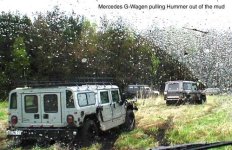
Classic pic...G-wagen pulling out a Hummer H1 :dancin: :clap:
 

Attachments

  • g pulling h1.jpg
    g pulling h1.jpg
    56.7 KB · Views: 19,052
Canadians suffer minor injuries in Afghan blast

Link

Graham said he was also pleased that lives may have been saved by the new light-armored vehicles the troops are using, called G-Wagons.

Despite the power of the blast, witnesses said the soldiers' G-Wagon was hardly damaged.

"I have renewed faith in the vehicles we're driving," Warrant Officer Mike Gauley said. He added the troops inspected the vehicle carefully for damage, but all they found was "a broken headlight."

:)
 
Mercedes G-Class Named Classic "Off-Road Vehicle of the Year 2006"
Posted on February 9, 2006

When speaking of a Mercedes-Benz model, there is none more classic than the G-Class. Its style has remained largely unchanged for the past 27 years, and this fact has caused many to question whether or not Mercedes would even keep producing the beloved SUV.

Mercedes has uncategorically denied this claim, and today they have published yet another press release re-affirming their commitment to the G-Class, while at the same time boasting of the G's latest accomplishment in the land of 4x4's.

It turns out, the G-Class recently received another award, being voted "Off-Road Vehicle of the Year 2006" in the "Classic" category by the readers of Off Road magazine. This marks the third time the Mercedes G-Class has been honored by the publication, and adds to the extensive list of accolades already bestowed upon it, including being voted world's best off-roader thirteen times by readers of the German publication Auto Motor und Sport.

So how does Mercedes feel about the G-Class? Here's what they had to say: "This latest victory reaffirms the model strategy of Mercedes-Benz, which is just as unique as the classic off-roader itself: the G-Class has retained its striking body shape and stable foundations in unchanged form since 1979. At the same time constant evolution has kept the "G" at the technical forefront. Neither is there an end to this success story in sight, as the new special model Grand Edition demonstrates."
MercedesGClassGrandEdition1Small.jpg
 

Members online

Forum statistics

Threads
278,316
Messages
3,554,111
Members
248,016
Latest member
Advally Service

Trending content

Back
Top