Missing, Knock CEL, Hesitation ~1800-2400RPM

Saiba Samurai

New member
Hey all, picked up a 1985 4Runner SR5 (manual, 22RE). It had a refurbished 22RE motor swapped in, but the truck has been missing since I got it. I have been trying to track down the issue, and haven't had any luck yet. I've been scouring the forums looking for things to check.

Issues: Missing, CEL - Knock, Hesitation/Stutter ~1800-2400 RPM

So far I've checked/verified/replaced/done the following:
- AFM - Checked, was bad and replaced.
- TPS - Checked and adjusted to in spec
- Wires, Plugs, Distributor Replaced (When I replced the distributor I set to 5 degrees BTDC)
- Pulled the Throttle Body and Upper Intake Manifold and cleaned them
- Pulled the valve cover and adjusted the valves. [While I had it at TDC (0 degrees) the holes on the gear were at 12 o'clock]
- Checked the timing, it bounces around a bit but seems to be staying with 5-8 degrees at idle
- Adjusted idle to ~700RPM
- Replaced the vacuum hoses (I still think there might be a leak, but I can't pinpoint it.)
- Checked the injectors, all reading 2.5 OHMs, also listened to them and they are all ticking like I'd expect
- Compression Test shows 161-165 psi on all 4 cylinders (warm).
- Fuel pressure jumpered 38psi, idle vacuum pulled and plugged 40psi, and 30psi straight idling, pressure remained above 21psi while off
- Tested the ignitor and coil today (minus the dry cell battery test) and it looks good.
- Injectors & Wiring Replaced (No more Miss!)

I think at this point all I have left is to look into fuel and electrical issues. Is there anywhere else I should possibly look before I go down that route?

Any advice on which direction I should go and advice on order I should approach things?
 
Last edited:
Register to hide this ad
Hey all, picked up a 1985 4Runner SR5 (manual, 22RE). It had a refurbished 22RE motor swapped in, but the truck has been missing since I got it. I have been trying to track down the issue, and haven't had any luck yet. I've been scouring the forums looking for things to check.

Issues: Missing, CEL - Knock, Hesitation/Stutter ~1800-2400 RPM

So far I've checked/verified/replaced/done the following:
- AFM - Checked, was bad and replaced.
- TPS - Checked and adjusted to in spec
- Wires, Plugs, Distributor Replaced (When I replced the distributor I set to 5 degrees BTDC)
- Pulled the Throttle Body and Upper Intake Manifold and cleaned them
- Pulled the valve cover and adjusted the valves. [While I had it at TDC (0 degrees) the holes on the gear were at 12 o'clock]
- Checked the timing, it bounces around a bit but seems to be staying with 5-8 degrees at idle
- Adjusted idle to ~700RPM
- Replaced the vacuum hoses (I still think there might be a leak, but I can't pinpoint it.)
- Checked the injectors, all reading 2.5 OHMs, also listened to them and they are all ticking like I'd expect
- Compression Test shows 161-165 psi on all 4 cylinders (warm).

I think at this point all I have left is to look into fuel and electrical issues. Is there anywhere else I should possibly look before I go down that route?

Any advice on which direction I should go and advice on order I should approach things?
Have you tested the igniter? Or the coil?
 
If you pull the plug wires can you determine which cylinders are involved?
Do you have a spark checker?
Do you have a go pro that can take pictures of your spark checker while you drive?
My remote gut guess is that you have a clogged injector or two if the spark checker shows OK.
 
You need to track down the problem with the knock sensor. The knock sensor is there to allow the ECU to adjust timing properly. A knock sensor code doesn't mean the engine is knocking, rather it means that the ECU is no longer getting a signal from the sensor. When that happens the ECU is programmed to retard timing to avoid any possibility of knocking (since it has no way of detecting the onset of knock) and your engine runs poorly with low power and poor throttle response because of the severely retarded timing.

The problem is likely in the knock sensor wiring, not in the sensor itself - they are pretty rugged and simple.
 
Have you tested the igniter? Or the coil?

No I haven't tested either of those. I'll do some research and figure out how.


If you pull the plug wires can you determine which cylinders are involved?
Do you have a spark checker?
Do you have a go pro that can take pictures of your spark checker while you drive?
My remote gut guess is that you have a clogged injector or two if the spark checker shows OK.

I pulled each wire and it feels like #3 is the problem child. Unfortunately, I don't have a spark checker. I'll see about picking one up.


You need to track down the problem with the knock sensor. The knock sensor is there to allow the ECU to adjust timing properly. A knock sensor code doesn't mean the engine is knocking, rather it means that the ECU is no longer getting a signal from the sensor. When that happens the ECU is programmed to retard timing to avoid any possibility of knocking (since it has no way of detecting the onset of knock) and your engine runs poorly with low power and poor throttle response because of the severely retarded timing.

The problem is likely in the knock sensor wiring, not in the sensor itself - they are pretty rugged and simple.

The engine is definitely missing, so I've been really focused on trying to figure out the miss and hoping that once I figure that out the knock would take care of itself. I hadn't considered that the CEL and knock sensor would cause the hesitation.

I went out and did an OHM check on the knock sensor and it seems okay. I visually inspected the wiring and it's certainly suspect, but I don't know how to test it.
 
Last edited:
How did you do an ohm check on the knock sensor? The knock sensor is a piezoelectric crystal microphone which should show as an open circuit on an ohms test. If you read anything else with wiring to the ECU disconnected, that's a problem.

If you have an oscilloscope you can connect to the knock sensor and whack the block with a hammer. You should see a transient response to the hammer strike. I don't know of any other good way to test the sensor itself. If your multimeter has a fast AC voltage range with millivolt sensitivity, you might be able to see the blip on the meter when you strike the block.

Connecting the knock sensor to the mic input of your laptop and running Audacity in record mode is also a good poor man's oscilloscope and will show (and record) the transient from the sensor.
 
How did you do an ohm check on the knock sensor? The knock sensor is a piezoelectric crystal microphone which should show as an open circuit on an ohms test. If you read anything else with wiring to the ECU disconnected, that's a problem.

If you have an oscilloscope you can connect to the knock sensor and whack the block with a hammer. You should see a transient response to the hammer strike. I don't know of any other good way to test the sensor itself. If your multimeter has a fast AC voltage range with millivolt sensitivity, you might be able to see the blip on the meter when you strike the block.

Connecting the knock sensor to the mic input of your laptop and running Audacity in record mode is also a good poor man's oscilloscope and will show (and record) the transient from the sensor.

I pulled the knock sensor out and put 1 lead on the tip and one on the body. It registered infinity, so I figured that meant it is fine. Maybe that's not a good way to test it?

I don't have an oscilloscope, but I'll see if I can find someone that does to borrow one.


If I had issues with the knock sensor, wouldn't it be retarding things through the entire RPM band? not just in the 1800-2400 RPM range? I am going to take it out for another test drive and check the upper band to see if there's any issues there. That's something I haven't done.
 
Last edited:
That was a valid reading, but doesn't really tell you if it's working. On the other hand, they very seldom go bad; the wiring is the usual problem.
 
That was a valid reading, but doesn't really tell you if it's working. On the other hand, they very seldom go bad; the wiring is the usual problem.

So I just took it for another test run and ran the RPMs up to above 4k. At about 4.2k it started to stutter a bit but came out of it at 4.4k. The power seemed to disappear after it came out of it though.. running it up above 4.4k seems near impossible.

Not sure if that helps any in the remote diagnosis.

I also noticed that after pulling the knock sensor and putting it back in, it wouldn't start. I went down and wiggled the wires around and it started right up.

I take that to mean the wires are very suspect now...
 
So I just took it for another test run and ran the RPMs up to above 4k. At about 4.2k it started to stutter a bit but came out of it at 4.4k. The power seemed to disappear after it came out of it though.. running it up above 4.4k seems near impossible.

Not sure if that helps any in the remote diagnosis.

I also noticed that after pulling the knock sensor and putting it back in, it wouldn't start. I went down and wiggled the wires around and it started right up.

I take that to mean the wires are very suspect now...

Had it sitting idling, and wiggled the KS wire a little bit and the CEL turned on. Going to chase that rabbit for a while I guess. Looks like I'll have to take off the upper intake manifold again.
 
That was a valid reading, but doesn't really tell you if it's working. On the other hand, they very seldom go bad; the wiring is the usual problem.

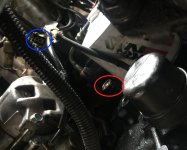
Alright, I feel like an idiot. What I pulled out thinking it was the knock sensor was actually the oil pressure sender unit. :rtfm:

I searched a little deeper and I think I found what should be the knock sensor.. but looks like the previous owner just plugged it with a screw.

Also I noticed a connector that's not connected to anything. Wondering if I need to figure that out.. of if that's the connector I need to plug in when I find a new knock sensor. I didn't check if it has 1 or 2 cables in it.. but obviously it has 2 plugs.
 

Attachments

  • Knock Sensor.jpg
    Knock Sensor.jpg
    120.3 KB · Views: 206
Did a fuel pressure test just now, looks like at idle I'm getting 30psi. If I disconnect the vacuum hose to the regulator it will increase to 40psi. However after revving the engine a little it will drop back down to 30psi.

Also used an injector tester to test one of the injectors and with a medium burst spray it dropped about 2psi. Not sure how much they should drop, I'll likely go out and test the others I can access to see if they are consistent.
 
My last foray into a similar issue was with a 1989 BMW... The fuel pressure on that car had to be 42psi to run properly. I'd try to find a spec. You might be starving out.
 
Fuel Pressure
Engine idling, with vacuum hose disconnected from pressure regulator 2.3 - 2.7 kg/cm2 (33 - 38 psi, 226 - 265 kPa)
Engine idling, with vacuum hose connected to pressure regulator 1.9 - 2.2 kg/cm2 (27 - 31 psi, 186 - 216 kPa)
Residual pressure with ignition key off above 1.5 kg/cm2 (21 psi, 147 kpa) for 5 minutes

Did you check compression?? Fuel Injector & Fuel Filter !!
 
Have you tested the igniter? Or the coil?

Tested the ignitor and coil today (minus the dry cell battery test) and it looks good.

I'm still not confident in testing the wiring via the ECU. Do I just pull the plugs out of the ECU and then stick my probes in there? Seems like I'm going to have to unbolt it from the sidewall to really tell if I'm in the right pin.
 
Fuel Pressure
Engine idling, with vacuum hose disconnected from pressure regulator 2.3 - 2.7 kg/cm2 (33 - 38 psi, 226 - 265 kPa)
Engine idling, with vacuum hose connected to pressure regulator 1.9 - 2.2 kg/cm2 (27 - 31 psi, 186 - 216 kPa)
Residual pressure with ignition key off above 1.5 kg/cm2 (21 psi, 147 kpa) for 5 minutes

Did you check compression?? Fuel Injector & Fuel Filter !!

Everything but the fuel filter. Listed my tests in my original post and I'm keeping it updated.

Going to retest the fuel pressure tonight to gather all the readings.
 
Changed the plugs again and the ignition coil today. The misfire is a LOT better, but it's still there.. just in a different spot now. Only around 2800 RPMs now. The truck was feeling sluggish so I swapped back in the old ignition coil to see if that was it.. It's running better again but the 2800 RPM miss is still there.

On the downside, the exhaust has started popping now. :/

TLDR: Changed spark plugs.. made the miss better, but still there and now exhaust is popping.

I think I can hear a leak around the exhaust manifold when driving.. but when it's idling I can't hear it.. so it's hard to track down if it exists.
 
Figured out what caused the new problems.. it was me.

Forgot to plug back in injector #2 connector. (I was building a harness last night to test the injector spray.) Now that it's plugged back in, all the new problems are gone and the misfire is back.

Guess that means my misfire is probably something to do with #2... I'm thinking injector right now.
 
Figured out what caused the new problems.. it was me.

Forgot to plug back in injector #2 connector. (I was building a harness last night to test the injector spray.) Now that it's plugged back in, all the new problems are gone and the misfire is back.

Guess that means my misfire is probably something to do with #2... I'm thinking injector right now.

- Injectors & Wiring Replaced (No more Miss!)
 

Members online

Forum statistics

Threads
278,316
Messages
3,554,120
Members
248,016
Latest member
Advally Service

Trending content

Back
Top