
You are using an out of date browser. It may not display this or other websites correctly.
You should upgrade or use an alternative browser.
You should upgrade or use an alternative browser.
Mpg Mods?
- Thread starter Fermn
- Start date
Redsoxx1918
New member
Use street tires, inflate a little extra, drive slower, improve aerodynamics. All that will get you an extra MPG or two.
Sent from my iPhone using Tapatalk
Sent from my iPhone using Tapatalk
Sprint booster or Pedal Commander. Improves throttle and mpg depending on how you drive.
I’m having a hard time believing Sprint Booster or Pedal Commander would improve mpg. They both filter your throttle position signal and modify it to gain more throttle. The stock throttle mapping is so laggy and lackluster because it is designed to give you Less throttle then you asked for under a certain % throttle position….
Please provide some evidence to support this claim.
I’m having a hard time believing Sprint Booster or Pedal Commander would improve mpg. They both filter your throttle position signal and modify it to gain more throttle. The stock throttle mapping is so laggy and lackluster because it is designed to give you Less throttle then you asked for under a certain % throttle position….
Please provide some evidence to support this claim.
You said a mouthful- “The stock throttle mapping is so laggy and lackluster because it is designed to give you Less throttle then you asked for under a certain % throttle position…”
It saves me gas because I don’t have to mash the pedal and/or dropping a gear every time I want to get moving or pass someone at highway speeds

Romeo1
Member
Best mpg mod for a 5th gen, or any 4wheel drive body on frame is to buy an actual commuter rig and save the body on frame 4runner for weekends, fun, wheeling, or reasons like sundaes on sunday.
Get a run around car. Your bank account will thank you. AWD cars and cuvs geared toward mpg are the ultimate mpg mod. #savethenittos
Get a run around car. Your bank account will thank you. AWD cars and cuvs geared toward mpg are the ultimate mpg mod. #savethenittos
You said a mouthful- “The stock throttle mapping is so laggy and lackluster because it is designed to give you Less throttle then you asked for under a certain % throttle position…”
It saves me gas because I don’t have to mash the pedal and/or dropping a gear every time I want to get moving or pass someone at highway speeds
Drive By Wire Throttle: Your foot/pedal input =/ actual throttle plate
You don't have to mash the pedal because Sprint Booster is giving you more throttle plate opening for less pedal input. More throttle plate opening is going to increase fueling and decrease mpg.
Yea... so Sprint Booster or Pedal Commander do not improve mpg...
Take your misinformation elsewhere
Last edited:
John in NC
Member
Some say buy a 2nd commuter car, but the math doesn't work.
Say you buy a beater Camry that gets 35 mpg. By the time you buy the car, pay the tax/ tag/ registration fees, and insure it, you're upside down already on any savings you'd get from the 4runner's 18.5 or so average mpg to the Camry's 35 mpg. Add in maintenance and you're really sunk.
Now if your fun vehicle is a fully built mostly off road rig, an around town and road trip car like a Camry would be nice to have as a 2nd vehicle.
PS I drive like I'm on a leisurely Sunday cruise 90% of the time and still only manage about 18 city and can get 22 or so highway but that's more in the 65-72 mph range. Over 72 the mpg drops quickly.
Say you buy a beater Camry that gets 35 mpg. By the time you buy the car, pay the tax/ tag/ registration fees, and insure it, you're upside down already on any savings you'd get from the 4runner's 18.5 or so average mpg to the Camry's 35 mpg. Add in maintenance and you're really sunk.
Now if your fun vehicle is a fully built mostly off road rig, an around town and road trip car like a Camry would be nice to have as a 2nd vehicle.
PS I drive like I'm on a leisurely Sunday cruise 90% of the time and still only manage about 18 city and can get 22 or so highway but that's more in the 65-72 mph range. Over 72 the mpg drops quickly.
Last edited:
Romeo1
Member
Some say buy a 2nd commuter car, but the math doesn't work.
Say you buy a beater Camry that gets 35 mpg. By the time you buy the car, pay the tax/ tag/ registration fees, and insure it, you're upside down already on any savings you'd get from the 4runner's 18.5 or so average mpg to the Camry's 35 mpg. Add in maintenance and you're really sunk.
Now if your fun vehicle is a fully built mostly off road rig, an around town and road trip car like a Camry would be nice to have as a 2nd vehicle.
PS I drive like I'm on a leisurely Sunday cruise 90% of the time and still only manage about 18 city and can get 22 or so highway but that's more in the 65-72 mph range. Over 72 the mpg drops quickly.
Must not be putting many miles then. On my old gig I commuted 100-110 miles per day. My diesel truck got 19 mpg. The scooby got 25-26. Even paying around 3k for the car, with diesel being $.50-.60 higher, insurance and tags, it all in resulted in a per mile running cost that was exactly half. I was .11-.12 cpm where the truck was .22-.24 cpm. I sold the car when I was done and no longer needed it. Took a 400$ hit was all.
That Subaru made me $5,000 in less than 2 years and kept almost 50,000 miles off of an expensive vehicle.
But if putting on miles in an inefficient manner makes sense to you, then do it. Most people don’t don’t actually know their running per mile cost. I can tell you commuting 2500 miles per month costs no less than 80$ per month when your doing it on fancy Toyo LT tires……
If you commute, a second, cheap, beater vehicle absolutely makes sense. We haven’t even brought depreciation into this discussion yet.
Just my experience. Your money, do what you wish.
John in NC
Member
[MENTION=643801]Romeo1[/MENTION]
We are talking about 4runners, not diesel trucks like you used as your personal example. Let’s compare apples to apples. But yes to your point if you're driving 20,000+ miles a year, paying diesel fuel prices, a reliable car getting good gas mileage is a great 2nd vehicle. My wife's old Corolla, bulletproof and amazing MPG.
For light to moderate distance commuters, driving a mostly stock 4runner, a second vehicle does not make sense. Now if someone has a fun, efficient play vehicle as a 2nd car that’s another story.
My wife also has a Highlander but for some reason we pile the miles on my 4runner and I'm fine with that. I hope I get to 200,000+ miles before I get the urge to buy newer, I'm at 140,000 now. I put on about 13,000+ miles a year, she barely puts any miles on the Highlander. She barely gets better gas mileage than I do in the 4runner. The new hybrid Highlander does OK. My sister has one.
To reiterate another point I made, if you have a built 4runner on big tires getting terrible gas mileage, by all means snag a commuter car.
Diesel gas being $.50 more per gallon or whatever it is, that’s not what we are dealing with here. Also for the beater mileage car, you have to factor in tires when needed, oil changes, unexpected repairs, insurance/ taxes/ registration/ tags.... and it may be free but parking and storage is a factor as well.
We are talking about 4runners, not diesel trucks like you used as your personal example. Let’s compare apples to apples. But yes to your point if you're driving 20,000+ miles a year, paying diesel fuel prices, a reliable car getting good gas mileage is a great 2nd vehicle. My wife's old Corolla, bulletproof and amazing MPG.
For light to moderate distance commuters, driving a mostly stock 4runner, a second vehicle does not make sense. Now if someone has a fun, efficient play vehicle as a 2nd car that’s another story.
My wife also has a Highlander but for some reason we pile the miles on my 4runner and I'm fine with that. I hope I get to 200,000+ miles before I get the urge to buy newer, I'm at 140,000 now. I put on about 13,000+ miles a year, she barely puts any miles on the Highlander. She barely gets better gas mileage than I do in the 4runner. The new hybrid Highlander does OK. My sister has one.
To reiterate another point I made, if you have a built 4runner on big tires getting terrible gas mileage, by all means snag a commuter car.
Diesel gas being $.50 more per gallon or whatever it is, that’s not what we are dealing with here. Also for the beater mileage car, you have to factor in tires when needed, oil changes, unexpected repairs, insurance/ taxes/ registration/ tags.... and it may be free but parking and storage is a factor as well.
Last edited:

Jetboy
New member
My 4Runner is my 2nd car. Lol. If you want to go crazy on the offroad mods - there's a million reasons not to do it on a daily driver. Not just fuel costs, but all the other compromises you make for off road turn it into a crappy daily driver. I work from home now, so my commuter is a pair of socks. I bought a tank of gas last weekend for the first time in at least a month, but I can't remember when I bought gas last before that. Could have been in October sometime.
FWIW - a 35mpg commuter car vs 18mpg average in a 4Runner saves about $0.10/mile at $4/gal gas. Doing the rough math if you drove the 35mpg car 10k miles a year you'd save about $1,000 in fuel. With a home charged EV for commuting on my residential retail rate I'd pay around $.03/mile. The per-mile savings over my 18mpg 4Runner would then be more like $.19/mile. With an EV now you're looking at $1,900 in savings per 10k miles. And operating costs are far lower. Downside is the car is more expensive. But if I were needing a commuter car to put a lot of daily miles on - it'd be an EV. Probably a cheap used Nissan Leaf or something like that.
Then you'd also have to consider maintenance cost differences, the cost of insurance and registration etc. Some states are a lot more expensive than others. I live between two states, one has no sales tax and many cars are registered once and get permanent plates for life and no annual inspections, so the cost to own is a lot cheaper than the other state that has a high sales tax, higher annual registration fees, and annual emissions testing. That difference based on state is around $300/year for my 4Runner, plus $3k up front in sales tax.
I've been wanting to swap our RX350 for a PHEV like a rav4 Prime or possibly a Model Y for a while now. But the car market is nuts, so for now I'm kinda just in a holding pattern until the market resets a bit. If Toyota doesn't get its shit together with production soon with some decent PHEVs that are actually available in volume (5k units per year doesn't look like Toyota is even really trying regardless of chip shortage issues), we'll probably go with a Model Y. I don't really even like the Model Y that much. But it's kinda the only game in town that's viable to actually go buy one.
FWIW - a 35mpg commuter car vs 18mpg average in a 4Runner saves about $0.10/mile at $4/gal gas. Doing the rough math if you drove the 35mpg car 10k miles a year you'd save about $1,000 in fuel. With a home charged EV for commuting on my residential retail rate I'd pay around $.03/mile. The per-mile savings over my 18mpg 4Runner would then be more like $.19/mile. With an EV now you're looking at $1,900 in savings per 10k miles. And operating costs are far lower. Downside is the car is more expensive. But if I were needing a commuter car to put a lot of daily miles on - it'd be an EV. Probably a cheap used Nissan Leaf or something like that.
Then you'd also have to consider maintenance cost differences, the cost of insurance and registration etc. Some states are a lot more expensive than others. I live between two states, one has no sales tax and many cars are registered once and get permanent plates for life and no annual inspections, so the cost to own is a lot cheaper than the other state that has a high sales tax, higher annual registration fees, and annual emissions testing. That difference based on state is around $300/year for my 4Runner, plus $3k up front in sales tax.
I've been wanting to swap our RX350 for a PHEV like a rav4 Prime or possibly a Model Y for a while now. But the car market is nuts, so for now I'm kinda just in a holding pattern until the market resets a bit. If Toyota doesn't get its shit together with production soon with some decent PHEVs that are actually available in volume (5k units per year doesn't look like Toyota is even really trying regardless of chip shortage issues), we'll probably go with a Model Y. I don't really even like the Model Y that much. But it's kinda the only game in town that's viable to actually go buy one.
Charles Bronson
Member
I’m having a hard time believing Sprint Booster or Pedal Commander would improve mpg. They both filter your throttle position signal and modify it to gain more throttle. The stock throttle mapping is so laggy and lackluster because it is designed to give you Less throttle then you asked for under a certain % throttle position….
Please provide some evidence to support this claim.
I could see it working to some extent.
How? Contrary to popular belief, it's better MPG wise to briskly accelerate up to cruising speed rather than lumbering along to get up to speed. Same goes for passing. Better to do it quickly over a short amount of time. Overall, it uses less fuel.
Charles Bronson
Member
The best ways to conserve fuel in these vehicles is to:
1) Keep highway speeds below 70mph. Easier said then done as most interstates are 70-75mph and traffic flow near 80mph.
2) Don't go crazy on tires. All terrain tires are terrible for MPGs. Wider, taller, and heavier tires, like so many do on their 4Runners, make MPGs even worse.
1) Keep highway speeds below 70mph. Easier said then done as most interstates are 70-75mph and traffic flow near 80mph.
2) Don't go crazy on tires. All terrain tires are terrible for MPGs. Wider, taller, and heavier tires, like so many do on their 4Runners, make MPGs even worse.
I could see it working to some extent.
How? Contrary to popular belief, it's better MPG wise to briskly accelerate up to cruising speed rather than lumbering along to get up to speed. Same goes for passing. Better to do it quickly over a short amount of time. Overall, it uses less fuel.
There is some truth to your first point in regards to how you accelerate. There is a golden middle ground of too fast or too slow of acceleration. This is mostly dependent on the BSFC on your engine. However, the topic is far more complicated then engine specific fuel to power ratio. You have to also consider how much power you are using to accelerate and combine the two to understand total fuel usage for the acceleration event.
Take a look at this BSFC chart:
Complete BSFC map generated from EPA benchmarking test data of Toyota... | Download Scientific Diagram
You'll see that mid-high throttle while maintaining RPMs between ~1,500 to ~2,500 RPM is the lowest BSFC or most efficient island for the engine. However, this is just the engine specific fuel consumption per horsepower. Generating more horsepower, requires more fuel! We would have to do the math, but for the shown engine map, it is likely most efficient to accelerate @ ~60 kw in the 250 g/kwh rather than @ 120kw in the 220 g/kwh. Too slow of acceleration may be @ ~20kw in the 450 g/kwh island.
My advice would be too accelerate as quickly as you can while still keeping the ECO light lit. It is a good middle ground of obtaining great fuel economy and not totally pissing everyone off behind you or getting rear ended. There are some conditions where you simply cannot achieve the speed limit while maintaining the ECO light, in which case you just need to drive "normally".
Your second point about passing couldn't be more wrong. If you are in cruise control and are coming up on someone, the best fuel efficiency is to simply maintain your cruise control and pass them. Accelerating to quickly pass them and then return to your cruising speed will use more fuel.
Lastly, Pedal Commander/Sprint Booster DOES NOT help you accomplish the first point. It increases the gain between throttle pedal position % and throttle plate %, which reduces the granularity of your control. Additionally, the increased gain results in increased rate of throttle % change which results in less steady state combustion. The computer can only respond so quickly to add or reduce fuel relative to the incoming air, constantly changing the incoming air results in spikes of "rich" fueling - aka wasted fuel. Slow and small changes to the incoming air mass allow the engine to run more consistently at stoichiometric or slightly lean (assuming normal cruising, not full load events that require rich mix for cooling).
Unless of course you think Toyota engineers tuned the DBW throttle map to help you use more fuel... :rofl::rofl:
My credibility? I have 10+ years experience engineering/designing Internal Combustion Engines (Gas and Diesel).
Last edited:
Jetboy
New member
I have never seen a BSFC map for the 1GR. I think I've seen one somewhere at some point for the 2GR, but I can't find it.
This is the closest I can come up with that might be kinda close to the 1GR. I suspect the 1GR peak efficiency is lower in the RPM range than the 2GR due to the longer stroke and port injection only. My experience in general is that the 1GR thermal efficiency drops fast after 3k rpms. And the transmission losses also go up quickly once the torque converter unlocks. So it's hard to imagine a scenario on the highway that you'd get an MPG benefit from anything that causes you to drop out of 5th gear with the torque converter locked.
I would also say that the 1GR is remarkably fuel efficient at idle and on trail duty. In side by side trips with mostly Land Cruiser 80 series, the 5th gen 4R uses something like half of the fuel on low speed trails and probably even less than half at idle.
This is the same concept broken into two graphs that show the same information in a little more digestible way for folks who might not be familiar with reading a BSFC map. This is I think supposed to be 2GR vs 3VZ, but I'd just use it as a general reference for mid size v6 engines.

I think this is supposed to represent 2gr vs 2gr-FKS (the atkinson cycle simulation) overlaid. You can see that the peak efficiency window is pretty small for the non FKS 2GR. And probably even smaller for the 1GR. And it's peaking in efficiency at high load around 1800rpms.
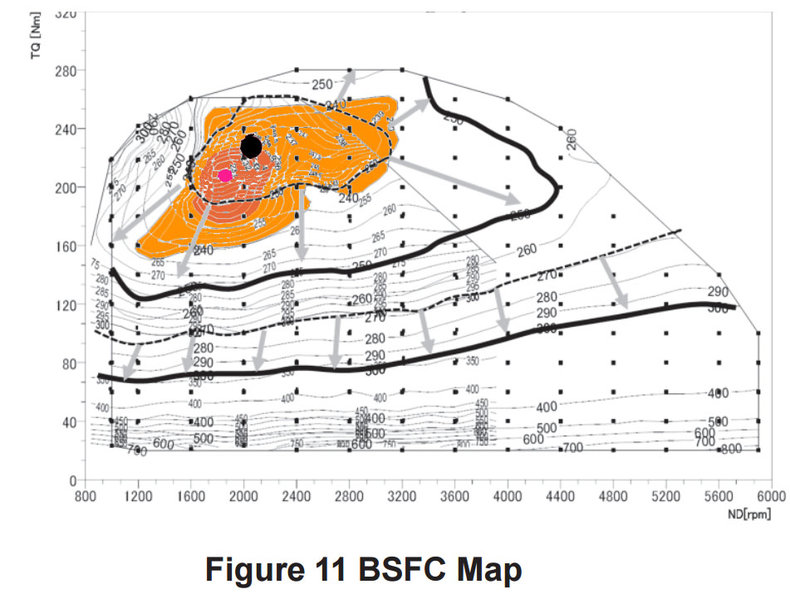
This is the closest I can come up with that might be kinda close to the 1GR. I suspect the 1GR peak efficiency is lower in the RPM range than the 2GR due to the longer stroke and port injection only. My experience in general is that the 1GR thermal efficiency drops fast after 3k rpms. And the transmission losses also go up quickly once the torque converter unlocks. So it's hard to imagine a scenario on the highway that you'd get an MPG benefit from anything that causes you to drop out of 5th gear with the torque converter locked.
I would also say that the 1GR is remarkably fuel efficient at idle and on trail duty. In side by side trips with mostly Land Cruiser 80 series, the 5th gen 4R uses something like half of the fuel on low speed trails and probably even less than half at idle.
This is the same concept broken into two graphs that show the same information in a little more digestible way for folks who might not be familiar with reading a BSFC map. This is I think supposed to be 2GR vs 3VZ, but I'd just use it as a general reference for mid size v6 engines.
I think this is supposed to represent 2gr vs 2gr-FKS (the atkinson cycle simulation) overlaid. You can see that the peak efficiency window is pretty small for the non FKS 2GR. And probably even smaller for the 1GR. And it's peaking in efficiency at high load around 1800rpms.
Attachments
Last edited:
Just drove 1500 miles since Wednesday last week.
Gladstone MI to Franklin WI (Milwaukee) - Thanksgiving Thursday
Franklin WI to Chicago IL (Des Plaines) - meet with friends Friday
Des Plaines IL to Green Bay WI - overnight by Lambeau Field for sports bars Friday to Saturday
Green Bay WI to Gladstone MI - overnight at home Saturday night
Gladstone MI to Grayling MI - overnight at other home Sunday night
Grayling MI to Detroit MI - Monday (concert, Genesis!!!)
Detroit MI to Grayling MI - Tuesday
Grayling MI to Gladstone MI - Wednesday (back to work)
My '18 SR5P is running stock tire size (Grabber AT2 P rated not the Load range E that some people kill mpg with), Bilstein 6112s up front et at 1 & 3, nearly stock height and I run a pedal commander 99% of the time at #3 (not race 3) base 3. I do not have excess weight beyond travel gear and about 60 pounds of tools / air compressor.
I averaged 17.4 mpg for the trip (calculated). Computer said 16.9 mpg. I did reset the dash readout on the way back for about 100 miles and saw 20.0 at 67 mph...can you guess what my average speed was for most of the trip?
I've driven millions of miles and can attest to the "speed kills" mpg, especially with the T4R. Had 4 oil changes since July 1 this year (my wife and I make the most of our weekends!).
I don't think this platform (T4R) we're talking about and love will yield better mpg. Maybe 1-2 mpg with careful driving and luck. Huge impacts of headwind, slight grades or worse, driving over 70 mph.
My whole point of this post is to encourage you to enjoy your 4Runner! I've enjoyed them for 21 years, gen3, gen4 V8, and now gen5.
Filling up the gas tank is just part of the game.
Cheers
Gladstone MI to Franklin WI (Milwaukee) - Thanksgiving Thursday
Franklin WI to Chicago IL (Des Plaines) - meet with friends Friday
Des Plaines IL to Green Bay WI - overnight by Lambeau Field for sports bars Friday to Saturday
Green Bay WI to Gladstone MI - overnight at home Saturday night
Gladstone MI to Grayling MI - overnight at other home Sunday night
Grayling MI to Detroit MI - Monday (concert, Genesis!!!)
Detroit MI to Grayling MI - Tuesday
Grayling MI to Gladstone MI - Wednesday (back to work)
My '18 SR5P is running stock tire size (Grabber AT2 P rated not the Load range E that some people kill mpg with), Bilstein 6112s up front et at 1 & 3, nearly stock height and I run a pedal commander 99% of the time at #3 (not race 3) base 3. I do not have excess weight beyond travel gear and about 60 pounds of tools / air compressor.
I averaged 17.4 mpg for the trip (calculated). Computer said 16.9 mpg. I did reset the dash readout on the way back for about 100 miles and saw 20.0 at 67 mph...can you guess what my average speed was for most of the trip?
I've driven millions of miles and can attest to the "speed kills" mpg, especially with the T4R. Had 4 oil changes since July 1 this year (my wife and I make the most of our weekends!).
I don't think this platform (T4R) we're talking about and love will yield better mpg. Maybe 1-2 mpg with careful driving and luck. Huge impacts of headwind, slight grades or worse, driving over 70 mph.
My whole point of this post is to encourage you to enjoy your 4Runner! I've enjoyed them for 21 years, gen3, gen4 V8, and now gen5.
Filling up the gas tank is just part of the game.
Cheers

1000MPH
Senior Member
I guess I got a unicorn. Just finished a 1250 mile road trip. Truck was filled with gear, about 350lbs.
From Reno, NV, to the Southern Sierras, to the Central Coast, up into Big Sur, back to Reno via I5.
Includes about 30 miles total of 4L hill climbing.
Filled up 4 times with regular Costco gas:
23.0mpg
22.3
21.5
21.1
From Reno, NV, to the Southern Sierras, to the Central Coast, up into Big Sur, back to Reno via I5.
Includes about 30 miles total of 4L hill climbing.
Filled up 4 times with regular Costco gas:
23.0mpg
22.3
21.5
21.1
I guess I got a unicorn. Just finished a 1250 mile road trip. Truck was filled with gear, about 350lbs.
From Reno, NV, to the Southern Sierras, to the Central Coast, up into Big Sur, back to Reno via I5.
Includes about 30 miles total of 4L hill climbing.
Filled up 4 times with regular Costco gas:
23.0mpg
22.3
21.5
21.1
Well done! A bit more impressive with your mild mods. Either way, totally possible, my last 5 fill ups were 21.1, 21.3, 20.6, 23.1, 23.0.
Do you drive at or near the speed limit on highway? Do you use cruise control or very careful throttle control? Pay attention to traffic and stops to reduce unnecessary braking and re-acceleration?
Or just drive chill and hope for the best haha?
Romeo1
Member
[MENTION=643801]Romeo1[/MENTION]
We are talking about 4runners, not diesel trucks like you used as your personal example. Let’s compare apples to apples. But yes to your point if you're driving 20,000+ miles a year, paying diesel fuel prices, a reliable car getting good gas mileage is a great 2nd vehicle. My wife's old Corolla, bulletproof and amazing MPG.
For light to moderate distance commuters, driving a mostly stock 4runner, a second vehicle does not make sense. Now if someone has a fun, efficient play vehicle as a 2nd car that’s another story.
My wife also has a Highlander but for some reason we pile the miles on my 4runner and I'm fine with that. I hope I get to 200,000+ miles before I get the urge to buy newer, I'm at 140,000 now. I put on about 13,000+ miles a year, she barely puts any miles on the Highlander. She barely gets better gas mileage than I do in the 4runner. The new hybrid Highlander does OK. My sister has one.
To reiterate another point I made, if you have a built 4runner on big tires getting terrible gas mileage, by all means snag a commuter car.
Diesel gas being $.50 more per gallon or whatever it is, that’s not what we are dealing with here. Also for the beater mileage car, you have to factor in tires when needed, oil changes, unexpected repairs, insurance/ taxes/ registration/ tags.... and it may be free but parking and storage is a factor as well.
It’s just math @%1;
People can justify it anyway they wish, but body on frame anything to rack up miles is throwing money away.
I have 3 personal vehicles and a full tilt do what I want all expenses paid tundra for work. I can tell you exactly what they all cost per mile and what a company rig is worth having in a year.
It’s all apples to apples. It’s called cents per mile. Even the government doesn’t care when you do taxes on what you drive regarding expensing mileage as it’s also a fixed amount per mile.
There’s also a lack of discussing what depreciation actually costs. You have to add that to the per mile cost also.
Personally, I don’t care. I’m the guy that shows up and buys stuff for cash when the new wears off and it’s “wore out”.
Gas and tires is only part of the savings. Avoiding the depreciation in value of a high dollar vehicle is the real savings.
Look at the book values yourselves and tell me “a commuter isn’t worth it”. Same rig, only change is the mileage. Example is a 17’ off road premium. Couple grand a year in fuel, and almost 10k worth of depreciation.
I guess the real question here is what is considered a lot of money? That almost $20k would have made about $7k in some nice vanguard funds this year. Maybe more.


Last one is just for fun. Never thought I’d see $65k 4Runners and JLU’s, but here we are…….. it’s a pro, but still….. gotta love that 84 month financing.
Experience has taught me using the appropriate tool for the job yields better results. Trying to improve mpgs on 4x4 is a losing battle.

Last edited:
John in NC
Member
[MENTION=643801]Romeo1[/MENTION]
I agree a daily driver getting good MPG is a great option for some. Lots of opinions on the subject.
Heck recently we had 5 cars between us, my wife and I, but 2 were purely fun cars (Chevelle and Model-A Ford), and the 5th car was the wife's prior daily we were going to keep but sold to my wife's brother (for a song, you're welcome brother-in-law...). A cherry condition Chevy Trailblazer replaced by her Highlander.
So again, whatever makes sense to a particular person, go for it.
I still have the Model-A, sold the Chevelle and the Trailblazer, so we're down to 3 cars. Now I'm itching bigtime for a Baja-Bug or Fox-Body Mustang 5.0... Ha! Never ends does it?
Also, not speaking of your situation Romeo1, if someone truly can't stomach the MPG of a 4runner and it's their sole vehicle, they should look at something like an AWD wagon, a Rav-4, Subaru Crosstrek- something along those lines. My buddy at work replaced his lifted 4 door jeep with a crosstrek and loves it, amazing MPG (33 mixed mpg) and capable AWD.
Ok, back to the subject of improving the MPG of the 4runner- I'll reiterate- lay off the gas pedal in the city, keep tires inflated, and keep the highway speeds down a bit.
But really on these vehicles what's that going to save you, 1-2 mpg in a stock 4runner?
To me a more important benefit- savings on brakes/ tires/ and wear and tear. Plus, lower blood pressure and hopefully fewer feelings of road rage with 'easy' driving.
One more point. In my situation, I want to take the 4runner past 200,000 miles, so I'm happy to daily drive it. The "Tin-Can" the kids call it compared to the wife's Highlander. She rags on me because her car is more refined and has all the bells and whistles.
OK I'm rambling, thanks for the spirited discussion!
I agree a daily driver getting good MPG is a great option for some. Lots of opinions on the subject.
Heck recently we had 5 cars between us, my wife and I, but 2 were purely fun cars (Chevelle and Model-A Ford), and the 5th car was the wife's prior daily we were going to keep but sold to my wife's brother (for a song, you're welcome brother-in-law...). A cherry condition Chevy Trailblazer replaced by her Highlander.
So again, whatever makes sense to a particular person, go for it.
I still have the Model-A, sold the Chevelle and the Trailblazer, so we're down to 3 cars. Now I'm itching bigtime for a Baja-Bug or Fox-Body Mustang 5.0... Ha! Never ends does it?
Also, not speaking of your situation Romeo1, if someone truly can't stomach the MPG of a 4runner and it's their sole vehicle, they should look at something like an AWD wagon, a Rav-4, Subaru Crosstrek- something along those lines. My buddy at work replaced his lifted 4 door jeep with a crosstrek and loves it, amazing MPG (33 mixed mpg) and capable AWD.
Ok, back to the subject of improving the MPG of the 4runner- I'll reiterate- lay off the gas pedal in the city, keep tires inflated, and keep the highway speeds down a bit.
But really on these vehicles what's that going to save you, 1-2 mpg in a stock 4runner?
To me a more important benefit- savings on brakes/ tires/ and wear and tear. Plus, lower blood pressure and hopefully fewer feelings of road rage with 'easy' driving.
One more point. In my situation, I want to take the 4runner past 200,000 miles, so I'm happy to daily drive it. The "Tin-Can" the kids call it compared to the wife's Highlander. She rags on me because her car is more refined and has all the bells and whistles.
OK I'm rambling, thanks for the spirited discussion!
Last edited:
Similar threads


- Replies
- 4
- Views
- 2K

