My Career Advice / Ideas / Suggestions

Koko4

New member
I have been trying to do some serious thinking lately about the whole career / life path ordeal. I am 26, have a liberal arts bachelor degree (double major in Creative Writing and Spanish) and currently have a job. However, it is an office job and I do not see myself doing it for forever. It may be good for a few years, BUT I have discovered that I am more of a hands-on person instead of a sit-in-front-of-a-computer everyday type person.

With that being said, I feel like my current degree is pretty useless in the "real world" (no offense to any liberal arts majors here). I want to be able to make a decent salary / living (not sure EXACTLY how to define that, but I just don't want to live paycheck-to-paycheck and I want to be comfortable). I also want a hands-on position. I want to feel physically tired at the end of each day, as opposed to mentally drained.

I know a lot of you guys fit that bill perfectly, and I was going to ask if you like what you do, and if it keeps you on your feet / gives you a decent amount of daily movement and exercise. I feel like if I stay in an office too long, I'm going to get fat just like the majority of our American population. =P

I'm thinking something specialized (field tech / engineer?), and I wouldn't mind having to go back to school for something. I just don't want my current bachelor's degree to go to waste. I understand that I may be doing something COMPLETELY different than what my original degree is in, but if possible, I would like to be able to spring-board off of my degree and have it help me in some way (be it a higher salary, jumping-off point for a specialized technical job of some sort, etc). I hope this makes sense. I just don't want it to go to complete waste.

This stuff might help narrow it down... I LOVE being outdoors, I love climbing trees and rock climbing, and I like hiking / offroading / basically anything to do with nature. I was thinking maybe some type of field tech or service tech, or field engineer..I honestly don't know. If I had to go back to school to get a different degree, I'm hoping that the fact that I did all of my core classes during my previous degree would help me skip straight ahead to the major-stuff. Thanks for any advice you guys may have. I'm 26, but am starting to feel like life is passing me by and I don't have a hold on my own future!
 
Register to hide this ad
Forrest service or BLM maybe? There's also the oil/gas rush going on in various parts of the country as well. There's also the power generating industry. Wind, solar, hydro, nuclear, good ole coal. There's also the transmission side of that industry as well. It is a pretty hands on job. I made the switch from a shop foreman at a pickup truck accessory shop to the power generation industry about 4.5 years ago and, for the most part, I'm glad I did. It was an initial pay cut but over the coarse of 4 years, I've more than doubled my pay. It's pretty hands on and is relaxed at the same time.

Whatever you do, it's easier to experiment with jobs before the wife and kids appear.
 
I think the power generating or power transmission side of things would be best for me. If I were to do something like the oil/gas rush, I'd have to relocate to where the jobs are (West Texas, North Dakota) which are pretty barren places. I'd have to leave behind the dog and girlfriend for months at a time, which would suck.

BLM or Park Ranger would be cool, but I would think those jobs would be in high demand and also I've heard that in some parts of the country, you are sort-of unofficially "grandfathered in" because there are tons of people that would love to have that job, but not many vacancies. Also, I don't think the pay would be fantastic.

Power generating / power transmission could be an awesome field. Hands on, yes highly specialized. Room for upward growth..and demand in pretty much any part of the country. I think that would be a good start. And you're totally correct about this being easier to do before wife and kids..which is why I've started to really buckle down on it now.

What exactly do you do for the power generation industry, if you don't mind me asking? What kind of prior knowledge / skills did you have to have before landing the job, or did you basically get in on the ground floor, apprentice under somebody, and work your way up? I don't know what types of certifications / schooling would be necessary to get into the industry, but it definitely seems like a good start, and something I'd be interested in. I love working on cars / figuring things out / building things, and I like to actually be able to SEE the results of my work in action.
 
I'm currently in the operations dept. at the power plant I work at. Things I do include: taking readings from various guages/meters, taking samples from various sources of water, coal, oil, ash, limestone slurry (what we use to remove SO2 from burning coal), light clean-up of spills (we usually just clean enough to get whatever equipment running again, then we call the laborers), light maintenance (checking/adding oil, light bulb replacement on various equipment, fixing small leaks on various equipment, it really depends on your skill set), sometimes helping the maint. or electrictians with a job. It is shift work though. Some nights, weekends, days, 12 hr shifts but I only work 14 days a month and still get OT. Not sure how you feel about that.

I came in as a laborer. I know, not the most gloriest job but it was a job in a very tough financial time for my family. Did a lot of shoveling and sweeping but it was kick back and it was a nice change of place from where I came from.

I had basically no knowledge of power plants other than I knew this one burnt coal and produced electricity. I did have over 10 years experience in the pickup truck accessory industry and I was ASE and SEMA certified. I can draft up stuff, weld using TIG, MIG, stick, know how to use hand and power tools and I'm self motivated. I've taken a variety of classes at CNM but never achieved any degree.

I currently just recieved another promotion and I'm now really getting into the water treament side of things (chemistry, making the water pure before it even gets close to our boiler). Hopefully, through this, I can get my water board certification (I will then be qualified to run a water treament facility anywhere).

We do face some threats to our job though. The EPA is the biggest threat right now. The price and supply of coal is another but it is really a worst case basis. My advice would be get into the transmission side of things (high voltage line work). They will still be there even as the EPA shuts down more and more power plants. If you want to get into a power plant, do a little research and find a company that takes care of its employees then find a plant they own that is staying up to date with its emissions equipment. Power plants that are spending money to stay in compliance are much more likely to stay online and off the EPA's radar. The older plants with little or no emissions equipment will be shut down, if not already, in the future.

Hope this helps you out.
 
Rather than go back for an undergraduate degree, go back for a masters in whatever new field you choose. Have a look at Georgia Tech's offerings. If they are anything like what's offered at VA Tech you'll have many choices in the engineering/outdoor/forrestry fields. Many masters candidates are studying something completely different from their undergrad degrees. I mentioned GA Tech because staying in state will be much cheaper in the long run. Research the job market in the fields of study that interest you first!
 
I would recommend the Nuclear Industry. Maybe think about something along the lines of Quality Control Inspector for new Nuclear Power Plant Construction. Having a 4 year Degree will help in the "Qualification" process.... Due to the fact that most of the experienced people are nearing retirement many companies are having a hard time finding people with much experience so they have gone the route of training people with no experience in order to fill the demand.

Being in Atlanta you are currently near the first two new Reactor construction projects in the last 30 years. You are outside for most of the day and typically busy as you possibly can be. Its a great experience and if all goes for the future of the Industry it will provide a high paying career and a good way to see the United States as you will likely move around every few years chasing the work.
 
GM350, thank you for the detailed response in your work. I like to see how people got where they are today, and it helped to see that you didn't start off knowing exactly that: "This is it for me". When you're 26 and staring down the rest of your life, it's kind of nerve-racking to have this on your plate.

Nervo19, a master's degree would be a great idea, especially since I would be staying in-state and GT is a very prestigious college. I am pretty sure that my bachelor's degree would have to at least be in engineering..otherwise I do believe I would have to take all of the major courses in order to "catch up" to the rest of the master's class, which would take 2+ years to just receive the equivalent of the bachelor's degree.

I talked to my dad today (he's an Electrical Engineer) and in particular, I was interested in learning about Field Engineering. He said that for that, I would definitely have to have an Engineering degree to even enter the field, and he said that I'm "nowhere near qualified" for that position, as of now. Pretty discouraging. I am hesitant to just jump into anything, because I am not sure if it will be a good choice for me, if I will like it, etc. I guess the old saying applies here, that doing something is better than doing nothing.

Youngr, the Nuclear Industry would definitely pay well, and would have some potential for moving around / living in various regions. Wouldn't I be in pretty much the same boat, though? Having to have a Nuclear Engineering degree or at least some type of Engineering degree to enter the field?

I just want to make a good living for myself, actually work with my hands, and enjoy what I do! Is that so much to ask?!? Feeling frustrated!
 
GM350, thank you for the detailed response in your work. I like to see how people got where they are today, and it helped to see that you didn't start off knowing exactly that: "This is it for me". When you're 26 and staring down the rest of your life, it's kind of nerve-racking to have this on your plate.

Nervo19, a master's degree would be a great idea, especially since I would be staying in-state and GT is a very prestigious college. I am pretty sure that my bachelor's degree would have to at least be in engineering..otherwise I do believe I would have to take all of the major courses in order to "catch up" to the rest of the master's class, which would take 2+ years to just receive the equivalent of the bachelor's degree.

I talked to my dad today (he's an Electrical Engineer) and in particular, I was interested in learning about Field Engineering. He said that for that, I would definitely have to have an Engineering degree to even enter the field, and he said that I'm "nowhere near qualified" for that position, as of now. Pretty discouraging. I am hesitant to just jump into anything, because I am not sure if it will be a good choice for me, if I will like it, etc. I guess the old saying applies here, that doing something is better than doing nothing.

Youngr, the Nuclear Industry would definitely pay well, and would have some potential for moving around / living in various regions. Wouldn't I be in pretty much the same boat, though? Having to have a Nuclear Engineering degree or at least some type of Engineering degree to enter the field?

I just want to make a good living for myself, actually work with my hands, and enjoy what I do! Is that so much to ask?!? Feeling frustrated!

have you considered working a trade? if that would be something you'd like doing it would fulfill the other parameters you've set
 
have you considered working a trade? if that would be something you'd like doing it would fulfill the other parameters you've set

Are you referring to something I would get from a 2yr technical school, or from an apprenticeship program? Something like an electrician, welder, or lineman? I think I would actually enjoy some of that stuff. And I guess that would probably be a TON safer than going back for an entirely new bachelor's degree.. I could probably get that done easier while working part-time and go into little / no debt..

As of now, I have my bachelor's degree, and absolutely NO debt (which is a step up from a ton of people I know with similar degrees). So I am at least thankful for that.
 
Are you referring to something I would get from a 2yr technical school, or from an apprenticeship program? Something like an electrician, welder, or lineman? I think I would actually enjoy some of that stuff. And I guess that would probably be a TON safer than going back for an entirely new bachelor's degree.. I could probably get that done easier while working part-time and go into little / no debt..

As of now, I have my bachelor's degree, and absolutely NO debt (which is a step up from a ton of people I know with similar degrees). So I am at least thankful for that.

yeah thats exactly what i meant, welder, carpenter, mechanic, plumber, electrician, something of that nature.

I used to work as a heavy equipment mechanic, it was hard work physically and mentally, and its not that hard to get started in it. most places will take you on as an apprentice or trainee before you get any schooling in the field.
 
my advice is that it is never too late to go back to school for a 2nd bachelors, this time in a technical field.

I think getting a liberal arts masters on top of your liberal arts degree would be a mistake, at least if you want to move anywhere near technical.

sure there are colleges out there that claim to offer technical masters for liberal arts undergrads but in my opinion it is a bunch of hogwash mainly to take your money. They only care about getting paid, not the economy, jobs or the future employability of students. This is why there are degrees for a masters in library science. Absolutely unneeded. If I was running a library I would rather hire someone with a 4 year degree in history than a 4 year degree in phycology + a 2 year masters in library science. At least the history major should have an idea about history and other things that are important to anyone walking into a library.​

If you want to go back and get a technical job then I would strongly consider the community college route and take the math classes needed for an engineering degree. There are about 2+ years of math you will need and it really isn't optional. Anyone who offers a path without the math is not offering a real technical degree path. You will need to do multivariable calculous (not business calc which is a walk in the park) and the like. I believe you may find it isn't as hard as people make it out to be and at community college things move at a fair pace.

Your path would look like this ......

TRIG
PRE-CAL
CALC I (muti-variable)
CALC II (muti-variable
then you have about 2-3 more math classes before you can transfer to a state college for engineering or IT type of degree.

Personally I would recommend computer science as it is booming. Even if you don't want to be a programmer there are lots of jobs and doorways that will open if you get this type of degree.

My degree is Information Systems Management, B.S. from University of California Santa Cruz (go Banana slugs).

I'm a classic example. My degree is not traditional engineering, although it is a B.S. within the school of engineering and thus I had to take a large math track and do a bunch of electives and core within that school.

I read somewhere that people who get a masters degree in a field often limit themselves unless it is a broad degree. Get a masters degree in mathematics, statistics, programming, MBA for example and there are tens of thousands of jobs you could slide into. Get a masters degree in child counseling or library science (not even a science) or fine arts and you just limited yourself to less than ten career paths. I warned my sister against this and she is now going back to school and studying computer science.

Its scary at first but trust me if you just start the math track at your local community college, after 2 classes you will know if you can do it or not. Take TRIG, then PRE-CAL. Try your hardest to get an A. If you can make it through that and keep your study habbits up you will make it the rest of the way.

Also .... you're only 26. I was only 24 when I started college and 25 by the time I really started the math. You could have a technical degree via a (very affordable vs private) state college in probably 3 years. It will take longer than a ITT Tech type of degree because you have to do the math but it is a solid degree from a real college, and trust me if you do it you will never regret not going the quicker "private tech school" way.

What about nursing? State colleges have great nursing programs. My GF is a nurse and my (male) buddy from the Navy is a nurse. They both, for the most part, are very happy with their career and pay. Nursing is not easy either and will require real academic discipline. Most nursing programs you would want to get into would be for a BS. You would have to take organic chemistry and a bunch of classes that require lots of memorization. study study study !

Just remember, it is never too late to go back to school. Especially if you can change your life to do it. Whats hard is when people have kids, a wife, car payments, a mortgage and they realize they are smart enough to get a technical degree but they didn't do it before they got a bunch of responsibilities and now they can't do it. If you can do it then go for it!


:angel:

Lastly, do you know what BLS.gov is? It is a website where the government uses the census and economists to profile and track job growth across the country. Thinking of getting a job as a park ranger or police officer? Great but look it up on BLS.gov

You can do this for different job types and career sectors by typing "bls gov jobs engineering" or "bls gov jobs teaching" into Google.com. You will be able to see % of a degree that actually finds a job, pay spreads for each field, and job #s growth per field.


Good luck.
 
Last edited:
yeah thats exactly what i meant, welder, carpenter, mechanic, plumber, electrician, something of that nature.

This would be my suggestion as well.

Yeah, you'll be hot/cold/dirty a lot of the time, but sitting in a cubicle all day sucks. Since I have a Public Relations degree with a minor in Philosophy, I understand about having a "worthless" degree in the real world.

I'm lucky I fell into Technical Writing. And make pretty good money for my degree and where I live. Otherwise I would be contemplating my options.
 
And I guess that would probably be a TON safer than going back for an entirely new bachelor's degree.. I could probably get that done easier while working part-time and go into little / no debt..

Honestly I don't think it is "safer" ...

The only thing you have to loose (besides cash) is the years left in your life.

You have X years left to live right? So if you decide to re-invent yourself you may not get another chance in 5 years, who knows where you will be then.

I would just suggest doing a lot of research before going down any one path.

Getting a second bachelors would require you to work part time and also go to school.

Getting a trade degree or an apprenticeship in welding, carpentry, plumbing or other types of jobs almost always requires years of dedicated training and the constant threat of being replaced by illegal labor. So if you do the program (and hopefully its free ??) you will still be out 2+ years of time.

That is why I'd say if you could be an engineer or in a related field then go for it. If you really struggle with math or science then perhaps consider otherwise.

Also note not everyone with an engineering or technical degree works in an office. My job is actually a field pre-sales engineer. I travel around quite a bit and are not locked down.
 
I talked to my dad today (he's an Electrical Engineer) and in particular, I was interested in learning about Field Engineering. He said that for that, I would definitely have to have an Engineering degree to even enter the field, and he said that I'm "nowhere near qualified" for that position, as of now. Pretty discouraging. I am hesitant to just jump into anything, because I am not sure if it will be a good choice for me, if I will like it, etc. I guess the old saying applies here, that doing something is better than doing nothing.


I just want to make a good living for myself, actually work with my hands, and enjoy what I do! Is that so much to ask?!? Feeling frustrated!

my advice is that it is never too late to go back to school for a 2nd bachelors, this time in a technical field.

I think getting a liberal arts masters on top of your liberal arts degree would be a mistake, at least if you want to move anywhere near technical.

sure there are colleges out there that claim to offer technical masters for liberal arts undergrads but in my opinion it is a bunch of hogwash mainly to take your money. They only care about getting paid, not the economy, jobs or the future employability of students. This is why there are degrees for a masters in library science. Absolutely unneeded. If I was running a library I would rather hire someone with a 4 year degree in history than a 4 year degree in phycology + a 2 year masters in library science. At least the history major should have an idea about history and other things that are important to anyone walking into a library.​

If you want to go back and get a technical job then I would strongly consider the community college route and take the math classes needed for an engineering degree. There are about 2+ years of math you will need and it really isn't optional. Anyone who offers a path without the math is not offering a real technical degree path. You will need to do multivariable calculous (not business calc which is a walk in the park) and the like. I believe you may find it isn't as hard as people make it out to be and at community college things move at a fair pace.

Your path would look like this ......

TRIG
PRE-CAL
CALC I (muti-variable)
CALC II (muti-variable
then you have about 2-3 more math classes before you can transfer to a state college for engineering or IT type of degree.

Personally I would recommend computer science as it is booming. Even if you don't want to be a programmer there are lots of jobs and doorways that will open if you get this type of degree.

My degree is Information Systems Management, B.S. from University of California Santa Cruz (go Banana slugs).

I'm a classic example. My degree is not traditional engineering, although it is a B.S. within the school of engineering and thus I had to take a large math track and do a bunch of electives and core within that school.

I read somewhere that people who get a masters degree in a field often limit themselves unless it is a broad degree. Get a masters degree in mathematics, statistics, programming, MBA for example and there are tens of thousands of jobs you could slide into. Get a masters degree in child counseling or library science (not even a science) or fine arts and you just limited yourself to less than ten career paths. I warned my sister against this and she is now going back to school and studying computer science.

Its scary at first but trust me if you just start the math track at your local community college, after 2 classes you will know if you can do it or not. Take TRIG, then PRE-CAL. Try your hardest to get an A. If you can make it through that and keep your study habbits up you will make it the rest of the way.

Also .... you're only 26. I was only 24 when I started college and 25 by the time I really started the math. You could have a technical degree via a (very affordable vs private) state college in probably 3 years. It will take longer than a ITT Tech type of degree because you have to do the math but it is a solid degree from a real college, and trust me if you do it you will never regret not going the quicker "private tech school" way.

What about nursing? State colleges have great nursing programs. My GF is a nurse and my (male) buddy from the Navy is a nurse. They both, for the most part, are very happy with their career and pay. Nursing is not easy either and will require real academic discipline. Most nursing programs you would want to get into would be for a BS. You would have to take organic chemistry and a bunch of classes that require lots of memorization. study study study !

Just remember, it is never too late to go back to school. Especially if you can change your life to do it. Whats hard is when people have kids, a wife, car payments, a mortgage and they realize they are smart enough to get a technical degree but they didn't do it before they got a bunch of responsibilities and now they can't do it. If you can do it then go for it!


:angel:

Lastly, do you know what BLS.gov is? It is a website where the government uses the census and economists to profile and track job growth across the country. Thinking of getting a job as a park ranger or police officer? Great but look it up on BLS.gov

You can do this for different job types and career sectors by typing "bls gov jobs engineering" or "bls gov jobs teaching" into Google.com. You will be able to see % of a degree that actually finds a job, pay spreads for each field, and job #s growth per field.


Good luck.

Your Dad knows what he is talking about. Now you COULD be a service Tech with your education. Those are the guys who work with their hands, repairing air conditioners, water lines, string line for cable, etc but you would have to be trained in a short course for that industry. They fit the bill for what you want - work with your hands, work outside and all that.

I get out in the field every now and then but not as much as I did when I was younger. A few months ago I spent a day on a oil rig in the Gulf testing a new valve for a crane but again, not so much anymore.

My son just finished his 2nd year of Engineering. His math so far:
Calc1
Calc2
Calc3
Differential Equations
Discrete Mathematics

Of course Statics, Dynamics, Thermodynamics, Physics and all the other general engineering classes use the math that is being learned at the time.

I will submit to you that being an engineer is vastly overrated and you have to be a very specific type of guy to do it, especially what you are describing as a "field engineer." I have spent time, especially when I was your age, in every hole and backwoods place on six continents. I have froze in Russia and burned up in Africa. Gotten lost in China and feared for my life in Indonesia. Was it fun? Sure, for the first few years then it became a trudge, especially after my first child was born.

My advice? Enjoy the job you have now and spend every minute of spare time hiking, biking, climbing and all outdoor activities. If you absolutely hate your job then find another but just remember that the grass is not greener on the other side. It's just different grass.

I love being outside too but after returning from a trip to Central America several years ago I did not go outside here for quite awhile. Living in a tent for a few weeks in a 3rd world jungle and having people with guns as your handlers is not fun.
 
Youngr, the Nuclear Industry would definitely pay well, and would have some potential for moving around / living in various regions. Wouldn't I be in pretty much the same boat, though? Having to have a Nuclear Engineering degree or at least some type of Engineering degree to enter the field?

I just want to make a good living for myself, actually work with my hands, and enjoy what I do! Is that so much to ask?!? Feeling frustrated!

Not exactly. The entire thing as far as Quality Control is concerned is governed my ASME NQA-1. It does not specify a Engineering Degree. It only specifies a 4 year degree. There is a guy here with a History Degree but he has previous experience as well.....

You could also go into a craft position. There are Carpenters, Rodbusters, Iron Workers, Welders etc. They too make excellent money. Many here are new to the craft world but they too are being trained.
 
[MENTION=66316]1engineer[/MENTION] I'm not sure you quoted my bloated massive quote lol

OP,
All I was trying to get across is that if you want to be technical you need to take those math classes and its not as hard you may think. Also you don't have to be an electrical engineer or aerospace to be into technology. Maybe you would be better off as the guy who gets a BA in computer science and goes into management. At least then if you are smart you can work a good job in technology without being an R&D guy.

Not every company can consist only of R&D engineers but more and more these days TECH companies want their Program Managers and MBAs to at least have a math or engineering degree of some sort. If you want to be in the club you need to take those classes.

Working as a repair person or technician can be rewarding as well and you don't have to take those classes to get those jobs but you will also be on a different track, treated more as a blue collar worker. Its as simple as that.
 
Last edited:
[MENTION=66316]1engineer[/MENTION] I'm not sure you quoted my bloated massive quote lol

OP,
All I was trying to get across is that if you want to be technical you need to take those math classes and its not as hard you may think. Also you don't have to be an electrical engineer or aerospace to be into technology. Maybe you would be better off as the guy who gets a BA in computer science and goes into management. At least then if you are smart you can work a good job in technology without being an R&D guy.

Not every company can consist only of R&D engineers but more and more these days TECH companies want their Program Managers and MBAs to at least have a math or engineering degree of some sort. If you want to be in the club you need to take those classes.

Working as a repair person or technician can be rewarding as well and you don't have to take those classes to get those jobs but you will also be on a different track, treated more as a blue collar worker. Its as simple as that.

'Cause it was a good response and I forgot to tell you after I quoted you lol.
 
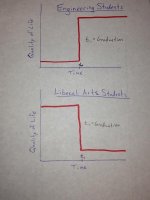
I have many Liberal Arts grad friends in life and they all have good, if diverse, jobs in many fields except what they studied in college lol. So to interject some humor into this day I will post a graph that was published on Twitter yesterday from "Engineering Humor."

I thought it was relevant to this thread and is the way most engineers view their Liberal Arts brethren:
 

Attachments

  • Bm9LFN1CMAEYjsn.jpg
    Bm9LFN1CMAEYjsn.jpg
    38.9 KB · Views: 175

Members online

Forum statistics

Threads
278,315
Messages
3,554,104
Members
248,016
Latest member
Advally Service

Trending content

Back
Top