My cross-country towing experience.

Bimmer-Bob

New member
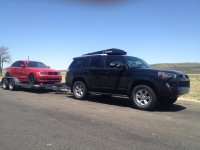
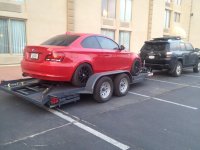
Some of you may have read or even contributed to my threads regarding my plan to tow my BMW to North Carolina from Southern California with my 4Runner. Or you may just be interested in our truck's towing ability, as it seems to be a topic that comes up regularly around here. Either way, I received a lot of good advice from fellow members on this forum, and thought it best to submit an after action report of sorts.

Background
I had to find a way to get two vehicles from Southern California to North Carolina. My wife couldn't drive because she just had a baby, so convoying was out. Additionally, I wasn't crazy about extra wear and tear on my fairly low-mileage BMW. I could've hired a shipping carrier to take the car, but I've heard too many horror stories, and my itinerary was indirect - I was going from SoCal to Oregon before heading to North Carolina, so the car would've arrived on the east coast a couple of weeks before me and I would've had to pay for storage during that time. I also figured that, being in the military, regular (often long-distance) moves were just part of my reality, so the cost of buying a trailer would be offset by the convenience of always being able to move my vehicles myself over the next 10 or 20 years. As a bonus, the ability to tow my car shorter distances for track days appealed to me as well.

The Route
My situation was a little complicated. Before moving, I had to go unaccompanied to New England for 5 weeks. My wife was due to have a baby any day, and in fact gave birth a couple of days before I had to leave. While I was gone, she went to stay with her parents in the Pacific Northwest. When I returned to SoCal, I would have to arrange the pack out of my house, then drive in tow to the PNW, hang out for about 10 days, then continue on to NC. My family would then fly east. This route would've involved a lot of elevation changes: on the 5 North alone, I would've gone over the Grapevine north of LA, then over Mount Shasta after the Central Valley, then the Siskiyou Pass at the CA-OR border, and then through the Coast Range on my way to western OR. On my way east, I would've had to navigate the Rockies, of course.

A last minute wrinkle arose that changed everything. When I picked up the trailer I had custom ordered (more info on that below) there was a problem: the manufacturer had built the trailer with standard axles instead of dropped axles, and further, the dealer had specified "no dove tail" on the build sheet. The result was that the loading deck was WAY too high, and the resulting ramp angle, even with 6' ramp extensions, was far too steep for my lowered BMW to clear. Luckily, the manufacturer took responsibility and offered to rush build a replacement trailer under warranty. Unfortunately, that meant I had to leave the BMW at a friend's place, drive the 4Runner to Oregon to see my family for about a week, then drive back to SoCal to pick up my new trailer, load the BMW, and drive east.

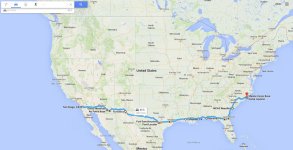
The new route would take me east on I-8 to I-10, all the way to I-95 North. As far as I know, this is just about the flattest route you can take across the country, with the only significant elevation changes occuring early on, through the Cuyamaca Mountains east of San Diego (a few 6% grades and max elevation around 4800 feet, I think).

The final route I decided on came out to 2,894 miles, not including stops for gas, food, and lodging:
Screen Shot 2014-05-21 at 11.02.14 AM.jpg

The Truck
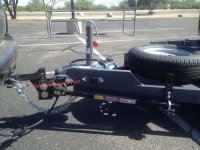
Tow vehicle is a 4Runner, of course. A 2014 SR5 Premium 4x4 to be exact. I know its relatively short wheelbase and V6 engine make it less than an ideal tow vehicle, so I set out to make what improvements I could. The first thing I did was swap out the stock P tires for LT tires. I went with BF Goodrich All-Terrains in load range C, stock sizes. For transmission cooling, I went with a B&M SuperCooler (#70264). For a little extra help with the load on the rear end, I opted for Firestone Coil-Rite air bags (#4135). Finally, for brake control I chose the top-of-the line Tekonsha P3, wired with the 3040-P adapter to make it completely plug-and-play. The tranny cooler and air bags were installed by The Truck Shop in San Diego, a Toyota truck specialist. They fabbed really neat metal flanges onto the tow hitch in order to mount the valves for the air bag hoses:photo-1.jpg
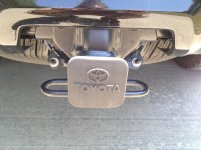
Really clean install; I was impressed.
 

Attachments

  • photo-1.jpg
    photo-1.jpg
    133.6 KB · Views: 3,054
  • Screen Shot 2014-05-21 at 11.02.14 AM.jpg
    Screen Shot 2014-05-21 at 11.02.14 AM.jpg
    107 KB · Views: 2,494
Last edited:
Register to hide this ad
The Trailer
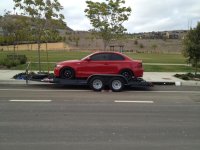
The trailer I opted for was the California Car Hauler by Carson Trailer, a manufacturer based out of Los Angeles County. I wanted something lightweight but not too expensive (aluminum was out of the question). The Carson's open-deck design is a good compromise between cost and weight, and to get a trailer any lighter I would've had to spend exponentially more. Carson lists the trailer at 1560# empty in base configuration, but I made some changes that added to that. I weighed the first trailer I took delivery of at ~1800#. My car weighs in around 3100#, so you can do the math and see how close I'm cutting it. Unfortunately, I never got around to weighing the replacement trailer due to time constraints, but I'm very curious to see where it ended up. I plan to weigh it soon and will update this thread with that info when I do.
Anyway, a little about the trailer: it is a 16' (bed length), open-deck, tandem axle design with a 4" dove-tail for easier loading. I custom ordered it with dropped torsion axles for an even lower loading deck height and lower center of gravity/better ride, electric brakes on all 4 wheels, LED lights for better visibility and less maintenance, 6' ramps, flush mounted D-rings x4, a spare mounted flat on the A-frame, and plastic loomed wiring. I immediately replaced the stock bias ply tires with a set of Goodyear Marathon radial ST tires. My rationale was to spec the trailer to be as safe and easy to pull as possible, since I knew I was going to be right at the limit. My philosophy in any endeavor is to "control what you can control," and I approached this trailer build and towing project that way.

Etc.
The Owner's Manual states that any trailer over 2000# requires the use of a sway control device, and I figured that a weight distributing hitch would be a good idea. Based on reputation and positive reviews, I went with an Equal-i-zer set up.
I considered the McKesh towing mirrors, but found them to be overly expensive and I wasn't crazy about the way they mounted. I settled on universal clip-on mirrors (#3891) by a company called K Source. They use a pretty solid ratcheting system to attach to the stock mirrors. I found them to be extremely useable (a little inevitable vibration, but not enough to diminish their function) and very cost effective.
If you've towed with the 4Runner, you might've noticed the slight difficulty in accessing the 7-pin plug-in; it's mounted way under the truck, and requires you to really get down on your hands and knees to get at. I don't really mind, except that the 7-pin connector cable on the trailer barely reaches, and in fact I had a couple of instances with the first trailer where the plug came loose, and I lost braking and lights. Thankfully, the trailer was unloaded in these instances and easily manageable. I did not want to risk this happening with a full load, so I asked about getting a longer cable when the trailer was being rebuilt. They offered to provide me with a 7' cable vs the standard 4' cable. I really didn't want to deal with an extra 3' of cable, so my solution was to order an 18" extension cable, which proved to be just about perfect.

The Load
With the aforementioned 6' ramps, 6' ramp extensions, 4" dove-tail, and dropped axles, the second trailer was a piece of cake to load. I set up a tongue weight of 500# using a Sherline tongue weight scale. The car was tied down using ratcheting straps from Mac's Tie-Downs. BMW's design precluded the use of the included axle straps, so instead the car was secured using T hooks purchased from Bimmerworld. These create attachment points to the car's frame, and in conjunction with the ratcheting action of the straps, virtually eliminate movement of the car on the trailer.

The Drive
Having to pick up and return the first trailer, and then pick up the second trailer, provided me with an opportunity to tow unloaded for a few hundred miles, which did a lot to get me comfortable with the whole experience of pulling a trailer, backing up, coupling and uncoupling, etc.
My first day out fully loaded was still a little tense, and happened to be the hilliest day of the trip. Starting out in California, my speed was limited by law to 55 mph, and I honestly wouldn't have felt comfortable going any faster. I can honestly say, though, at no point did I feel unable to maintain close to this speed, even going up 6% grades (45-50 mph at worst). A Tow/Haul mode would be nice, but our truck's S mode is pretty brilliant for keeping the truck in it's power band on the uphills and increasing engine braking on the downhills. Perhaps the fact that I daily drive a manual transmission car made this very intuitive for me, I don't know.
I think the fact that I autocross and track my car definitely has given me a sense for car control and a bit of extra awareness on the road, and I would say my main approach while towing was just to give my self "more," be it time to execute maneuvers, or space to do so, or both. I was constantly thinking ahead, and made sure to avoid any sudden inputs.
By the time I got to Arizona, I was comfortable pushing 60-65 mph, which happens to be the limit of what ST tires are rated to. I actually found out that Goodyear certifies it's tires up to 75 mph, provided you add 10 PSI to what their load-inflation tables suggest (not to exceed the 55 PSI limit). I had enough of a margin to permit this, and by the end of the trip was happiest around 70-72 mph.
The very worst thing I experienced on the road was high winds. Not because they pushed my trailer around, but because the truck itself catches a lot of wind. I just slowed down a little when necessary.

A Few Tips
- Accessory towing mirrors should be considered absolutely essential equipment. There is no way the stock mirrors are adequate for towing safely.
- A weight distributing hitch with sway control is a very, very good thing. I had absolutely zero sway towing 3000 miles at max load, and always felt like the truck was in control of the trailer (rather than the other way around). I couldn't imagine doing what I did with just a standard ball hitch.
- Air bags are great, too. In conjunction with the WDH, I was able to achieve only about a 1/2" of rear sag with a 500# tongue weight.
- Just keep the truck in S4 all the time. Don't be afraid to go down to S3 (or even S2!) and just live there for a while on steep grades. People shy away from sustained high revs for some reason - in my opinion, the engine can handle it. The extra power and ability to keep the brakes in reserve are worth it to me.
- Above all, take it easy. Respect what you're doing, understand that things can go very wrong, and then take steps to ensure that they don't.

A Caveat
My experience towing a 16' car hauler on dropped axles is probably not going to be analogous to towing a 25' or 30' travel trailer of equal weight. Fully loaded, my car and trailer sit lower than my truck, so that the trailer is basically drafting the truck. A big travel trailer is going to present a big airfoil behind the truck, and I imagine would handle a lot worse at speed.

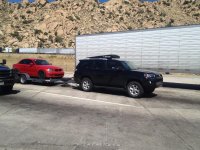
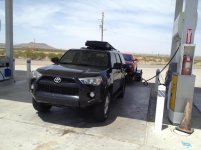
On to pics. Your comments or questions are welcome.
 

Attachments

  • photo.jpg
    photo.jpg
    134.1 KB · Views: 2,945
  • photo 1.jpg
    photo 1.jpg
    137.4 KB · Views: 2,539
  • photo 2.jpg
    photo 2.jpg
    139.4 KB · Views: 2,632
  • photo 3.jpg
    photo 3.jpg
    126.1 KB · Views: 2,666
  • photo 4.jpg
    photo 4.jpg
    137.7 KB · Views: 3,562
  • photo 5.jpg
    photo 5.jpg
    127.2 KB · Views: 2,695
Last edited:
Good to hear that everything went smoothly other than the mishap of the new trailer being delivered not according to your spec.

Lets see some pictures! Also pictures of the 1 series.
 
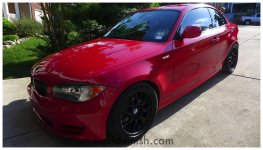
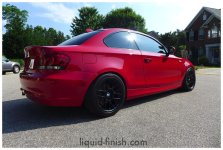
And as a bonus, here are a couple of snaps of my car post-detail after arriving in North Carolina. The car got covered in stucco overspray while at a friend's place in San Diego, when I was away visiting family in Oregon. Combine that with a 3,000 mile trip in tow, and it needed a little refresh, lol.
 

Attachments

  • LFD08-34.jpg
    LFD08-34.jpg
    138.9 KB · Views: 2,497
  • LFD08-41.jpg
    LFD08-41.jpg
    140.6 KB · Views: 2,557
Last edited:
1 series looks sweet! I almost got a 1M in 2011 and regret not doing so every time I see a modded 1 series on the road.

Glad they are releasing an M2 in about a year the car seems perfect size as well.
 
Sweet!

Did you track your fuel mileage?

FWIW I average 13 mpg @ 57 mph towing under ideal conditions.

Head wind/tail winds are my concern for taking longer "cross country" trips.

Curious about your low profile [yet still heavy] results.
 
1 series looks sweet! I almost got a 1M in 2011 and regret not doing so every time I see a modded 1 series on the road.

Glad they are releasing an M2 in about a year the car seems perfect size as well.

Thanks!

I've got my eye on the M2 as well, but it's a little hard to justify getting rid of the 1er when it's all paid off. We'll see.
 
Did you track your fuel mileage?

FWIW I average 13 mpg @ 57 mph towing under ideal conditions.

Head wind/tail winds are my concern for taking longer "cross country" trips.

Curious about your low profile [yet still heavy] results.

Unfortunately, I did not track fuel mileage. Maybe I didn't want to know!

Honestly, it seemed like I was stopping for gas about as often with a loaded trailer as an unloaded one, but that can't be right, I guess.
 
Unfortunately, I did not track fuel mileage. Maybe I didn't want to know!

Honestly, it seemed like I was stopping for gas about as often with a loaded trailer as an unloaded one, but that can't be right, I guess.

I have pulled around 4800# 800 miles and got about 11 mpg. You should be close to that. One easy way though is to check credit card receipts for the trip and that will give you an idea. You can map from station to station and check.
 
What was your Front Axle Load Restoration with your WDH?

Did you monitor transmission/coolant temperatures?

Here are my front wheel well measurements:
Loaded tow vehicle, uncoupled: 34 3/4"
Loaded tow vehicle, coupled, no WD: 35 3/8"
Loaded tow vehicle, coupled, w/ WD: 35"
As above, + air bags @ 35 PSI: 35 1/16"​

Also unfortunately, I did not invest in a tranny temp gauge and thus had no way of monitoring temps. I just trusted that installing the cooler lowered temps some, and certainly was better than not having one.
 
S Mode

I towed my 2800 lbs trailer from DC to Houston (1600 miles). All stock, without any fancy trailer aids like you did. However, when I get geared up to tow my track car I will for sure be following you on all of the additional towing goodies. All I noticed with the lesser load was what you had mentioned about using S mode as a 'tow mode'. The trans likes to shift into 5th when it just shouldn't. I too like to keep the revs up when towing. Also, when my dad took over driving for a while he kept wanting to use the cruise control which was a disaster with the shifting.

 
Op, I'm just curious but what kept you from a tundra if you tow that much? You've got mad love for the 4R to do all that to tow :)
 
Glad to hear it all worked out. I remember you talking about doing this a while ago. The airbags are by far the single best modification I did for towing. I wish I had done it when I first towed it from Seattle to Oakland on I-5 but better late than never. Will second that higher RPMs are not that big of a deal, I found the sweet spot at a little over 3000RPM when climbing 8% 8 mile grade of Siskiyou Pass (think I was doing about 40-45 during that time). Thanks for the link on the tongue scale, will be picking one up so I can check the tongue weight next time I hitch up. Can never be too informed when it comes to this stuff. Great write up!
 
Op, I'm just curious but what kept you from a tundra if you tow that much? You've got mad love for the 4R to do all that to tow :)

Well, to get a similarly equipped Tundra I would've had to go up to the Platinum, and spend about $10k more than what I did for my 4Runner. Also, while it would've towed better, it would have done everything else worse (to me). It would be even less fuel efficient, even more difficult to park, less suitable as a family vehicle, etc.

If I had it to do all over again, I might consider a CrewMax Tundra more strongly, but the 4Runner is my largest vehicle to date, and when I was shopping for a truck it felt pretty huge - I couldn't imagine what a Tundra would've felt like (I'd driven my dad's Suburbans and Expeditions and never really liked them). Now that I'm used to driving a truck, a full-size pick-up might not be so bad, but there's still the issue of price - Tundras aint exactly cheap!

But bottom line is tha I do like the 4runner. It meets my family's needs very well, and while it's not the most capable tower or hauler, and manages to complete thos missions fairly well, when required. I think it's a good "do anything" truck, even if it's not the best at everything it does.
 
Glad to hear it all worked out. I remember you talking about doing this a while ago. The airbags are by far the single best modification I did for towing. I wish I had done it when I first towed it from Seattle to Oakland on I-5 but better late than never. Will second that higher RPMs are not that big of a deal, I found the sweet spot at a little over 3000RPM when climbing 8% 8 mile grade of Siskiyou Pass (think I was doing about 40-45 during that time). Thanks for the link on the tongue scale, will be picking one up so I can check the tongue weight next time I hitch up. Can never be too informed when it comes to this stuff. Great write up!

Thanks! Glad you found the write up helpful. I seem to recall reading about your experience towing through the Siskiyous while I was in Oregon actually, having recently driven the pass northbound. It definitely boosted my confidence!

Anyway, the tongue weight scale is not that expensive and is a cinch to use. I mostly liked it for the confidence it gave me - proper tongue weight is a big enough deal that it's worth not having to guess about.
 

Members online

Forum statistics

Threads
278,311
Messages
3,554,082
Members
248,016
Latest member
Advally Service

Trending content

Back
Top