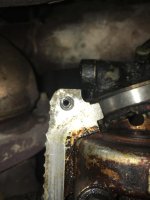
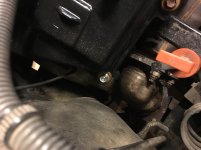
Need help removing broken valve cover bolt

You clearly have a broken cobalt bit in there. You won't ever drill through that, and no ez-out or extractor will work in there. I talk out of experience, wasted hours on this. Only thing I see that could drill a hole in there are those special diamond bits.

If you don't have access to a welder, you could buy a cheap one, you'll use it the rest of your life.

Get a nut which the inner diameter is a bit smaller than the original broken bolt. get that welder to a high setting and flux-core tack weld the broken bolt and bit into the center of the nut, taking care not to heat up the aluminium too much. That will go right out, easy as butter with the heat. Deburr the aluminium area with 800 grit sand paper after the work. Practice a lot if you never welded on another bolt and nut before attempting
 
Last edited:
You clearly have a broken cobalt bit in there. You won't ever drill through that, and no ez-out or extractor will work in there. I talk out of experience, wasted hours on this. Only thing I see that could drill a hole in there are those special diamond bits.

If you don't have access to a welder, you could buy a cheap one, you'll use it the rest of your life.

Get a nut which the inner diameter is a bit smaller than the original broken bolt. get that welder to a high setting and flux-core tack weld the broken bolt and bit into the center of the nut, taking care not to heat up the aluminium too much. That will go right out, easy as butter with the heat. Deburr the aluminium area with 800 grit sand paper after the work. Practice a lot if you never welded on another bolt and nut before attempting

I see what you are saying. My question is, how much torque was applied to shear the bolt. All this left handed drilling, pre and post bit breaking off, has not even loosened this bolt a smidge.

What about just leaving it in there, replacing the VC with new gasket, tighten the 7 bolts and put some RTV or FIP or whatever in that corner?
 
I see what you are saying. My question is, how much torque was applied to shear the bolt. All this left handed drilling, pre and post bit breaking off, has not even loosened this bolt a smidge.

What about just leaving it in there, replacing the VC with new gasket, tighten the 7 bolts and put some RTV or FIP or whatever in that corner?

You'd have a good chance of a leak. Worse place to miss a bolt. Not much torque needed to break a bolt this size really, this is in aluminium. And leaving that half-assed job this way is nothing to be proud about later on.

If you go the nut and weld way, with the heat of the welder attacking the core bolt, the thing will back out like butter after you let it cool down. I've been through the same on a aluminium transmission and dealt with it this way. I am just pointing you in the direction I personally dealt with that problem and succeeded. Clean it well before welding.

There are also those dremel small diamond bits, but I am not sure it will go through carbide. Personally I would not even try this.

https://s7d2.scene7.com/is/image/homedepotcanada/p_1000154437.jpg?$pipGallery$&id=xRURp3&fmt=jpg&fit=constrain,1&wid=400&hei=400
 
Last edited:
Sorry you're in this spot

I think a safe assumption at this point is that it's not coming out easily, and you are in over your head (because you said so)

Your options are to take the vehicle in to a shop, or pull the head and take the head in.
There's a fair chance of the head being salvageable and before you risk making a bad situation worse, the smart play may the harder route (because easy hasn't worked)

I wouldn't be surprised if the bolt was cross threaded into the head at some point in the past and that's what you're dealing with now. This is why valve cover studs make sense.

A used head to replace the buggered one might work out best and cheapest in the long run and you can order that and swap it at home if you're up for it.

Good luck and post back what you decide/do


Sent from my Pixel XL using Tapatalk
 
Find a tight fitting torques bit and hammer it into the hole you drilled and use a impact driver on it.


Sent from my iPhone using Tapatalk

If you go the impact driver route, buy some of this and put it on the tip of the bit you are using before hitting it into the hole; my brother's boat mechanics do such when they sometimes run into seized screws thanks to salt water:
https://www.amazon.com/Permatex-80037-Valve-Grinding-Compound/dp/B000HBM80M

Sorry you're in this spot

I think a safe assumption at this point is that it's not coming out easily, and you are in over your head (because you said so)

Your options are to take the vehicle in to a shop, or pull the head and take the head in.
There's a fair chance of the head being salvageable and before you risk making a bad situation worse, the smart play may the harder route (because easy hasn't worked)

I wouldn't be surprised if the bolt was cross threaded into the head at some point in the past and that's what you're dealing with now. This is why valve cover studs make sense.

A used head to replace the buggered one might work out best and cheapest in the long run and you can order that and swap it at home if you're up for it.

Good luck and post back what you decide/do


Sent from my Pixel XL using Tapatalk


So, I had to focus on some important things in life, beyond this broken bolt. Luckily the weather in Denver cooperated and I was able to ride my bike while my 4Runner gathered dust in my friend's garage.

I got back to working the bolt. Carbide bits helped me drill past any obstructions, but extraction did not pas out. I thin the steel and aluminum are now one! I was able to drill through it with a 7/64" carbide bit!! I feel like next step is to drill it out with incrementally larger bits, then tap it.

Looking for input on size of drill bit in order to tap it so I can use an M6 bolt. As well as any general directions. Everyone's insight has been very helpful.
 

Attachments

  • bolt hole.jpg
    bolt hole.jpg
    126.4 KB · Views: 676
The trick will be drilling it 90° straight and inline with the hole in the valve cover.

Google says an M6 x 1 coarse thread requires an M5 drill while M6 fine threads take slightly larger drills
http://www.shender4.com/metric_thread_chart.htm

I can tell you from experience you will want to do this carefully, with plenty of oil, match the feed with the speed of the drill and don't run the drill too fast. I'd want to do this on a drill press if possible.

Sent from my Nexus 5X using Tapatalk
 
The trick will be drilling it 90° straight and inline with the hole in the valve cover.

Google says an M6 x 1 coarse thread requires an M5 drill while M6 fine threads take slightly larger drills
Thread - Drill & Tap Chart

I can tell you from experience you will want to do this carefully, with plenty of oil, match the feed with the speed of the drill and don't run the drill too fast. I'd want to do this on a drill press if possible.

Sent from my Nexus 5X using Tapatalk

Thanks for the info and advice. This will not be done on a drill press, so careful and hopeful will have to suffice.
 
Victory!!!

The trick will be drilling it 90° straight and inline with the hole in the valve cover.

Google says an M6 x 1 coarse thread requires an M5 drill while M6 fine threads take slightly larger drills
Thread - Drill & Tap Chart

I can tell you from experience you will want to do this carefully, with plenty of oil, match the feed with the speed of the drill and don't run the drill too fast. I'd want to do this on a drill press if possible.

Sent from my Nexus 5X using Tapatalk

It was a battle, but I am happy to say the bolt did not win! I used one of these https://www.grainger.com/product/CHICAGO-LATROBE-Jobber-Drill-Bit-6ZKG9 and one of these Big Gator V-Drill Guide - Metric (MDG1000NP) | Rockler Woodworking and Hardware, plus a second set of hands to hold the drill guide while I drilled out the bolt. Then tapped it and installed a fresh from Toyota VC bolt.

Thanks to [MENTION=95183]octanejunkie[/MENTION], [MENTION=99144]19963.4lsr5[/MENTION], and everyone else who offered up advice from personal experience. I tried nearly all the suggestions, in one way or another, except [MENTION=84331]diverscale[/MENTION] 's suggestion (I was just not ready to learn to weld, although it might have been quicker).

Now I just hope I can remember where all those hoses go!!!
 

Attachments

  • IMG_3986.jpg
    IMG_3986.jpg
    125.2 KB · Views: 550
It was a battle, but I am happy to say the bolt did not win! I used one of these https://www.grainger.com/product/CHICAGO-LATROBE-Jobber-Drill-Bit-6ZKG9 and one of these Big Gator V-Drill Guide - Metric (MDG1000NP) | Rockler Woodworking and Hardware, plus a second set of hands to hold the drill guide while I drilled out the bolt. Then tapped it and installed a fresh from Toyota VC bolt.

Thanks to [MENTION=95183]octanejunkie[/MENTION], [MENTION=99144]19963.4lsr5[/MENTION], and everyone else who offered up advice from personal experience. I tried nearly all the suggestions, in one way or another, except [MENTION=84331]diverscale[/MENTION] 's suggestion (I was just not ready to learn to weld, although it might have been quicker).

That's great to hear & mad respect for not letting this broken bolt defeat you. It's a sickening feeling the split second before you feel the bolt snap & even worse is when the extraction attempts begin to create more damage. The toughest part is knowing when to walk away to regroup & start fresh. I appreciate you following up on this thread with your progress and successful outcome! Nobody plans on having a broken bolt in tough to reach places but when it happens threads like this one become invaluable.
 

Members online

Forum statistics

Threads
278,312
Messages
3,554,089
Members
248,016
Latest member
Advally Service

Trending content

Back
Top