Need help with mysterious major oil leak

Glad you found the problem! I hadn't been following this thread until yesterday but your description of the leak definitely threw out a red flag towards it being a rolled seal - been there done that!

It's definitely a pain in the ass to re-do timing belt jobs, but at least now you know the problem and can get it fixed!
 
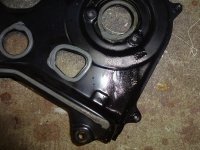
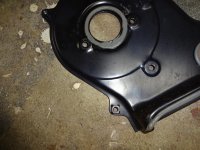
Back of the upper rear timing belt cover. Proof positive of where the leak was.

If only I had been able to see that while it was installed, I could have saved 7+ pages of forum threads. :becky: And kept my blood pressure normal. And not pulled so many of my thinning hairs out. And not thumped my head against a brick wall (but I am still doing that, pissed at myself for not being meticulous enough). I screwed up. This isn't the first timing belt job I have re-done. Or the second. But this very well may be the last timing belt job I ever do. My wife's uncle offered to pay me $300 in labor to do his Honda Pilot timing belt. I said I was sorry, but I am burned out on timing belts, and don't want to screw up someone else's.
 

Attachments

  • DSC01248.jpg
    DSC01248.jpg
    137.2 KB · Views: 321
  • DSC01249.jpg
    DSC01249.jpg
    136.8 KB · Views: 332
Hey! I told you so. Just kidding. Man I have had to redo some stuff way worse than this before. The best lessons are always learned the hard way! That's why men don't read directions. if we succeed we are awesome, if we fail we really learn a lesson.

Remember, remove that cam cap bearing that holds the seal in place. Takes all the effort out of installing the seals. You almost cannot screw it up if you do.

Good find and good luck.
 
Also, they make 'repair sleeves' for the nicked cam that you experienced. I had to do that on my brother-in-law's VW GTI after we messed it up doing the timing belt/seals.

Good luck with the fix!

In my experience, the 'bad' Toyotas of this vintage were the US made ones, or ones that were not reasonably well taken care of.

-Charlie
 
Get the OEM seal. Freeze it for 24 hours. Put a dab of grease on the inner seal and a light dab of oil on the outer. Lightly tap it in, I like using a 5oz rock hammer.

I would charge three times as much for a Pilot TB change. I have done a Ridgeline, getting the crank bolt off isn’t fun. Plus it IS an interference engine.
 
Glad you got it figured out. I've done a timing belt job on these trucks twice now. I never had any problem getting the AC compressor off but those two bolts that hold the tensioner on are definitely a pain in the ass to get to.

I just put some engine oil on the seals when I pushed them on. I used a rubber mallet and a piece of wood to knock them in and they all went on easily.

The tensioner bolt for the power steering is a pain in the ass to get to also. I think that was the biggest issue I ran into and it just took forever to bring the tension up since there is no room in there.
 
I had the seal lip get messed up on my Saturn SL1. Fortunately it didn't require the entire front of the engine to come apart.

Edit. Twice now I didn't like how easy the OEM seal installed and I removed it and installed a napa seal.


Sent from my iPhone using Tapatalk
 
Update (hopefully my final one on this leak):

With over 40 miles on it since replacing the passenger side camshaft seal, the leak appears to be gone. Everything is as dry as a bone. In the back of my mind, I think I knew that was the problem all along, but I kept hanging onto hope that it was some other simple thing that was easily repaired.

During the initial timing belt replacement, that seal had gotten "rolled", and since it was on the bottom of the shaft, I didn't notice it. Lesson (a very painful one) learned to check everything 2 or 3 times, very thoroughly, before putting things back together.

Also, that a/c compressor bracket will always be my nemesis. If I ever do this again, I will find a way to remove the tensioner by snaking a 1/4" drive extension and u-joint up in there, to avoid over an hour of ridiculous, unnecessary work screwing with that bracket. It is very helpful to know where each of the two lengths of bolts go, as it is not obvious when the bracket it in there. Mark them upon removal, or study them before putting it all back in there..

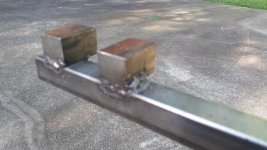
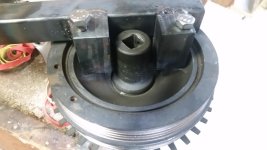
I had made a crankshaft pulley holding tool for my daughter's Protege5 when I did her timing belt a couple of months ago. Luck was on my side, and that tool happened to fit my T4R crank pulley perfectly, so I was able to re-use it. That made torquing the crank bolt possible. I was also able to use it to hold the camshaft pulleys while I torqued them (by wedging my welded blocks into the cam pulley spokes). I think I will keep this tool as long as I own vehicles, as I imagine it will work on many types. I had some steel bar stock and 1" square tubing in my shop. For reference, the bolt holes are 75mm apart, and I used 3/8-16 Grade 8 bolts (not as likely to bend). They happen to fit nicely inside the holes in the pulley, and since they don't actually thread in, they just act as pins. Here are some pictures of it, and that is a Protege5 crank pulley.

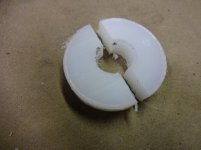
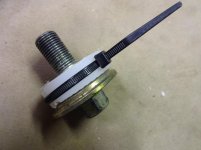
Another little tool I fashioned made the job easier too. Ever remove the crank pulley, then re-install the bolt so you can rotate the crank and time the engine, then when you need to remove the bolt, the crank rotates backward and you lose everything? You can get around this by using a strap wrench. Or you can make one of these and the job becomes simple, easy and precise. I had some Delrin in my shop. I made it into a thick, split washer. If the crankshaft bolt is stuck in the shaft by friction, just cut the zip tie and pop the washer out with a screwdriver, and the crank never rotates. A metal hose clamp could be used instead of a zip tie. I chamfered the inside of the hole where the fillet is on the crankshaft bolt.

Now, onto figuring out why oil is still being blown or sucked into my intake. It smokes real heavy on startup. I will buy a new OEM PCV valve tomorrow. Hopefully the two aftermarked brand new ones were the cause of this (but extremely unlikely). I don't know what else to try, before compression and leakdown tests, since everything looks good on top of my engine. There is a little fresh oil inside my PCV hose.
 

Attachments

  • 20180728_095821.jpg
    20180728_095821.jpg
    138.2 KB · Views: 325
  • 20180728_125508.jpg
    20180728_125508.jpg
    122 KB · Views: 331
  • DSC01256.jpg
    DSC01256.jpg
    118.7 KB · Views: 336
  • DSC01257.jpg
    DSC01257.jpg
    113.7 KB · Views: 325
Last edited:
Good to hear.

If the OEM PCV fails to stop the excess oil/blow by, check for blue smoke coming out of the tailpipe on cold start up. Then I will guess you valve stem seals are in need of replacement,
 
Good to hear.

If the OEM PCV fails to stop the excess oil/blow by, check for blue smoke coming out of the tailpipe on cold start up. Then I will guess you valve stem seals are in need of replacement,

The smoking sure is coincidental with my oil leak, and timing belt replacement. The smoke on startup is either white or blue (can't really tell myself, but I will try standing back there while someone else starts it). Would faulty valve stem seals cause oil to go into my intake manifold? I wouldn't think so. I know for a fact that fresh oil is in there, and am puzzled as to how. It would be strange that two brand new PCV valves were defective. I can't see any other way for that much oil to get in there.
 
If your seals are toast, then yes you will see oil in the intake all day long. If it is enough oil running through the PCV, they will have a short life. My advice is if that is the problem, then install a catch can between the PCV and the manifold, to see how much oil is getting blown on that bank. But the only long term fix would be new seals, which means the TB would be coming off again.

Check to see the color of the smoke. That is where I would start.
 
If your seals are toast, then yes you will see oil in the intake all day long. If it is enough oil running through the PCV, they will have a short life. My advice is if that is the problem, then install a catch can between the PCV and the manifold, to see how much oil is getting blown on that bank. But the only long term fix would be new seals, which means the TB would be coming off again.

Check to see the color of the smoke. That is where I would start.

I will try to determine the color of the smoke tomorrow when I start it to go get a new PCV valve.

From the small amount of research I have done on catch cans, I saw a reference of $200. Would it be possible to make one myself? Just a container with some fittings that match the PCV valve hose? And where would I find info on how much oil caught over a specified time or mileage means something in particular?

Are there any other possibilities besides a faulty PCV valve or faulty valve seals causing this oil in the intake? I keep looking, hoping to find a missing or incorrectly routed rubber hose on top of my engine, but everything looks ok.

Finally, how big of a job is to to replace valve seals? Does it involve removing the cylinder heads?

If it's going to cost many hundreds or more to fix this vehicle, I'm not going to do it. I don't have that money, and I am sick of working on this thing.
 
The only reason I can give you so much info on such is I have leaky valve seals (exhaust on cylinder #5) and run a small catch can. If I didn’t have it after the PCV but before the manifold, I would see blue smoke on start up on cold mornings.

Here is a good but cheap one. Can be found on Amazon. Make sure to get some PCV line from a local store:
https://www.godspeedperformance.com/oil-catch-can-style-rev9power-ac-067-p-576180.html

No, the heads don’t have to but the cams have to come out, hence my reason to run the catch can for the last couple of years. If you have a leak down tester it can pinpoint which seals are leaking.....
 
The only reason I can give you so much info on such is I have leaky valve seals (exhaust on cylinder #5) and run a small catch can. If I didn’t have it after the PCV but before the manifold, I would see blue smoke on start up on cold mornings.

Here is a good but cheap one. Can be found on Amazon. Make sure to get some PCV line from a local store:
https://www.godspeedperformance.com/oil-catch-can-style-rev9power-ac-067-p-576180.html

No, the heads don’t have to but the cams have to come out, hence my reason to run the catch can for the last couple of years. If you have a leak down tester it can pinpoint which seals are leaking.....

Thanks. So, now I gather that a catch can isn't to measure the amount of oil coming from the PCV valve, but rather just to catch stuff before it goes into the intake. A preventative or corrective measure, instead of a diagnostic tool. Correct?

I don't have a leakdown tester, and haven't ever done that. But I do have a compression tester.
 
That is correct. It catches excess oil from blow by; some automakers such as some BMWs will dump this oil back into the crankcase without the use of a catch can due to the inherent design of the engine. You want only air passing through the manifold.

You really need a leak down tester, using air it “inflates” the engine based on the cylinder being tested at TDC on the intake. With such you could hear where the air is escaping, then go, well here is the problem.
 
Another update:

This morning, I cranked it up by reaching through the passenger door, so I could see the initial smoke when it cranked. Hard to say if it was blue or white, even though I am not color blind. It was either very light blue, or white, and it did smell like burned oil. Then I drove to the dealer and bought a new OEM PCV valve, to replace the two brand new aftermarket ones from RockAuto that I had recently installed, just in case I really experienced a fluke with two brand new, defective valves.

The smoke tapered off fairly quickly, and I didn't see any while driving. Now, here is the thing that really puzzles me. When I shut it down to run into a store for 5-15 minutes, I don't see any smoke when I start it up again. When I let it set for an hour or more, I get a huge plume of smoke when I start it up again. That seems to me like it is drawing oil into the intake while it is setting there and not running. Like there is some kind of vacuum going on and drawing oil in there all by itself.

I will drive it a few more times, as the need to drive arises, and see if the new OEM PCV valve happened to fix this problem (I seriously doubt it did).

My coolant level is not noticeably lower. Neither is my oil level. The engine seems to be running perfectly fine.

Also, it still appears as though my leak (the original, main reason for this thread) is completely gone. No sign of any drip.

I am going to start another thread about this oil in the intake problem, with some discussion about catch cans. Reason being that this thread started as an oil leak thread, then it is turning into an engine smoking thread (because mine coincidentally started to smoke while I was dealing with the leak, and I thought they may somehow be related). I want to keep things separate and simple (my old, cluttered brain gets confused easily :biggrin2:). I will probably start that thread later this evening.

 
That is good to hear. There is nothing wrong with some discovery. Pull the vacuum tube off the back of the driver’s side valve cover and see if it is dry or wet with oil.

I would like to think the OEM PCV cuts down on a good bit of the blow by.
 
That is good to hear. There is nothing wrong with some discovery. Pull the vacuum tube off the back of the driver’s side valve cover and see if it is dry or wet with oil.

I would like to think the OEM PCV cuts down on a good bit of the blow by.

Do you mean the bigger (about 9/16"-5/8" OD) rubber hose that comes up vertically off of a 90 degree fitting off of the back of that VC? That is the only one I see. I just checked, and it happens to be dry of oil inside. Just a little black soot.

So, my last 2 brand new aftermarket PCV valves may not be defective, or the wrong part, but just not as good as a higher-performing OEM one? If it's not yet apparent, I'm a dummy on how this particular stuff works, as a system.

Maybe I will keep this discussion in this thread, until I gather enough intel to start one about a (temporary?) fix, depending on what I discover.
 
Yep, that is the one. If it is bone dry, then the driver’s side has no blow by. That is good.

Having never used an aftermarket PCV on my 3rd gen, I can’t comment. Having used non OEM on other applications it can be a hit or miss sometimes.

But if you can do see if the smoke is blue.....
 

Members online

No members online now.

Forum statistics

Threads
278,316
Messages
3,554,120
Members
248,016
Latest member
Advally Service

Trending content

Back
Top