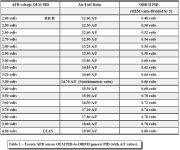
Words
Please avoid quoting me in the future. Thank you.

Words

....Beuller...?
I think your scan tool has switched sensor 1 and sensor 2 voltages. Normally sensor 1 voltage fluctuates as it senses and adjusts fuel trims and sensor 2 voltage should stay steady if your catalytic converter is operating as designed. Even if your catalytic converter is bad you should still see sensor 1 voltage fluctuating.
Sorry, didn’t get notification of any replies in this thread.
This isn’t right. He has a front AFR sensor, which is not a narrowband O2 sensor that you’re describing. The AFR sensor is essentially a wideband O2 sensor. So as long as the AFR is constant, the output voltage reported by the ECU for bank 1 sensor 1 will also hold constant.
Dual cats = front sensor is wideband (well, not quite - it is an AFR sensor with a reduced range compared to true wideband sensors). They are on '99-'00 California emissions and all '01-'02 4Runners. The output of that sensor is scaled to narroband-style readings for reporting via OBD-II, but can be converted back to wideband with the chart above.It's not a wideband sensor. Voltage will fluctuate for the upstream sensor as it changes and adjusts fuel trims. Feel free to provide a source for where it says that it's a wideband sensor though.
It's not a wideband sensor. Voltage will fluctuate for the upstream sensor as it changes and adjusts fuel trims. Feel free to provide a source for where it says that it's a wideband sensor though.
Words and claims but no evidence provided
Wow, way to be pedantic. It is a 'wide-band' in the sense that it is not a traditional O2 sensor. You guys are saying the same thing. Ok, so it doesn't sense 9:1 up to 20:1, it only is accurate from around 12:1 up to 18:1. The point is that it can accurately sense more than about 14.6:1 to 14.8:1.Still waiting on any sort of evidence to prove that it's a wideband. As far as I've seen and experienced it's just a normal range air/fuel sensor (for California emissions) or a normal oxygen sensor for everything else.
There's a difference in sensing range between a wide band air/fuel sensor and the air/fuel sensor that Toyota uses. If you aren't going to provide any sources to back up your statements then I'll see my way out.
When presented with a conflicting point of view/idea from what I've established through my own experience, research, and knowledge to be true then I require substantiated evidence to change that. A lengthy explanation of what someone thinks is great, but not really a verified source. Maybe if more people adopted this outlook there would be fewer people believing the moon landing was fake, the earth is flat, and aliens walk among us. Am I being difficult? Absolutely! If the roles were reversed I would provide outside evidence as well if someone required it. Should be pretty easy for him to provide it since it's "easily Google-able".Wow, way to be pedantic. It is a 'wide-band' in the sense that it is not a traditional O2 sensor. You guys are saying the same thing. Ok, so it doesn't sense 9:1 up to 20:1, it only is accurate from around 12:1 up to 18:1. The point is that it can accurately sense more than about 14.6:1 to 14.8:1.
-Charlie
Still waiting on any sort of evidence to prove that it's a wideband. As far as I've seen and experienced it's just a normal range air/fuel sensor (for California emissions) or a normal oxygen sensor for everything else.
There's a difference in sensing range between a wide band air/fuel sensor and the air/fuel sensor that Toyota uses. If you aren't going to provide any sources to back up your statements then I'll see my way out.
As far as I've seen and experienced it's just a normal range air/fuel sensor
Normally sensor 1 voltage fluctuates as it senses and adjusts fuel trims and sensor 2 voltage should stay steady if your catalytic converter is operating as designed. Even if your catalytic converter is bad you should still see sensor 1 voltage fluctuating.
I think your scan tool has switched sensor 1 and sensor 2 voltages.
LOL are you serious? So now you're acknowledging that it's an AFR sensor (and can report the actual air fuel ratio, unlike an older style O2 sensor)...
...which contradicts your prior post where you describe the operation of a traditional narrowband O2 sensor (and not an air/fuel sensor)...
So let me ask you this. Do you still stand by your statement that you think OP's scan tool is switching readings between sensor 1 and 2?
[MENTION=319302]Bad Luck[/MENTION], here you go. Here is some reading material for you:
https://www.autoequipment.com.au/image/data/Support/Toyota Planar Sensors - Part 3.pdf
Wideband O2 Sensors and Air/Fuel (A/F) Sensors
It is an air/fuel ratio sensor, but not a wideband like the majority of aftermarket sensors. Aftermarket sensors generally go from 10:1-20:1 (https://support.haltech.com/portal/...ensor measures,range of a conventional engine!) where as the Toyota sensors go from 12.5:1-18.5:1 (https://www.autoequipment.com.au/image/data/Support/Toyota Planar Sensors - Part 3.pdf).
Air/fuel sensors and oxygen sensor voltages will fluctuate. You know what isn't supposed to fluctuate? The oxygen sensor that is downstream of a properly functioning catalytic converter. That voltage should fluctuate less than the upstream sensor (air/fuel or oxygen). So, yes I do still think that the sensor positions are switched on whatever OP is using to look at live data.
Where did I tell you it wasn't an air/fuel sensor?
You're just being obtuse at this point.
Wideband, Wide range, AFR sensor, air/fuel sensor, etc., they're all words describing the same thing: a sensor that can accurately report what the actual AFR is. The sensing range of different sensors may vary somewhat, but it's immaterial to the conversation at hand, and debunks your original assertion that OP's scan tool is switching sensor 1 and sensor 2. His scan tool is not confusing anything, it is reporting the correct values for the respective sensors.
What would you call an air/fuel sensor with only 60% of the sensing range of most wide band air/fuel sensors? I wouldn't consider that a wide band, but clearly you do.
You have your opinion and I have mine in that respect. I have never seen my rear oxygen sensor readings fluctuate the way that OP shows. I have California emissions as well.
I'm sure the evidence to support your opinion is "easily Google-able" as well, right?And none of this has any bearing on your incorrect assertion that OP's scantool was displaying the wrong values for the sensors.
And none of this has any bearing on your incorrect assertion that OP's scantool was displaying the wrong values for the sensors.
I'm sure the evidence to support your opinion is "easily Google-able" as well, right?
You can't even compare rear sensor readings since your rear sensor is emulated according to your signature.
I mean, I've already posted the graph showing what the reported B1S1 voltage correlates to for AFR. Like I said earlier, his graph needs to be rescaled so that we can see more resolution in the 0.4v to 0.8v range. But based on what he posted, his front sensor generally seems to be in the correct range.
What evidence have you provided backing up your erroneous claim that his scantool is screwing up?