Odyssey Group 34 - Whats been your experience?

I am considering installing an Odyssey Group 34 to replace my factory battery. The second choice would be their Group 31 size. The 34 will fit in the factory tray with a spacer and the original connectors should fit also. I am planning to run a Dometic cfx50 fridge and it could see 24-36 hours between engine starts during camping trips. I have a 700watt jl audio amp powering my stereo but dont usually run the stereo with the engine off. My questions...

1- If you have a similar set up whats been your experience?

2- what model number did you buy?

3- if you had to do it over would you go with a group 31?

Thanks in advance.
 
Register to hide this ad
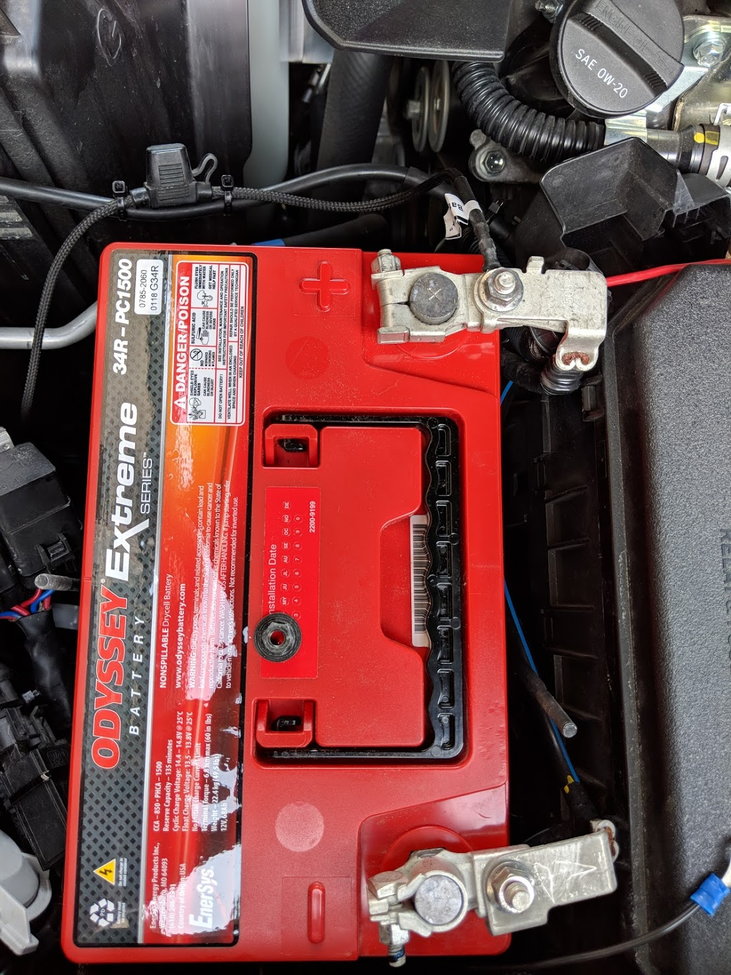
I just installed the 34, I have no plans to run a fridge, but I am running several accessories and plan to put my JL amp on it as well, I did have to use the spacer but it wasn't a big deal as most of the optimas I've used over the years needed a spacer as well. I got the 34R-PC1500T and it's a great battery

img_20180517_175245_b54e1fa21e95d9228f5abbd6a954f4d4c5bdf5a4.jpg


mvimg_20180517_180722_bc55b1919393af57d6b70bee08106f4f4dc1ba08.jpg


I will say that I've been super impressed with the faster ignition and start up with this battery. I have a 6 month old truck with a brand new factory battery and the difference is night and day when you turn the key. I know the 31 is a larger form factor and has more cranking amps, if I was running a fridge I'd probably go for the 31 just for the piece of mind and extra capacity, just my 2cents. I think you may have to modify your battery terminals for the 31 though
 
Had a 31m and it lasted about two years, wouldn’t hold a charge anymore. The running theory is that it was too big for the factory alternator and wouldn’t fully recharge. Replaced it with a 34 and haven’t had any issues.

Jump starter packs are getting better and better now, look into those if you want some redundancy for your system. The Antigravity units are impressive.

Lastly, you may consider comparing the Odyssey to Batteries+ X2 series, they’re rebranded Northstar with similar specs but less $$. Hope that helps.
 
I have the 34 PC1500 single battery and running the Dometic cfx65w. Just came back from Moab last week for a week. The 1st initial day before the trip when I got the fridge was concerning as voltage dropped down to 12.0v over the coarse of 12hrs. But after that, it maintain a 12.5-12.6v in the morning for every night i was there. From my understanding, the Dometic is one if the lowest power consumption fridge and I'm running a single battery setup, so i wouldn't be concern even for 2 days before start. You dont really need the spacers as i dont have the spacer on. And as for the 31m, it's nice to have the extra juice but I don't think I need it.
 

Attachments

  • 20180303_130732.jpg
    20180303_130732.jpg
    134.5 KB · Views: 6,730
Last edited:
it's not just capacity, it's also voltage. most marine batteries (31 and 34) need a higher voltage than what the stock charging system is running.

capacity is definitely an issue though with the 31m, i didn't have many issues when i had a longer commute and was also driving frequently to project sites but now I have a 15-25min commute and spend more time in the office. i use an on board charger now, but if i don't use it my battery is pretty drained by the end of the week and have even had occasions where it will get as low as the fridge shutoff voltage by thurs or fri afternoon (though that usually requires an empty fridge, it doesn't run much if i keep it mostly full)

I'm planning on getting the 270A alternator i just haven't had the energy to mess with it yet, it looks like a pain to get to to replace and run new wires.
 
Im happy with my 34

I have the 34 PC1500 single battery and running the Dometic cfx65w. Just came back from Moab last week for a week. The 1st initial day before the trip when I got the fridge was concerning as voltage dropped down to 12.0v over the coarse of 12hrs. But after that, it maintain a 12.5-12.6v in the morning for every night i was there. From my understanding, the Dometic is one if the lowest power consumption fridge and I'm running a single battery setup, so i wouldn't be concern even for 2 days before start. You dont really need the spacers as i dont have the spacer on. And as for the 31m, it's nice to have the extra juice but I don't think I need it.


Went 34 because of price and not messing with the tray. I run KC camp lights on both sides of the 4R probably 2-3 hours at night when camping (I have small children) and a Dometic CFX40. No issues. I also have one of those juice packs just in case though.
 
you can spend $10-$20 for a basic battery tray or get a nice custom one that can bolt down for just $70, you don't need to buy the expensive pelfreybilt - the tray is easy to deal with
 
Yep, I have the Odyssey Group 34R battery. I have a CFX50 as well, but I also had an ARB37QT before. I ran it non-stop from when I left Denver, to San Diego, to Baja all the way down to Cabo. In Cabo, I took the fridge out and plugged it in at the resort. Put it back in and ran it another 4 days straight back to Denver. I have a National Luna monitor and the 34 battery stayed in the yellow overnight every night, and the meter never really dropped into the red.

I picked it over the 31 cause of the weight savings, and I don't have much to power when the engine is off, other than a fridge.
 
it's not just capacity, it's also voltage. most marine batteries (31 and 34) need a higher voltage than what the stock charging system is running.

capacity is definitely an issue though with the 31m, i didn't have many issues when i had a longer commute and was also driving frequently to project sites but now I have a 15-25min commute and spend more time in the office. i use an on board charger now, but if i don't use it my battery is pretty drained by the end of the week and have even had occasions where it will get as low as the fridge shutoff voltage by thurs or fri afternoon (though that usually requires an empty fridge, it doesn't run much if i keep it mostly full)

I'm planning on getting the 270A alternator i just haven't had the energy to mess with it yet, it looks like a pain to get to to replace and run new wires.

Have you tried the rectifier trick that ups the charging voltage?
 
I am on my second 31. I had the old Diehard 31m (rebranded Odyssey), I noticed @ 22 months the case cracked on the top and started getting weak voltage >12.3, returned it for full refund, bought a Odyssey 31m-pc2150 (before they switched the poles) I do have the “voltage booster” fuse.

My truck does fine if I drive it a lot, other than that I keep it on a NoCo smart charger as if I don’t make long trips it does slowly discharge. I personally believe the suboptimal charging is software/ECU issue. I have the TE edition 130 amp alternator, which should be plenty.

I am curious how everyone that did the big3 upgrade are doing, there were at least a few dozen that group buy’d the xp270 alternators.
 
Last edited:
I have an 34R Odyssey installed for about 8 months now. Zero issues so far.

I bought it directly from Odyssey. Someone on here posted a discount code at the time for 20% off. Not sure if any discount codes are offered now. It had free shipping and got here in 2 days, also it was manufactured less than a month before it arrived so it was good to know it had not been setting on a shelf for many months. Spend a few dollars for the adaptor plate to raise the battery and it fits in with no hassle.
 
Some additional info about charging Odyssey AGM batteries

http://www.odysseybattery.com/documents/US-ODY-TM.pdf

Odyssey Battery Tech Manual said:
  1. Trickle chargers that do not have a regulated trickle charge voltage between 13.5V and 13.8V (no lower than 13.5V and no higher than 13.8V) will cause early failure of the Battery. Use of such chargers with the Battery will also void the Battery’s warranty.
  2. For applications where an alternator is present, the alternator must deliver between 14.0V and 14.7V when measured at the Battery’s terminals. Consult the ODYSSEY battery technical manual or owner’s manual for any necessary temperature compensation. Alternators that do not have a regulated charge between 14.0V and 14.7V (no lower than 14.0V and no higher than 14.7V) will cause early failure of the Battery.
 
Any downsides beside cost?

I guess your not catching the bigger picture, having anything other than the stock flooded type battery requires more than just dropping the battery in your engine bay. The charge system is just not really compatible with AGM battery charge requirements.

I have a hkb voltage booster, a mounted noco marine charger/maintainer and a 31m battery. It still requires maintenance. I plug my truck in when its not in use for more than a couple of days. So if you aren't willing to maintain it then yes just having an heavy duty agm battery itself is a downside.
 
I guess your not catching the bigger picture, having anything other than the stock flooded type battery requires more than just dropping the battery in your engine bay. The charge system is just not really compatible with AGM battery charge requirements.

I have a hkb voltage booster, a mounted noco marine charger/maintainer and a 31m battery. It still requires maintenance. I plug my truck in when its not in use for more than a couple of days. So if you aren't willing to maintain it then yes just having an heavy duty agm battery itself is a downside.

I was specifically referring to any downsides to using the voltage booster, regardless of the battery size or type...
 
I was specifically referring to any downsides to using the voltage booster, regardless of the battery size or type...

Well then you were right, the price :) :D

I think they are really to new to determine if there are any long term detrimental effects to the trucks electrical subsystems. I haven't seen or heard of any issues in the last few years.
 
Last edited:
Installed one on my 18 4R. Currently running a CFX50w and charging some electronics while camping. Used it for over a week on and off and it’s been great. Never seen it below 12.5V.
 
I guess your not catching the bigger picture, having anything other than the stock flooded type battery requires more than just dropping the battery in your engine bay. The charge system is just not really compatible with AGM battery charge requirements.

I have a hkb voltage booster, a mounted noco marine charger/maintainer and a 31m battery. It still requires maintenance. I plug my truck in when its not in use for more than a couple of days. So if you aren't willing to maintain it then yes just having an heavy duty agm battery itself is a downside.

Could you link to the charger and booster you are using? Also, what device do you use to monitor the battery? I am nearly decided to do the 31 and avoid a future aux battery set up.
 
[MENTION=176486]Louisiana Overland[/MENTION]

The HKB voltage booster:
https://www.hkbelect.com/product/206-mk3-micro-blade-75a-electronic-fuse-version-2016/

NoCo Gen1 Mini 4a: (some use the Gen1 10amp or the Gen2)
https://no.co/genm1

I have a Carista OBDII and the voltage on the app dashboard when I am curious, it is monitoring what the ECU is picking up (so there could be some variance). I also just check with a voltage meter every other month or so. You could pick up a national luna BMS-10101 single battery for like $30. I just haven't found a decent usable place to mount one. There are a dozen+ out there, since it is just a monitor and not a management system they are relatively inexpensive.
 

Members online

Forum statistics

Threads
278,311
Messages
3,554,082
Members
248,016
Latest member
Advally Service

Trending content

Back
Top