off highway trailer towing with Weight Distribution hitch?

flip2020

New member
hello all,

I have a 2008 Toyota 4Runner V8, with weight distribution hitch receiver, Rated at 7000# towing without weight distribution hitch, and 9300# tow rating with weight distribution hitch. Max tongue weight is about 10% of each, (actually slightly higher).

I'm planning to buy a Pop up tent camper, with front cargo carrier that will haul a small ATV (about 600#).

-Trailer is 24ft total length, about 64 inches tall when folded,
-weighs 2900# dry, and gross trailer weight of 4000#.
- tongue weight = 417 lbs dry (loaded could be about 600#, just guessing)

I live in Wyoming where we do not do much interstate highway travelling, most of the roads used would be winding, gravel and dirt roads, up and down hills, through creeks, etc. any highway travelling would be at about 60 to 65 mph, for only small portions of each trip.

Also, tight turns while backing up into tight areas is necessary for my application, I have to be able to come within inches of "jackknifing" to fit into some areas.

In my situation, would you recommend a weight distribution system? with sway? or would it be better not to use anything.

thank you
 
Register to hide this ad
Not sure about your application, but as an FYI, V8 runners came with 5000 lbs towing capacity without Weight Distribution, and 7000(4WD)/7200(2WD) capacity with the WD hitch system.

It sounds like you don't need a WD hitch for a 4000 lb trailer with 600 lb ATV on it, but it's close to the limits.
If I were you, I'd do without the WD and run some air helper springs on the rear axle.
 
Your weight ratings are too high by 2000lbs.

I think the weight distributing system would get in the way on steep transitions. For example, going up from a creek crossing the trailer is in the creek but the truck is on a slope. The weight distributing bars won't let it bend that way.

Also, weight distributing lowers the clearance under the hitch since the boat anchor sits low compared to a normal hitch ball. The ball might be at the same height, but the sockets for the load bars sit lower. And most of them are adjustable for different trailer heights, so there's often a bar that extends down even farther.

4000lbs is within the rating to use without weight distribution. It would make it better on the highway, but I think it will get in the way off road.

Keep in mind that if your tongue weight is 600lbs the cargo capacity in the vehicle is reduced accordingly. Look up the GVWR.
 
oops, yeah my weights were off. I was looking at the total gross weights for the tow vehicle, trailer and cargo. Even then I was a bit wrong.

So it looks like my max tow capacity would be the 5000#, unless I buy the expensive $500 weight distributing hitch....right?

My receiver allows for the WDH, but unless I buy the fancy hitch, I should not tow beyond 5000#
 
If the weight numbers for the trailer are correct, then you probably won't need a weight distribution system. In addition, it would only work as designed on paved roads. In the situations you describe, especially when backing up, you would have to disconnect the spring bars and sway control device to make those type of sharp turns. I would want to be sure about the tongue weights, especially if you plan to load an ATV on the front platform of the trailer. If they are going to be close to the max limits, you may want to consider an air bag assist system for the rear springs to help with the potential rear end sag.
 
I guess my weight confusion came after I read the sticker on the hitch receiver itself, it clearly states
- max tow capacity when used with weight CARRYING hitch = 7300
- max tow capacity when used with weight DISTRIBUTING hitch = 7300
:crazy:

yes, it states the same tow capacity for both!! the only changes is the tongue weight going from 700 lbs to 1095 lbs.

but I assume I need to go by the manuals numbers, that sticker doesn't make sense to me.

I do have the 4wd v8, so only 7000 lb with WDH would be more logical, and 5000# with a weight carrying.
 
If the weight numbers for the trailer are correct, then you probably won't need a weight distribution system. In addition, it would only work as designed on paved roads. In the situations you describe, especially when backing up, you would have to disconnect the spring bars and sway control device to make those type of sharp turns. I would want to be sure about the tongue weights, especially if you plan to load an ATV on the front platform of the trailer. If they are going to be close to the max limits, you may want to consider an air bag assist system for the rear springs to help with the potential rear end sag.

every thing you said makes a lot of sense. I probably need to look into an air bag assist system. have you had any experience with them? are they difficult to install? It seems pretty necessary if I'm going to have this much tongue weight.
 
One thing I noticed in the manual is it states to use anti-sway device when towing over 2000#.

However, we got a pop up in January that weight 2650 dry and could go up to 3250 GVWR.

I loaded it up a bit with just the built in 7000# WDH (not a full blown equalizer or anderson system) headed to the mountains for an hour long test run and didn't feel any sway at all.

So, while I'm considering getting some sort of sway control - likely built into an Anderson Anti Sway WDH system, I'm not sure I feel it's really necessary. We'll be pulling it long distances on occassion (Yellowstone is 10.5 hours/600 miles away).

It would be cool to hear from others that pull campers and get their thoughts on whether anti-sway has proven necessary. Probably has a lot to do with the type of trailer as well, I guess. TTs will be more susceptible to the effects of wind and passing trucks.
 
One thing I noticed in the manual is it states to use anti-sway device when towing over 2000#.

However, we got a pop up in January that weight 2650 dry and could go up to 3250 GVWR.

I loaded it up a bit with just the built in 7000# WDH (not a full blown equalizer or anderson system) headed to the mountains for an hour long test run and didn't feel any sway at all.

So, while I'm considering getting some sort of sway control - likely built into an Anderson Anti Sway WDH system, I'm not sure I feel it's really necessary. We'll be pulling it long distances on occassion (Yellowstone is 10.5 hours/600 miles away).

It would be cool to hear from others that pull campers and get their thoughts on whether anti-sway has proven necessary. Probably has a lot to do with the type of trailer as well, I guess. TTs will be more susceptible to the effects of wind and passing trucks.

I agree, I like to hear real world experience of towing pop ups, especially if they have a toy hauler deck on the front ;) its surprizingly hard to find many other 4runner owners with pop upexperience.

Do you know the tongue weight of your unit?
 
every thing you said makes a lot of sense. I probably need to look into an air bag assist system. have you had any experience with them? are they difficult to install? It seems pretty necessary if I'm going to have this much tongue weight.

I don't have any personal experience with air assist systems, but I believe the air bags are installed inside the rear coil springs. How difficult an install that would be might be better answered by someone who already has them.
 
One thing I noticed in the manual is it states to use anti-sway device when towing over 2000#.

However, we got a pop up in January that weight 2650 dry and could go up to 3250 GVWR.

I loaded it up a bit with just the built in 7000# WDH (not a full blown equalizer or anderson system) headed to the mountains for an hour long test run and didn't feel any sway at all.

So, while I'm considering getting some sort of sway control - likely built into an Anderson Anti Sway WDH system, I'm not sure I feel it's really necessary. We'll be pulling it long distances on occassion (Yellowstone is 10.5 hours/600 miles away).

It would be cool to hear from others that pull campers and get their thoughts on whether anti-sway has proven necessary. Probably has a lot to do with the type of trailer as well, I guess. TTs will be more susceptible to the effects of wind and passing trucks.

I am a bit confused, or maybe you are mixing up the weight distribution capable hitch receiver (which you have in the factory V8 hitch), and the weight distribution system which is not part of the oem hitch, but an aftermarket add on system. Some, but not all weight distribution towing systems have sway control built into the system, while others require a separate sway control device be attached. An Equalizer type system, like I use, incorporate sway control into the base system (using the friction connection between the spring bars and the trailer frame mounts. Other types that use chain supported spring bars (like the Reese system) need an add on shock like cylinder for sway control. I believe it is also possible to get just a sway control device that does not incorporate weight distribution capabilities.

In any case, trailer sway can be caused by several factors. Improper axle alignment on the trailer, too much or too little tongue weight, trailer not riding level, and cross wind pressure on the trailer are possible causes. If you are not experiencing sway with your current setup, you may be alright. But if sway does become a problem while driving, it can be a scary issue to deal with.
I guess the old adage, better safe than sorry might apply here. It is your call.
 
Last edited:
If I were you, I'd probably not bother with the sway control for what you're doing. At low speeds and especially on uneven terrain with tight turns, it would mostly serve to just annoy you. Sway control bars and all are useful for heavy loads at high speed. But even towing my car I never used them and with brakes never did feel unsafe. That was about 5,500lbs.

The airbags I did install because without the tongue weight really put a serious sag on the rear and caused it to bottom out easily. The installation is very easy. You simply need a jack, some jack stands and some hand tools.
 
I'm hauling a travel trailer around New Mexico right now. It's a light-weight hybrid and my first trip with it. We've put on about 1,200 miles last I looked and have dealt with quite a bit of wind. My old hybrid came with a WDH but I decided to see how it handles w/o the WDH or any sway control. Even with the winds it's fine as I think you will be too.

The points TechWrench made are also very important so I think you're good to go as is.
 
If I were you, I'd probably not bother with the sway control for what you're doing. At low speeds and especially on uneven terrain with tight turns, it would mostly serve to just annoy you. Sway control bars and all are useful for heavy loads at high speed. But even towing my car I never used them and with brakes never did feel unsafe. That was about 5,500lbs.

The airbags I did install because without the tongue weight really put a serious sag on the rear and caused it to bottom out easily. The installation is very easy. You simply need a jack, some jack stands and some hand tools.

what type of airbags are you using? i'm looking at firestone right now, but wondering how intense I would need to go.
 
Yeah. I'll probably get a WDH system with anti-sway built in. I prefer the better safe than sorry. Plus it will help with the bounce when going over expansion joints on bridges etc.

The manual is a bit fuzzy on the hitches until you've read it a couple of times. It doesn't help that Toyota changed the hitch options on the early models.

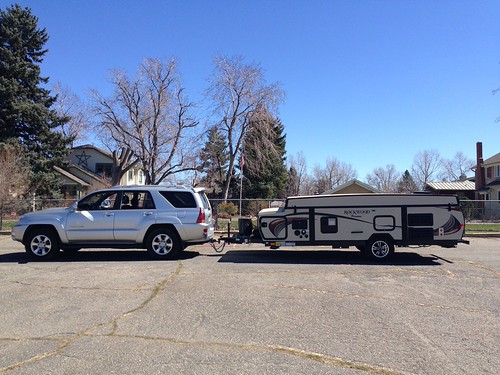
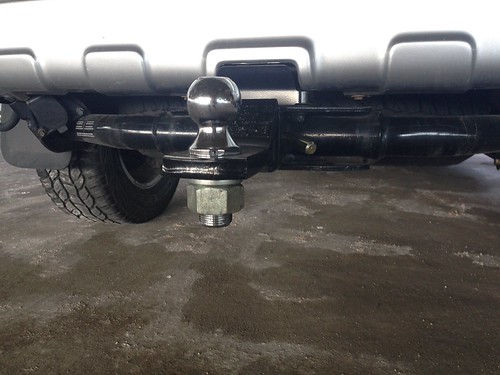
Here's my setup. I haven't taken it to the landscaping place down the road yet to have it weighed but 'factory specs' on the PUP tongue weight are around 350#. With a GVWR and cargo in the storage area I wouldn't be suprised if I got close to 500# tongue weight (including 4Runner cargo space) fully loaded.

Hope I'm not hijacking the thread too much.

Untitled by turnnow, on Flickr

Untitled by turnnow, on Flickr

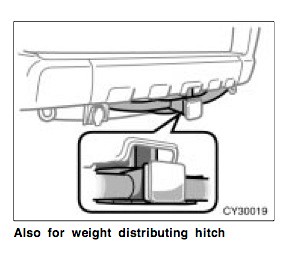
From page 307 in the manual.

Screen Shot 2015-04-10 at 11.42.49 AM by turnnow, on Flickr
 
Here's my setup. I haven't taken it to the landscaping place down the road yet to have it weighed but 'factory specs' on the PUP tongue weight are around 350#. With a GVWR and cargo in the storage area I wouldn't be suprised if I got close to 500# tongue weight (including 4Runner cargo space) fully loaded.

Weight in the trunk of the 4runner doesn't count as tongue weight, though it does count against the GVRW and rear axle weight. It's important that the actual tongue weight of the trailer be around 9-11% of the weight of the trailer when it's loaded with whatever amount of load you are putting in it, otherwise you could end up with dangerous sway that can cause you to lose control. Anti-sway can help reduce sway if your setup is marginal or in crosswinds, but it's not a substitute for the correct tongue weight.
 
Yeah. I'll probably get a WDH system with anti-sway built in. I prefer the better safe than sorry. Plus it will help with the bounce when going over expansion joints on bridges etc.

The manual is a bit fuzzy on the hitches until you've read it a couple of times. It doesn't help that Toyota changed the hitch options on the early models.

Here's my setup. I haven't taken it to the landscaping place down the road yet to have it weighed but 'factory specs' on the PUP tongue weight are around 350#. With a GVWR and cargo in the storage area I wouldn't be suprised if I got close to 500# tongue weight (including 4Runner cargo space) fully loaded.

Hope I'm not hijacking the thread too much.

Untitled by turnnow, on Flickr

Untitled by turnnow, on Flickr

From page 307 in the manual.

Screen Shot 2015-04-10 at 11.42.49 AM by turnnow, on Flickr

Hey, Thanks for the pics. That is very close to what i'm looking at getting. it really helps to see how its going to look all set up. Is that picture taken of it fully loaded? I don't see a whole lot of rear end sag....actually looks pretty good.

Do you have any sort of airbag system or anything on your 4runner?
 
Hey, Thanks for the pics. That is very close to what i'm looking at getting. it really helps to see how its going to look all set up. Is that picture taken of it fully loaded? I don't see a whole lot of rear end sag....actually looks pretty good.

Do you have any sort of airbag system or anything on your 4runner?

No airbags or anything. That's just the stock setup. The camper isn't fully loaded but there's an extra 125# or so fore of the axle.

Nothing in the 4runner cargo area and no passengers (left the wife and kid at home while I went on my joy ride).

Once it's loaded up it might get a little bit of sag in the rear. I'll probably end up getting an Anderson Anti Sway hitch next month. Chipping away a little extra savings towards one so it hurts a little less to shell out $450 for peace of mind. :)

But if I hit my max GVWR of the camper (3250) and go up to 15% on the tongue, 450-490# is not out of the question.

Will probably end up with one of these.

https://www.andersenhitches.com/Catalog/andersen-nosway-weight-distribution-hitch.aspx
 

Members online

Forum statistics

Threads
278,312
Messages
3,554,089
Members
248,016
Latest member
Advally Service

Trending content

Back
Top