Offroad drivetrain durability as tire size increases

Stock Drivetrain durability - your experience

  • I run 37's offroad - no failures so far.

    Votes: 0 0.0%
  • I run 37's offroad - have had failures.

    Votes: 0 0.0%
  • I run 34-35's - no failures so far.

    Votes: 8 7.8%
  • I run 34-35's - have had failures.

    Votes: 5 4.9%
  • I run 33's - no failures so far.

    Votes: 50 49.0%
  • I run 33's - have had failures.

    Votes: 3 2.9%
  • Stock size w/ aggressive tread - no failures so far.

    Votes: 36 35.3%
  • Stock size w/ aggressive tread - have had failures.

    Votes: 0 0.0%

  • Total voters
    102
With 33's: Worn out steering rack, destroyed alignment cam tabs, worn out suspension bushings, and blown shocks. Also hotter transmission temps.

With 35's: destroy CV's and tie rods fairly easily, destroyed steering racks and bent spindles in addition to the above.

Ended up with 34's because i didn't want to deal with blown CV's and tie rods. However, there is not alot of data points on 34's so i'm not sure where they stand in terms of reliability and drivetrain compromise. To mitigate risk, I went with a lighter 34's Mt to give me peace of mind.

I wouldn't say all of the damage of the above is attributed to larger tires, it could be what we were also doing at the time. Some damage more likely to happen desert running vs rock crawling and vise versa. Other damage is bound to happen if u go offroading versus flexing at the parking lot of REI.

In my mind, CV and tie rods are the weak links going above 33, because the rest i mentioned can be upgraded or prevented.

oh yea, cam tabs are trashed on mine as well. also inner wheel wells from full bump.
 
Easy way of thinking: While, i broke and bent alot of things on 33's, I didn't have to carry spares to make it home.

Thank you for all great details in your post. I think this is my preliminary assumption about these rigs that, though many other factors need to be taken into account, 33's are very sustainable for most terrains and applications.

34's are bit tougher on the drivetrain, but also survivable.

35's will likely pop a CV if you get into it, but the front diff, transmission, tcase and rear diff are all good to go. Even in popping a CV - it's a fairly straightforward repair that only requires familiarity, safe jacking and a few key tools, other than a normal tool kit.
 
Last edited:
35's will likely pop a CV if you get into it, but the front diff, transmission, tcase and rear diff are all good to go. Even in popping a CV - it's a fairly straightforward repair that only requires familiarity, safe jacking and a few key tools, other than a normal tool kit.

The 5th gen is a massive improvement in the design of the front spindle upright and lower ball joint assembly for field replacement of the CV. It's a super easy job because of how that lower spindle area separates with 2 bolts for the ball joint bracket. It's an easy trail side repair. The older setups like the LC100 were a huge PITA to do.
 
The 5th gen is a massive improvement in the design of the front spindle upright and lower ball joint assembly for field replacement of the CV. It's a super easy job because of how that lower spindle area separates with 2 bolts for the ball joint bracket. It's an easy trail side repair. The older setups like the LC100 were a huge PITA to do.

X2. All i needed to add to my kit is a 35-36mm socket for the axle end nut. (Not the castle nut, but the inner one)
 
Depending on how crazy you want to go on being prepared - you might also include a wiper seal for the diff housing side. Sometimes those get chewed up when you blow an axle if it flops too much. I toss them in for remote trips just because I happen to have them around, but you can get off the trail even if the seal is shot without replacing it. You'd just have to fix a second time after you get home in most cases. I have had the seal fail on its own though - probably due to the needle bearing issue. It was on that side, but preceded the needle bearing going out by about 10k miles. I assume they were related. I bought the ECGS bushing, but toyota warrantied it and it hasn't returned. So I keep a seal and the ECGS bushing ready to go if it happens again.

I also like to have a wood chisel for removing the dust cap on the hub. You won't deform it with a fine cutting edge like a wood chisel that you can tap under the lip and pry it off. My other suggestion is a medium length drift or steel chisel, or even a piece of pipe. Something you can use to remove the inner CV from the diff housing. If you haven't done it before - the inner CV has landings machined into it that are there for you to put a drift against and hammer them out. No need for a slide hammer or using a pry bar. Just put your rod/drift/pipe/whaver against the landing and whack with a hammer and it'll pop that snap ring out without any drama.

If i were to add any other spare parts - I'd carry a spare rear drive shaft. It's exposed and mine has a fair bit of trail rash on it. There's not really a good way to protect it and they're around $100 or less for a spare. I don't think it's necessary, but if I were regularly going to the harder places like Johnson Valley or the Rubicon, I'd have one along. For normal exploring it'd be totally overkill.
 
The 5th gen is a massive improvement in the design of the front spindle upright and lower ball joint assembly for field replacement of the CV. It's a super easy job because of how that lower spindle area separates with 2 bolts for the ball joint bracket. It's an easy trail side repair. The older setups like the LC100 were a huge PITA to do.

Wheels bearings too from what it looks like?
 
Depending on how crazy you want to go on being prepared - you might also include a wiper seal for the diff housing side. Sometimes those get chewed up when you blow an axle if it flops too much. I toss them in for remote trips just because I happen to have them around, but you can get off the trail even if the seal is shot without replacing it. You'd just have to fix a second time after you get home in most cases. I have had the seal fail on its own though - probably due to the needle bearing issue. It was on that side, but preceded the needle bearing going out by about 10k miles. I assume they were related. I bought the ECGS bushing, but toyota warrantied it and it hasn't returned. So I keep a seal and the ECGS bushing ready to go if it happens again.

I also like to have a wood chisel for removing the dust cap on the hub. You won't deform it with a fine cutting edge like a wood chisel that you can tap under the lip and pry it off. My other suggestion is a medium length drift or steel chisel, or even a piece of pipe. Something you can use to remove the inner CV from the diff housing. If you haven't done it before - the inner CV has landings machined into it that are there for you to put a drift against and hammer them out. No need for a slide hammer or using a pry bar. Just put your rod/drift/pipe/whaver against the landing and whack with a hammer and it'll pop that snap ring out without any drama.

If i were to add any other spare parts - I'd carry a spare rear drive shaft. It's exposed and mine has a fair bit of trail rash on it. There's not really a good way to protect it and they're around $100 or less for a spare. I don't think it's necessary, but if I were regularly going to the harder places like Johnson Valley or the Rubicon, I'd have one along. For normal exploring it'd be totally overkill.

I did actually have one small issue this post reminded me of. On 33's. After a good rough trail day I noticed fluid dripping from my right axle (OEMs). Got under to see it coming from the differential dust seal. Those seals are tough as heck! It wasn't damaged but got knocked slightly cock-eyed out of flush. Luckily not inwards towards the diff. Just removed the axle which is super easy now on the 5th. Knocked it back to it's proper position carefully. Too far you're breaking it out and buying a new seal. Back to new
 
Wheels bearings too from what it looks like?

I think you still need a press to swap over the hub parts. But I've never done it on either one. Swapping an assembled hub/bearing combo would be quick and easy though. I think it's just 4 bolts and a wire connector beyond removing the CV.

I think the rear wheel bearings are a PITA on both like they always have been. Not something you'd do trailside. Haven't done a rear wheel bearing on a 5th gen either. Visually they look just like the prior generations.
 
I think you still need a press to swap over the hub parts. But I've never done it on either one. Swapping an assembled hub/bearing combo would be quick and easy though. I think it's just 4 bolts and a wire connector beyond removing the CV.

I think the rear wheel bearings are a PITA on both like they always have been. Not something you'd do trailside. Haven't done a rear wheel bearing on a 5th gen either. Visually they look just like the prior generations.

From what I seen you can simply bolt on a new hub with bearings already in. It looked doable as a trail repair with a deadblow hammer and finangling around the rotor shield. I dont know about LC100 but on the older 3rd gen you have to take the whole knuckle arm off and use a shop press and even then it's a still PITA. It's all pressed together. The 5th gen looks a lot simpler and beefier in general. Like the LBJ bolts you mention, the 4 small ones on 3rd gen have been known to shear and that whole upside down LBJ design wheel falling off thing.
 
Depending on how crazy you want to go on being prepared - you might also include a wiper seal for the diff housing side. Sometimes those get chewed up when you blow an axle if it flops too much. I toss them in for remote trips just because I happen to have them around, but you can get off the trail even if the seal is shot without replacing it. You'd just have to fix a second time after you get home in most cases. I have had the seal fail on its own though - probably due to the needle bearing issue. It was on that side, but preceded the needle bearing going out by about 10k miles. I assume they were related. I bought the ECGS bushing, but toyota warrantied it and it hasn't returned. So I keep a seal and the ECGS bushing ready to go if it happens again.

I also like to have a wood chisel for removing the dust cap on the hub. You won't deform it with a fine cutting edge like a wood chisel that you can tap under the lip and pry it off. My other suggestion is a medium length drift or steel chisel, or even a piece of pipe. Something you can use to remove the inner CV from the diff housing. If you haven't done it before - the inner CV has landings machined into it that are there for you to put a drift against and hammer them out. No need for a slide hammer or using a pry bar. Just put your rod/drift/pipe/whaver against the landing and whack with a hammer and it'll pop that snap ring out without any drama.

If i were to add any other spare parts - I'd carry a spare rear drive shaft. It's exposed and mine has a fair bit of trail rash on it. There's not really a good way to protect it and they're around $100 or less for a spare. I don't think it's necessary, but if I were regularly going to the harder places like Johnson Valley or the Rubicon, I'd have one along. For normal exploring it'd be totally overkill.

My intact dust caps will attest to the wood chisel technique. What do you see happening to the rear drive shaft, it gets damaged to the point the slip joint cant work or what?

Never had any luck with the CV drift method (the FSM way) I always had to resort to a prybar on those lips, which sometimes still doesn't work so I resort to careful prying against diff housing. Even with the snap ring hole in correct orientation and a bit of grease holding it. Maybe I'm doing something wrong I dunno.

Another tip I can think off is I noticed Autozone sells valvoline gear oil in squeezy bags. Takes up less space and you don't need a pump (which inevitably breaks half way through).
 
Last edited:
My intact dust caps will attest to the wood chisel technique. What do you see happening to the rear drive shaft, it gets damaged to the point the slip joint cant work or what?

Never had any luck with the CV drift method (the FSM way) I always had to resort to a prybar on those lips, which sometimes still doesn't work so I resort to careful prying against diff housing. Even with the snap ring hole in correct orientation and a bit of grease holding it. Maybe I'm doing something wrong I dunno.

Another tip I can think off is I noticed Autozone sells valvoline gear oil in squeezy bags. Takes up less space and you don't need a pump (which inevitably breaks half way through).

The drive shaft is just a low point. Going over rocks I've had it be the point that supports the weight of the vehicle. It's held up. But if you did that at speed you could bend it. Usually the result is a jump rope effect or a broken u-joint if it binds enough.

the 4Runner shaft is steel and has decent wall thickness, so it's a LOT better than many aluminum ones on modern trucks. You just have to look a a Ford or GM aluminum drive shaft wrong and it'll fail. Most commonly they get a dent in the thing wall tube and then under power that dent is a weak spot that causes a complete failure when the tube collapses and twists apart. The other failure I've seen is the aluminum cast u-joint housing part hitting a rock and breaking the tabs off on a raptor shaft. Some parts should not be aluminum. I'm not sure there's anything you'd do to upgrade the 4R shaft. Just have a spare if you were going desert racing where you might have a hard hit, or on very rough rock crawling where you might hit it pretty hard. The fact that we don't see broken ones on here is a good indication that maybe my concern is overblown.
 
The drive shaft is just a low point. Going over rocks I've had it be the point that supports the weight of the vehicle. It's held up. But if you did that at speed you could bend it. Usually the result is a jump rope effect or a broken u-joint if it binds enough.

the 4Runner shaft is steel and has decent wall thickness, so it's a LOT better than many aluminum ones on modern trucks. You just have to look a a Ford or GM aluminum drive shaft wrong and it'll fail. Most commonly they get a dent in the thing wall tube and then under power that dent is a weak spot that causes a complete failure when the tube collapses and twists apart. The other failure I've seen is the aluminum cast u-joint housing part hitting a rock and breaking the tabs off on a raptor shaft. Some parts should not be aluminum. I'm not sure there's anything you'd do to upgrade the 4R shaft. Just have a spare if you were going desert racing where you might have a hard hit, or on very rough rock crawling where you might hit it pretty hard. The fact that we don't see broken ones on here is a good indication that maybe my concern is overblown.


Definitely food for thought.

Where do you land on the topic of rear diff armor. I never touched my rear diff in moab, though i kissed my front engine skid and lower shock mounts just barely.

There’s a video of a fifth gen going over part of the ‘con or part of Dusy where the diff armor came loose, became a liability and had to be repaired to avoid damage to the pinion yoke and driveshaft.

I also notice that most rear diff protection robs you of at least an inch or so of ground clearance (Clarence). Tough tradeoff, IMO.
 
Definitely food for thought.

Where do you land on the topic of rear diff armor. I never touched my rear diff in moab, though i kissed my front engine skid and lower shock mounts just barely.

There’s a video of a fifth gen going over part of the ‘con or part of Dusy where the diff armor came loose, became a liability and had to be repaired to avoid damage to the pinion yoke and driveshaft.

I also notice that most rear diff protection robs you of at least an inch or so of ground clearance (Clarence). Tough tradeoff, IMO.


I think diff armor and front LCA armor are both more for show than to protect from damage. The axle housing steel is plenty strong. The place where there's risk of damage isn't protected. The likely damage point on that the rear differential is the ring gear being damaged by a rock to the thinner rear face of the axle housing. There are weld on heavy duty cover plates that protect that area. But it's not protected by the bolt on type rear differential skid plates.

I think you'd have to get really rowdy in a fifth gen to start doing that kind of damage. This isn't something you can accidentally bump into a rock and break a tooth on a ring gear. It's more like what you're going to be doing with a dedicated rock crawler. If there's anything on the rear axle that could use protection, first place is the rear shock mounts. They get pretty beat up. After that if you have KDSS, some way to protect the KDSS piston and fixed side link. I have bent my fixed side link by dropping onto a rock. That's what scares me about the KDSS extensions. They make those even more exposed. If you're not going to go play in the rocks they're probably a great option. If you are, there's a chance you're going to drop onto a rock on one of those points and bend your piston or your fixed side link. I think the piston side would typically give enough that it wouldn't be too much of an issue.

You definitely need to upgrade or reinforce the rear lower control arms. They are for sure weak link. But they're really easy to reinforce if you have a welder and can go by a couple pieces of light duty channel. I have a right up on it on here somewhere if you search for it. It only cost a few bucks for some metal and spray paint.

With respect to front lower control arms, arms themselves are more than strong enough for anything you'll do. The only spot you'd want to protect from damage would be the cam tabs depending on what skid plate you have up front. Some of the aftermarket ones expose those cam tabs that would otherwise be protected by the OEM skid plates. But there are better cam tab protection options. The Marlin setup in my opinion is the best one that I've seen.
 
Last edited:
I think diff armor and front LCA armor are both more for show than to protect from damage. The axle housing steel is plenty strong. The place where there's risk of damage isn't protected. The likely damage point on that the rear differential is the ring gear being damaged by a rock to the thinner rear face of the axle housing. There are weld on heavy duty cover plates that protect that area. But it's not protected by the bolt on type rear differential skid plates.

I think you'd have to get really rowdy in a fifth gen to start doing that kind of damage. This isn't something you can accidentally bump into a rock and break a tooth on a ring gear. It's more like what you're going to be doing with a dedicated rock crawler. If there's anything on the rear axle that could use protection, first place is the rear shock mounts. They get pretty beat up. After that if you have KDSS, some way to protect the KDSS piston and fixed side link. I have bent my fixed side link by dropping onto a rock. That's what scares me about the KDSS extensions. They make those even more exposed. If you're not going to go play in the rocks they're probably a great option. If you are, there's a chance you're going to drop onto a rock on one of those points and bend your piston or your fixed side link. I think the piston side would typically give enough that it wouldn't be too much of an issue.

You definitely need to upgrade or reinforce the rear lower control arms. They are for sure weak link. But they're really easy to reinforce if you have a welder and can go by a couple pieces of light duty channel. I have a right up on it on here somewhere if you search for it. It only cost a few bucks for some metal and spray paint.

With respect to front lower control arms, arms themselves are more than strong enough for anything you'll do. The only spot you'd want to protect from damage would be the cam tabs depending on what skid plate you have up front. Some of the aftermarket ones expose those cam tabs that would otherwise be protected by the OEM skid plates. But there are better cam tab protection options. The Marlin setup in my opinion is the best one that I've seen.


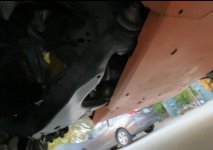
I think my cam tabs are fairly well protected from rock damage (as seen in my pic) by my belly skid set?

But do they also need reinforcement related to simple leverage, too?
 

Attachments

  • D576966A-82CC-4988-973C-6463B4507A08.jpg
    D576966A-82CC-4988-973C-6463B4507A08.jpg
    42.8 KB · Views: 364
The likely damage point on that the rear differential is the ring gear being damaged by a rock to the thinner rear face of the axle housing. There are weld on heavy duty cover plates that protect that area.

If there's anything on the rear axle that could use protection, first place is the rear shock mounts. They get pretty beat up.

After that if you have KDSS, some way to protect the KDSS piston and fixed side link. I have bent my fixed side link by dropping onto a rock. That's what scares me about the KDSS extensions. They make those even more exposed. If you're not going to go play in the rocks they're probably a great option. If you are, there's a chance you're going to drop onto a rock on one of those points and bend your piston or your fixed side link. I think the piston side would typically give enough that it wouldn't be too much of an issue.

You definitely need to upgrade or reinforce the rear lower control arms. They are for sure weak link. But they're really easy to reinforce if you have a welder and can go by a couple pieces of light duty channel. I have a right up on it on here somewhere if you search for it. It only cost a few bucks for some metal and spray paint.


With respect to front lower control arms, arms themselves are more than strong enough for anything you'll do. The only spot you'd want to protect from damage would be the cam tabs depending on what skid plate you have up front. Some of the aftermarket ones expose those cam tabs that would otherwise be protected by the OEM skid plates. But there are better cam tab protection options. The Marlin setup in my opinion is the best one that I've seen.

My rear shock mounts are armored.

I did the lower link armor, but hadn’t even considered he arms themselves being a weak point. I’ll have to mull that over.

I also remember now that weld-on rear diff armor plates on Toyota’s is good simple insurance. That’s an easy mod, IMO.
 
Last edited:
This is a high quality thread so I bookmarked it. Great posts by [MENTION=118321]Jetboy[/MENTION] and [MENTION=151737]mrblah[/MENTION] especially. I am shocked! Not! Lol.

I use the Rockmen rear lower control arms. I do have a rear diff skid. The C4 one is pretty tight to the diff. I guess it makes me feel better since I used to have one on my Outback for years. Now, front LCA skids are a joke, that's for sure. Rear? It is certainly not "required."

I would say the bigger question for everybody is how they used their vehicle. Most people on this thread have very clear ideas and the associated experience.

It really all boils down to the overall use/package IMO. Even if it is a trail rig, the question of exact use is still key.

I am super happy with mine as is listed in my signature (I will get 8112 fronts with adjusters when they build them but that's cause I am getting spoiled).

The reason is that it is a do-it all for me:

--long-distance interstate
--urban (though thankfully pretty minimal as I work chiefly from home)
--pretty good speed solo desert (closer to the UTVs than to the Jeeps, there are no Raptors except at the bar, lol)
--also solo low-end difficult rated trails like Elephant Hill or Fins and Things or the like. Black Bear, Mineral Creek etc
--plenty of solo remote trips at variable speeds
--when in company, I could drive some harder stuff but very little of that is of any interest to me.

There are literally a dozen trails that 1/ I care to drive and 2/ I would not take my 4R on so doing anything more (except 8112!) ain't really of any interest.

Now bigger tires would always be nice, sure, but all things considered I will stay in the full 32" area, max a smallish 33 (32.6-32.7).

Btw, I drove an offroad optimized Bronco with the new Bilstein shocks (cheap but effective). It was way better than a JL but wind noise at 70 in wind was unbearable even with the hard top. So for me, just that one thing alone would be a show stopper due to the importance of long-distance trips to me. Just an example of how I think of all the mods: in terms of total package.
 
I think my cam tabs are fairly well protected from rock damage (as seen in my pic) by my belly skid set?

But do they also need reinforcement related to simple leverage, too?
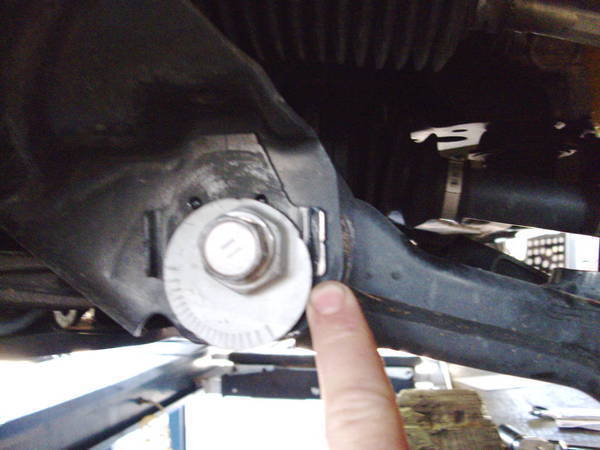
Besides protecting the bottom lips from direct strikes with rocks, you'll likely end up folding over the tabs the eccentrics rotate in. They sell gusset kits, or you could probably just lay a couple weld beads outside the OEM ones.
PICT1753.JPG
 
Last edited:
I see some rigs with 4.10’s and 4.56’s. Wonder if the thinner ring gear teeth hold up as well.

Not a 4Runner, but ran 4.56 in all 3 of my JKU's with 35" 10 ply E load tires Kenda Klever R/T's. Since the deliverable torque is being reduced due to the ease of turning (think pedaling a 10 speed bike in 1st vs 8th) the shearing force will be reduced. That's why you just don't see a lot of gear change failures, unless they were installed incorrectly or the break in period ignored.
 
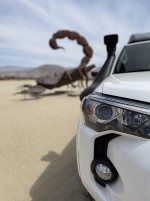
Spent a long weekend traveling and offroading in the socal backcountry. We absolutely fell in love with our rig again, and have a clearer vision of where we want to end up.

Consequently, we’re going to have a shop do a proactive body mount chop, alignment tab reinforcement and some light fenderwell massaging.

And then soon we’ll probably size up to 285/70-17 or 285/75-17 BFG KO2’s, to play the game of inches for some more clearance

Really appreciate all the info in this thread.
 

Attachments

  • FB6AC112-1744-482E-AB33-75C529C55FC8.jpg
    FB6AC112-1744-482E-AB33-75C529C55FC8.jpg
    113.8 KB · Views: 346
Last edited:

Members online

Forum statistics

Threads
278,309
Messages
3,554,071
Members
248,016
Latest member
Advally Service

Trending content

Back
Top