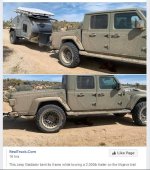
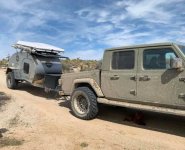
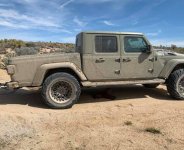
"Ladies and gentlemen. This is why proper installation is crucial.
This gladiator owner had shocks installed that were TOO LONG, causing the shock to be used as a bumpstop. The shock mounts are on the “weakest” part of the frame. Add this, with hitting the dunes and a trailer, you’re gonna have a bad day.
Please always use caution when installing your own parts or having a shop install them for you."
Which I believe is pure BS as they don't claim they were there or that they have any 1st hand knowledge of the situation.
Hameedi: Basically, the core – the root cause – is that the vehicle is traveling too fast for the obstacle, and the truck is running out of travel. By a large margin. They're going too fast for the obstacle by a large margin. The frame is not the first item to yield in that condition – despite what's been theorized, the first thing when you do exceed the vehicle's travel capability [is that] you have a certain safety zone where you will hit the bump stop and nothing will happen. If you hit that same obstacle at an even faster speed, then you will yield the jounce bumper cup – that's the little piece of steel that holds the jounce bumper. If you hit that same obstacle at an even greater speed, then the next thing to go is the frame.
That energy has to be absorbed somehow, and we actually went through a fairly detailed FMEA [Failure Mode and Effects Analysis], so if you do happen to far exceed the suspension's capability, the safest thing for that vehicle is for the frame to yield. If you had an infinitely stiff frame, then what that would do is, the rear of that vehicle – the suspension – when that axle is going up so hard, so fast, it would 'donkey kick' the rear of that truck really high into the air. That's a very undesirable condition."