
You are using an out of date browser. It may not display this or other websites correctly.
You should upgrade or use an alternative browser.
You should upgrade or use an alternative browser.
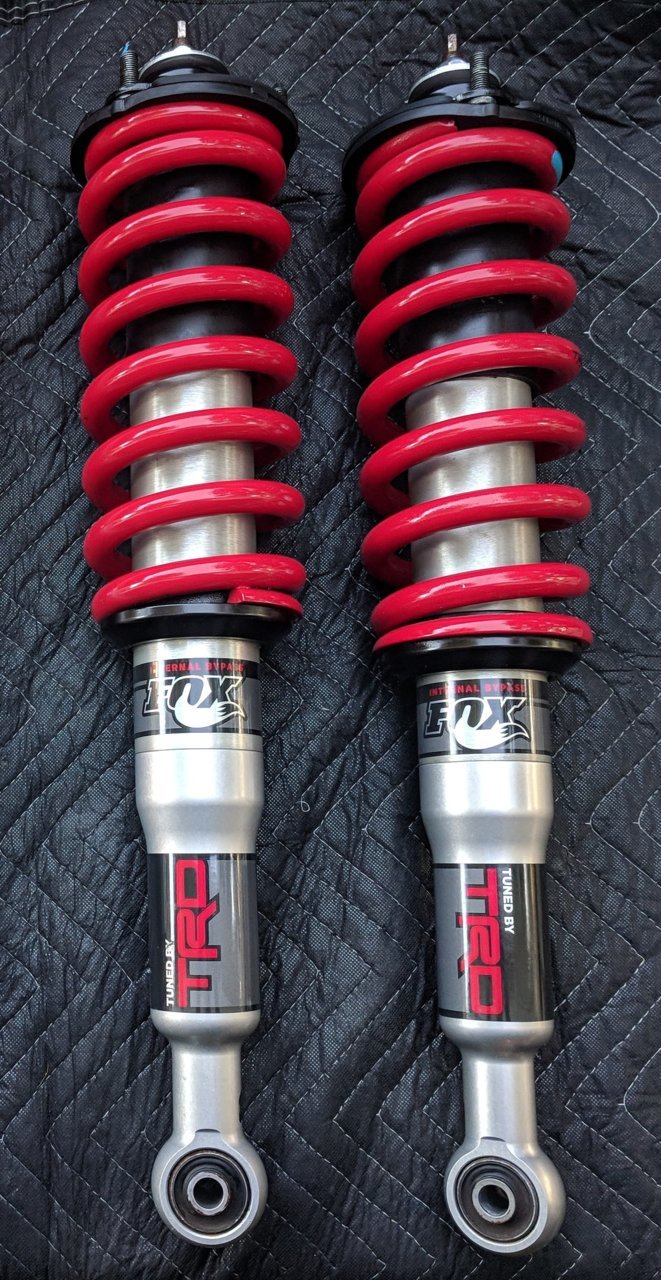
PRO Fox suspension install on 2020 TRD-Off-Road /w KDSS
- Thread starter niadh0
- Start date
I asked my buddy who has the Canadian 2019 TRD-Off-Road with KDSS about his front suspensions. The part number on both the front ones are 48510-35440 (22inch) - meaning the height and the perch setting on the OEM normal/regular shocks on both sides is identical.
this being said, TRD Pro does not have KDSS and therefore the significant perch setting difference in the front may be balancing the weight somehow.
with KDSS model, does KDSS take care of the weight distribution and if so does it make sense that the TRDPffRoad with KDSS come with identical front end suspensions?
if this makes sense (KDSS with front suspensions with identical perch and coils) then going back to my original question... if I mount two identical TRD-Pro-Fox with the same perch/coils then I should not have any lean... plus the shocks will still performed as designed because i am not playing around with any spacers.
just trying to validate my theory. BTW, I found a person ( [MENTION=74022]Silversurfercal[/MENTION] ) on the forum who is willing to swap one of his TRD-Fox front with mine so that both of us end up with identical fronts. but before that, calling your expert input.
many thanks
this being said, TRD Pro does not have KDSS and therefore the significant perch setting difference in the front may be balancing the weight somehow.
with KDSS model, does KDSS take care of the weight distribution and if so does it make sense that the TRDPffRoad with KDSS come with identical front end suspensions?
if this makes sense (KDSS with front suspensions with identical perch and coils) then going back to my original question... if I mount two identical TRD-Pro-Fox with the same perch/coils then I should not have any lean... plus the shocks will still performed as designed because i am not playing around with any spacers.
just trying to validate my theory. BTW, I found a person ( [MENTION=74022]Silversurfercal[/MENTION] ) on the forum who is willing to swap one of his TRD-Fox front with mine so that both of us end up with identical fronts. but before that, calling your expert input.
many thanks
That's a big difference side to side. It's really odd. I'm curious why. I looked at some pics of the Tacoma set and they're slightly offset with the passenger side having a bit more preload (the passenger side being the one with the lower perch set a bit higher.) On the bottom of the lower spring perch they indicate which side they go on. Visually that looks like it has more difference left/right than the Tacoma. That would be consistent with KDSS lean caused by the cylinder on the driver's side.
Incidentally, on my fox factory series shocks I do have to set the passenger side about 1/2" higher to get the front to level side/side. Assuming those are identical side/side it would generally match. It's pretty unusual though to have that much weight difference side/side. I know the fuel tank could weigh around 200lb full. But that's less than 100lb, and it's on the wrong side.
Last edited:
wow. thanks. good to know. 0.5 is almost not noticeable. how about the back side? doe the rear also balance side to side? I am assuming that you did a direct suspension swap and not using any spacers etc. thx
I've installed the Pro fox on my 15 kdss equipped vehicle for 4000kms now. There is about ~.5" lean, lower on the passenger side. The shocks ride very plush on-road and firms up nicely going higher speeds off-road. Brake dive is minimized significantly.
Driver rear is 37" fender to ground, passenger rear is 36.25". I direct swapped without any spacers, but I wish I had thrown a 1" spacer in the front.
I'm not sure about swapping the shocks with a friend because they are labeled left and right side. Not sure if it's due to the different perch height or differences internally.
I'm not sure about swapping the shocks with a friend because they are labeled left and right side. Not sure if it's due to the different perch height or differences internally.
wow. thanks. good to know. 0.5 is almost not noticeable. how about the back side? doe the rear also balance side to side? I am assuming that you did a direct suspension swap and not using any spacers etc. thx

osideplayer
New member
Dobinsons suspension for KDSS,
front springs and shocks perches, same height same springs
Rear springs, right rear spring 10mm taller than the left rear. Same spring rate left to right.
But are they cush?
Hey guys this is slightly on topic and slightly off topic. I am also awaiting a 2020 TRD Off Road (Canadian ver with KDSS) and interested in lifting the front to level. Still researching whether new suspension or the spacer is going to be a better option for me.
Questions:
1) Do you anticipate needing to re-align the headlights with this much lift on the front end i.e. need to aim them downwards(I might be a little lazy on my search feature for this one - sorry)?
2) What about the safety sense sensor and camera new for 2020 4runner - do you think removing the rake on the vehicle will reduce the effectiveness of the system?
Thanks in advance.
Questions:
1) Do you anticipate needing to re-align the headlights with this much lift on the front end i.e. need to aim them downwards(I might be a little lazy on my search feature for this one - sorry)?
2) What about the safety sense sensor and camera new for 2020 4runner - do you think removing the rake on the vehicle will reduce the effectiveness of the system?
Thanks in advance.

Jetboy
New member
Hey guys this is slightly on topic and slightly off topic. I am also awaiting a 2020 TRD Off Road (Canadian ver with KDSS) and interested in lifting the front to level. Still researching whether new suspension or the spacer is going to be a better option for me.
Questions:
1) Do you anticipate needing to re-align the headlights with this much lift on the front end i.e. need to aim them downwards(I might be a little lazy on my search feature for this one - sorry)?
2) What about the safety sense sensor and camera new for 2020 4runner - do you think removing the rake on the vehicle will reduce the effectiveness of the system?
Thanks in advance.
Yes to both. Headlights for sure. Safety sense... not sure but probably. Also if you don't reset the zero point expect rear brakes to wear faster due to b the portioning being off.

jrandom
New member
I pack HD marine grease all around them. The stuff is thick and contamination has had a very hard time penetrating it. I am on my first set @ 30k, lots of high speed corrugated driving, I just took them out to replace them a couple months ago. Apart from grime on the outer layer of grease the grease closest to the bearing was clean. The bearings themselves were still in fine shape, articulated, cleaned and repacked w/ grease.For me, the biggest reason I'd love to swap to the TRD Pro set is that they use rubber bushings instead of spherical bearings. I HATE the spherical bearings on the fox setup I have. They last me about 10-15k miles between necessary replacements. And it's a PITA to do because the misalignments corrode and end up bonded to the mount bolt.
I 100% agree with this. I have run a 3 different heights, ~.75/~1.5/~2.75. So much so I am going to lower my fronts a bit closer to ~2.0, I will take a little bit of rake back for comfort and fuel economy. I'd like to try a little longer/stiffer spring so I can forgo some of the preload.I will say that the fox "factory series" ride extremely plush at 1" lift height. They get a lot firmer by 3" lift. I've run my junk at every lift height from 0-3" and overall setup at 1-1.5" is the ideal place for overall ride quality. I only crank it up to the full height for my once a year trip down to rock crawl in California.
Jetboy
New member
My last set looked like this:
They're due again. I just haven't had time to do it. Unfortunately it's looking like I'm going to have to cut them out again. I loaded them up with anti-seize, and it seemed to work pretty well at first. I had them out last fall, but this fall they're just totally seized again. I bought some rubber boots that totally cover the entire lower area and I'm going to try them next and fill with grease to see if that helps.
Also if you don't reset the zero point expect rear brakes to wear faster due to b the portioning being off.
Sorry, can you explain what you're talking about here?
Jetboy
New member
Sorry, can you explain what you're talking about here?
Brake pressure is split front/rear. Prior to modern electronics almost all vehicles had brake proportioning valves attached to the rear suspension. More weight on the rear compressed the rear suspension and a lever would automatically adjust the amount of brake pressure to the rear axle. So if you had more weight - more of the braking would be done by the rear - where the weight was.
I'm not an expert on the brake system in the 4Runner but I am reasonably confident that it performs the same brake proportioning through the vehicle pitch (rake). The 4Runner has a set of sensors that measure pitch, yaw, tilt, etc. You can reset the "zero point" that is a baseline for the ECU when empty. If you don't do that - and you "level" your 4Runner, it thinks you have a few hundred lbs of cargo in the back all the time. Then the driver complains that the rear brakes were worn out in 30k miles. It's a result of the 4Runner thinking you're hauling a bunch 4-600lb of cargo all the time and using the rear brakes much more than it should be. It can also cause issues with VSC engagement and other safety features that rely on the pitch as an input to determining vehicle loading and predicting behavior.
This is how to do it:
Zero Point Calibration question
Brake pressure is split front/rear. Prior to modern electronics almost all vehicles had brake proportioning valves attached to the rear suspension. More weight on the rear compressed the rear suspension and a lever would automatically adjust the amount of brake pressure to the rear axle. So if you had more weight - more of the braking would be done by the rear - where the weight was.
I'm not an expert on the brake system in the 4Runner but I am reasonably confident that it performs the same brake proportioning through the vehicle pitch (rake). The 4Runner has a set of sensors that measure pitch, yaw, tilt, etc. You can reset the "zero point" that is a baseline for the ECU when empty. If you don't do that - and you "level" your 4Runner, it thinks you have a few hundred lbs of cargo in the back all the time. Then the driver complains that the rear brakes were worn out in 30k miles. It's a result of the 4Runner thinking you're hauling a bunch 4-600lb of cargo all the time and using the rear brakes much more than it should be. It can also cause issues with VSC engagement and other safety features that rely on the pitch as an input to determining vehicle loading and predicting behavior.
This is how to do it:
Zero Point Calibration question
Wow, thanks. I've worked on cars basically since I was a fetus and I never once considered the fact that changing the suspension would have an effect on the brake system. You're also the first person I've seen bring it up since I joined here which is kind of crazy with all the suspension modification threads that pop up on a regular basis.
Appreciate the info.
jrandom
New member
My last set looked like this:
They're due again. I just haven't had time to do it. Unfortunately it's looking like I'm going to have to cut them out again. I loaded them up with anti-seize, and it seemed to work pretty well at first. I had them out last fall, but this fall they're just totally seized again. I bought some rubber boots that totally cover the entire lower area and I'm going to try them next and fill with grease to see if that helps.
Yeah, wow that thing is cooked, burnt to a crisp. Mine don't look anything like that, I get a fair bit of briny road driving too (well you know what they do to roads here) What boot did you come across? Curious. The grease packing has been working for me but hey if the boot fits

ShermanOlsen
Member
I've installed the Pro fox on my 15 kdss equipped vehicle for 4000kms now. There is about ~.5" lean, lower on the passenger side. The shocks ride very plush on-road and firms up nicely going higher speeds off-road. Brake dive is minimized significantly.
Jshen, I'm not sure how the TRD Fox are labeled in terms of left to right. But on which side did you install the pre-loaded shock? (I'm assuming it is pre-loaded and not a shorter coil?). Since non-KDSS and KDSS vehicles tend to lean in opposite directions it does make sense to me to swap sides from the typical TRD Pro installation, and to put the preloaded shock on the passenger side to correct for the usual KDSS lean.

adrummingdude
New member
If you like the "plush" ride the TRD Pro has, why would you use a spacer for leveling? Doesn't using spacers on the strut towers to level harshen the ride since now the spring is more compressed?
Jshen, I'm not sure how the TRD Fox are labeled in terms of left to right. But on which side did you install the pre-loaded shock? (I'm assuming it is pre-loaded and not a shorter coil?). Since non-KDSS and KDSS vehicles tend to lean in opposite directions it does make sense to me to swap sides from the typical TRD Pro installation, and to put the preloaded shock on the passenger side to correct for the usual KDSS lean.
The underside of the bottom spring perch is labeled front left /front right. I never thought to swap sides at the time.
If you like the "plush" ride the TRD Pro has, why would you use a spacer for leveling? Doesn't using spacers on the strut towers to level harshen the ride since now the spring is more compressed?
There are different designs of spacers. Ones that sit above the coilover don't alter the spring rate. Correct me if I'm wrong guys. But regardless, I'm patiently waiting for eibach as they have something in the works for the pro fox.
osideplayer
New member
So I have a assembled set of fox shocks and I'm really tempted to take one side apart to see if there's a hidden perch adjustment.... Can I do this with basic coil compressors from the auto store?

Similar threads
- Replies
- 3
- Views
- 2K
- Replies
- 3
- Views
- 5K
- Replies
- 0
- Views
- 9K

- Replies
- 2
- Views
- 6K

Forum statistics
Trending content
-

-

-
-
-
Thread 'Fixed: Dead Instrument Cluster in 2003 Toyota 4Runner (Corrosion Issue)'
- TheSpeakGeek
Replies: 9