Proper Lower Ball Joint Inspection & Testing Procedure

BobWa

New member
There is a lot of talk about replacing LBJ's as preventative maintenance, just going by mileage, so if you are in the camp of "don't fix it if it's not broken", then here is the procedure how to inspect the ball joints.

This is the procedure that is described in the official Toyota service manual, and I will be paraphrasing, and not using their images, so no copyrights are broken. :biggrin2:

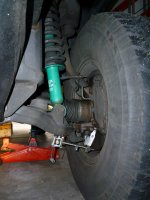
To perform this test you will need a good dial indicator (nothing from the $1 store that binds on measurements less than 1/4"), and a good mount for it. Jack up the side of the vehicle so the suspension is not in tension, and the wheel is off the ground.

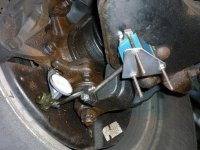
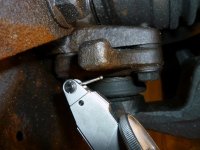
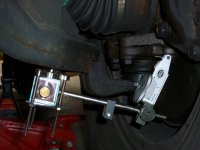
Place the dial indicator so it will measure vertical movement between the lower control arm and the steering knuckle. I'm using a gigantic rare earth magnet to hold the assembly to the lower control arms. Put some tension on the dial indicator so at rest, the needle is somewhere in the middle of the measuring range.

Now grab the wheel and pull up a few times. Have someone look at the dial. Measure deflection on the needle. Now push down on the wheel a few times. Measure deflection again. Add up the 2 numbers.

If the sum is greater than 0.5mm, or 0.02", then you have exceeded the maximum allowed wear. Better replace it. If not, you are good to go for a while. There is a big safety margin in the maximum wear figure. It's a Toyota, after all. :cool:
 

Attachments

  • 019ee0a9032cfebeff4776f1b1ccff4b.jpg
    019ee0a9032cfebeff4776f1b1ccff4b.jpg
    133.5 KB · Views: 8,834
  • b2d075e514d481454b513f7fdff661d4.jpg
    b2d075e514d481454b513f7fdff661d4.jpg
    132.2 KB · Views: 15,907
Register to hide this ad
It's very simple, but depends on the type of dial gauge you have. Here is a picture of mine at rest, at '0', and it's at a 90 degree angle relative to the body. The more classic model has the gauge parallel to the body.

It just has to be oriented so vertical movement between the control arm and steering knuckle is being measured.
 

Attachments

  • 13bf649ed72be02af8f2065786cb3eb4.jpg
    13bf649ed72be02af8f2065786cb3eb4.jpg
    134.9 KB · Views: 16,486
  • 341fbfebcd3b27cb28baf2aad7f86ab3.jpg
    341fbfebcd3b27cb28baf2aad7f86ab3.jpg
    135.7 KB · Views: 7,187
I like the method, and like that you measured everything to know for sure if you need to replace them. I also like that you posted the specs so the people that want to "look for play" will realize how little movement really is out of spec.

The downside to this is that I'm guessing the average 4Runner owner doesn't have a dial indicator, and the price of a decent indicator and stand is a good portion of what the parts of the LBJ would cost anyway.

I think in the end I would still say for as cheap of a part as they and as much damage as a failure can cost. I would still say just replace them if there is a question about them.
 
thanks for posting, I'll get this done on my next tune up in spring, I'll post some pics when I get it done
I bought a dial and mag stand for $25 they are not that expensive, i used it for a disc runout when my rotors were " warped" , only got highspots where the brake impression mark was.
I will be doing this check before i change the joints
 
Last edited:
The downside to this is that I'm guessing the average 4Runner owner doesn't have a dial indicator, and the price of a decent indicator and stand is a good portion of what the parts of the LBJ would cost anyway.

I picked mine up for $25 also, on Ebay. It's a useful measuring tool to have, does have lots of other uses for DIY work.

My ball joints have 150k and are well within the specs, so it doesn't make sense to replace them. Putting new parts on introduces 2 negative factors: defective parts, and installation errors. Both of those are non-issue if I keep the parts that served me well for 150k.
 
If your LBJs have 150k or 10 years replace them. It is that simple.

The rubber wears out and starts to break down over time.


My ball joints have 150k and are well within the specs, so it doesn't make sense to replace them. Putting new parts on introduces 2 negative factors: defective parts, and installation errors. Both of those are non-issue if I keep the parts that served me well for 150k

Sorry but that's BS. If you are smart enough to confirm they are still good via your dial tool then you are definitely smart enough to correctly replace them. Saying effectively that they've worked fine so far therefore replacing them would be not worth the risk of a bad install job doesn't make sense.

If the LBJ fails while moving you stand a good chance of crashing, killing you, your passenger(s) and others on the road. Also your truck would quite possibly be totaled.

All of that risk .... Just replace them. Sure you can check them every 5k with your oil change but you'd be better off just changing them and knowing the new parts are good for remaining life of the truck.

About getting a bad part ... Just buy the Toyota/OEM part instead of a cheapo part and you will be fine.
 
Last edited:
Maybe you missed where I said decent dial indicator. Never seen a good brand go for $25 even used and in need of a calibration.
 
Last edited:
Are you sure?

BobWa,are you positive about the specs. it seems a bit low for it being only 0.02" maybe 0.20" i could get that reading from a vehicle with less than 50k.just checking my friend,most balljoint specs. i have seen are 0.20" anything more than this is considered worn.very nice set up you got there i have never seen a dial indicator of that style before i have a similar magnetic base set up with a ball tip roller.:rockon:
 
Maybe you missed where I said decent dial indicator. Never seen a good brand go for $25 even used and in need of a calibration.

$25 is a very resonable price for a used tool that is not demand. So picking up a $100 dial indicator for $25 used is common. Calibrating is not an issue. Just take a digital caliper, clamp it to a desk, clamp the dial gauge next to it, and just make sure they show the same when adjusting the digital caliper. Takes 5 minutes total. And if you want to calibrate your digital caliper just take some spark plug feeler gauge. Or can even calibrate the dial gauge using the feeler gauges. This is not rocket science.
 
$25 is a very resonable price for a used tool that is not demand. So picking up a $100 dial indicator for $25 used is common. Calibrating is not an issue. Just take a digital caliper, clamp it to a desk, clamp the dial gauge next to it, and just make sure they show the same when adjusting the digital caliper. Takes 5 minutes total. And if you want to calibrate your digital caliper just take some spark plug feeler gauge. Or can even calibrate the dial gauge using the feeler gauges. This is not rocket science.

Did you really just suggest to calibrate a caliper that generally ranges 0-6" at only the small end of its specs using a set of feeler gauges? Do yourself a favor and invest in a set of gauge blocks so you can test at both ends of the spectrum if you want to do home calibrations. While your at it I would look into an actual flat surface like a granite block to replace your desk for procedures like that. I still find it far easier/cheaper in the long run to spend the money on known good equipment to use when accuracy is really that important. Be it machining something (for myself or others) or testing a vehicle part that could could cause far more $'s in damage if it fails.
 
Did you really just suggest to calibrate a caliper that generally ranges 0-6" at only the small end of its specs using a set of feeler gauges? Do yourself a favor and invest in a set of gauge blocks so you can test at both ends of the spectrum if you want to do home calibrations. While your at it I would look into an actual flat surface like a granite block to replace your desk for procedures like that. I still find it far easier/cheaper in the long run to spend the money on known good equipment to use when accuracy is really that important. Be it machining something (for myself or others) or testing a vehicle part that could could cause far more $'s in damage if it fails.

You are one of those guys that think everyone needs $5,000 worth of Matco tools to do an oil change, and generally takes everything to the extreme just for the sake of the argument. :laugh:

If someone can mount their cheap Ebay gauge on a simple desk, and stick some feeler gauges under it to measure that 0.01mm, 0.1 and 1mm read just fine, that is all the calibration that's needed. We are not machining parts for NASA here. :D
 
I do see the value in at least checking ones LBJs and if you can post a picture of the FSM or some kind of direct specs that would be great. I still believe that if they are old (see above) then just replace them.
 
Well I don't believe in buying crap products no matter what, thats why I'm here on a Toyota forum and not on a ________ forum talking about what fell off of my truck today because I hit a pot hole. My tool collection ranges quite widely in terms of where it was bought, and new or used. Sometimes you can get away with buying some HF goodies, sometimes you need the precision and or strength of the more expensive stuff.

Above anything else though I believe is something is worth doing its worth doing right. (and in a lot of personal cases OVER doing) In the last example it is common practice in any calibration method that I have done on tools, sensors or anything else, that it gets done in at lest two points (more is better) and never at the extreme ends of its range since accuracy usually isn't great at the limits.
 
That would actually be frowned upon by the admins, I would imagine, as the Toyota service manual still has full copyright protection. :tape:

I've seen it posted before, just don't host it through the forum if you think there will be an issue.
 
and never at the extreme ends of its range since accuracy usually isn't great at the limits.

This is totally offtopic, but it sounds like you've spent a lot of time in the analog world. The new electronic stuff is quite amazing though, and doesn't suffer from a lot of what analog was plagued with.

Take the new digital calipers. The technology is totally self calibrating, and accurate over extreme ends. And when it malfunctions, it will almost definitely be obviously bogus readings, eliminating the need for constant calibration.

How Digital Calipers
 

Members online

No members online now.

Forum statistics

Threads
278,309
Messages
3,554,071
Members
248,016
Latest member
Advally Service

Trending content

Back
Top